

Most furniture retailers think of delivery labor as a line item. You pay the crew, you pay the subcontractor invoice, and whatever's left after the truck rolls back into the yard is your margin. That framing is exactly why so many stores bleed money they can't trace.
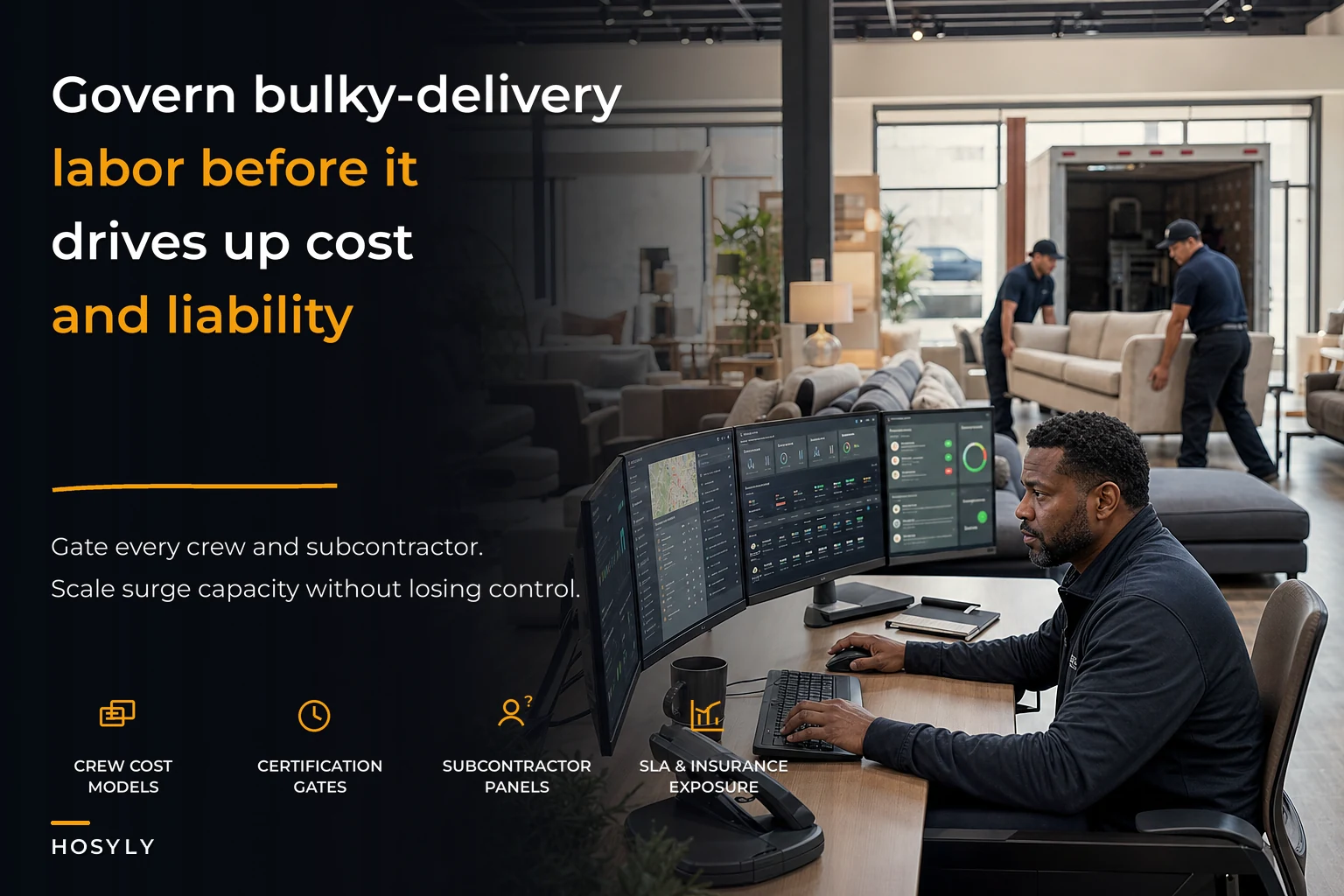
Your delivery and install workforce isn't a cost line — it's a control system. Who you dispatch, what they're certified to do, how you price surge labor, and how your subcontractor contracts allocate liability all feed into each other. Break one part and the failure shows up somewhere completely different: a damaged wall becomes an insurance claim, an uncertified installer becomes a warranty dispute, a mispriced peak week becomes a quarter of thin margins.
This is a systems article. Not a list of hiring tips. The goal is to show how crew cost, capacity, certification, subcontractor governance, and liability exposure connect — and where the whole thing tends to snap as you grow from one truck to five.
The core problem: you're governing labor with three disconnected systems
Walk into almost any growing furniture retailer and you'll find labor decisions split across three places that never talk to each other.
Scheduling lives in one system — often a spreadsheet or a routing tool. Pay and certification live in a payroll platform or, worse, in the operations manager's head. Subcontractor relationships live in email threads and whatever contract someone signed 18 months ago. Insurance and incident tracking live in a folder nobody opens until a claim arrives.
Each of these works fine in isolation. The problem is that furniture delivery decisions require all four at once. When a dispatcher assigns a two-person crew to a top-floor walkup with a sleeper sectional, they're implicitly making a certification decision (do these two know how to safely stair-carry 140 lbs?), a cost decision (is this a premium job that should carry a surcharge?), and a liability decision (if they scratch the stairwell, whose insurance pays?).
In real operations, that dispatcher is making all three calls blind. They see a name and a time slot. They don't see the certification status, the historical damage rate, or the contract terms. That's the root failure, and it doesn't get better with more experienced dispatchers — it gets worse with volume.
What breaks first, and in what order, as you scale
There's a predictable sequence to how workforce governance falls apart. It rarely collapses all at once. It degrades in a specific order.
Eliminate inventory headaches and order delays.
Hosyly streamlines your furniture orders and stock management for seamless store operations.
- Real-time inventory tracking
- Automated order processing
- Customer notifications & engagement
No credit card required
One to two trucks, all W-2 crews. Everything works because one person knows everyone. The owner or GM personally knows which installer is careful, which one rushes, and which customers to keep away from the new hire. Governance is entirely tribal knowledge. This feels fine and hides the coming problem.
Three to five trucks, first subcontractors added. This is the first real break. You bring on a subcontractor panel to handle overflow, and suddenly you have crews touching customer homes that you've never trained and can't observe. Damage rates diverge. Some sub crews are excellent, some are careless, and you have no scorecard telling them apart until claims pile up.
Six-plus trucks, mixed W-2 and sub, multiple markets. Now the tribal knowledge is gone. Nobody knows everyone. The GM who used to hand-assign the tricky jobs is managing managers. Certification lapses go unnoticed. Surge hiring during peak brings in crews whose backgrounds nobody verified. This is where a single bad month of incidents can wipe a quarter's profit.
The pattern that shows up across furniture operations is that the tools stay the same while the coordination problem grows exponentially. A spreadsheet that governed 4 crews cannot govern 22 crews across three metros with different certification requirements and different subcontractor contracts. It just quietly stops being accurate, and accuracy is the whole game.
Building crew-cost and capacity models that actually reflect the job
The first thing to fix is the fiction that all delivery labor costs the same. It doesn't, and pricing it flat is where hidden margin loss begins.
-
Base crew hours — loaded labor rate times realistic on-site time, not the optimistic estimate
-
Travel and windshield time — the dead time between stops, which is where dense routing pays off
-
Complexity premium — stairs, tight access, disassembly, wall-mounting, haul-away
-
Risk load — a small per-job reserve for jobs with elevated damage or injury probability
-
Certification requirement — some jobs legally or practically require a certified installer, which changes who can be assigned
Here's what most stores miss: capacity isn't measured in trucks or crews. It's measured in certified capacity for a given job type. You might have six crews available on Saturday and still be unable to take a complex power-recliner install because only two of your people are certified for the electrical connection and both are already booked.
A realistic capacity model looks like this:
| Job type | Crews qualified | Avg on-site time | Complexity load | Effective daily capacity |
|---|---|---|---|---|
| Standard delivery (no assembly) | All crews | 25–40 min | Low | High |
| Delivery + basic assembly | Most crews | 45–75 min | Medium | Medium |
| Sectional / stair-carry | ~60% of crews | 60–90 min | High | Constrained |
| Power/adjustable base install | ~30% of crews | 75–120 min | High + certified | Tightly constrained |
Once you model capacity this way, you stop overpromising delivery windows you can't actually staff. The two-person crew logic behind this — pairing rules, load-building, and appointment density — is worth reading alongside our breakdown of two-person delivery scheduling for bulky furniture.
Pay and certification schemas: pay for competence, gate on safety
Two things get conflated constantly: what you pay someone and what you allow someone to do. These are separate schemas and they need to stay separate.
Pay schema answers: what does this crew or subcontractor earn for this job? Flat per-stop, hourly, tiered by complexity, or a hybrid. The mistake most stores make is a flat per-stop rate, which quietly incentivizes crews to rush the hard jobs — the exact jobs where rushing causes damage. If a stair-carry sectional pays the same as a nightstand drop, guess which one gets the careful treatment.
Certification schema answers: is this person permitted to be assigned this job at all? This is a gate, not a preference. A crew without current lift-and-carry safety certification, or without the specific product training for adjustable bases, should be un-assignable for those jobs at the system level. Not "flagged." Un-assignable.
Certification is also a perishable asset. A crew certified in January might have lapsed by July. In a manual system, nobody catches the lapse — you find out when a claim reveals an uncertified installer touched a warranty job. In furniture, that single fact can void the manufacturer's warranty coverage and shift the whole cost onto you.
-
Certification type (safety, product-specific, electrical, EPA/haul-away where relevant)
-
Issue date and expiry
-
Verification source (who confirmed it)
-
Auto-block status when expired
Tie the gate to scheduling and the dispatcher can no longer accidentally assign an uncertified crew. You remove the failure mode instead of training people to watch for it.
Subcontractor panel governance: the part that quietly decides your reputation
Your subcontractors deliver furniture into customers' homes wearing something close to your brand. Yet most furniture retailers govern their sub panel with less rigor than they govern their SKU catalog.
Panel governance means treating your subcontractor roster as a managed portfolio, not a rolodex you dial when you're slammed. That involves entry standards, ongoing scorecards, and clear exit triggers.
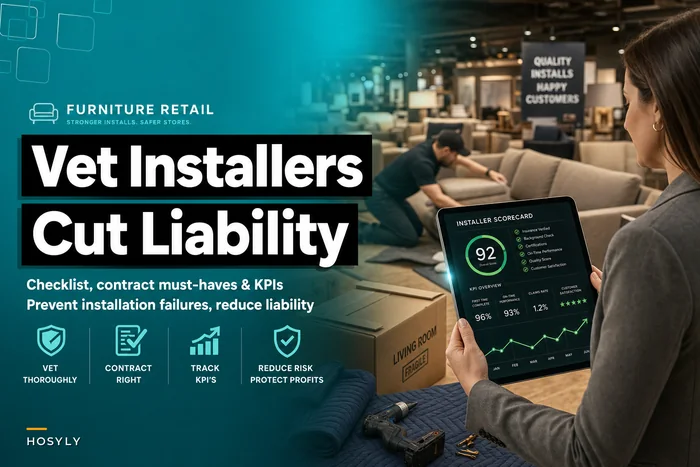
Entry standards should be non-negotiable and verified before the first job: current liability insurance with your store named as additional insured, workers' comp coverage, background checks on crew members entering homes, and completion of your safety and product training. This overlaps heavily with how you'd vet any install partner — the mechanics of vetting and governing furniture installers to cut liability apply directly to your sub panel.
Ongoing scorecards are where the real governance happens. A subcontractor scorecard tracks the metrics that predict cost and reputation risk:
-
On-time arrival rate
-
Damage/claim rate per 100 deliveries
-
Customer satisfaction on delivery-specific surveys
-
Re-delivery / failed appointment rate
-
Certification currency
-
Insurance currency
Sub panels drift. A great subcontractor in year one gets overbooked, hires green crews, and their damage rate creeps up while you're not looking. Without a running scorecard, you keep sending them your hardest jobs based on a reputation they no longer earn. The scorecard turns "I think they're still good" into "their claim rate went from 1.2 to 4.1 per 100 over two quarters." That's the kind of number that changes a decision fast.
Surge hiring scorecards: peak season is where governance dies
Peak periods force you to add capacity fast, and speed is exactly when standards slip. The store that spends six weeks vetting a permanent crew will onboard a surge subcontractor in a single phone call because the trucks need to roll on Saturday.
A surge hiring scorecard is a pre-agreed minimum bar that doesn't get waived under pressure. It's deliberately shorter than your full onboarding — because it has to be usable in a hurry — but it never drops below the safety and liability floor.
-
Insurance verified — current COI on file, additional insured confirmed. No exceptions, ever.
-
Crew background check — completed or provisionally cleared through an expedited check.
-
Safety certification — either current, or the crew is restricted to low-complexity jobs only until certified.
-
Supervised first jobs — surge crews run their first few deliveries paired with or shadowed by a known crew.
-
Restricted job scope — surge hires are un-assignable for high-liability jobs (electrical, stair-carry, high-value pieces) until they clear the scorecard.
Build and pre-clear your surge panel during the 12-week ramp so the minimum bar never gets waived under pressure.
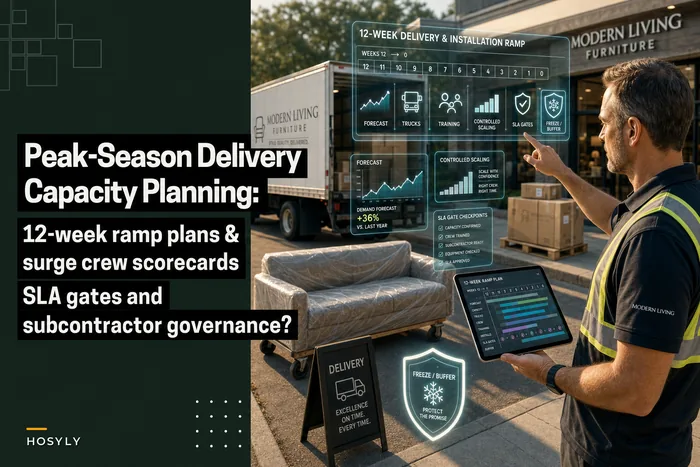
The connection to capacity planning matters here: your 12-week peak ramp should build the surge panel before the volume hits, not during it. We cover the ramp cadence and surge crew scoring in more depth in peak-season delivery and installation capacity planning.
Stores that get this wrong treat surge hiring as a volume problem when it's actually a risk-concentration problem. Your newest, least-vetted crews handle your highest-volume, highest-pressure week. That's how a single peak season generates claims that eat the whole season's incremental profit.
SLA and penalty templates: put the incentives in writing
Handshake arrangements with subcontractors work until they don't. When a sub crew damages a $4,000 dining set and shrugs, you find out fast whether your agreement actually assigned that risk.
Your subcontractor SLA should make performance measurable and consequences automatic. A few clause types that earn their keep:
Service level clause. Defines on-time arrival window, acceptable failed-delivery rate, and required customer communication. Sample framing: "Contractor shall arrive within the scheduled two-hour window on no less than 92% of assigned deliveries measured monthly. Sustained performance below this threshold triggers review and potential panel suspension."
Damage responsibility clause. Assigns cost of product and property damage caused by contractor negligence. Sample framing: "Contractor bears financial responsibility for product damage and third-party property damage arising from contractor's handling, up to the limits of contractor's insurance, with a documented incident review for all claims exceeding $500."
Certification warranty clause. Contractor warrants that only certified crew members perform certification-gated work. Sample framing: "Contractor warrants that all adjustable-base and electrical installations are performed exclusively by personnel holding current manufacturer certification. Breach voids contractor's claim to payment on the affected job and shifts warranty exposure to Contractor."
Penalty/chargeback clause. Ties specific failures to specific deductions — a missed appointment chargeback, a re-delivery cost pass-through, a damage deductible.
The mistake stores make is writing these clauses and then never enforcing them, because enforcement requires the incident data that's scattered across email. A penalty clause you can't measure against is decoration. The contract and the scorecard have to be the same system, or the contract is theater.
Incident and insurance exposure controls
Every furniture delivery carries three exposures: product damage, property damage to the customer's home, and injury to your crew or the customer. Governing these isn't about paperwork — it's about controlling which exposures land on your books versus your subcontractor's.
The exposure controls that matter:
-
Additional insured status on every subcontractor policy, verified and current, so their coverage responds first
-
A documented incident workflow — photo evidence, immediate report, customer sign-off condition on delivery
-
Incident scorecards per crew and per sub that surface rising risk before it becomes a lawsuit
-
A claims reserve model that prices expected incident cost into your delivery fee instead of pretending it's zero
The pattern that costs stores the most: they discover an insurance gap after an incident. A subcontractor's coverage lapsed in March, nobody noticed, and the June injury claim lands entirely on the retailer's policy — driving up their premium for years. Insurance currency belongs in the same gate as certification: expired coverage means un-assignable, automatically.
A short real scenario
A regional furniture retailer running about 9 trucks across two metros was carrying a mixed workforce — six W-2 crews and a rotating panel of five subcontractors. Delivery volume was roughly 380–430 stops a week. Damage claims were running higher than they could explain, somewhere around $6k–$8k a month in product write-offs and property repairs, and nobody could tell which crews were driving it.
The fix wasn't dramatic. They built a per-crew and per-subcontractor scorecard tracking claim rate, on-time rate, and certification currency, then gated scheduling so uncertified or lapsed-insurance crews couldn't be assigned complex jobs. Within about two quarters, they'd identified that two subcontractor crews accounted for a disproportionate share of the damage — one had a claim rate roughly three times the panel average. They restricted those crews to low-complexity jobs, put one on a corrective plan, and dropped the other.
Monthly damage cost settled into the $3k–$4k range. Nothing exotic happened. They just stopped assigning their hardest jobs to their riskiest crews, which they couldn't do before because they had no way to see the risk.
Where an integrated control-plane changes the math
Everything above is achievable with discipline and spreadsheets — right up until scale breaks the spreadsheets. The reason growing furniture retailers move to an integrated workforce platform isn't the features. It's that the failure modes described here all share one root cause: scheduling, pay, certification, subcontractor scorecards, and insurance status live in separate places, so no single decision can account for all of them at once.
An integrated workforce control-plane — the kind of AI-assisted operational software built for exactly these operations — closes that gap by making the constraints enforce themselves. Certification lapses make a crew un-assignable automatically. Insurance expiry blocks scheduling before an incident, not after. Subcontractor scorecards update from incident and delivery data instead of memory. Surge hires stay restricted to their cleared job scope until they pass the gate. The AI automation handles the tedious cross-checking — matching certification requirements to job types, flagging drifting damage rates, surfacing the sub crew whose numbers are quietly sliding — so your dispatcher isn't making three-way risk decisions blind.
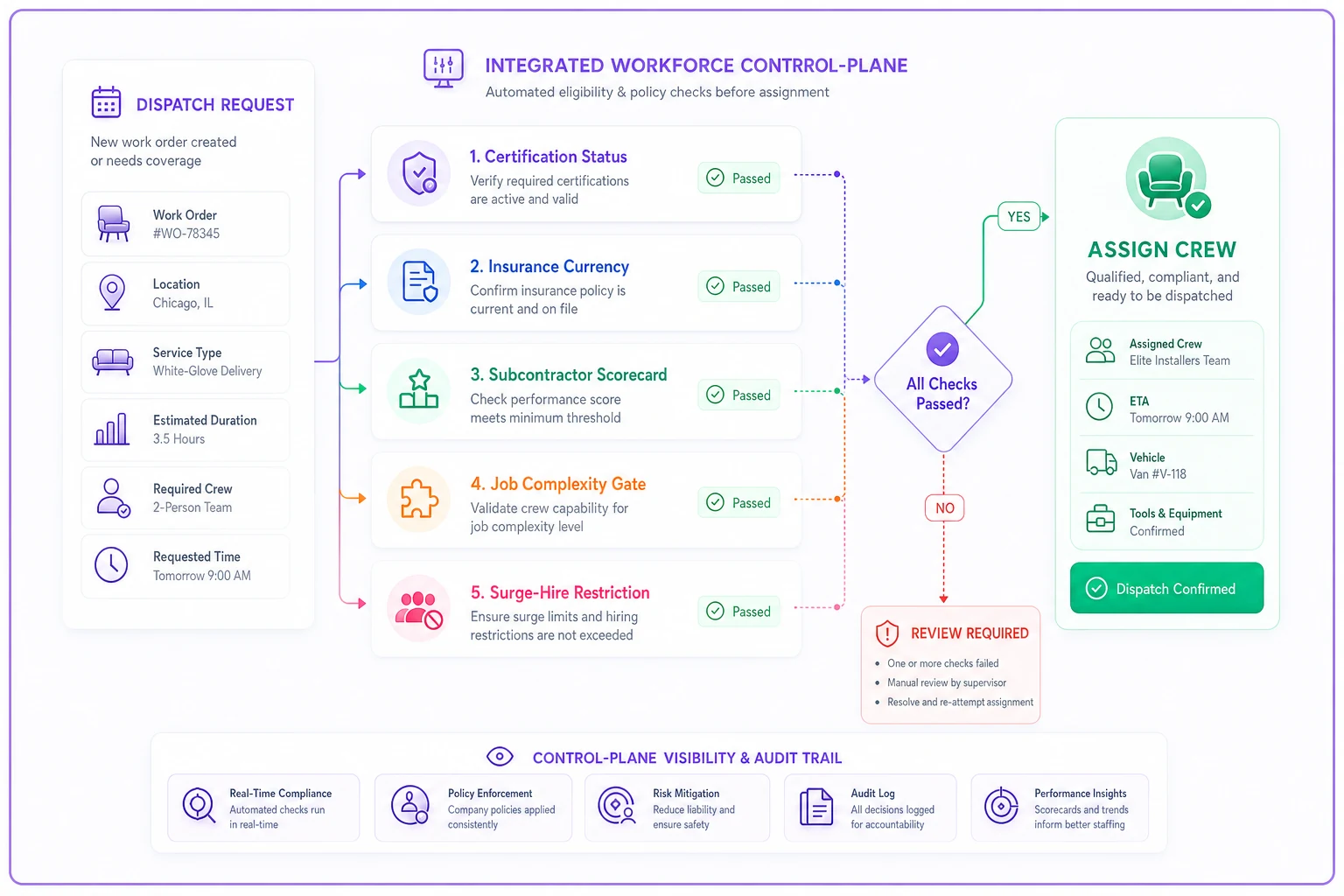
The value isn't automation for its own sake. It's that the coordination problem stops growing faster than your ability to manage it.
The bigger point
Furniture delivery workforce governance fails quietly. There's no alarm when a certification lapses, no siren when a subcontractor's damage rate creeps up, no flag when a surge crew touches a job they shouldn't. The costs accumulate in claims, warranty voids, insurance premiums, and reputation — showing up months later, disconnected from the decision that caused them.
The stores that stay profitable as they scale aren't the ones with the best individual installers. They're the ones who built a system where the risky assignment simply can't be made — where crew cost, capacity, certification, subcontractor scorecards, and insurance exposure are one connected control system instead of five disconnected ones. Get that architecture right at three trucks, and it holds at thirty. Ignore it, and you'll rebuild it the expensive way, one claim at a time.
Ready to elevate your furniture business?
Join 500+ furniture retailers using Hosyly to increase efficiency, improve customer satisfaction, and grow revenue.