



Furniture deliveries fail for predictable reasons. The couch won't make the turn at the second-floor landing. The crew arrives during the customer's lunch hour instead of the confirmed morning window. One guy calls in sick, leaving his partner stranded with a 280-pound sectional. The truck's loaded wrong, forcing the crew to unload three dining sets just to reach one nightstand.
None of this is bad luck. These are systematic scheduling failures that hit furniture retailers who treat two-person furniture delivery scheduling like standard package routing. After going through delivery operations at dozens of furniture stores, the pattern shows up fast: stores lose roughly $1,800–2,400 per truck per month on failed deliveries, customer credits, and overtime — all traceable to poor crew pairing, load sequencing, and route planning that ignores the physical reality of moving bulky items.
The hidden complexity of furniture delivery logistics
Most furniture retailers inherit their delivery scheduling from whoever set up the point-of-sale system. The result is a patchwork of Excel sheets, delivery apps designed for parcels, and manual phone calls that create more problems than they solve.
Think about what actually goes into planning tomorrow's deliveries. Your scheduler looks at eight stops across the city and groups them geographically — northside morning, southside afternoon. Makes sense on paper. But Stop 3 requires carrying a king bed frame up three flights of exterior stairs. Stop 4 has a hallway so narrow it needs furniture dollies. Stop 7's loading dock closes at 2 PM. By the time these constraints surface, the crew is already on the road.
Complexity multiplies when you factor in crew capabilities. Not every two-person team can handle every delivery. Your veteran crew might breeze through a complicated modular sectional assembly while a newer team needs 40 extra minutes for the same job. Pairing two people both under 5'6" means certain pieces physically cannot be moved safely, regardless of experience. Most scheduling systems treat all crews as interchangeable anyway.
Load building adds another layer of chaos. A typical furniture truck holds 12–18 major pieces depending on configuration. Loading sequence determines efficiency — but also delivery possibility. Pack an L-shaped sectional wrong and you're reshuffling at every stop. Position the dining table against the fragile mirror and you're buying someone a new mirror. Most stores discover these problems through damage claims and angry customer calls, not before.
Real capacity planning versus wishful thinking
Here's a realistic two-person furniture delivery scheduling scenario that shows what actual capacity constraints look like.
Eliminate inventory headaches and order delays.
Hosyly streamlines your furniture orders and stock management for seamless store operations.
- Real-time inventory tracking
- Automated order processing
- Customer notifications & engagement
No credit card required
The Tuesday Morning Disaster
-
Stop 1
Studio apartment, 4th floor, queen bed + nightstand
-
Stop 2
Single-family home, sectional sofa + coffee table
-
Stop 3
Townhouse with narrow stairs, dining set (6 chairs + table)
-
Stop 4
High-rise with freight elevator restrictions, king bedroom set
-
Stop 5
Split-level home, recliner chairs (2) + entertainment center
-
Stop 6
Condo with street parking only, loveseat + ottoman
The scheduler estimates 35 minutes per stop based on their standard formula. Total route time: 3.5 hours plus 45 minutes driving. Seems fine for a morning route.
Here's what actually happens:
Stop 1 requires hand-carrying everything up four flights because the building's elevator is broken. Add 25 minutes.
Stop 2's sectional won't fit through the front door assembled. The crew spends 30 minutes trying different angles before partially disassembling it in the driveway. Add 35 minutes.
Stop 3's dining table legs need removal to navigate the stairwell turn. Nobody brought the right Allen wrench size. They improvise with multi-tools. Add 20 minutes.
Stop 4's freight elevator requires a building certificate of insurance the office forgot to send. After 40 minutes of phone calls, they reschedule. Wasted stop: 40 minutes.
By Stop 5, they're running 90 minutes late. The customer left for work. Another reschedule.
Stop 6 gets pushed to the afternoon crew, who are already behind.
Final morning tally: three completed deliveries, two reschedules, one incomplete, crew overtime, six unhappy customers who rearranged their entire day for nothing.
This happens weekly at stores using basic routing software or manual scheduling. The solution isn't working harder or hiring more crews — it's building schedules that reflect operational reality.
Building routes that account for bulk and access
Effective two-person furniture delivery scheduling starts with understanding your true constraints, not your theoretical capacity. Most stores drastically underestimate the time variance between "easy" and "difficult" deliveries.
Access-based time multipliers:
| Delivery Type | Base Time | Actual Range | Key Variables |
|---|---|---|---|
| Ground floor, direct access | 20 min | 15–25 min | Parking distance, door width |
| Stairs (per flight) | +8 min | +5–15 min | Stair width, turns, railings |
| Elevator building | 25 min | 20–45 min | Elevator size, wait times, move-in restrictions |
| Tight access (narrow halls/doors) | +15 min | +10–30 min | Disassembly needs, maneuvering space |
| Assembly required | +20 min | +15–60 min | Complexity, crew experience, tool availability |
These aren't worst-case estimates — they're median values from actual delivery data. A third-floor apartment delivery with assembly takes 45–65 minutes on average, not the 25 minutes most systems allocate.
Route optimization for furniture differs fundamentally from package delivery. Geographic proximity means nothing if you're grouping incompatible delivery types. Three apartment buildings in the same complex might look like efficient clustering, but if they're all third-floor walk-ups with queen beds, you've just destroyed your crew's productivity for the rest of the day. And their backs.
Better routing logic sequences deliveries by these factors:
-
Physical demand curve
Start with easier ground-floor deliveries when crews are fresh. Save the most physically demanding stops for mid-route when they're warmed up but not yet exhausted.
-
Access windows
Commercial buildings and many apartment complexes have specific move-in hours. Missing these windows means automatic reschedules.
-
Load accessibility
Sequence stops so you're not constantly reshuffling truck contents. The dining set going to Stop 6 shouldn't block access to Stop 2's nightstand.
-
Crew capabilities
Match route difficulty to team strength. Veteran crews handle complex assembly and tight-access deliveries. Newer teams get straightforward drops.
This kind of sequencing doesn't happen naturally from geographic clustering alone — it takes deliberate planning before the route ever gets built.
Pairing rules that prevent delivery failures
Two-person crew pairing isn't about scheduling two random employees for the same shift. Wrong pairings create cascading failures that ripple through your entire delivery operation.
Physical compatibility matrix:
The uncomfortable reality about furniture delivery: certain physical combinations simply don't work. A crew where both members are under 5'6" cannot safely navigate a king-size mattress up stairs — the physics of leverage makes it impossible. One person under 150 pounds paired with a similarly-sized partner struggles with solid wood dining tables over 180 pounds.
Smart pairing accounts for combined lifting capacity (should safely exceed 400 pounds), height differential (roughly 4–8 inches works best for balance), experience mix (one veteran, one newer employee for training), and communication compatibility in terms of language and work pace.
Experience-based pairing mistakes:
Stores often pair their two most experienced delivery people together, thinking this builds a "super crew." What it actually does is create training bottlenecks and leave weaker crews struggling with deliveries they're not ready for. Better to distribute experience across all crews while maintaining minimum capability thresholds.
Real pairing scenario:
-
Crew 1
Andre + Marcus (all experience concentrated)
-
Crew 2
Tony + David (moderate capability)
-
Crew 3
Carlos + James (disaster waiting)
Effective pairing:
-
Crew 1
Andre + Carlos (veteran alongside intermediate)
-
Crew 2
Marcus + James (experienced training new)
-
Crew 3
Tony + David (solid moderate team)
This distribution ensures every crew can handle standard deliveries while building capability across the whole operation — not just the A-team.
Load-building sequences that preserve both merchandise and sanity
Truck loading determines delivery success more than almost any other controllable factor. Poor loading adds 60–90 minutes to routes through constant reshuffling, increases damage rates by roughly 15–20%, and pushes experienced crews toward the exit faster than low pay ever would.
The physics of furniture stacking:
Unlike packages, furniture doesn't follow simple stacking logic. Weight distribution, shape compatibility, and protection requirements create complex three-dimensional puzzles. A typical 24-foot box truck holds 2–3 bedroom sets, or 1 large sectional plus 4–5 smaller pieces, or 2 dining sets plus 3–4 occasional pieces, or 8–10 individual chairs and small items.
But those capacities assume optimal loading. Real-world loading efficiency runs around 65–75% of theoretical capacity due to shape mismatches and protection requirements.
Practical load-building sequence:
-
Map the route backwards
Load Stop 6 first, Stop 1 last. Seems obvious, but a surprising number of stores still load chronologically by order date.
-
Create stability walls
Large flat pieces like mattresses and tabletops against truck walls create stable surfaces for smaller items.
-
Protect the fragile
Glass-top tables, mirrors, and artwork need dedicated protection zones, not just blankets thrown over them.
-
Maintain access lanes
Keep 18-inch pathways to access strapped items without a full unload at every stop.
-
Tool and supply staging
Dollies, straps, blankets, and tools in consistent locations, not buried under merchandise.
Loading example for a six-stop route:
Stop sequence: Downtown apartment → Suburb house → Townhouse → Office building → Condo → Final residential
Loading order (back to front): residential dining set in a protected corner position, condo bedroom furniture against the left wall, office conference table centered and tied down, townhouse sectional against the right wall partially disassembled, suburban entertainment center in an accessible middle position, and the downtown apartment dresser and nightstands up front for quick access.
This configuration minimizes handling at each stop while protecting fragile items from shift damage during transit.
Quick visual of the load-building workflow:
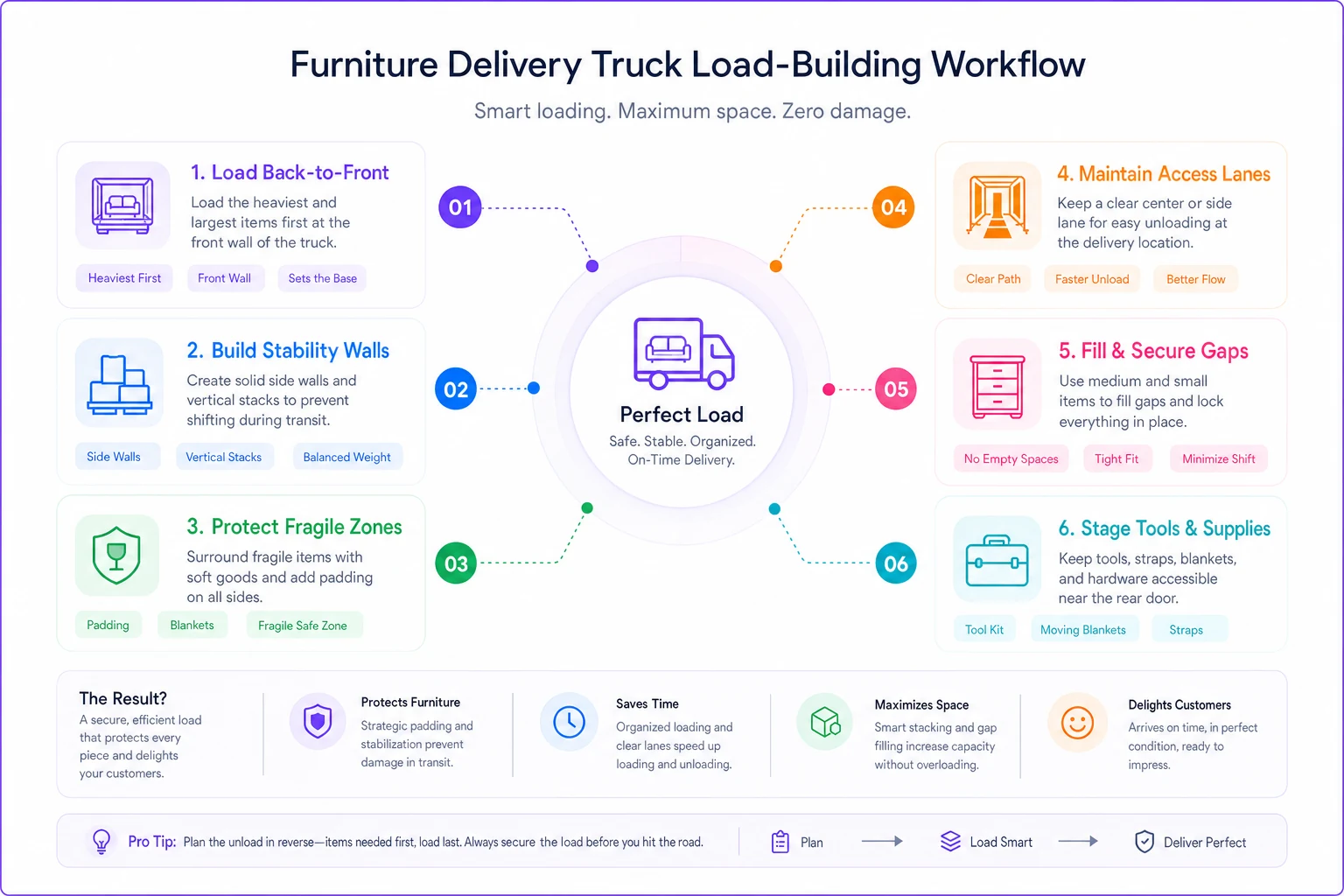
The diagram should show loading Stop 6 first, key protection zones, and an 18-inch access lane to demonstrate minimal reshuffling.
Map the route backwards before you load the truck to avoid unnecessary reshuffling at stops.
This configuration minimizes handling at each stop while protecting fragile items from shift damage during transit.
Shift templates calibrated to furniture delivery reality
Generic 8-hour shift templates break down fast when applied to furniture delivery. The physical demands, customer availability windows, and truck capacity constraints all require scheduling that reflects how deliveries actually play out.
Heavy Morning Template (Best for residential-heavy days):
-
7
00 AM: Crew arrival, truck inspection
-
7
30 AM: Depart for Stop 1
-
8
00 AM–12:00 PM: 4–5 stops, heaviest items front-loaded
-
12
00 PM–12:30 PM: Lunch/recovery break
-
12
30 PM–2:30 PM: 2–3 lighter stops
-
2
30 PM–3:00 PM: Return, unload returns/damages
Balanced Template (Mixed commercial/residential):
-
8
00 AM: Crew arrival
-
8
30 AM–10:30 AM: 2–3 commercial deliveries (access windows)
-
10
30 AM–1:30 PM: 3–4 residential stops
-
1
30 PM–2:00 PM: Break
-
2
00 PM–4:00 PM: 2 final stops
-
4
00 PM–4:30 PM: Cleanup and documentation
Avoiding the 4-hour death zone:
Crews working beyond 4 continuous hours show measurable performance degradation. Injury rates spike, damage increases, and customer interactions suffer. Yet many stores push crews through 6-hour continuous routes to "maximize efficiency." That false economy generates returns, damage claims, and workers' comp that far outpace any labor savings.
Technology coordination versus manual chaos
The gap between manual scheduling and coordinated operations software isn't just efficiency — it's the difference between sustainable delivery operations and constant crisis management.
Most furniture stores cobble together a POS system for orders, spreadsheets for routes, WhatsApp for crew communication, phone calls for customer confirmation, and paper forms for delivery documentation. This fragmentation creates information delays, miscommunication, and scheduling conflicts that compound into operational failures quickly.
Modern operational software built for furniture delivery addresses these gaps through integrated workflows. AI-powered platforms can analyze delivery history to predict accurate time requirements, automatically flag access constraints from previous deliveries, and optimize crew pairings based on performance data rather than guesswork.
The real value isn't automation for its own sake — it's capturing operational knowledge that normally walks out the door when experienced schedulers leave. When your lead time management systems connect with delivery scheduling, you can promise accurate delivery windows at the point of sale instead of scrambling to fit deliveries in after the fact.
Measuring what matters: KPIs for two-person delivery
Traditional delivery metrics like cost per mile and stops per hour miss the operational reality of furniture delivery. Better measurements focus on sustainable performance.
First-attempt completion rate: Percentage of deliveries completed on first attempt. Target: above 92%. Below 85% indicates systematic scheduling problems.
Damage rate by crew pairing: Tracks which crew combinations generate damage claims. Identifies training needs and problematic pairings early.
Time variance by delivery type: Measures actual versus planned time by access type. Feeds directly back into capacity planning.
Crew utilization versus overtime: Balance between high utilization and excessive overtime. Sweet spot is 80–85% utilization with under 5% overtime.
Customer time window achievement: Percentage hitting promised delivery windows. Should exceed 95% for morning windows, 90% for afternoon.
One furniture store tracking these metrics found their Tuesday/Thursday crews consistently outperformed Monday/Wednesday/Friday teams by around 20%. The difference was simple: Tuesday/Thursday ran dedicated crews who developed rhythm and communication over time. The MWF crews mixed personnel based on availability, which quietly destroyed team cohesion week after week without anyone noticing the pattern.
From reactive scrambling to predictable operations
Two-person furniture delivery scheduling isn't about finding perfect solutions — it's about building systems that handle inherent complexity while keeping service quality and crew sustainability intact.
The stores doing this well share some common habits. They treat crew pairing as strategic planning, not random assignment. They build routes based on actual access constraints, not just geographic proximity. They load trucks for operational efficiency, not maximum capacity. They design shifts around human performance curves, not arbitrary time blocks. They measure completion quality, not just completion speed.
The difference between constant delivery crises and smooth operations isn't heroic effort from dispatchers or crews grinding harder. It's systematic attention to the dozens of small decisions that compound into success or failure over time. When scheduling reflects operational reality instead of theoretical efficiency, missed appointments drop, damage decreases, and crews actually show up Monday morning.
Smart operators increasingly rely on AI-enhanced operational platforms that learn from delivery patterns, predict capacity requirements, and flag problems before trucks roll. But whether you're using spreadsheets or sophisticated software, the core principles don't change: respect the physics of moving furniture, account for human limitations, and build schedules that work in practice, not just on paper.
Your delivery crews already know what works. They've learned through thousands of deliveries which apartment complexes have impossible staircases, which pairings cause friction, and which loading sequences save hours. The challenge isn't discovering better practices — it's systematizing the knowledge your teams already carry into repeatable operations that don't depend on one experienced dispatcher who somehow holds everything together.
That shift starts with treating two-person furniture delivery scheduling as complex operations management — not just logistics. Once you do that, the path from chaotic scrambling to predictable delivery becomes a lot clearer than most owners expect.
Ready to elevate your furniture business?
Join 500+ furniture retailers using Hosyly to increase efficiency, improve customer satisfaction, and grow revenue.