

Most furniture retailers don't fail peak season because they lack trucks. They fail because they scaled the wrong things at the wrong time, hired temp crews with zero screening, and had no rules for when to say no to a same-week install. The result is a November where delivery capacity technically doubles but customer complaints triple.
Seasonal delivery capacity planning for furniture is less about adding vehicles and more about controlling how fast you ramp, who you let onto a truck, and what conditions have to be met before you promise a date. Get those three things right and the peak stops feeling like damage control.
The real shape of a furniture peak (and why last-minute scaling never works)
Furniture demand doesn't spike overnight. It builds. A typical mid-size retailer sees delivery volume climb from a baseline of around 90–110 completed installs a week up to 220–260 during the six-week holiday stretch, then a second smaller wave in spring.
The mistake owners make constantly: waiting until they're already drowning in week one of the spike to start hiring and renting. By then, the good temp crews are gone, the reliable box-truck rentals are booked, and you're onboarding people the same morning they're loading a $2,800 sectional.
Ramping capacity is a lead-time problem, not a volume problem. You can't compress training, route-density learning, and crew pairing into a single week. Trucks scale fast. Competent two-person crews who don't gouge doorframes do not.
A useful mental model: your baseline crews carry institutional knowledge — they know which neighborhoods have tight stairwells, which SKUs need blankets vs. shrink wrap, how to handle an annoyed customer. Temp crews carry none of that. Every temp crew you add without a ramp plan is a quality dilution unless you offset it with structure.
A 12‑week ramp instead of a panic
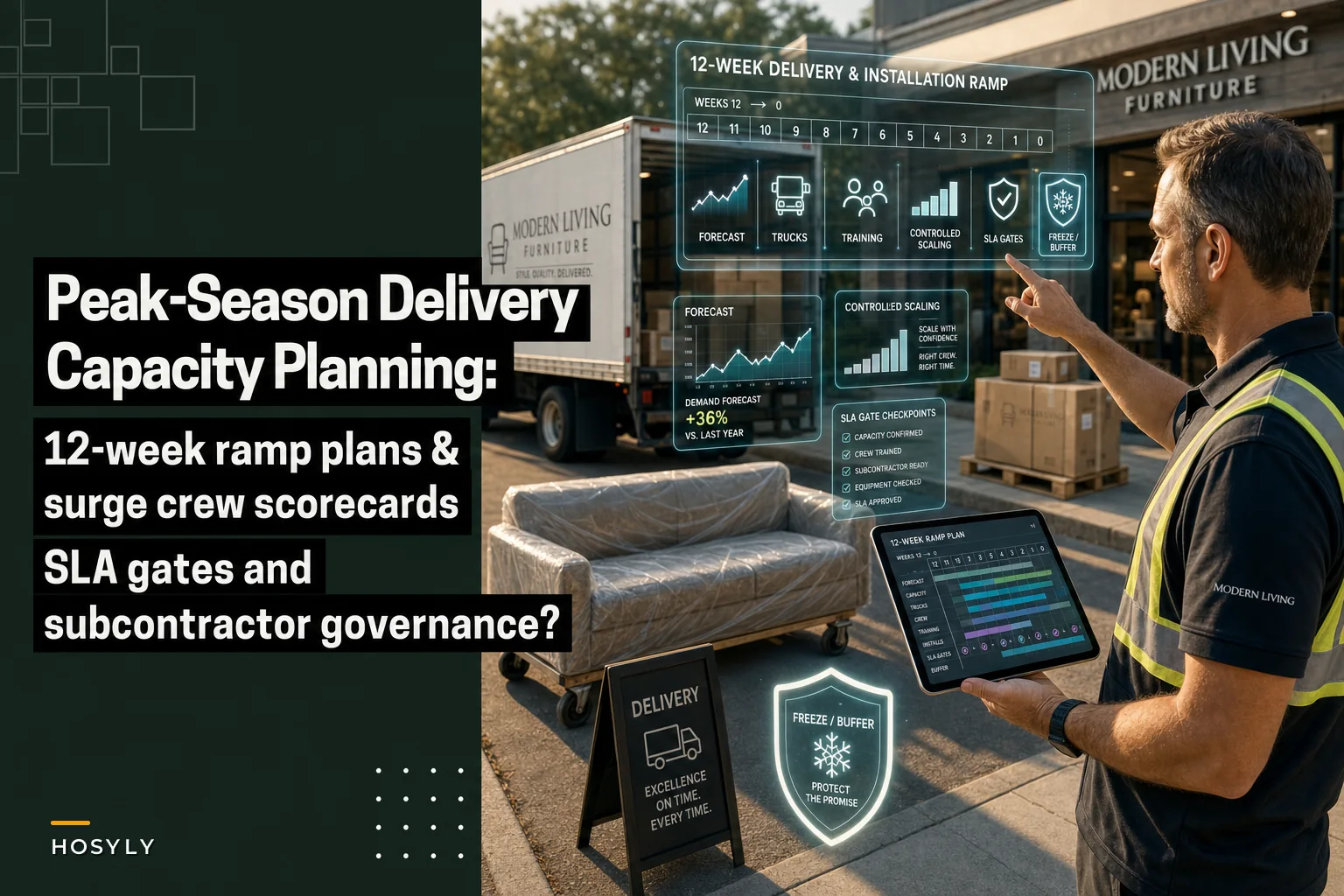
The fix that actually holds up is a staged 12-week ramp that starts before demand does. The point isn't to have full capacity 12 weeks out — it's to layer capacity in slowly enough that quality doesn't collapse when volume peaks.
Eliminate inventory headaches and order delays.
Hosyly streamlines your furniture orders and stock management for seamless store operations.
- Real-time inventory tracking
- Automated order processing
- Customer notifications & engagement
No credit card required
-
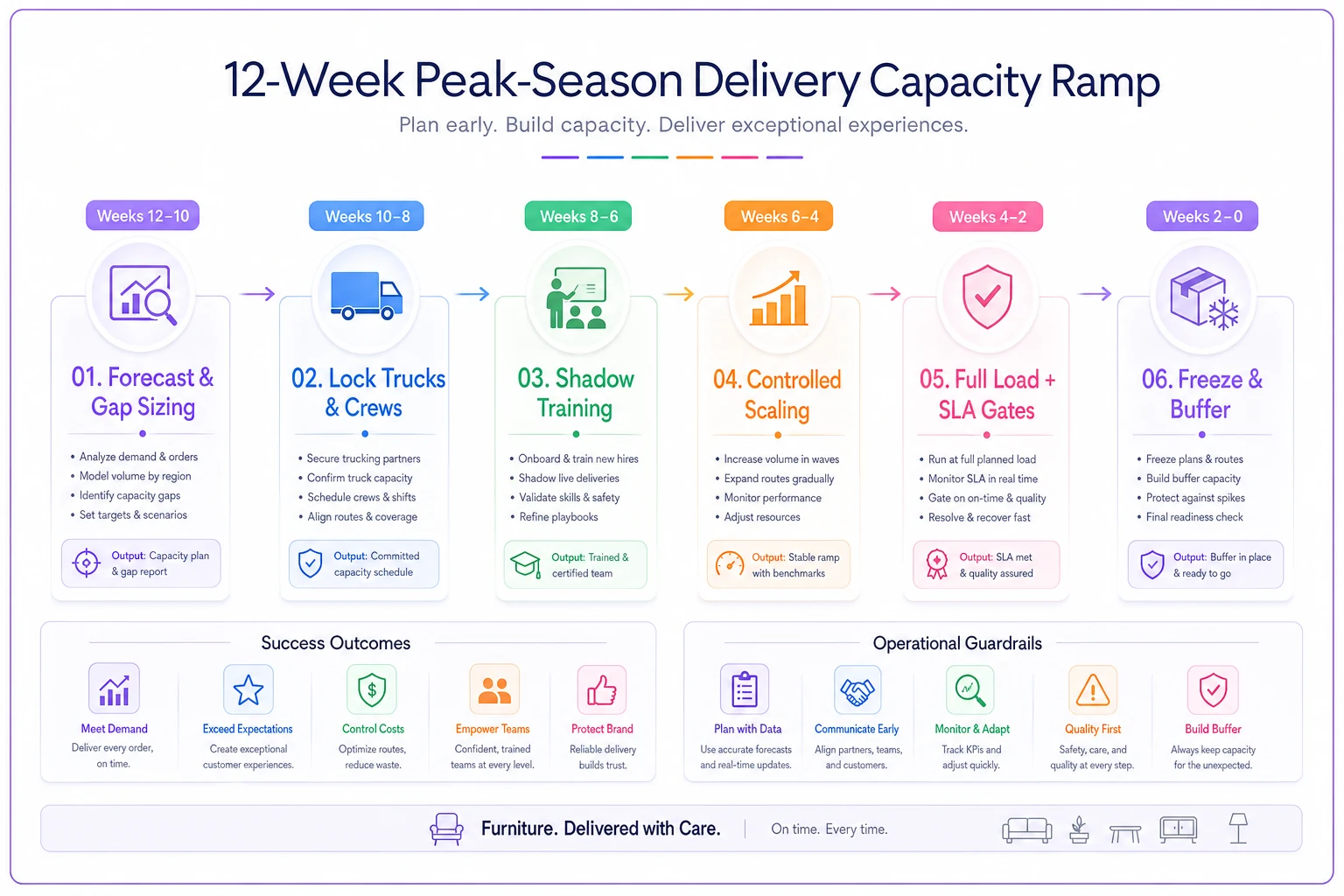
Weeks 12–10 (Forecast lock + gap sizing) Pull last year's weekly completed-install counts by zone. Overlay this year's preorder book and promo calendar. Calculate your peak-week gap — the number of daily install slots you're actually short. If baseline is 20 installs/day and peak needs 48, your gap is 28.
-
Weeks 10–8 (Source and pre-book) Lock truck rentals and reserve temp crews now, not later. Sign subcontractor agreements. Rates are lower and availability is real this far out.
-
Weeks 8–6 (Shadow training) Bring temp crews in at low volume, riding along with your best baseline crews. One temp per two experienced installers. This is where they learn your damage-prevention standards and your handoff steps.
-
Weeks 6–4 (Controlled scaling) Temp crews start running their own routes but capped at simpler jobs — flat-pack, single-item, ground-floor. Complex installs stay with senior crews.
-
Weeks 4–2 (Full load, gated) All crews live. SLA gates (covered below) turn on to protect the schedule.
-
Weeks 2–0 (Freeze and buffer) Stop adding new people. Hold roughly 10–15% slot buffer for reschedules and weather.
The ramp works because by week six, temp crews aren't strangers anymore. They've done ride-alongs and simple routes. The compounding failure — untrained crews doing complex installs at peak volume — never happens.
Here's a visual summary of the 12-week ramp.
When a 12‑week ramp is overkill
If your peak lift is small — going from 90 to maybe 120 installs a week — a full 12-week ramp is more process than you need. A 5–6 week version works fine. The full ramp earns its keep when peak volume is 2x+ baseline or when you're leaning heavily on subcontractors you don't work with year-round.
Surge crew scorecards: stop treating temp crews as interchangeable
The biggest hidden cost of peak season is damage and rework caused by crews nobody is actually measuring. During baseline months you know your regulars. At peak you might have 8–12 crews on the road, half of them new, and no clean way to see who's generating the missed appointments and doorframe gouges.
A surge crew scorecard fixes this by scoring every crew — permanent and temp — on the same handful of metrics, refreshed weekly. Not annually. Weekly, because peak is short and a bad crew running unmonitored for three weeks can generate more claims than they earn in revenue.
| Metric | What it catches | Target during peak |
|---|---|---|
| On-time arrival % | Routing and pacing problems | ≥ 90% |
| First-visit completion % | Prep, SKU data, install skill | ≥ 85% |
| Damage/claim rate per 100 jobs | Handling discipline | ≤ 3 |
| Reschedule-caused-by-crew % | Reliability | ≤ 5% |
| Customer sign-off issues | Attitude, cleanup, walkthrough | trending down |
The insight most people miss: a temp crew can have a great on-time rate and still be your worst crew, because they're rushing to hit the next stop and leaving scuffed walls behind them. That's why first-visit completion and damage rate matter more than raw speed. A crew that arrives on time but needs two visits costs you far more than one that's ten minutes late and done in one.
Run the scorecard as a simple weekly review. Any crew that breaches two metrics two weeks running gets pulled off complex routes or dropped entirely. The vetting principles here overlap heavily with what goes into vetting and governing furniture installers to cut liability and repeat installations — peak season just means you're doing that governance weekly instead of quarterly, and on people you've known for six weeks instead of six years.
The surge-rate negotiation playbook
Where owners lose real money at peak is on rates. When you're desperate in week one, you pay whatever the subcontractor asks. Booked early with a plan, you negotiate from a completely different position.
-
Book volume commitments, not day rates. "I'll guarantee you 40 installs over these six weeks" gets a better per-install rate than day-by-day scrambling. The subcontractor values the guaranteed income.
-
Tier your rate by job complexity. Don't pay the same for a nightstand drop-off and a 5-piece sectional install up three flights. A tiered rate (simple / standard / complex) protects margin and gives crews a reason to take the hard jobs.
-
Build the damage clause into the rate conversation up front. Agree that claims traced to crew handling come out of their pay, with photo evidence. Crews that balk at this are telling you something.
-
Lock a surge premium ceiling. If you must pay more for last-minute coverage, cap it — no more than 20% over standard, for example. Otherwise week-of panic rates quietly erase your delivery margin.
Retailers who negotiate rates in weeks 10–8 typically land 10–18% below what they'd pay booking mid-spike. On a peak involving several hundred subcontracted installs, that difference alone can be worth more than the entire cost of running the ramp process.
Who should NOT lean on subcontractors at peak
If your product mix is dominated by complex, high-value installs — custom sectionals, wall units, anything where a mistake means a four-figure claim — flooding your peak with unfamiliar subcontracted crews is risky no matter how good your scorecard is. In that case you're better off capping the promises you make (fewer install slots, longer windows) than diluting quality. Volume you can't install cleanly isn't revenue, it's future claims.
SLA gates: the part that actually limits missed appointments
Even with a solid ramp and scored crews, you'll still blow up your peak if your sales team keeps promising same-week installs the operation can't support. SLA gates are the conditions that must be true before a delivery date gets confirmed.
-
Capacity gate Is there an open slot in that zone on that day, accounting for buffer? No slot, no promise.
-
SKU-readiness gate Is the item physically in the building and inspected? Promising an install for stock that's still on a truck somewhere is how you manufacture reschedules.
-
Crew-match gate Does the job complexity match an available crew's tier? A complex install shouldn't auto-book onto a temp crew's route.
-
Access gate Have you confirmed delivery constraints — elevator, stairs, parking, doorway width — before locking the appointment? Missing this is a top cause of failed first visits.
Gates matter more at peak than at baseline because your slack disappears. In a slow month, a bad promise gets absorbed — you shuffle a crew, nobody notices. At peak, every over-promise cascades because there's no empty slot to shuffle into. One missed appointment at peak isn't one problem, it's three.
The load-building and pairing side of this also deserves real attention, since gates only work if the underlying schedule is built sensibly — the routing logic in two-person delivery scheduling for bulky furniture is what the capacity gate is checking against.
Most stores run gates manually — a dispatcher eyeballing a spreadsheet — and it holds until volume doubles, at which point the manual check quietly gets skipped under pressure. This is exactly where operational software with built-in booking rules earns its place: the gate logic runs automatically at the point of promising a date, so a same-week complex install simply can't be booked onto a crew that isn't qualified or a day that's already full. It's not about replacing the dispatcher — it's about making sure the rules that protect peak season don't get abandoned the week you need them most.
A real scenario
A regional furniture retailer with two showrooms and an in-house delivery team ran into the classic wall two seasons ago. Baseline was around 100 installs a week; the holiday peak pushed demand past 230. They scaled by grabbing whatever temp crews they could find in the first week of the spike.
That year: first-visit completion dropped to roughly 70%, damage claims spiked to around 9 per 100 jobs, and they were rescheduling so many appointments that customers were getting installs pushed into January. Surge rates paid on the fly ran well above what early booking would have cost.
The following year they ran a 10-week ramp, scored every crew weekly, and turned on SLA gates for anything above a simple drop-off. Temp crews spent two weeks shadowing before running solo routes. First-visit completion recovered to the mid-80s, claims settled back to 3–4 per 100, and reschedules dropped to the point where the January spillover basically disappeared. They also spent noticeably less on subcontractor rates because they'd locked them in at weeks 9 and 8.
Nothing dramatic happened. They didn't buy more trucks. They just stopped scaling in a panic and put structure around the three things that actually break at peak.
Where to start if you only do one thing
If a full ramp feels like too much to stand up this cycle, start with the SLA gates. They're the cheapest to implement and they stop the bleeding fastest, because most peak-season chaos traces back to promises the operation couldn't keep. Add the crew scorecard next season, then build out the full 12-week ramp once you've seen where your real capacity gaps sit.
Peak season doesn't reward the retailer with the most trucks. It rewards the one who ramped early, measured the crews on the road, and refused to promise dates the operation couldn't actually deliver. Those three habits compound — and once they're in place, the November scramble stops feeling like a fire drill and starts feeling like a plan.
Peak season doesn't reward the retailer with the most trucks. It rewards the one who ramped early, measured the crews on the road, and refused to promise dates the operation couldn't actually deliver. Those three habits compound — and once they're in place, the November scramble stops feeling like a fire drill and starts feeling like a plan.
Ready to elevate your furniture business?
Join 500+ furniture retailers using Hosyly to increase efficiency, improve customer satisfaction, and grow revenue.