

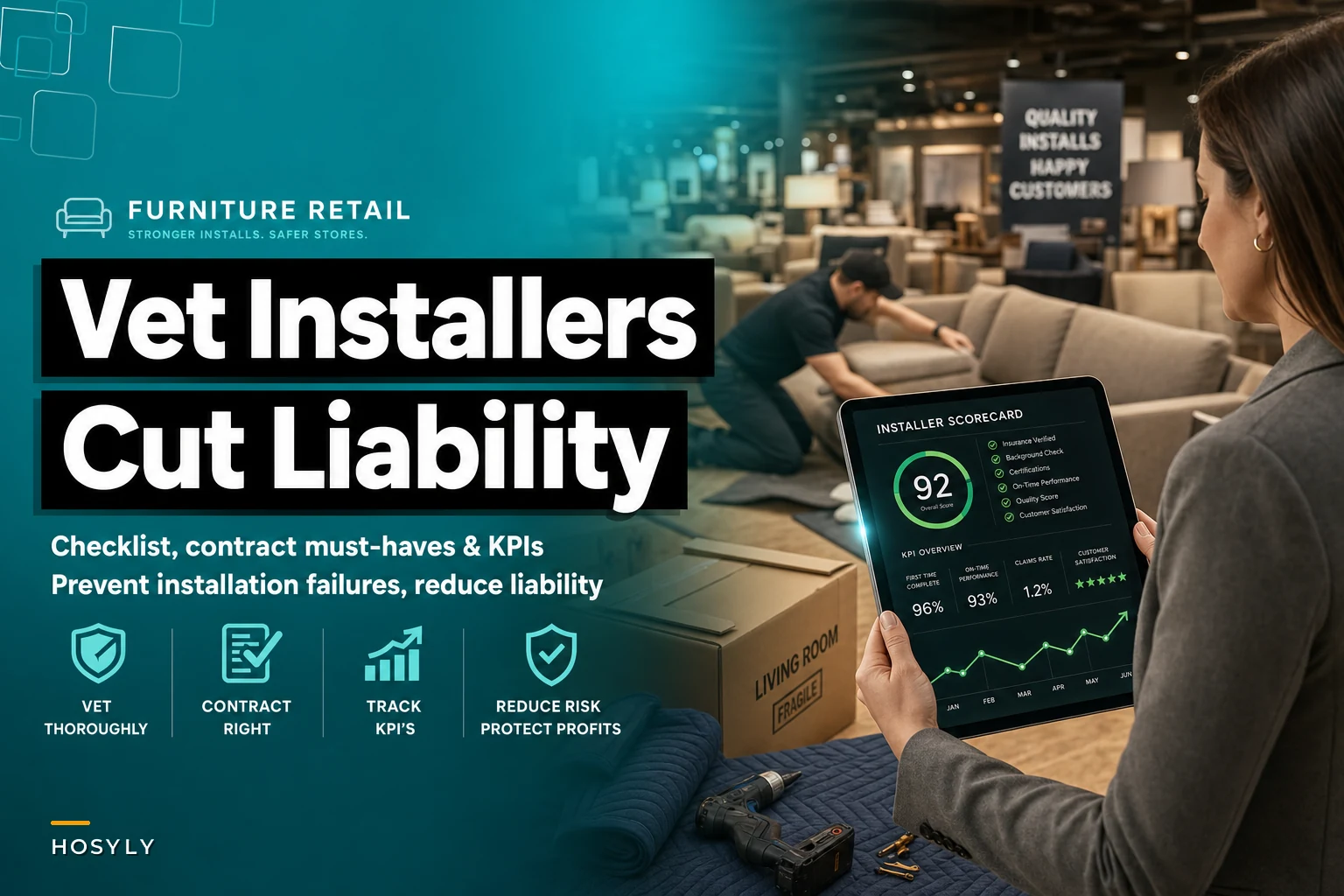

Furniture installation liability isn't just about insurance claims and property damage. The real cost shows up months later — when customers stop referring friends, skip your store on their next purchase, and leave reviews warning others about their installation nightmare. The pattern is consistent across furniture retailers: stores that treat installer vetting as an afterthought deal with far more repeat installations and noticeably higher customer acquisition costs.
Most furniture retailers discover their installer problems backwards — through angry customer calls, damage claims, or negative reviews. By then, the operational and reputational damage is already spreading. The subcontractor selection process you put in place today directly affects whether customers come back two years from now.
The Hidden Cost Structure of Bad Installation Partners
A damaged hardwood floor might cost $1,800 to refinish, but that's just the visible expense. The actual cost cascade from poor installer vetting looks more like this:
Direct costs:
-
Property damage claims (average $900–$2,400 per incident)
-
Repeat installation labor and scheduling
-
Customer appeasement discounts ($200–$500 per incident)
-
Staff time managing complaints (8–12 hours per major incident)
Indirect costs:
-
Lost repeat business from affected customers
-
Negative review management and response
-
Sales team credibility damage when pitching delivery
-
Higher insurance premiums after multiple claims
Long-term costs:
-
Reduced word-of-mouth referrals
-
Lower close rates when delivery concerns come up
-
Competitive disadvantage versus stores with reliable installation
One mid-sized furniture retailer in Ohio tracked their true all-in cost per installation incident at roughly $3,400 when factoring in lifetime customer value loss. They had been calculating it at $600 based only on direct repair costs. That gap is pretty common, and it's exactly why the math on proper vetting looks so different once you run it correctly.
Why Standard Contractor Agreements Miss Critical Protection Points
Pull up any standard furniture installation contractor agreement and you'll find boilerplate language about insurance requirements and indemnification. What you won't find are the operational controls that actually prevent problems.
Eliminate inventory headaches and order delays.
Hosyly streamlines your furniture orders and stock management for seamless store operations.
- Real-time inventory tracking
- Automated order processing
- Customer notifications & engagement
No credit card required
The gaps in typical agreements:
Insurance requirements state minimum coverage amounts but don't specify what types of damage must be covered. Installers often carry general liability that excludes certain property damage types or has massive deductibles that effectively make small claims your problem.
Background check language exists but lacks any verification mechanism. Saying "contractor must conduct background checks" means nothing without proof of completion, scope requirements, and ongoing monitoring.
Performance standards focus on completion metrics rather than customer experience. An installer might hit every delivery window while leaving customers frustrated with their communication, property care, or assembly quality.
Corrective action clauses also tend to jump straight to termination without intermediate steps — which leaves you choosing between keeping a problematic installer or suddenly losing capacity in the middle of peak season.
The Pre-Vetting Elimination Round
Before diving into insurance certificates and reference checks, run potential installers through quick filters that save everyone time:
-
Capacity reality check Ask for their current weekly installation volume and busy season surge capacity. If they're already maxed out or can't scale for the holidays, stop there.
-
Geographic coverage mapping Request their actual service area with response times by zone. Many installers claim broader coverage than they can reliably deliver.
-
Equipment and vehicle audit Verify they own appropriate vehicles and equipment for your product mix. Sectional sofa installers need different capabilities than bedroom set specialists.
-
Communication systems test Send a test customer inquiry through their normal channels. Response time and quality preview what your customers will experience.
-
Scheduling flexibility probe Present a scenario requiring installation rescheduling. Their response reveals whether they can adapt to real-world delivery complications.
These filters tend to eliminate a significant portion of candidates before you've invested meaningful time in deeper vetting.
Insurance Verification That Actually Protects You
Getting an insurance certificate means nothing if you don't verify the right coverage types, amounts, and exclusions:
Required Coverage Types
| Coverage Type | Minimum Amount | Key Exclusions to Check |
|---|---|---|
| General Liability | $1M per occurrence | Property damage from moving items |
| Auto Liability | $1M combined single limit | Non-owned vehicle coverage |
| Workers Compensation | State minimum | Independent contractor exclusions |
| Cargo/Transit Coverage | $50K minimum | Furniture-specific damage |
| Umbrella Policy | $2M aggregate | Coverage trigger requirements |
Verification Steps Beyond the Certificate
-
Additional insured status Require being named as additional insured on their general liability policy, not just receiving a certificate
-
Direct carrier verification Call the insurance company to confirm coverage is active and matches the certificate
-
Claims history review Request a 3-year loss run report showing previous claims
-
Exclusion documentation Get written confirmation of what damage types are covered
-
Renewal tracking Set calendar reminders 60 days before policy expiration dates
Red Flags in Insurance Documentation
-
Certificate issued by agent instead of carrier
-
"Information purposes only" disclaimer language
-
Occurrence limits matching aggregate limits (suggests minimal coverage)
-
Excessive exclusion riders or endorsements
-
Coverage gaps between policy periods
Require direct carrier verification before accepting a certificate.
Getting an insurance certificate means nothing if you don't verify the right coverage types, amounts, and exclusions:
Background Screening Beyond Criminal Checks
Criminal background checks are the bare minimum. Comprehensive installer screening examines multiple risk dimensions:
Driving record analysis: Moving violations predict property damage risk better than criminal history. Frequent violations in a short window tend to correlate with higher damage claims.
Social media behavior audit: Public profiles reveal professionalism, customer interaction style, and potential liability risks. Look for customer complaints, unprofessional content, or signs of operational instability.
Business stability indicators:
-
Business registration and license verification
-
Tax ID confirmation
-
Address history (frequent moves suggest instability)
-
Banking reference (established business accounts)
-
Trade association memberships
Customer interaction screening: Have someone call posing as a customer with questions. Their phone manner, knowledge, and follow-through indicate what your customers will actually experience.
Technical competence verification: Require assembly demonstration for complex furniture pieces. Many installers claim broader expertise than they actually have.
Contract Terms That Prevent Problems
Your installer agreement needs specific operational requirements beyond standard legal protections:
Communication Standards
-
Response time requirements for customer inquiries (2-hour maximum)
-
Escalation protocols for delivery issues
-
Customer notification templates for delays
-
Post-installation follow-up requirements
Property Protection Protocols
-
Mandatory floor protection specifications
-
Wall and doorway clearance requirements
-
Photography documentation before and after installation
-
Damage reporting timeline (immediate for major, same-day for minor)
Quality Control Measures
-
Customer sign-off requirements with specific checklist
-
Photo documentation of completed installation
-
Assembly verification steps for each furniture type
-
Cleanup and packaging removal standards
Performance Tracking Requirements
-
Weekly reporting on completion rates, issues, and customer feedback
-
Monthly business review meetings during first 6 months
-
Quarterly performance evaluations with documented metrics
-
Annual insurance and certification updates
Your installer agreement needs specific operational requirements beyond standard legal protections:
KPI Framework for Ongoing Governance
Track these metrics monthly to identify problems before they escalate:
Quality Indicators:
-
First-time installation success rate (target
>95%)
-
Customer satisfaction scores (target
>4.5/5)
-
Damage claim frequency (target
<2%)
-
Assembly error rate (target
<1%)
Operational Metrics:
-
On-time arrival rate (target
>90%)
-
Communication response time (target
<2 hours)
-
Installation duration vs. estimate (target
within 20%)
-
Capacity utilization (track for surge planning)
Risk Indicators:
-
Insurance claims filed
-
Customer complaints by type
-
Employee/subcontractor turnover
-
Vehicle incident reports
Business Health Signals:
-
Invoice accuracy
-
Payment term compliance
-
Documentation completeness
-
Training participation
Track these metrics monthly to identify problems before they escalate:
The Corrective Action Ladder
Binary consequences — warnings or termination — don't work well in practice. Graduated responses give you actual leverage to improve performance rather than just creating a paper trail.
Level 1: Coaching Intervention
Trigger: Single customer complaint or minor operational issue
Response:
-
Document specific issue and expectation gap
-
Provide written coaching with improvement timeline
-
Offer training resources or shadowing opportunity
-
Follow up within 7 days to verify understanding
Level 2: Performance Improvement Plan
Trigger: Repeated issues or failure to improve after coaching
Response:
-
30-day formal improvement plan with specific metrics
-
Weekly check-ins with operations manager
-
Required retraining on problem areas
-
Temporary reduction in installation volume
Level 3: Probationary Status
Trigger: Failure to meet improvement plan goals
Response:
-
60-day probation with heightened monitoring
-
Mandatory supervisor approval for all installations
-
Customer follow-up calls on every delivery
-
Performance bond or increased insurance requirement
Level 4: Suspended Status
Trigger: Major incident or continued performance issues
Response:
-
Immediate suspension from new installations
-
Complete pending commitments under supervision
-
Comprehensive review of entire relationship
-
Decision on termination vs. remediation within 10 days
Level 5: Termination
Trigger: Unremediated major issues or multiple suspensions
Response:
-
Formal termination notice with cause documentation
-
Transition plan for pending installations
-
Customer notification for scheduled deliveries
-
Final settlement of outstanding issues
Binary consequences — warnings or termination — don't work well in practice. Graduated responses give you actual leverage to improve performance rather than just creating a paper trail.
Building Your Installer Scorecard System
Monthly scorecards make performance transparent and give installers something concrete to work toward:
Scorecard Components:
-
Performance metrics vs. targets (weighted scoring)
-
Customer feedback summary with verbatims
-
Operational issues log with resolution status
-
Recognition for exceptional performance
-
Action items for next period
Scoring Methodology:
-
40% weight
Customer satisfaction metrics
-
30% weight
Operational reliability
-
20% weight
Communication and documentation
-
10% weight
Business relationship factors
Performance Tiers:
-
Platinum (95+ score)
Priority scheduling, volume bonuses
-
Gold (85-94)
Standard terms, eligible for growth
-
Silver (75-84)
Increased monitoring, improvement focus
-
Bronze (<75)
Active intervention required
Review Cadence:
-
Weekly
Operational metrics review with installation team
-
Monthly
Comprehensive scorecard review with each installer
-
Quarterly
Strategic relationship assessment
-
Annually
Contract renewal negotiation based on performance
Monthly scorecards make performance transparent and give installers something concrete to work toward:
Technology Integration for Installer Governance
Manual tracking works fine when you have three or four installers and low volume. Once you're managing eight or ten contractors across multiple delivery zones, spreadsheets and email threads start creating blind spots — things get missed, follow-ups fall through, and by the time you notice a performance problem it's already showing up in your reviews.
This is where AI-powered operational platforms help streamline the governance process. Instead of manually collecting customer feedback, tracking completion rates, and managing corrective actions across disconnected systems, operational software consolidates everything into a single view.
A good platform handles the routine data collection automatically — customer surveys go out right after installation, damage reports kick off insurance verification steps, and performance trends get flagged before they become a pattern you can't ignore. The value isn't that the software replaces your judgment. It's that your team stops spending half their time chasing paperwork and starts actually acting on the data that matters.
Here's a simple workflow for how an operational platform automates governance:
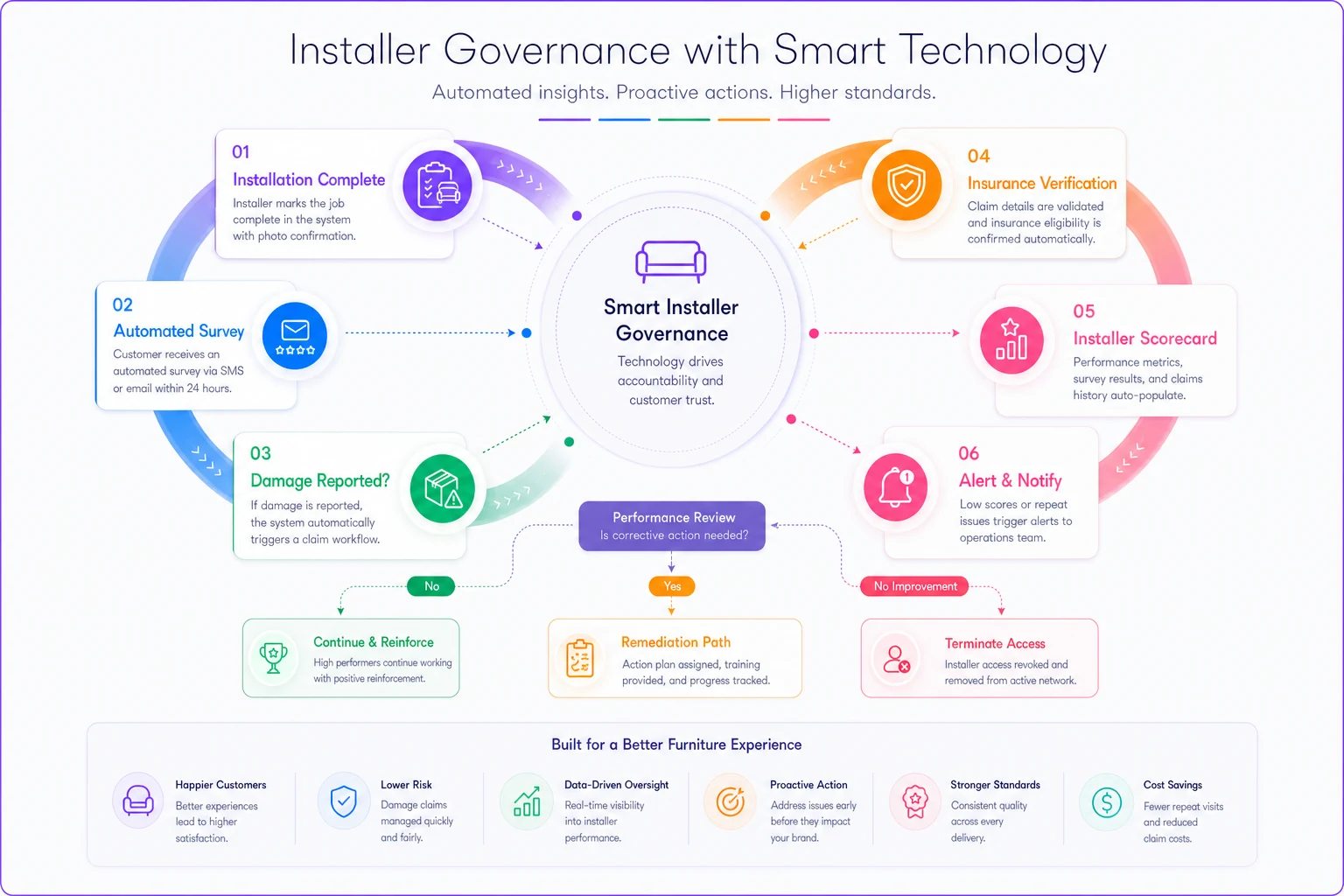
This shows how data flows from installation to action without manual handoffs.
| Governance Task | Manual Approach | With Operational Software |
|---|---|---|
| Customer feedback collection | Follow-up calls, delayed and inconsistent | Automated surveys sent post-installation |
| Installer scorecard updates | Monthly spreadsheet compilation | Continuous, auto-populated scoring |
| Insurance renewal tracking | Calendar reminders, easy to miss | Automated alerts before expiration |
| Damage claim workflows | Email threads, no clear ownership | Triggered workflows with documentation |
| Performance trend visibility | Quarterly at best | Real-time, surfaced proactively |
The stores that govern this process well aren't necessarily the ones with the most staff — they're usually the ones that stopped trying to do it manually.
Common Vetting Mistakes to Avoid
Most furniture retailers discover their installer problems backwards — through angry customer calls, damage claims, or negative reviews.
-
Over-indexing on price The cheapest installer quote often hides inadequate insurance, poor training, or an unsustainable business model. Calculate total cost including repeat installations, damage claims, and customer lifetime value impact.
-
Trusting references without verification Installers provide their best references. Call customers not on the reference list by asking for recent installation addresses. Check online reviews across multiple platforms.
-
Ignoring seasonal capacity planning Installers who seem reliable in March might be overwhelmed in November. Understand their true surge capacity and competing commitments before peak season hits.
-
Accepting generic insurance certificates Many installers use template certificates that don't reflect actual coverage. Require policy documentation and speak directly with their insurance agent.
-
Skipping ongoing monitoring Strong vetting means nothing without continuous governance. Performance degrades gradually, and regular monitoring is the only reliable way to catch it early.
-
Creating adversarial relationships Governance shouldn't feel punitive. The best installer relationships balance accountability with partnership — using metrics to improve performance, not just document failures.
The best installer relationships balance accountability with partnership — using metrics to improve performance, not just document failures.
When to Bring Installation In-House
Sometimes the answer isn't better contractor vetting but eliminating contractors entirely. Consider in-house installation when:
-
Installation quality is central to your brand differentiation
-
Volume justifies dedicated employee teams
-
Geographic concentration supports efficient routing
-
Contractor quality stays inconsistent despite governance efforts
-
Customer experience requirements exceed what contractors can deliver
The transition requires significant operational investment but gives you complete control over the customer experience. Several regional furniture chains report meaningful improvement in customer satisfaction after bringing installation in-house, though startup costs typically run $200K–$400K for proper implementation.
Furniture installer selection isn't just about finding someone who can deliver a sofa without scratching the walls. Your installer network becomes the final touchpoint that determines whether customers remember your store positively or share horror stories with friends.
The vetting framework here might seem extensive compared to simply collecting insurance certificates and checking a couple of references. But the operational cost of poor installer selection — repeat deliveries, damage claims, lost customers, staff time — far exceeds the upfront investment in doing this properly.
Start with the pre-vetting elimination round to quickly filter obvious mismatches. Build contracts with specific operational requirements, not just legal protections. Establish KPIs that track what matters for customer experience, not just completion rates. Build corrective action processes that actually improve performance rather than just creating a paper trail.
Treat installer governance as an ongoing operational discipline, not a one-time exercise. The furniture retailers with the strongest customer loyalty understand that their reputation rides in every delivery truck, carried by every installation team, into every customer's home.
Ready to elevate your furniture business?
Join 500+ furniture retailers using Hosyly to increase efficiency, improve customer satisfaction, and grow revenue.