


Most furniture retailers don't have a pricing problem. They have a pricing governance problem. The number on the tag is fine. What's broken is who's allowed to change it, when they can change it, how fulfillment fees get attached to it, and what happens when a category manager decides to run an unplanned 15% off promo on a sectional line right before a delivery-cost increase kicks in.
That gap between "we set prices" and "we control pricing across channels, seasons, and people" is where margin quietly leaks. Bulky SKUs make it worse, because the sticker price is never the real economics. A $1,899 sofa carries delivery, install, insurance, return-freight risk, and floor-sample depreciation. Change any one of those without a rule, and your 42% blended margin becomes 31% without anyone noticing until the quarter closes.
This article lays out a three-tier governance model — strategy, cadence, and guardrails — plus the decision matrices, approval gates, and templates you actually need to run pricing on bulky items without it turning into chaos every time someone wants to move a number.
Why bulky-SKU pricing breaks differently than everything else
Small-ticket retail forgives sloppy pricing. If your accessory margins are off by three points, volume papers over it. Bulky furniture doesn't forgive anything, for a few structural reasons.
The first is that fulfillment cost is a huge, variable slice of the unit economics and it's rarely baked into the pricing decision. A wardrobe that costs $54 to deliver in a metro zone might cost $180 to a rural three-flight walk-up. If your pricing team treats delivery as a flat "shipping fee" line, you're subsidizing the expensive deliveries with the cheap ones and pretending your margin is uniform. It isn't.
The second is channel drift. The same sectional lives on your website, your marketplace listings, your showroom tags, and a B2B quote. Each channel has different fee structures, different discount authority, and different promotion calendars. Without governance, you get a customer who saw one price online, another in-store, and a third from a salesperson trying to save the sale.
The third is timing collisions. Furniture pricing decisions interact with delivery capacity, supplier lead times, and floor-sample cycles. Running a promotion on a slow-lead SKU right when you're already backordered just deepens the backlog and burns cash on expedited freight. Nobody planned that — it happened because the promo calendar and the ops calendar don't talk to each other.
These three failures compound. A well-meaning discount plus an unmodeled delivery zone plus a channel mismatch turns a "small promotion" into a negative-contribution order. And because the P&L only shows the aggregate, the owner assumes it was a good month with thin margins, not a governance leak.
The three-tier model: strategy, cadence, guardrails
The whole point of governance is to separate decisions that should be slow and deliberate from decisions that should be fast and bounded. Three tiers does that cleanly.
Eliminate inventory headaches and order delays.
Hosyly streamlines your furniture orders and stock management for seamless store operations.
- Real-time inventory tracking
- Automated order processing
- Customer notifications & engagement
No credit card required
Tier 1 — Strategy (quarterly, owner/leadership). This is where you set the archetype margin floors, the fulfillment-fee structure per SKU archetype, the discount authority levels, and the promotion windows for the quarter. Slow-moving, high-stakes decisions live here. Nobody below this tier gets to redefine what a "protected margin" is.
Tier 2 — Cadence (weekly/biweekly, category managers). This is the operating layer. Within the strategy guardrails, category managers run tests, adjust promo timing, respond to competitor moves, and approve discounts inside their authority. They can't rewrite the rules; they can play inside them.
Tier 3 — Guardrails (real-time, automated + floor staff). These are the hard limits that never require a meeting: minimum margin per order after fulfillment, maximum discount without escalation, blocked promotions on backordered SKUs, channel-price consistency checks. When someone tries to break one, the system flags it or blocks it. No debate.
Here's a quick visual mapping the tiers and the decision flow.
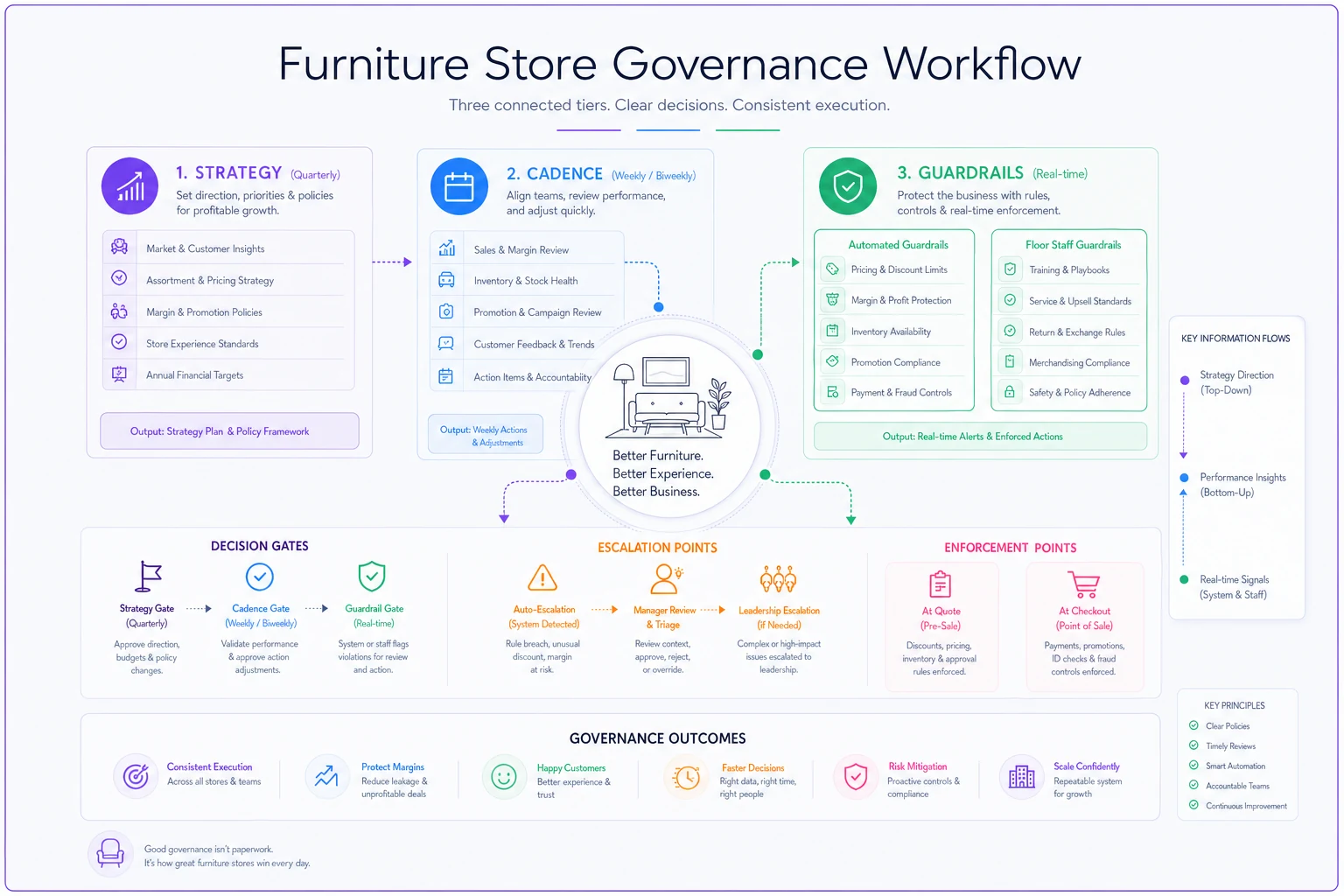
The mistake most retailers make is collapsing all three into one tier — usually a manager who "knows the numbers" and approves everything by feel. That works at $3M in revenue with one location. It falls apart the moment you add a second showroom or a serious online channel, because that one person becomes the bottleneck and the inconsistency all at once.
Archetype-level fulfillment-fee decision matrix
You cannot price fulfillment SKU by SKU. There are too many, and the data churns too fast. Instead, group SKUs into archetypes and set fee logic per archetype. This is the single highest-leverage move in the whole system.
Here's a working archetype matrix you can adapt:
| Archetype | Example SKUs | Delivery handling | Install complexity | Base fulfillment fee logic | Margin floor after fulfillment |
|---|---|---|---|---|---|
| Flat-pack light | Accent chairs, small tables | Parcel / single-person | None | Flat fee, absorbed if order > $X | 45% |
| Flat-pack bulky | Bookcases, dressers | Two-person, no lift | Low (customer-assemble) | Zone-based tiered fee | 40% |
| Assembled bulky | Sofas, beds | Two-person + threshold | Medium | Zone + access surcharge | 38% |
| Modular / sectional | L-shaped sectionals, wall units | Two-person + staging | High (in-home assembly) | Zone + access + install fee | 36% |
| White-glove / made-to-order | Custom wardrobes, dining sets | Scheduled crew | High + haul-away | Cost-plus, quoted per order | 34% |
The insight most people miss: the margin floor should get lower as the archetype gets heavier, not stay flat. That feels backwards until you realize the heavy archetypes carry higher absolute dollar contribution and more pricing power. Trying to hold a 45% floor on a made-to-order dining set just prices you out of the sale. The floor protects you against negative orders, not against thin ones.
Access surcharges are where the real leakage hides. Stairs, elevators, long carries, and tight doorways turn a modeled $90 delivery into a $200 one. If your checkout and your quote flow don't capture access conditions, your fulfillment fee is a guess. This connects directly to how you present those fees to the customer — worth reading our breakdown on setting delivery, installation and insurance fees without killing conversion, because the governance model only works if the customer-facing fee structure supports it.
Testing cadence: how to change prices without gambling
Pricing changes on bulky items are slow to reveal their effects. A sofa's true return rate and delivery-cost profile don't show up for weeks. So your testing cadence has to be patient and structured, not reactive.
A cadence template that works for most mid-size retailers:
-
Define the hypothesis and the guardrail first. "Raising the install fee on modular from $89 to $119 won't drop conversion below X." Set the abort threshold before you start.
-
Pick one archetype and one channel. Don't test price and fee changes across all channels at once — you'll never untangle the cause.
-
Run for a minimum of 3–4 weeks. Bulky-item purchase cycles are long. Two weeks tells you nothing except noise.
-
Measure contribution per order, not conversion alone. A test that lifts conversion 4% but drops post-fulfillment margin 6 points is a loss. Most teams only watch conversion and declare false wins.
-
Document the result in a shared log. Every test outcome feeds next quarter's strategy tier. Undocumented tests just get re-run by the next manager.
Set and record the abort threshold before launching the test.
Teams tend to test price but not fees, or fees but not price, and never the interaction between them. On bulky SKUs, the interaction is the whole game. A slightly higher sticker with a "free delivery" frame often beats a lower sticker plus a visible delivery charge — but only in certain archetypes and certain zones. If you want to go deeper on the checkout mechanics, the A/B testing and microcopy approaches in our post on pricing shipping and installation at checkout pair directly with this cadence.
Approval gates and escalation points
Guardrails only work if there's a clear line for when a human has to step in. Here's a gate structure that keeps decisions fast without letting margin bleed:
-
Gate 0 (automatic, no approval) Discounts within category-manager authority, on in-stock SKUs, inside an approved promo window. Just goes through.
-
Gate 1 (category manager sign-off) Discounts up to 15%, or any fee waiver on a single order. Same-day decision.
-
Gate 2 (leadership sign-off) Discounts 15–25%, promotions on backordered or long-lead SKUs, any price that pushes an order below its archetype margin floor. Requires a written reason.
-
Gate 3 (blocked, requires strategy review) Anything that breaks channel-price consistency, sells below cost-plus-fulfillment, or changes an archetype floor. This is a strategy-tier decision, not an in-the-moment one.
The escalation points that matter most:
-
An order projected to land below its archetype margin floor after real fulfillment cost — not sticker margin, actual post-delivery margin.
-
A promotion targeting a SKU with an open backorder — you're discounting demand you can't fulfill.
-
A channel-price mismatch greater than a set threshold — the moment your marketplace price and showroom price diverge, someone gets called.
-
A cluster of fee waivers by one salesperson — usually a sign someone's using "free delivery" to hit a quota and quietly killing contribution.
That last one is a quiet killer. One salesperson waiving delivery on 20% of their sectionals can erase the margin of an entire product line, and it never shows up as a "discount" in the reports because it's a fee waiver, not a price cut.
Governance means those waivers get logged and reviewed like any other margin decision.
Channel promotion windows
Bulky SKUs need coordinated promotion windows because promotions interact with delivery capacity. Running a 20% sectional sale during your peak delivery backlog isn't a marketing win — it's an operational grenade.
Build a promotion calendar that respects three constraints at once:
-
Delivery capacity Don't promote heavy archetypes when your crews are already at capacity. Push those promos into known slow-delivery weeks.
-
Supplier lead time Don't promote long-lead SKUs unless you're deliberately clearing or you have stock depth. A discount that triples demand on a 14-week-lead item just creates angry deposit-holders.
-
Channel exclusivity Decide per promotion which channels participate. A marketplace-only clearance shouldn't leak into showroom expectations.
The failure mode here is what happens when omnichannel rules are applied uniformly to bulky items — a promotion built for parcel-shippable accessories gets applied to sofas and the delivery network chokes. We covered why that uniformity is so damaging in the hidden cost of one-size-fits-all omnichannel rules for furniture, and it's the same root cause: pricing and promotion decisions made without the fulfillment reality attached.
A real scenario: where the leak was hiding
A two-location retailer doing roughly $9M–$10M annually thought their sectional category was their strongest margin line. On paper it showed around 41% gross margin. Cash flow said otherwise — the category was underperforming its own numbers by a noticeable amount every quarter.
When they broke it down by archetype and layered in actual fulfillment cost, the picture changed. Two things were happening. First, roughly a quarter of sectional deliveries had access surcharges — stairs, tight urban walk-ups — that were never captured at the point of sale, so those orders were shipping at a real cost $90–$140 above the modeled fee. Second, one showroom's sales team had been waiving delivery on higher-ticket sectionals to close deals. Around 18% of their sectional orders had a fee waiver that never registered as a discount.
Post-fulfillment, that "41% margin" category was actually running closer to 33% on the affected orders.
The fix wasn't a price increase. It was governance: an access-condition capture at quote and checkout, a hard escalation gate on fee waivers above a threshold, and an archetype margin floor that blocked below-contribution orders unless leadership signed off. Within two quarters the sectional category's real post-fulfillment margin moved back up by roughly 5–6 points — not because they charged more, but because they stopped leaking on orders that were quietly negative. No dramatic revenue jump. Just money they were already earning and losing at the same time.
When this level of governance actually makes sense
You don't need a three-tier model at every stage. Be honest about where you are.
It makes sense when:
-
You run more than one location, or a real online channel alongside a showroom.
-
Fulfillment cost is a meaningful and variable share of your bulky-item economics.
-
More than one or two people can change prices or waive fees.
-
You've caught yourself surprised by a "good revenue, thin margin" quarter.
It's overkill when:
-
You're a single showroom under a few million in revenue with one decision-maker who sees every order.
-
Your bulky mix is small and delivery is genuinely flat-cost across your area.
-
You'd spend more time maintaining the governance framework than the margin it protects.
Who should not start here: a brand-new store still finding its assortment. Governance protects a system that already works. If your archetypes, floors, and fulfillment costs aren't stable yet, formalizing them just locks in guesses. Get the unit economics roughly right first, then govern them.
Making it operational
The reason pricing governance fails isn't the model — it's the enforcement. Rules that live in a spreadsheet nobody checks are decorations. The gates and floors have to sit where the decisions actually happen: at quote, at checkout, and at the point a salesperson tries to waive a fee.
This is where connecting your pricing rules to your order and fulfillment data matters. When your operational platform knows the archetype, the delivery zone, the access conditions, and the real fulfillment cost of an order, the guardrails can enforce themselves — flagging below-floor orders, blocking promotions on backordered SKUs, and logging fee waivers automatically instead of relying on someone to remember. That kind of automation isn't about replacing judgment; it's about making sure the slow, deliberate strategy decisions actually hold at the fast-moving point of sale, without a manager having to police every transaction.
Start smaller than you think. Pick your two heaviest archetypes, set real post-fulfillment margin floors, put one escalation gate on fee waivers, and log every test. That alone catches most of the leaks. The full three-tier model can grow as your channels and locations do — which is exactly the point of building it around archetypes and rules rather than around one person's judgment. Systems scale. Gut feel doesn't.
Ready to elevate your furniture business?
Join 500+ furniture retailers using Hosyly to increase efficiency, improve customer satisfaction, and grow revenue.