
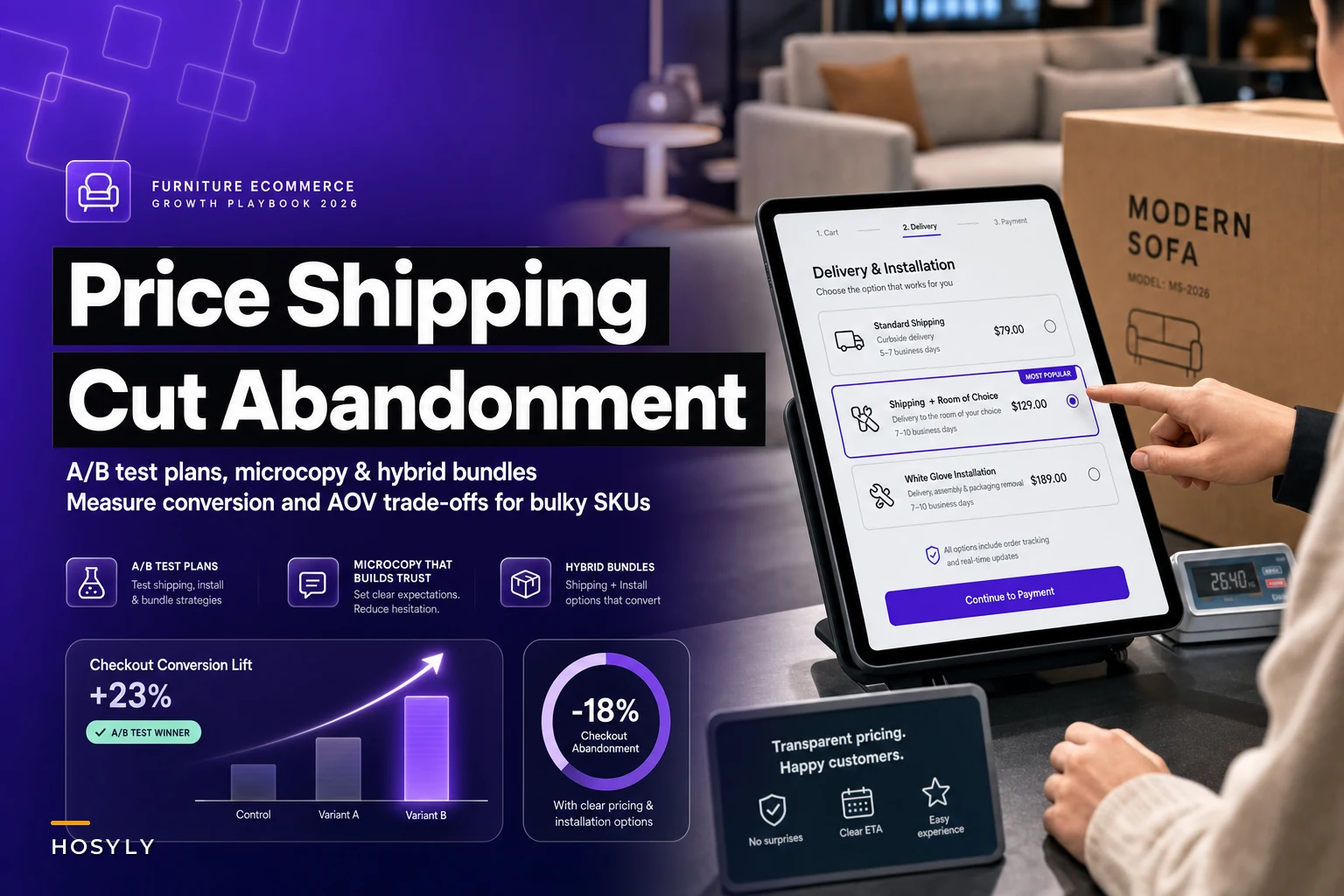

Most furniture checkout pages lose customers at exactly one line item: the moment shipping and installation costs appear. The product page did its job. The customer picked a $2,400 sectional. Then delivery adds $189, installation adds $120, and a small "haul-away" fee shows up they didn't expect. The cart sits there. It doesn't convert.
The frustrating part is that the fees themselves usually aren't the problem. Two stores can charge the exact same delivery cost and see completely different abandonment rates depending on how and when they show it. That's the whole game with furniture checkout shipping pricing — it's less about the number and more about the framing, the sequencing, and whether the customer feels like they're being nickel-and-dimed.
This post is about running that decision properly. Not guessing. Not copying what a competitor does. Actually testing shipping and installation pricing structures against real checkout behavior, with microcopy examples you can use and a way to read the conversion-versus-AOV trade-off so you don't accidentally boost one while quietly killing the other.
The specific problem: unbundled fees that stack visibly at the last step
There's a pattern that quietly bleeds conversions. A store treats delivery, installation, insurance, and haul-away as four separate line items, all revealed on the final checkout screen after the customer has entered their address.
From an accounting standpoint, this feels honest and clean. Every cost is itemized. Nobody's hiding anything. But from a behavioral standpoint it's a mess, because the customer experiences it as a series of small punches:
-
Subtotal
$2,400
-
Delivery
$189
-
Room-of-choice + installation
$150
-
Assembly
$95
-
Old-mattress haul-away
$45
That's $479 in add-ons appearing at the worst possible moment. The customer already emotionally committed to $2,400. Now they're recalculating, and each new line reads like a surprise. It's rarely the total that triggers the exit — it's the third fee. The first two feel expected. The third feels like the store is fishing.
The reverse mistake is just as common: baking everything into "free shipping" and quietly raising the product price by $300. That works until a customer cross-shops the identical SKU somewhere cheaper and assumes you're overpriced, because they never see that your price includes white-glove delivery and setup.
So the real question isn't "bundle or unbundle." It's which structure to test, against which segment, and how to measure whether it actually helped.
Why this happens: nobody actually tests it
Furniture checkout pricing tends to get set once, by whoever configured the ecommerce platform, and then never revisited. It gets treated as a settings problem instead of a conversion lever.
Eliminate inventory headaches and order delays.
Hosyly streamlines your furniture orders and stock management for seamless store operations.
- Real-time inventory tracking
- Automated order processing
- Customer notifications & engagement
No credit card required
Part of the reason is that bulky-item fees are genuinely complicated. Delivery cost varies by zone, by whether it's threshold or room-of-choice, by whether stairs are involved, by product weight class. It's tempting to build one rigid fee table and move on. That rigidity is exactly what creates the problem discussed in fixing false availability and failed deliveries with a minimal SKU data spec — when your SKU data can't distinguish a 40-lb accent chair from a 220-lb wardrobe, your fee logic can't either, and you end up applying blunt pricing that's wrong for half your catalog.
The second reason is fear of testing on high-ticket items. Owners get nervous running A/B tests when each conversion is worth thousands. It feels safer to leave it alone. But leaving it alone is a decision too — usually the worst one, because you're locked into a structure you never validated.
What a clean checkout A/B test actually looks like
You can't test five things at once on furniture checkout. Volume is too low and order values are too spread out. Isolate one structural change and give it enough traffic to mean something.
Here's a concrete test plan you can run without a data science team.
Test: Bundled "delivery & setup" vs. itemized fees
-
Control (A) Current itemized breakdown — delivery, installation, assembly, haul-away shown as separate lines at final step.
-
Variant (B) A single "White-Glove Delivery & Setup" line combining delivery + room-of-choice + assembly, with haul-away as the only optional add-on.
What to hold constant:
-
Same fee total (within a few dollars)
-
Same product pages and pricing
-
Same traffic sources
-
Same date range length (run both simultaneously, not sequentially — furniture demand swings weekly)
Primary metric: checkout completion rate (carts that reach payment ÷ carts that reach the shipping step). Guardrail metric: average order value, because if bundling accidentally suppresses the haul-away attach rate, you might win conversion but lose AOV.
Run it until each variant sees at least a few hundred qualifying sessions. For most single-location stores that's several weeks, not days. Don't call it early because one variant looks good on a Tuesday.
A simple structure comparison to decide what to test first
| Structure | Conversion tendency | AOV tendency | Best for |
|---|---|---|---|
| Fully itemized (4+ fees) | Lowest — fee stacking | Highest visible add-on capture | Customers who expect white-glove and want transparency |
| Single bundled delivery+setup | Higher — one clean line | Slight AOV dip (fewer add-on prompts) | Mid-ticket, first-time online buyers |
| "Free delivery" baked into price | Highest completion | Requires margin buried in SKU price | Competitive SKUs where price cross-shopping is rare |
| Hybrid: bundled core + 1 optional add-on | Strong balance | Preserves attach revenue | Most stores, most catalogs |
The hybrid row is where most furniture retailers should start their tests. It keeps the checkout clean while preserving one genuinely optional upsell — haul-away, or an extended-care add-on — that customers don't perceive as a forced fee.
The table above is a starting point, not a rulebook. Your specific delivery zones, product mix, and customer base will all shift where you land. That's exactly why testing matters more than copying someone else's structure.
Microcopy that changes how fees feel
The exact same $189 delivery charge reads completely differently depending on the words next to it. This is the cheapest lever you have — it costs nothing and you can test it independently of pricing structure.
Weak microcopy (reads like a penalty): > Shipping fee: $189 > Installation: $120
Stronger microcopy (reads like a service): > White-Glove Delivery & Setup — $309 > Two-person team brings it into your room, assembles it, and removes all packaging. Scheduled to a 4-hour window you choose.
Same money. But now the customer knows why it costs that, what they get, and that professionals are handling a heavy object so they don't have to. For a $200+ delivery fee on furniture, an unexplained number just invites suspicion.
A few microcopy patterns worth testing:
-
Anchor the effort. "Two-person team, stairs included" justifies the price better than the number alone.
-
Name the window, not the delay. "Delivered in a 4-hour window you pick" beats "Delivery in 7–10 days" even when the timeline is identical.
-
Make the optional fee feel optional. For haul-away
"Want us to take your old piece? Add $45" converts better than a pre-checked $45 line the customer has to notice and remove.
-
Explain "free" when it's free. If delivery is genuinely included, say "White-glove delivery included — a $300 value" so buyers cross-shopping on price understand what your number covers.
Try A/B testing the phrase "Two-person team" as an anchor in the bundled line to justify higher delivery pricing on bulky items.
The same logic that makes product photos convert applies to fee copy — clarity beats cleverness. If you've already tightened up your listing photos to lift conversion and cut returns, treat checkout microcopy as the next surface where a small wording change moves real money.
Hybrid bundles: the structure that usually wins
The version that tends to perform best across bulky SKUs is a two-tier hybrid:
-
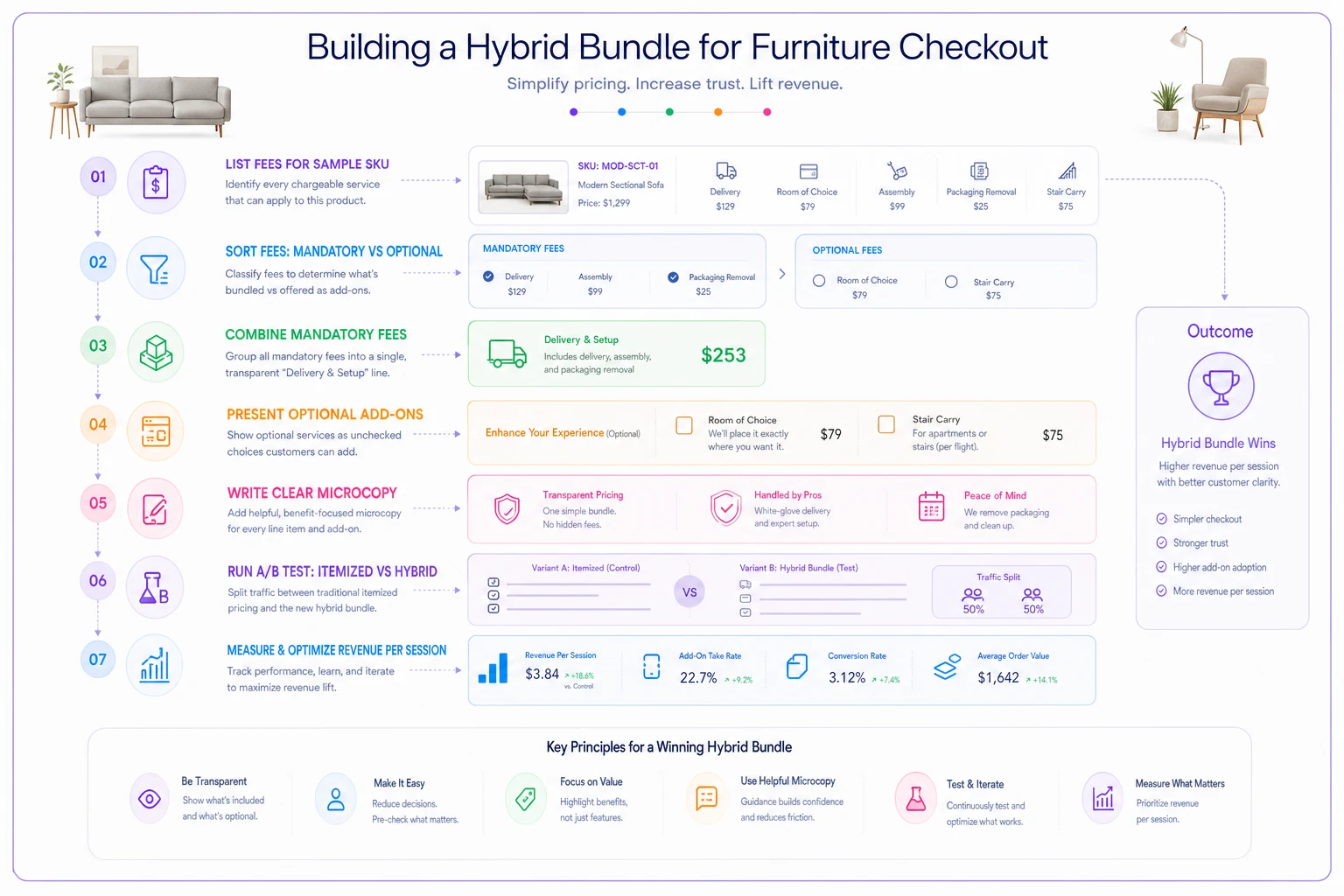
Bundle the unavoidable stuff — delivery, room-of-choice placement, and assembly — into one "Delivery & Setup" line. These aren't really optional for a customer buying a wardrobe. Presenting them separately just creates fee-stacking anxiety around costs they were always going to pay.
-
Keep one or two genuine choices visible — haul-away, extended protection, or express scheduling — as clearly optional add-ons.
This works because it respects the difference between a fee and a choice. Customers hate fees that feel mandatory-but-hidden. They're mostly fine with add-ons that are honestly optional. When you collapse the mandatory stuff into one line and let the optional stuff breathe, both conversion and add-on attach rates tend to move in the right direction.
Here's a simple process for building your hybrid bundle:
-
List every current checkout fee for a representative bulky SKU.
-
Sort each into mandatory-for-this-product vs. genuinely-optional.
-
Combine all mandatory fees into a single named line ("Delivery & Setup").
-
Leave 1–2 optional items as unchecked add-ons with clear one-line benefit copy.
-
Write microcopy for the bundled line that explains what's included.
-
Run it as Variant B against your current itemized checkout.
It's a simple process, but most stores never go through it because they're too deep in their own fee logic to see it from the customer's perspective.
The hybrid approach keeps the checkout clean while preserving one genuinely optional upsell — haul-away, or an extended-care add-on — that customers don't perceive as a forced fee.
Reading the conversion vs. AOV trade-off without fooling yourself
This is where most stores misread their own test. Bundling almost always lifts checkout completion. But if you strip out the add-on prompts, you can lose the attach revenue that was padding your order values. You need to look at both numbers together.
$$\text{Revenue per session} = \text{completion rate} \times \text{average order value}$$
A quick worked example. Say the itemized control converts at about 61% with an AOV around $2,780. The bundled variant converts closer to 68% but AOV slips to roughly $2,690 because fewer people add haul-away.
-
Control
0.61 × $2,780 ≈ $1,696 per session
-
Bundled
0.68 × $2,690 ≈ $1,829 per session
The bundle wins here — the conversion lift more than covers the small AOV dip. But you only see that if you multiply them together. If you'd looked at AOV alone, you'd have wrongly concluded bundling hurt you and killed a change that was actually making more money per visitor.
Run that same math on your own numbers before declaring a winner. Sometimes the itemized version wins because the add-on attach was carrying real margin. There's no universal answer — that's the entire point of testing rather than assuming.
A real scenario
A mid-size store selling bedroom sets and sectionals online, roughly 200–260 furniture orders a month, was running fully itemized checkout: four separate fees on the final screen. Checkout completion on carts that reached the shipping step was hovering in the low 60s%, and they assumed their prices were just too high for the market.
They didn't touch a single price. They restructured into a hybrid bundle — one "Delivery & Setup" line covering delivery, placement, and assembly, plus a single optional haul-away add-on — and rewrote the delivery microcopy to name the two-person team and the scheduling window.
Over about six weeks running against the old checkout, completion moved into the high 60s%. Haul-away attach dipped slightly, but revenue per session came out ahead because the conversion gain outweighed the lost add-ons. Nothing about their actual cost structure changed. The money was being left on the table purely in how the fees were presented and counted.
When this makes sense — and when it doesn't
Test bundling when:
-
Your checkout shows three or more separate delivery-related fees.
-
You're seeing drop-off specifically at the shipping step, not the product page.
-
Your delivery service is genuinely white-glove and worth explaining.
Be cautious about full bundling when:
-
A big share of your delivery revenue comes from optional add-ons you'd be burying.
-
You sell into wildly different delivery zones where one flat bundled number would badly over- or under-charge.
-
You're cross-shopped heavily on identical SKUs and burying delivery in the price would make you look overpriced.
Who should not run this yet: stores whose SKU data can't reliably tell heavy items from light ones. If your fee logic can't distinguish a 60-lb chair from a 250-lb armoire, fix the underlying product data first. Restructuring the presentation on top of broken fee logic just makes the wrong number prettier.
Furniture checkout shipping pricing rewards stores that treat it as an experiment instead of a setting.
The fee total often matters far less than whether the customer sees one honest line or four suspicious ones, whether the copy explains the service or just states a number, and whether you're reading conversion and AOV together instead of one at a time. Start with a single hybrid-bundle test against your current itemized checkout, hold everything else constant, and let revenue-per-session — not gut instinct — tell you which one to keep.
Ready to elevate your furniture business?
Join 500+ furniture retailers using Hosyly to increase efficiency, improve customer satisfaction, and grow revenue.