


A sectional shows "in stock" on the floor system, a customer buys it, the sales rep books a Thursday delivery, and the two-person crew shows up with a sofa that won't clear the stairwell. Or worse — the item was never deliverable in one piece, and nobody caught it because the catalog record said nothing about pack dimensions.
Almost every "failed delivery" and "false availability" problem in furniture retail traces back to the same root: the SKU record is missing the handful of fields that bulky items actually need. Not fancy data. Boring data. Pack width. Assembled weight. Whether it ships in two cartons or one.
This post is about furniture SKU data hygiene — specifically, the minimal required-field spec for bulky items, how to onboard it without drowning your team, and the verification cadence that stops bad records from quietly rotting your availability numbers.
Why bulky-item data breaks differently than everything else
Small-goods retailers get away with sloppy catalog data because a lamp that's an inch off doesn't cause a failed appointment. Furniture doesn't forgive that.
-
Assembled dimensions — what fits in the customer's room
-
Pack dimensions — what fits through the door, up the stairs, and into the truck
A record that only carries assembled dimensions looks complete. It passes a glance. But it's missing the exact number the delivery crew needs. This usually happens when the buyer copies the spec sheet from the supplier's retail-facing PDF — the one that lists the pretty assembled measurements and quietly skips the carton data.
Then availability gets involved. "In stock" in most systems means "we have units." It rarely means "we have units that can actually be delivered to this address as ordered." When a two-piece sectional is stocked as one SKU but arrives as two separate cartons on two different pallets, you can be "in stock" on paper and unable to fulfill a single complete order.
The real cost, in numbers
A mid-size store running around 300–400 deliveries a month tends to sit at a 6–9% failed-first-attempt rate before they clean up SKU data. A solid chunk of those — call it a third to a half — are data-driven, not customer-driven. Wrong access assumptions, missing pack dimensions, items that needed a three-person crew booked as two-person.
Eliminate inventory headaches and order delays.
Hosyly streamlines your furniture orders and stock management for seamless store operations.
- Real-time inventory tracking
- Automated order processing
- Customer notifications & engagement
No credit card required
Put rough money on it. A failed bulky delivery costs somewhere between $80 and $160 once you count crew hours, the truck slot, restock handling, and the reschedule call. If 40 of your monthly failures are data-caused, that's roughly $3k–$6k a month bleeding out of a problem that lives entirely in a spreadsheet.
And that's before the returns. An item that "fit" according to the catalog but didn't fit the stairwell comes back — and now you're eating a reverse logistics trip too.
The minimal required-field spec
You don't need 40 fields. You need the ones that change a fulfillment decision. Everything else is optional.
Here's the tight version — the fields that should be mandatory before any bulky SKU goes live and sellable:
| Field | Why it's required | Common failure when missing |
|---|---|---|
| Assembled W × D × H | Room fit, customer expectation | Wrong-size returns |
| Pack W × D × H (per carton) | Door/stair/elevator clearance | Can't get it inside; failed delivery |
| Number of cartons/pieces | Availability accuracy, crew sizing | "In stock" but incomplete units |
| Net + gross weight | Crew size, safety, vehicle load | Two-person job needing three |
| Assembly required (Y/N + level) | Time-slot length, service booking | Slot runs over, cascade of late jobs |
| Fragility / handling flag | Packing, stacking, route order | Transit damage |
| Handedness / orientation (if applicable) | Correct piece delivered | Wrong-facing chaise |
Note the bolded row. Pack dimensions is the single field that gets skipped most and causes the most damage. If you fix nothing else, make pack dimensions a hard-required field.
One more thing that gets missed constantly: cartons must be linked as a set. A three-carton bed frame should not be three loose SKUs floating near each other in the system. If your platform can't reserve all three together, your availability is lying to you the moment one carton sells short.
How the bad data gets in
Understanding the entry points tells you where to put the checks. Bad bulky-item records come from four places in practice:
-
Supplier onboarding — the spec sheet had assembled dims only, and whoever created the SKU filled the rest with guesses or blanks.
-
Manual re-keying — pack dimensions typed from a physical carton label, digits transposed (a 74 cm carton entered as 47 cm).
-
Range/variant sloppiness — a sofa comes in three fabrics; someone clones the record but forgets the "extra-deep" variant is 15 cm larger packed.
-
Silent supplier changes — the manufacturer switches packaging, the carton grows, and nobody updates anything because the item number stayed the same.
That last one is sneaky. A record can be perfect on day one and wrong six months later because the factory changed a box. This is why data hygiene isn't a one-time cleanup — it needs a cadence.
The onboarding checklist for new bulky SKUs
Put this in front of whoever creates catalog records. Nothing goes sellable until every box is checked:
-
- [ ] Assembled dimensions entered and confirmed against supplier spec
-
- [ ] Pack dimensions entered per carton, not for the assembled unit
-
- [ ] Carton count set, and all cartons linked as a single fulfillment set
-
- [ ] Net and gross weight entered (both — crews plan on gross)
-
- [ ] Assembly flag set with rough minutes if assembly required
-
- [ ] Fragility/handling flag applied
-
- [ ] Variant differences checked (does the XL/extra-deep version share these dims? Usually not)
-
- [ ] At least one physical measurement spot-check on the first received unit
-
- [ ] Delivery-service level auto-derived (two-person vs three-person) and sanity-checked
That physical spot-check on the first received unit is the highest-value step on the list.
That physical spot-check on the first received unit is the highest-value step on the list. Suppliers get carton data wrong more often than you'd expect. Measuring the first real carton catches it before a single order ships.
Verification SOPs: don't trust the record forever
Onboarding gets the record right on day one. Verification keeps it right. Two SOPs handle most of the risk.
SOP 1 — Receiving verification. On the first receipt of any new bulky SKU, and on any receipt flagged as a repackaged or new-batch delivery, the warehouse measures and weighs one carton and compares it against the record. If it's off by more than a small tolerance — a couple of centimeters, a kilo or two — the SKU gets flagged and pulled from "sellable-for-delivery" until reviewed. It can still sell for pickup. You just stop promising delivery on a record you no longer trust.
SOP 2 — Failed-delivery root-cause tagging. Every failed delivery gets a reason code, and "data error" is one of the options. When a crew reports "wouldn't fit — pack dims were wrong," that SKU is automatically queued for re-measurement. This turns your delivery failures into a feedback loop that cleans the catalog instead of just being a loss.
The connection between these two SOPs is the whole point: bad data either gets caught in the warehouse or gets caught on the truck. You want it caught in the warehouse. Every failure that reaches the truck is one the receiving check should have stopped.
A sketch of the verification workflow:
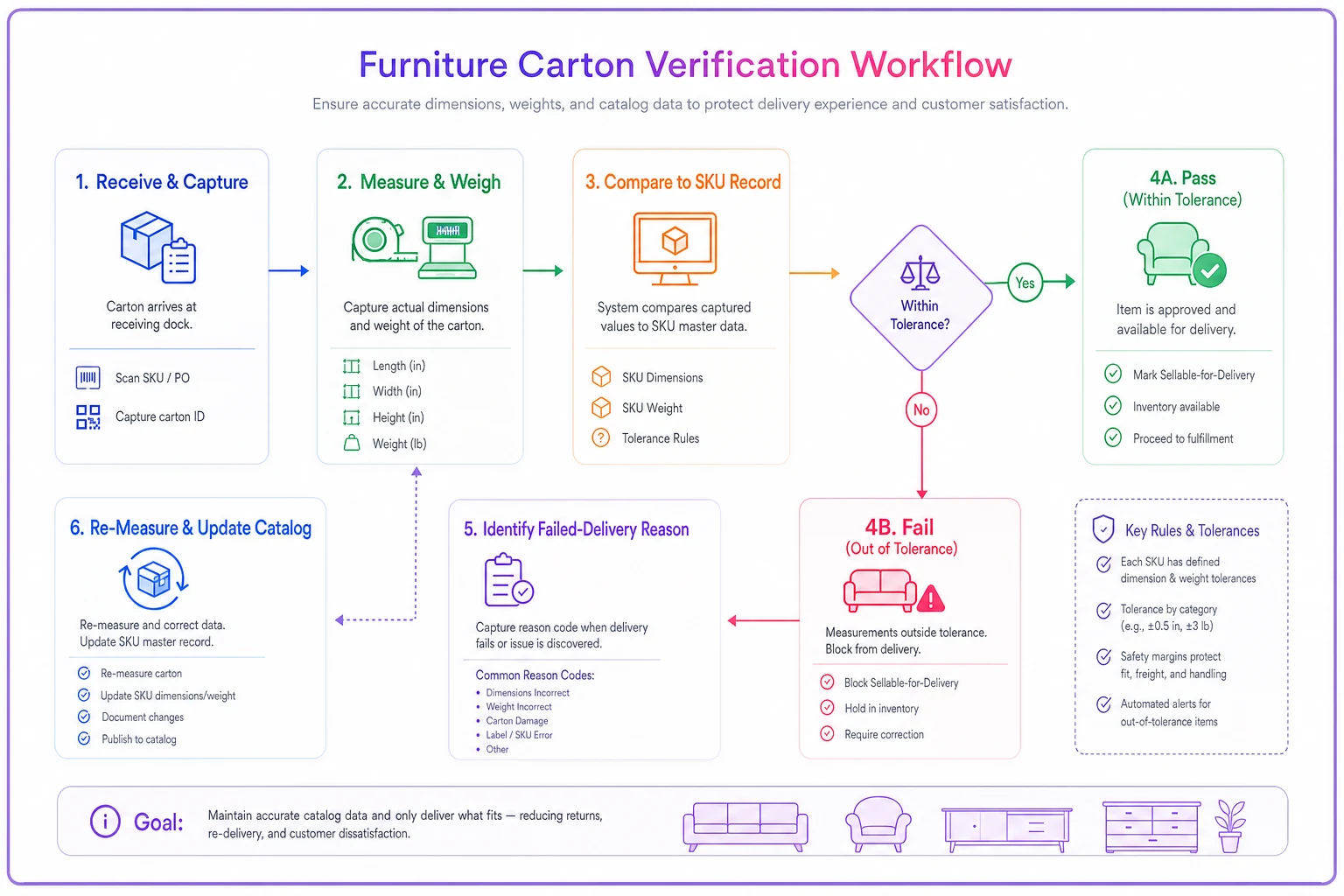
It shows receiving checks feeding into the re-measure queue and blocking sellable-for-delivery until records are verified.
Audit cadence that fits a real store
You can't re-measure everything constantly. Target the audit by risk instead.
-
Monthly any SKU that generated a data-tagged delivery failure, plus new SKUs added that month
-
Quarterly your top movers by delivery volume — the items where a bad record does the most damage per unit of wrongness
-
Twice a year a random 5–10% sample of the bulky catalog to catch silent supplier packaging changes
-
Event-triggered any SKU flagged at receiving, any supplier that changed packaging, any variant added to an existing family
The random sample is the underrated one. It's how you catch the factory-changed-the-box problem before it shows up as a cluster of failed deliveries.
A short real scenario
A single-showroom furniture retailer doing around 280 deliveries a month was sitting at roughly an 8% failed-first-attempt rate. When they reason-coded a couple of months of failures, a little over a third were traceable to catalog data — mostly missing or wrong pack dimensions on sectionals and bed frames, plus a handful of multi-carton items showing "available" when only some cartons were actually on hand.
They didn't overhaul anything. They made pack dimensions and carton-count mandatory fields, linked multi-carton items as sets, added the first-receipt measurement check, and set up the failed-delivery reason codes. Within about two months the data-driven failures dropped by more than half, and their overall failure rate settled around 5%. On their volume, the recovered crew time and avoided reschedules worked out to something in the low-thousands per month — money that had been evaporating into a fixable spreadsheet problem.
Nothing exotic. Just the boring fields, made required, and checked on a cadence.
Where good SKU data quietly pays off elsewhere
Clean bulky-item records don't only fix deliveries. Accurate carton counts and true availability feed straight into your forecasting and stocking decisions — the same data discipline matters when you're forecasting slow-moving, high-ticket furniture SKUs, because a SKU that's constantly showing false availability corrupts the sell-through signal you're trying to read.
It matters at the other end of the lifecycle too. When you're retiring slow-moving furniture SKUs without surprising customers, you need to know exactly what's physically deliverable versus what's stranded as partial carton sets. Bad data makes clean exits messy.
Where software helps — and where it doesn't
Tools won't fix a culture of skipping the pack-dimensions field. But once you've decided the fields are mandatory, a workflow platform that enforces required fields at SKU creation, links carton sets, blocks "sellable-for-delivery" status on flagged items, and routes failed-delivery reason codes back to a re-measure queue removes most of the human forgetting. AI-assisted checks can also catch obvious transposition errors — a carton dimension that suddenly can't physically contain the assembled item, or a weight that jumped 40% between batches — and flag them before they reach a customer.
That's the right role for automation here: catching anomalies and enforcing rules you already decided on. The judgment stays with your team. The nagging gets automated.
False availability and failed deliveries in furniture aren't mysterious. They're almost always a missing pack dimension, an unlinked carton set, or a stale record nobody re-checked after the factory changed a box. Make the small set of physical fields mandatory, verify the first real unit at receiving, feed delivery failures back into re-measurement, and audit by risk instead of trying to boil the ocean. That's the whole spec — and it'll do more for your delivery success rate than almost any process change on the truck side.
Ready to elevate your furniture business?
Join 500+ furniture retailers using Hosyly to increase efficiency, improve customer satisfaction, and grow revenue.