


Most furniture stores carry somewhere between 800 and 1,500 SKUs across their showroom and catalog.
Why zombie inventory is quietly killing your margins
Walk through any mid-sized operation and you'll spot the problem pieces—dining sets collecting dust since last summer, accent chairs nobody asks about, bedroom collections that move once every few months. They're not completely dead, which is exactly what makes them so difficult to deal with. They sell just enough to justify their existence on paper.
The real damage is in the margins you can't see directly. Each slow-moving SKU ties up roughly $3,000 to $8,000 in working capital between floor samples and backup inventory. Spread that across 200 underperforming SKUs and you're looking at anywhere from $600,000 to over a million dollars in trapped cash that could be funding better inventory or real operational improvements.
What makes furniture SKU rationalization especially tricky is that customers remember what they saw six months ago. They bring photos from their last visit. They reference the sectional their friend bought from you. Unlike clothing retail where seasons naturally retire products, furniture customers tend to expect consistency. Cut the wrong SKUs too fast and you'll have frustrated customers who've been planning a purchase for months.
The four metrics that catch dying SKUs before they become a real problem
Traditional furniture retail leans too hard on basic sell-through rates. A dining table that sells twice per quarter might look fine at 50% sell-through if you're only stocking four units—but that same table could be consuming 120 square feet of prime showroom space while contributing $800 in monthly margin. That's not a success story.
Eliminate inventory headaches and order delays.
Hosyly streamlines your furniture orders and stock management for seamless store operations.
- Real-time inventory tracking
- Automated order processing
- Customer notifications & engagement
No credit card required
You need four metrics working together to get the full picture.
Margin per square foot per month tells you the real estate efficiency of each SKU. Calculate total gross margin generated divided by showroom space occupied, including walking room. Anything below $15 per square foot per month in main showroom areas is underperforming. Back showroom areas can tolerate somewhere around $8–10.
Adjusted sell-through velocity accounts for both floor samples and warehouse stock. Raw sell-through might show 60% movement, but if you're constantly reordering to maintain floor presence, your actual velocity is probably much lower. Weight it by seasonal patterns—outdoor furniture naturally slows October through February.
Supplier lead time burden measures the planning overhead each SKU creates. A sofa with 16-week lead times from an overseas manufacturer creates very different operational stress than a domestically produced chair available in three weeks. Long lead time items that sell slowly trap you in ordering cycles that compound the working capital problem.
Cross-sell attachment rate reveals which SKUs are quietly driving broader purchases. That slow-selling console table might only move four units a month, but if 70% of buyers also purchase the matching dining set, retiring it could hurt dining room sales in ways that don't show up immediately.
| Category | Healthy Margin/sqft/mo | Danger Zone | Lead Time Tolerance | Typical Attachment |
|---|---|---|---|---|
| Sofas/Sectionals | $18–25 | Below $12 | Up to 14 weeks | 30–40% (ottomans, chairs) |
| Dining Sets | $15–20 | Below $10 | Up to 12 weeks | 50–60% (chairs, buffets) |
| Bedroom Sets | $20–30 | Below $15 | Up to 16 weeks | 40–50% (nightstands, dressers) |
| Accent Pieces | $12–18 | Below $8 | Up to 8 weeks | 15–20% (complementary items) |
| Mattresses | $35–50 | Below $25 | Up to 4 weeks | 60–70% (foundations, protectors) |
The danger is evaluating SKUs in isolation. A leather recliner showing $11 margin per square foot looks like a clear retirement candidate until you see it has a 65% attachment rate with higher-margin ottoman sales.
Building retirement rules that actually protect revenue
Effective SKU retirement isn't about drawing an arbitrary line and cutting everything below it. You need graduated triggers that account for seasonality, supplier relationships, and how customers actually shop.
Start with a three-tier classification:
Immediate retirement candidates fail all four criteria—margin per square foot below 50% of category average, sell-through under 25% quarterly, lead times over 12 weeks, and attachment rates below 10%. These are your cash traps. They're not supporting other sales, not turning fast enough to justify the space, and require too much ordering overhead to be worth keeping.
Phased retirement targets fail two or three metrics but have some redeeming quality—maybe strong attachment rates or they serve as entry points into premium collections. These get 90-day improvement plans before any final call.
Watch list items underperform in one area but remain viable. They get a six-month observation window with specific performance targets.
The retirement triggers also need to be dynamic. Seasonal patterns affect different categories at different times—don't evaluate patio sets in November based on October's numbers. Bedroom furniture peaks during January events and back-to-school periods. Dining sales spike before the holidays. Build that context into your thresholds.
Market positioning matters too. A high-end gallery can tolerate lower velocity on statement pieces that establish brand identity. Value-focused retailers need faster turns across the board. Supplier relationship value also extends beyond individual SKU performance—that Italian leather collection might underperform on its own, but if the vendor also carries your best-selling dining line with solid payment terms, the overall relationship might justify keeping a marginal SKU in the mix for now.
The phased pilot approach that keeps things from going sideways
Massive SKU purges create operational chaos and customer confusion. The smarter move is a controlled pilot that tests retirement impact before you commit to anything bigger.
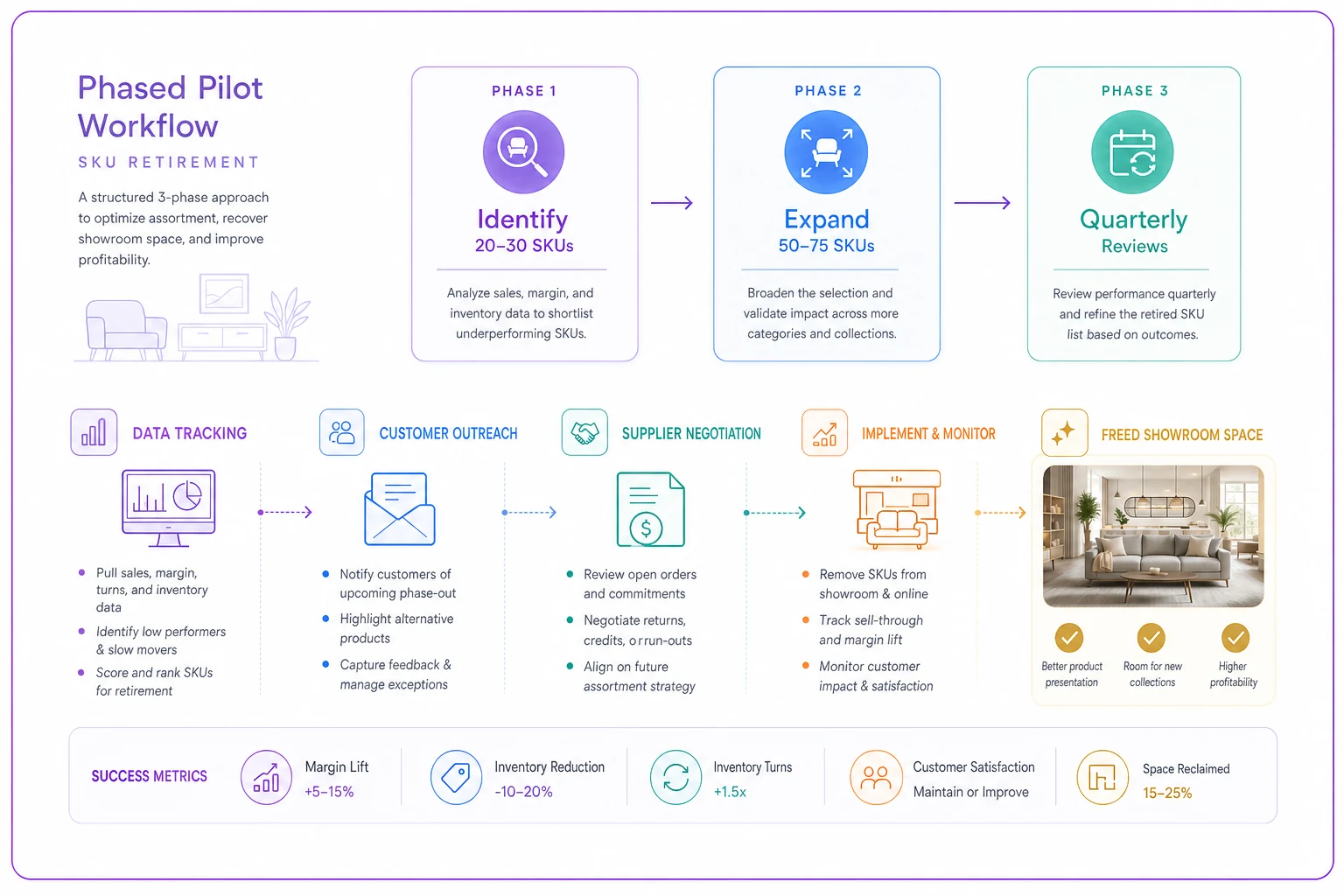
Phase 1 starts with your clearest losers—usually 20–30 SKUs that everyone internally agrees need to go. These become your learning lab. Track what actually happens when they disappear. Do customers ask for them? Do sales associates struggle to find alternatives? Does the freed space improve adjacent SKU performance in any measurable way?
During this first 30-day window, document everything:
-
Customer inquiries about retired items
-
Sales associate feedback and workarounds
-
Actual versus projected space utilization improvements
-
Working capital freed
-
Impact on related SKU sales
Phase 2 expands to 50–75 additional SKUs based on what you learned in Phase 1. This is where you start testing items with moderate attachment rates or seasonal complications. Coordinate timing with your supplier relationships—give vendors 60-day notice for significant reductions. Many will offer clearance pricing or consignment terms to help move remaining inventory.
Phase 3 establishes ongoing quarterly retirement reviews. Every quarter, the bottom 5% of performers get measured against the four-metric framework. This is what prevents zombie inventory from quietly rebuilding.
Here's a visual workflow of the phased pilot approach.
The typical pilot timeline:
-
Weeks 1–2
Identify and tag pilot SKUs
-
Weeks 3–4
Build transition plans and document alternatives
-
Weeks 5–8
Execute Phase 1 retirement
-
Weeks 9–10
Analyze results and adjust criteria
-
Weeks 11–16
Execute Phase 2 expansion
-
Week 17 onward
Quarterly review cycle
This phased approach keeps you from making wholesale changes before you understand the real customer and operational impact.
Customer communication that prevents the angry return visit
The biggest failures in furniture SKU rationalization happen when longtime customers discover their planned purchase vanished without any warning. A couple who's been saving for six months to buy a specific sectional doesn't care about your inventory optimization goals. They're just upset—and rightfully so.
Proactive communication prevents most of these situations, but it needs to be selective. Don't announce every retirement; that creates unnecessary urgency and confusion. Focus on items with demonstrated customer interest.
"We wanted to let you know that the Morrison Sectional you inquired about in September will be discontinued after December 31st. We currently have two in stock and can offer 15% off if you're ready to move forward. Alternatively, I'd love to show you our new Jackson Collection—similar style with improved fabric options."
"Final Season – Making Room for New Collections" "Limited Availability – Similar Styles Available" "Showroom Sample Sale – New Designs Coming Soon"
Frame retirement as positive evolution, not abandonment. Customers understand that styles update and collections change. What they don't understand is why the sofa they've been thinking about for three months suddenly disappeared without a word.
Give your sales team transition language that keeps the conversation moving forward rather than stalling on a discontinued item. A few examples:
Instead of: "We discontinued that item." Use: "We've moved to a newer version with better fabric options and faster delivery." Instead of: "That collection sold poorly." Use: "We're focusing on collections our customers have been requesting more of."
Selective, timely outreach and clear in-store signage handle most customer expectations without creating unnecessary alarm.
How to negotiate with suppliers without blowing up the relationship
Furniture suppliers tend to push back on SKU reductions, especially when you're cutting their underperformers. The conversation needs to shift from confrontation to collaboration.
Start with data, not opinions. Show them the four-metric analysis for their entire product line. Most suppliers have never seen their products evaluated through margin per square foot or attachment rate lenses, and the results often surprise them—their supposed hero product might be underperforming while a sleeper item is quietly carrying the category.
"Your Bridgeport dining collection generates $22 per square foot monthly with 14-week lead times. Your Meridian line only produces $8 per square foot with the same lead times. If we discontinue Meridian and expand Bridgeport displays, we project a 40% increase in your total sales volume with us."
When negotiating transitions for retiring SKUs, push for:
-
Extended payment terms on final orders
-
Consignment arrangements for clearance inventory
-
Marketing support for closeout sales
-
Floor sample buyback programs
-
Exclusive pricing on continuing lines
Many suppliers will go 20–30% off on final orders if it means protecting the relationship on stronger SKUs. Some will accept returns on slow inventory in exchange for larger commitments on performing lines.
The threat to drop a supplier entirely rarely plays well in furniture retail. Customers build loyalty to specific brands, and finding equivalent replacements takes months. Gradual transitions that preserve the relationship while improving the economics will almost always serve you better long-term.
Measuring success beyond just the freed capital
Three months into a rationalization effort, the obvious metrics look good—working capital freed, space recovered, fewer SKUs to manage. But the more meaningful indicators run a bit deeper.
Sales per square foot should improve 15–25% in affected areas. Not just because you removed poor performers, but because better merchandising of winning SKUs creates clearer navigation for customers who previously felt overwhelmed.
Average transaction values often climb 10–15% as sales associates get to focus on fewer, better options. When your team deeply knows 200 SKUs instead of half-knowing 400, their consultation quality improves in ways customers notice.
Lead time predictability tends to improve too. Concentrating volume with fewer suppliers often unlocks priority production slots and faster shipping instead of juggling small orders across a dozen vendors.
Customer satisfaction frequently goes up, which surprises some operators. The paradox of choice is real in furniture retail. A customer staring at twelve similar dining sets often leaves confused or buys nothing. Show them four distinct options with clear differences and the decision gets easier.
Sales associates are usually happier as well. They spend less time chasing availability, managing special orders, and explaining backorders. Mastering a focused assortment beats constantly learning new SKUs while forgetting old ones.
Where operational software fits into all of this
Manual SKU analysis across hundreds of products gets unwieldy fast. Spreadsheets tracking four metrics across multiple time periods, with seasonal adjustments and supplier variables layered in, tend to become documents that nobody properly maintains after the first quarter. It's not that people don't care—it's just genuinely hard to keep up.
AI-powered operational software shifts the retirement process from a periodic purge into something closer to continuous monitoring. Modern furniture retail platforms can automatically track all four performance metrics in real-time, flagging retirement candidates before they calcify into zombie inventory that's been quietly building for eighteen months.
Use SKU-level dashboards to monitor attachment rates and seasonally-weighted velocity in real time.
The seasonal complexity gets handled automatically—weighting summer furniture performance differently in October than in April, tracking attachment rates across all transactions to surface hidden relationships between seemingly unrelated SKUs.
Beyond the analytics, good operational software manages the communication workflow around retirements. When a SKU hits retirement triggers, the system can notify relevant suppliers, generate outreach for customers who recently inquired, and create transition notes for sales associates—without someone manually coordinating all of it across multiple channels.
For multi-store operations, this kind of automation becomes especially valuable. What underperforms in a suburban location might move well downtown. The software can identify those patterns and suggest location-specific strategies instead of blanket mandates that don't account for local demand.
The more significant advantage over time is predictive. By analyzing historical patterns, the software can flag SKUs likely to underperform before you've fully committed to inventory positions—which is a much better problem to solve than cleaning up zombie inventory that's already accumulated.
Treating retirement as a competitive advantage, not a one-time cleanup
SKU rationalization isn't about having fewer choices—it's about having better choices that actually sell. Stores that build this into their regular operations typically see meaningful improvement in inventory turns within the first year, often while maintaining or growing total revenue.
The discipline is treating retirement as an ongoing process, not an annual crisis. Every quarter, bottom performers should face scrutiny through the four-metric framework. Every supplier relationship should include frank conversations about portfolio performance. Every new SKU addition should come with a clear plan for what it's replacing.
Most furniture stores fear customer backlash from reducing selection, but customers don't want infinite choice—they want to make a confident decision and go home. A curated assortment of 200 high-performing SKUs beats a cluttered showroom of 400 mediocre options almost every time.
The math is straightforward enough. Freeing $800,000 in working capital from zombie inventory and reinvesting in proven performers typically generates $120,000–160,000 in additional annual margin. That's before accounting for reduced operational complexity, sharper sales team focus, and better supplier terms from concentrated volume.
Start with your worst 20 SKUs. Build the muscle memory of retirement analysis, customer communication, and supplier negotiation. Then expand systematically until it becomes as routine as reviewing daily sales.
The stores that get genuinely good at this don't just free up cash—they end up with more focused, profitable operations that serve customers better with less noise in the system.
Ready to elevate your furniture business?
Join 500+ furniture retailers using Hosyly to increase efficiency, improve customer satisfaction, and grow revenue.