

Most furniture retailers price delivery like it's a nuisance line item. One flat number. Maybe two — "in-town" and "out-of-town." Then they spend the next year quietly eating the difference between what they charge and what a two-person crew, a return trip, and a damaged-in-transit claim actually cost them.
The problem isn't that they charge too little. The problem is that they charge the same for orders that cost wildly different amounts to fulfill. A $79 flat fee is reasonable for a nightstand dropped at the door and a disaster for a sectional that needs two men, a flight of stairs, and 40 minutes of assembly. When one number has to cover both, you're either overcharging the easy jobs (and losing carts) or undercharging the hard ones (and bleeding margin). Usually both, at the same time.
Bulky item fulfillment pricing done right isn't about finding the "right price." It's about building a small system that ties what you charge to what an order actually costs to serve — then wrapping that in messaging that doesn't scare the buyer at the worst possible moment.
Why flat fees quietly wreck your margins
Your delivery cost isn't driven by distance. It's driven by a handful of order attributes that cluster into predictable archetypes:
-
Number of people required to carry it (one-man vs two-man)
-
Assembly time on-site
-
Access difficulty (stairs, elevators, tight doorways, walk-ups)
-
Value at risk (a $400 bookcase vs a $6,000 leather sectional)
-
Return-trip probability (was the customer reachable, was the item in stock, was it damaged)
A flat fee flattens all of that into one number. You end up cross-subsidizing. The customer buying an easy-to-deliver accent chair is paying part of the bill for the customer with the third-floor walk-up and the modular sofa. That's not just unfair — it's a conversion killer. The easy-order customer sees a $99 delivery fee on a $349 chair and bounces. The hard-order customer is thrilled, because you just delivered $180 of labor for $99.
The "average" delivery fee is almost never the right fee for any actual order. Averages are a comfort blanket. They hide the two failure modes happening simultaneously underneath.
Start with cost-to-serve, not with a price
Before you touch what the customer sees, you need to know what each type of order costs you. This is the part almost everyone skips, and it's the part that makes everything else work.
Eliminate inventory headaches and order delays.
Hosyly streamlines your furniture orders and stock management for seamless store operations.
- Real-time inventory tracking
- Automated order processing
- Customer notifications & engagement
No credit card required
Build a rough cost-to-serve model per archetype. You don't need accounting-grade precision — you need directional numbers you'd actually bet on. Break your fulfilled orders into 4–6 archetypes. A typical furniture retailer's breakdown looks something like this:
| Archetype | Crew | Avg on-site time | Access | Value at risk | Loaded cost to serve |
|---|---|---|---|---|---|
| Small parcel / doorstep | 1 person | 5–10 min | Easy | Low | ~$18–$30 |
| Room-of-choice, light | 1–2 people | 15 min | Moderate | Med | ~$55–$75 |
| Two-man, assembly | 2 people | 30–45 min | Moderate | Med–High | ~$120–$160 |
| Two-man, difficult access | 2 people | 45–60 min | Hard (stairs/walk-up) | High | ~$180–$240 |
| White-glove + haul-away | 2 people | 60+ min | Hard | High | ~$260–$340 |
To build your version, take your fully loaded delivery cost — crew wages, vehicle, fuel, insurance, average damage/claims allocation, and a realistic slice of failed-delivery redos — and divide it across archetypes based on time and risk, not just headcount. The redo allocation matters more than most people expect. If roughly 1 in 12 deliveries needs a second trip, that second trip's cost has to live somewhere in your model, and it belongs weighted toward the archetypes that fail most: difficult access, long assembly jobs.
Once you have a loaded cost per archetype, you have a floor. You know which orders you can afford to subsidize for conversion and which ones you absolutely cannot.
The three fee components — delivery, installation, insurance — should map to different parts of that cost:
-
Delivery covers the transport and the carry (crew + vehicle + access).
-
Installation/assembly covers on-site labor time specifically.
-
Insurance / damage protection covers value at risk and is where you recover claims exposure.
Splitting them isn't just accounting hygiene. It lets you flex each one independently against conversion, which is the whole point of the next step.
The elasticity test matrix: find the fee ceiling before you hit it
Knowing your cost floor tells you what you can't go below. Elasticity testing tells you what you can't go above without losing the sale. The gap between those two is your working range.
Most retailers never test this. They pick a fee, leave it for two years, and assume the abandonment is just how it is. In reality, delivery-fee sensitivity is wildly different across price bands and archetypes, and you can map it in about six to eight weeks of structured testing.
Set up a simple test matrix. On one axis, your archetypes. On the other, 2–3 fee levels per archetype — a floor near cost, a middle, and a stretch. Then watch conversion and completed-delivery margin at each cell. A realistic matrix in flight might look like this:
| Archetype | Fee A (near cost) | Fee B (middle) | Fee C (stretch) | Winner so far |
|---|---|---|---|---|
| Doorstep | Free | $19 | $29 | Free lifts conversion enough to pay for itself |
| Room-of-choice light | $49 | $69 | $89 | $69 — no conversion drop vs $49 |
| Two-man assembly | $99 | $129 | $149 | $129 holds; $149 starts leaking carts |
| Difficult access | $149 | $179 | $199 | $179, but abandonment climbs on sub-$1,500 orders |
| White-glove | $199 | $249 | $299 | $249 — buyers at this ticket barely flinch |
A few patterns worth internalizing:
-
Free delivery on low-cost/low-effort orders often pays for itself through conversion lift, if the underlying cost is genuinely low. Free on a doorstep parcel is cheap insurance for the sale. Free on a two-man assembly is how you go broke.
-
Fee sensitivity drops sharply as order value climbs. Someone spending $5,000 on a sectional doesn't abandon over a $249 white-glove fee. Someone spending $600 might abandon over $149. Same fee, completely different elasticity. Price the fee as a percentage feel of the cart, not just a flat dollar amount.
-
The stretch level usually reveals a cliff, not a slope. Conversion holds… holds… then drops off a ledge between two fee levels. That ledge is the number you need to know. Testing three levels finds it; guessing never will.
Run each cell long enough to get a real read — you're looking for directional signal, not statistical perfection. And test one variable at a time. If you change the fee and the messaging and the free-threshold in the same week, you've learned nothing.
Where this connects to the rest of your operation
Pricing fee-by-archetype only works if your operation can actually tell the archetypes apart at checkout. This is where a lot of otherwise-good pricing plans fall over.
If your product data doesn't know whether an item needs one person or two, whether it requires assembly, or how bulky it is, your checkout can't quote the right fee. You'll default back to a flat number out of necessity. That's why fee logic and product data are the same project. Every SKU needs the attributes that drive archetype assignment baked into its record — dimensions, weight class, crew requirement, assembly flag, value band.
Your fulfillment network shape matters too. A cross-dock or multi-tier setup changes your real cost-to-serve per zone, and if you're rethinking that structure, the pricing model has to move with it. The decision of when to centralize, cross-dock, or run a multi-tier fulfillment network directly reshapes the cost floors in your archetype table. Similarly, if you're running blanket rules across web, phone, and showroom orders, you're almost certainly mispricing at least one channel — the hidden cost of one-size-fits-all omnichannel rules shows up loudest in fulfillment fees, because the same sofa costs a different amount to deliver depending on which channel and promise it came through.
The chain looks like this: a SKU carries its fulfillment attributes → checkout reads those attributes and assigns an archetype → the archetype pulls the tested fee (delivery + install + insurance) → the customer sees a fee that matches reality → the fulfillment team gets an order already flagged with crew size and assembly needs. When that chain is intact, your pricing, your promise, and your dispatch all agree.
When it breaks anywhere, you get the classic furniture nightmare: a fee that undercharged, a crew that showed up short-handed, and a customer who's now furious about a second appointment. Getting the data right upstream isn't glamorous work, but it's what makes the whole fee structure actually hold together in practice.
Messaging that recovers cost without spooking the cart
You can have perfect fee math and still tank conversion if the fee shows up wrong. Where and how the number appears matters almost as much as the number itself.
A few things that consistently protect conversion:
-
Show fulfillment expectations early, not at the final step. The worst abandonment happens when a customer gets to the last screen and a delivery fee they never saw coming jumps the total. Surface the range on the product page. Surprise at checkout is what kills carts, not the fee itself.
-
Name the value, not just the charge. "White-glove delivery, assembly, and haul-away — $249" converts far better than "Delivery: $249." Same number, completely different feel. You're describing a service, not adding a tax.
-
Bundle insurance as protection, not as a penalty. "Damage-free delivery guarantee" lands better than "insurance surcharge." Customers happily pay to protect a $4,000 purchase; they resent an unexplained line item.
-
Use free-threshold anchoring where the math supports it. "Free room-of-choice delivery on orders over $1,999" pushes cart size up and makes the fee on smaller orders feel like a choice rather than a punishment.
Here's a set of customer-facing templates by archetype you can adapt:
-
Doorstep "Free standard delivery, arrives in 3–5 days."
-
Room-of-choice light "We'll bring it to the room of your choice — $69."
-
Two-man assembly "Two-person delivery plus full assembly — $129. We take the packaging with us."
-
Difficult access "Includes stairs and tight-space handling by our specialist crew — $179."
-
White-glove "Complete white-glove service: delivery, assembly, placement, and haul-away of your old furniture — $249."
None of them say "surcharge," "extra," or "additional fee." Every one describes work being done for the customer.
A short real scenario
A mid-sized furniture retailer running one showroom plus a growing online channel had a two-tier delivery fee: $79 local, $129 extended. Their checkout abandonment on orders under roughly $800 was ugly, and separately, their delivery operation was running at a loss they couldn't quite explain.
When they broke orders into archetypes, the picture snapped into focus. Around 60% of their volume was easy — doorstep and light room-of-choice orders that were overpaying at $79 and abandoning because of it. The remaining ~40% were two-man, assembly-heavy, and difficult-access jobs costing $140–$200 to serve while collecting $79–$129. The flat fee was chasing away the profitable easy orders and subsidizing the expensive hard ones.
They restructured into five archetypes, dropped the fee to free on the easiest tier (with a $1,499 threshold to protect margin), and raised the two-man-plus-access tiers to $149–$189 after a six-week elasticity test showed no meaningful conversion loss at those levels for higher-ticket carts. They also re-templated the messaging so the higher fees read as white-glove service, not surcharges.
Over the following quarter, cart abandonment on lower-ticket orders dropped noticeably, average order value ticked up because of the free-delivery threshold, and — the part that surprised them most — total delivery-related margin swung from a quiet monthly loss into the black. They didn't raise their average fee much at all. They just stopped charging everyone the same wrong number.
When this makes sense — and when it doesn't
This is worth doing if: you deliver a meaningful mix of easy and hard orders, your delivery operation's profitability is fuzzy, or your abandonment concentrates on lower-ticket carts. The more varied your fulfillment complexity, the more a flat fee is hurting you in both directions.
This is probably overkill if: you sell one narrow product type with genuinely uniform fulfillment — every order is the same crew, same assembly, same access profile. In that case, one well-calibrated fee is fine, and archetyping is just overhead.
Who should hold off: if your SKU data can't yet distinguish crew size, assembly, or bulk, fix that first. Archetype pricing built on guessed attributes will quote wrong fees and dispatch wrong crews, and you'll trade a pricing problem for an operations one.
A simple rollout you can actually run
Getting this off the ground doesn't require a big systems project. Most retailers can work through the core steps in a few weeks using data they already have.
-
Pull your last few months of deliveries and sort them into 4–6 archetypes by crew, assembly time, access, and value.
-
Build a loaded cost-to-serve number per archetype — include a realistic slice of failed-delivery redos and damage claims.
-
Confirm your SKU records carry the attributes needed to auto-assign each order to an archetype at checkout.
-
Split every fee into three parts
delivery, installation, insurance — so you can flex them independently.
-
Set three fee levels per archetype (near-cost, middle, stretch) and run an elasticity test for six to eight weeks, one variable at a time.
-
Watch for the conversion cliff, lock the fee just below it, and re-template the messaging so fees describe service, not surcharge.
-
Recheck the model quarterly — wage changes, fuel, and claim rates all move your floors.
Delivery, installation, and insurance fees aren't a cost you apologize for at checkout. They're a service you price honestly, per order, against what it actually takes to get a heavy, breakable thing into someone's living room. Get the archetypes right, test the ceilings, and describe the work instead of the charge — and you recover your real costs while keeping the carts that a flat fee was quietly pushing away.
Start by testing a free doorstep tier to validate conversion lift before adjusting higher-effort tiers.
Below is a simple visual of the rollout workflow to keep stakeholders aligned.
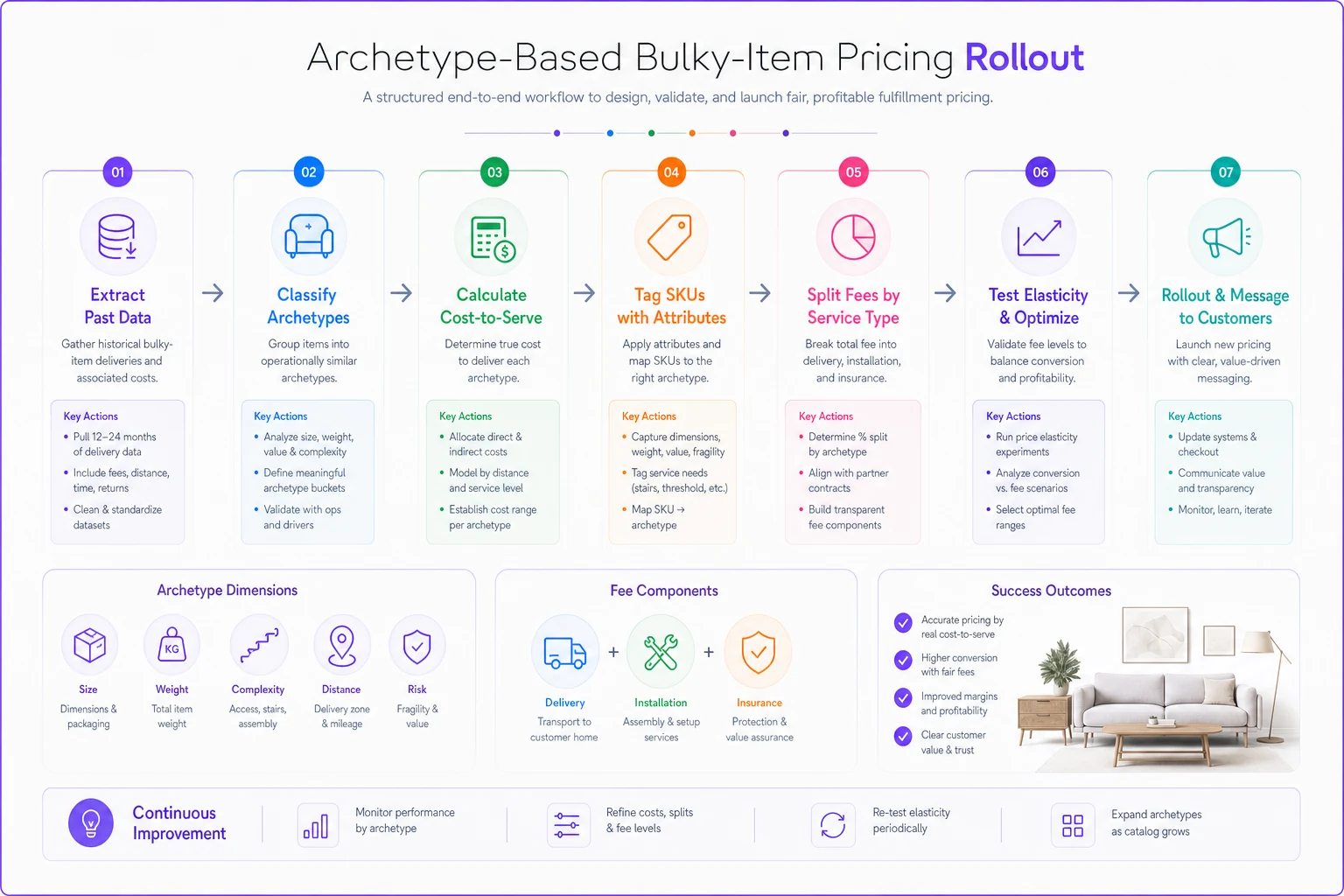
Use the visual during kickoff and retros to keep the project on the same page as you iterate through tests.
Delivery, installation, and insurance fees aren't a cost you apologize for at checkout. They're a service you price honestly, per order, against what it actually takes to get a heavy, breakable thing into someone's living room. Get the archetypes right, test the ceilings, and describe the work instead of the charge — and you recover your real costs while keeping the carts that a flat fee was quietly pushing away.
Ready to elevate your furniture business?
Join 500+ furniture retailers using Hosyly to increase efficiency, improve customer satisfaction, and grow revenue.