


Most furniture retailers with multiple locations get their fulfillment network wrong. Not because they're careless, but because bulky furniture creates operational tradeoffs that just don't exist with smaller products. A sectional sofa isn't a pair of shoes. You can't throw it on a truck and figure it out later.
The real challenge hits when you're running 3–10 stores. You're too big for single-location simplicity but too small for sophisticated distribution center economics. Every decision cascades: hold inventory at each store and you're drowning in carrying costs. Centralize everything and your delivery expenses explode. Try cross-docking and suddenly you're dealing with damage rates that make your margins disappear.
What makes this particularly brutal is that furniture retailers face contradictory pressures simultaneously. Customers expect fast delivery but won't pay premium shipping on a $2,400 dining set. You need variety to compete but every SKU ties up thousands in working capital. And unlike clothing or electronics, you can't just hand fulfillment off to a 3PL — most won't touch a 400-pound sectional.
The cost-per-delivery reality that breaks most network designs
The fundamental problem starts with delivery economics. A typical furniture delivery runs $140–$280 depending on distance, assembly requirements, and whether you need two people on the truck. That's your baseline constraint.
Now layer in the operational reality. When you're running direct-from-store delivery, costs look manageable on paper. Store A delivers to customers within 15 miles, Store B handles their zone, everything seems efficient. But then Store A runs out of that popular gray sectional while Store B has three sitting in back. Do you transfer inventory (adding $200 in handling and transport)? Send Store B's truck into Store A's zone (breaking your routing efficiency)? Or lose the sale?
This is where the math gets ugly. Say you're moving 45 sofas per month across three stores. Direct-from-store delivery averages $165 per drop. But here's what actually happens in practice:
Store inventory imbalances force 8–10 inter-store transfers monthly at $180 each. Another 5–7 deliveries require cross-zone routing, adding $75 per delivery in extra mileage and time. Your "efficient" $165 average becomes $195 in real cost. On 45 units, that's $1,350 monthly in hidden fulfillment expense.
The cross-dock alternative seems attractive at first. Consolidate incoming shipments, sort by delivery zone, reduce store inventory. Except now you're adding touches. Each piece gets unloaded at the cross-dock ($35), sorted and staged ($25), then reloaded for store delivery ($35). That's $95 in handling before it even reaches the store. Add facility costs and damage from extra handling, and your cross-dock adds $120–$150 per piece.
Service-level tradeoff curves that determine your competitive position
The uncomfortable truth about furniture fulfillment is that service levels and costs don't scale linearly. They follow a curve that gets progressively steeper as you push for faster delivery.
Eliminate inventory headaches and order delays.
Hosyly streamlines your furniture orders and stock management for seamless store operations.
- Real-time inventory tracking
- Automated order processing
- Customer notifications & engagement
No credit card required
Take a next-day delivery promise. Sounds great for competing with online retailers. But achieving 95% next-day fulfillment on bulky items means holding safety stock at each location. With furniture averaging $800 cost per unit and 20% annual carrying cost, each piece of safety stock costs you $13 monthly. Multiply across 50 SKUs and 3 stores, and you're burning $1,950 monthly just to maintain service levels.
| Delivery Promise | Fulfillment From Stock | Avg. Delivery Cost | Safety Stock Carrying Cost |
|---|---|---|---|
| 3-day | 70% | $165 | Minimal |
| 2-day | 85% | $175 (includes expedited transfers) | Moderate |
| Next-day | 95% | $195 | ~$2,400/month |
The steepness accelerates with store count. At 5 stores, next-day delivery requires around $4,100 in monthly safety stock costs. At 10 stores, you're looking at $7,800 monthly just to maintain inventory buffers.
Most retailers discover this curve the hard way. They promise next-day delivery to match online competitors, then watch their working capital evaporate into safety stock while delivery costs creep up from constant expediting.
Cross-dock versus store-hold decision rules
The decision to cross-dock or hold at stores isn't really a network-wide choice. It's a SKU-by-SKU decision based on velocity, bulk, and value density.
Start with velocity segmentation. Your fast-movers — top 20% of SKUs by unit movement — almost always belong at stores. The math is straightforward: if you're moving 3+ units monthly per store, the carrying cost is offset by delivery efficiency. These pieces should flow directly from supplier to store.
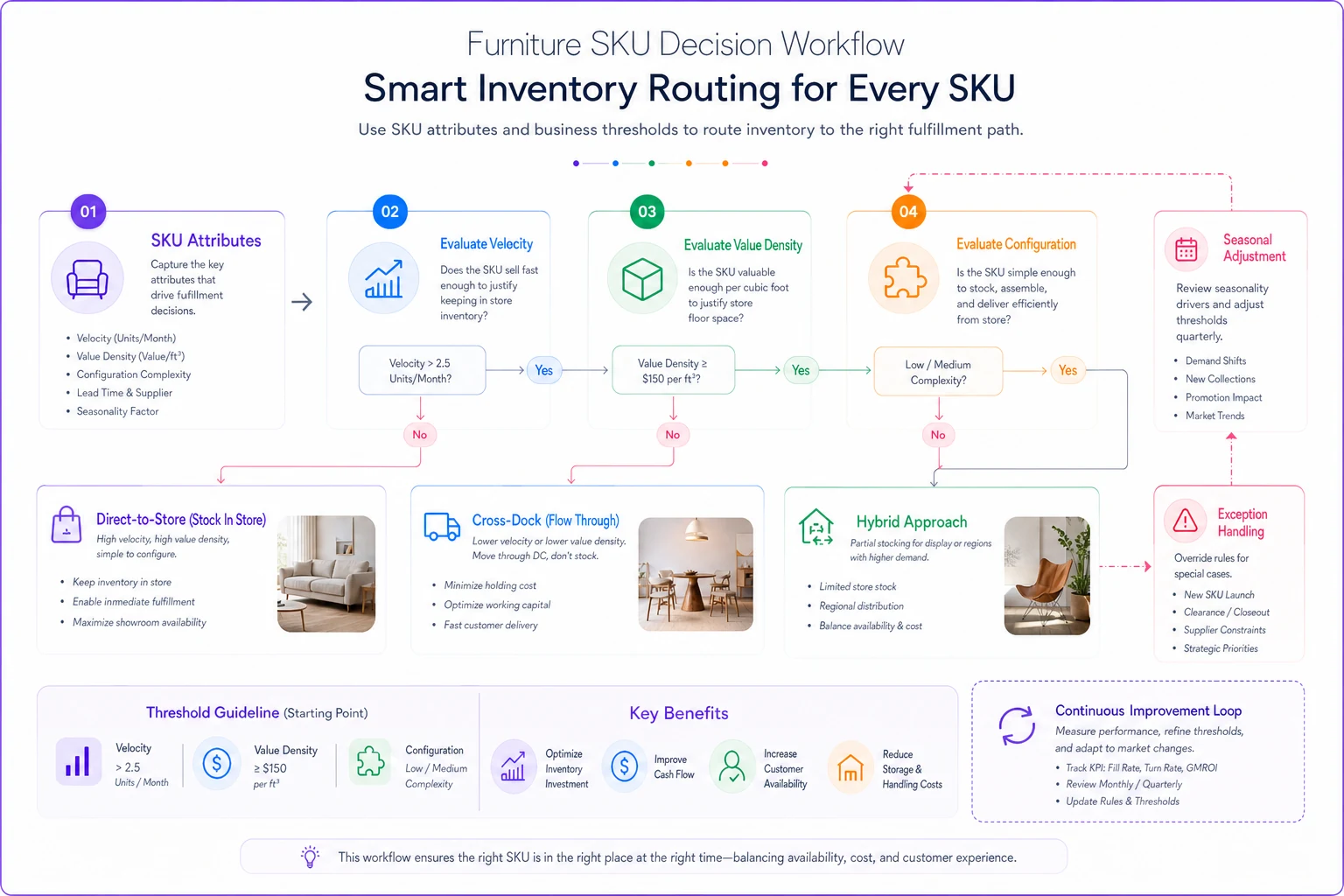
The diagram above maps a simple per-SKU decision flow showing when to send items to stores, when to route through a cross-dock, and when to use hybrid handling.
Place high-velocity SKUs at stores to avoid unnecessary cross-dock handling and extra touches.
Direct-to-store indicators:
-
Velocity above 2.5 units/month/store
-
Value density below $150 per cubic foot
-
Standard configurations (no customization)
-
Lead time under 4 weeks
Cross-dock candidates:
-
Velocity below 1 unit/month/store
-
Value density above $200 per cubic foot
-
Multiple configurations or finishes
-
Predictable seasonal patterns
Hybrid handling (worth the complexity):
-
Display models at stores, fulfill from cross-dock
-
Made-to-order items with standard components
-
Bulky items with modular assembly
The real insight here is that cross-docking isn't just about consolidation — it's about postponement. You're delaying the commitment of inventory to specific stores until you have actual demand signal.
The multi-tier trap for small footprints
Multi-tier networks sound sophisticated. Distribution center feeds regional cross-docks which supply stores. Very corporate, very efficient at scale. Also completely wrong for furniture retailers under 10 locations.
The economics break down immediately. A basic cross-dock facility for furniture needs 8,000–12,000 square feet minimum to handle staging and sorting. At $8–12 per square foot annually, you're spending $80k–$144k yearly before you move a single sofa. Add labor (2–3 full-time equivalents at $35k–$45k each) and equipment (forklifts, racking, dock equipment running $30k–$50k amortized annually), and your cross-dock needs to save $200k+ annually just to break even.
For that math to work, you need volume. Specifically, you need to be moving 200+ pieces monthly through the facility. Below that threshold, your per-unit handling cost exceeds any transportation savings.
What tends to happen: retailers with 4–6 stores see the big chains running distribution centers and assume that's the path to efficiency. They lease warehouse space, hire staff, buy equipment. Six months later they're staring at $35–$50 per piece in facility overhead alone, wondering where their gross margins went.
The volume threshold is unforgiving. At 150 pieces monthly, your facility cost per unit hits $110. At 100 pieces monthly, it's $165. Below 75 pieces monthly, you're better off paying LTL shipping directly to each store.
Numerical examples: the 3-store scenario
Running real numbers for a typical 3-store furniture operation shows clearly where each model breaks.
Baseline scenario:
-
3 stores, 15-mile average radius each
-
140 deliveries monthly total
-
Average ticket
$2,200
-
65 active SKUs
-
$450k total inventory value
Option 1: Pure store-hold
-
Inventory per store
$150k
-
Monthly carrying cost
$2,500 total
-
Delivery cost
$165 average
-
Inter-store transfers
12 monthly at $180 each
-
Monthly fulfillment cost
$23,100 + $2,160 transfers = $25,260
Option 2: Central cross-dock
-
Inventory per store
$75k (fast movers only)
-
Cross-dock inventory
$125k (slow movers)
-
Facility and labor
$14,000 monthly
-
Handling cost
$95 per piece inbound
-
Store delivery
$120 per piece (consolidated routes)
-
Monthly fulfillment cost
$13,300 handling + $16,800 delivery + $14,000 facility = $44,100
Option 3: Selective cross-docking
-
Store inventory
$110k each (top 40% SKUs)
-
Cross-dock inventory
$50k (bottom 30% SKUs)
-
Facility (shared with receiving)
$6,000 monthly
-
Handling
$95 per piece (42 pieces monthly through cross-dock)
-
Direct delivery
98 pieces at $165
-
Cross-dock delivery
42 pieces at $195
-
Monthly fulfillment cost
$16,170 direct + $8,190 cross-dock + $3,990 handling + $6,000 facility = $34,350
The selective model looks like the obvious winner, but there's a catch. It requires precise execution. You need systematic rules about what flows where, when to break those rules, and how to handle exceptions. Most furniture retailers attempt this hybrid approach but fail on execution — ending up with the complexity of both models and the benefits of neither.
The 7-store inflection point
Something fundamental changes around 7 stores. The math that killed multi-tier at 3 stores suddenly flips.
At 7 locations, you're moving 300–350 pieces monthly. Your per-unit facility cost drops to $45–55. More importantly, you gain routing density. Instead of sending trucks from each store, you can run efficient milk runs from a central point. A single truck can hit 3–4 stores in one route, dropping per-store delivery cost from $180 to $95.
| Network Type | Spread | Milk Run Efficiency | DC-to-Store Delivery | Safety Stock Reduction | Break-Even Volume |
|---|---|---|---|---|---|
| Clustered | 30 miles | 3.5 stores/route | $95/stop | ~35% | 185 pieces/month |
| Dispersed | 150 miles | 1.8 stores/route | $165/stop | ~20% | 320 pieces/month |
The dispersed network needs almost twice the volume to justify centralization. Most furniture retailers with scattered locations figure this out after signing a 5-year warehouse lease.
Special handling rules for oversized pieces
Oversized furniture — sectionals over 120 inches, dining tables for 10+ people, entertainment centers — breaks standard fulfillment logic. These pieces can't move efficiently through cross-docks and destroy truck utilization when mixed with standard items.
The unit economics are brutal. A 140-inch sectional takes the same truck space as three standard sofas but generates similar margin. Damage rates hit 15–20% with extra handling versus 3–5% for direct delivery. One damaged sectional wipes out the margin from five successful deliveries.
Always direct-ship from supplier:
-
Sectionals over 120 inches
-
Dining sets with 8+ chairs
-
Custom entertainment centers
-
Any piece over 350 pounds
Never cross-dock:
-
Anything requiring specialized handling equipment
-
Glass-top tables over 6 feet
-
Pieces with damage rates above 8%
-
Items sold less than once monthly per store
Special routing rules:
-
Dedicate specific delivery days for oversized
-
Never mix with standard delivery routes
-
Require delivery site inspection before committing
-
Maintain separate damage reserves (12% of sale price)
One furniture chain I worked with tried treating oversized pieces like regular inventory. After three months, damage claims hit $45k on $380k in oversized sales. They shifted to supplier-direct delivery with white-glove service. Delivery cost went up $40 per piece, but damage claims dropped to $8k monthly. Net improvement: $28k monthly just from keeping oversized pieces out of their own network.
When to stay decentralized (and when you're lying to yourself)
Sometimes the smartest bulky furniture fulfillment network design is no network at all. Pure decentralization — each store manages its own inventory and delivery — genuinely works in specific situations.
The math favors decentralization when:
-
Stores are geographically isolated (40+ miles apart)
-
Local taste varies significantly (modern downtown, traditional suburbs)
-
Average ticket exceeds $3,500 (margin covers inefficiency)
-
Volume stays below 35 deliveries monthly per store
The challenge is that retailers convince themselves they fit these criteria when they don't. "Our customers are different" becomes an excuse for operational laziness. Yes, your north-side store sells more traditional pieces. But do you really need completely separate inventory pools?
Run this test: track inter-store transfer requests for three months. If stores are requesting transfers more than twice weekly, your "local preference" argument is weak. When you're rationalizing SKUs, you often discover that 60–70% of your catalog sells uniformly across locations anyway.
Real decentralization benefits:
-
Zero facility overhead
-
Simple accountability (store manager owns everything)
-
Fast decision-making on markdowns
-
No complex inventory allocation rules
Real decentralization costs:
-
25–40% higher safety stock requirements
-
Lost volume discounts from split ordering
-
Inconsistent customer experience across stores
-
Inability to fulfill from alternate locations
Honestly, most 3–7 store furniture retailers default to decentralization not because it's optimal, but because coordination is hard. Building shared systems, establishing transfer protocols, managing centralized purchasing — it requires operational discipline that a lot of independent retailers just don't have in place yet.
Transition triggers: when to evolve your network
Networks don't evolve smoothly. They lurch forward when specific triggers hit. Understanding these triggers helps you prepare instead of reacting in crisis mode.
Trigger 1: Delivery cost exceeds 8% of revenue. When delivery hits this threshold, your current network is broken. Either you're running too many emergency transfers, crossing delivery zones constantly, or maintaining duplicate inventory everywhere. This is your signal to centralize at least part of your operation.
Trigger 2: Inter-store transfers exceed 15% of deliveries. You're already running an informal network, just inefficiently. These transfers mean your stores are interdependent. Formalizing with a cross-dock or hub store reduces handling and creates predictable processes.
Trigger 3: Inventory turns drop below 3.5 annually. For furniture, 3.5 turns is the danger zone. Below this, carrying costs eat your entire net margin. This usually indicates over-distribution — too much inventory spread across too many locations. Time to consolidate slow-movers.
Trigger 4: New store addition. Counter-intuitively, adding your 4th or 5th store often justifies network restructuring more than your 8th or 9th. Early additions dramatically increase complexity. Later ones tend to extend existing patterns.
Trigger 5: Geographic expansion beyond 50 miles. Distance breaks informal coordination. You can't just send a truck between stores anymore. This forces formal network design decisions — hub-and-spoke, regional clusters, or independent operation.
Most retailers hit multiple triggers simultaneously, creating operational crisis. Sales growth pushes delivery costs up while geographic expansion breaks informal processes. Suddenly you're bleeding cash on fulfillment while customer complaints spike at the same time.
Software coordination requirements for multi-location fulfillment
The dirty secret of furniture fulfillment networks: most fail because of information problems, not physical logistics. You can have a solid network design, but without proper coordination systems, execution falls apart.
Here's what breaks without it:
Inventory visibility vanishes. Store A doesn't know Store B has the sectional the customer wants. Customer leaves, sale lost. This happens dozens of times monthly in multi-store operations without unified inventory systems.
Transfer requests turn into email chains. "Do you have the gray sectional?" "Which gray?" "The one with chrome legs." "We have one but it might be sold." Three days later, the customer bought elsewhere. Manual coordination adds 2–3 days to every transfer.
Delivery promises become fiction. Sales staff can't see real availability across locations, so they commit to dates they can't hit. When you're managing lead times across suppliers and locations, disconnected systems mean nobody actually knows what's possible.
Route optimization stays manual. Drivers get printed lists, dispatchers use whiteboards, nobody knows optimal sequencing. You're leaving 20–30% efficiency on the table from poor routing alone.
The operational software that handles this coordination doesn't need to be complex, but it needs to be unified. Every location sees the same inventory picture. Transfer requests flow with proper approval workflows. Delivery capacity shows in real-time during sales conversations. AI-assisted platforms can handle a lot of the coordination work automatically — flagging inventory imbalances before they become transfers, suggesting optimal routing, surfacing which SKUs are building up at the wrong locations.
Most furniture retailers try to solve this with spreadsheets and phone calls. It works at 2 stores. At 3–4 stores, cracks show. By 5 stores, you're spending more time coordinating than selling. The right operational platform pays for itself just in prevented miscommunication — typically $3k–$5k monthly in avoided errors and efficiency gains for a 5-store operation.
Cost allocation methods that reveal true profitability
Most furniture retailers have no idea which fulfillment model actually makes money because their cost accounting is off. They spread delivery costs evenly across all sales, hiding which products and routes are actually destroying margins.
Here's how to allocate costs properly:
Direct delivery costs: Track actual cost per delivery, not averages. That $400 accent chair delivered alone costs you $165. The $3,200 sectional delivered alone also costs $165. One makes money, one doesn't. Averaging hides this entirely.
Inventory carrying costs: Assign by days-on-hand at specific locations. That dining set sitting in your suburban store for 180 days costs more than the identical set that turned in 30 days downtown. Location efficiency matters.
Transfer and handling costs: Tag to specific SKUs, not general overhead. Your fast-moving items subsidize slow-movers when you spread costs evenly. This masks which products actually deserve network support.
Damage and returns: Allocate by product type and fulfillment method. Cross-docked items might show 12% damage rates while direct-store delivery hits 3%. Spreading damage costs evenly makes cross-docking look better than reality.
Facility overhead: Assign by cube-days occupied. That oversized sectional consuming 200 cubic feet for 60 days uses far more facility resource than twenty accent chairs turning monthly. Volume-based allocation reveals true facility consumption.
When you allocate correctly, surprising patterns emerge. Those high-margin dining sets? After true fulfillment costs, they're barely profitable. The "commodity" sofas you thought were margin-thin? They're actually your money makers because they turn fast and ship efficiently.
Network design software limitations for furniture
Before you drop $50k on network optimization software, understand what these tools actually can't do for furniture retail.
Standard network optimization assumes products are homogeneous. It treats your $4,000 sectional like a pallet of boxes — same handling requirements, same damage risk, same customer expectation. Furniture breaks these assumptions completely.
The models can't handle:
Customer delivery experience requirements. Software optimizes cost, not white-glove service. It'll route your delivery truck efficiently but won't account for the two-person carry, furniture placement, and packaging removal that customers expect.
Showroom and delivery coordination. Your network isn't just about moving boxes. That sofa needs to be on the showroom floor until sold, then delivered within the promised timeframe. Traditional software separates these functions.
Damage probability by handling. Each touch point adds damage risk, but software treats all handling equally. Moving a glass coffee table through your cross-dock isn't the same as moving upholstered chairs.
Returns and repairs logistics. Furniture returns aren't simple reverse logistics. They involve inspection, repair evaluation, and refurbishment decisions. Network software assumes returns flow backward through the same network. Furniture returns need different treatment entirely.
Instead of pure optimization software, furniture retailers need operational platforms that understand their specific constraints — systems that know a sectional requires different handling than dining chairs, that track showroom pieces differently than warehouse stock, and that coordinate delivery promises with actual capacity.
The best approach: use network design software for macro decisions (should we add a cross-dock?), but run daily operations through furniture-specific systems that understand your actual constraints.
Conclusion: building your decision framework
After working with a wide range of furniture operations, the pattern is consistent: successful bulky furniture fulfillment network design isn't about finding the perfect model. It's about matching your network to your current reality while building flexibility for growth.
Start with an honest assessment. How many deliveries are you actually running? What's your true geographic spread? What percentage of sales come from stock versus special order? Most retailers guess at these numbers and design networks on assumptions.
Then apply the framework in order:
-
Under 100 deliveries monthly Stay decentralized. The overhead of coordination exceeds the benefits.
-
100–200 deliveries monthly Selective centralization. Cross-dock your slow-movers and oversized pieces while keeping fast-movers at stores.
-
200–350 deliveries monthly Hub-store model. Designate one location as your primary stock point with satellite stores holding only display and fast-movers.
-
Over 350 deliveries monthly True network design. This is where cross-docking, milk runs, and multi-tier structures start generating real returns.
But volume is just one variable. Geographic density matters more than store count. A tight 7-store cluster operates differently than 7 scattered locations. Product mix drives handling requirements — contemporary furniture with simple assembly works differently than traditional pieces requiring white-glove service.
The most successful furniture retailers constantly evolve their networks. They start simple, add complexity only when triggers hit, and maintain flexibility to adjust as conditions change. They also invest in operational coordination before physical infrastructure. Better information flow improves performance more than warehouse space.
Your network design determines whether you're building a profitable furniture business or just moving heavy objects around at a loss. The framework is clear. The math is clear. The question is whether you'll apply it before crisis forces your hand.
After working with a wide range of furniture operations, the pattern is consistent: successful bulky furniture fulfillment network design isn't about finding the perfect model. It's about matching your network to your current reality while building flexibility for growth.
Start with an honest assessment. How many deliveries are you actually running? What's your true geographic spread? What percentage of sales come from stock versus special order? Most retailers guess at these numbers and design networks on assumptions.
Then apply the framework in order: 1. Under 100 deliveries monthly: Stay decentralized. The overhead of coordination exceeds the benefits. 2. 100–200 deliveries monthly: Selective centralization. Cross-dock your slow-movers and oversized pieces while keeping fast-movers at stores. 3. 200–350 deliveries monthly: Hub-store model. Designate one location as your primary stock point with satellite stores holding only display and fast-movers. 4. Over 350 deliveries monthly: True network design. This is where cross-docking, milk runs, and multi-tier structures start generating real returns.
But volume is just one variable. Geographic density matters more than store count. A tight 7-store cluster operates differently than 7 scattered locations. Product mix drives handling requirements — contemporary furniture with simple assembly works differently than traditional pieces requiring white-glove service.
The most successful furniture retailers constantly evolve their networks. They start simple, add complexity only when triggers hit, and maintain flexibility to adjust as conditions change. They also invest in operational coordination before physical infrastructure. Better information flow improves performance more than warehouse space.
Your network design determines whether you're building a profitable furniture business or just moving heavy objects around at a loss. The framework is clear. The math is clear. The question is whether you'll apply it before crisis forces your hand.
Ready to elevate your furniture business?
Join 500+ furniture retailers using Hosyly to increase efficiency, improve customer satisfaction, and grow revenue.