


Most furniture retailers didn't build their omnichannel setup from scratch. They inherited it. The e-commerce platform came with default availability logic. The POS came with its own inventory rules. Somebody bolted on a marketplace connector, and now everything shares one set of assumptions originally designed for small, boxable, ship-anywhere products.
That's the root of the problem. Omnichannel operations for furniture retailers run on rulesets borrowed from general retail — rules that assume shipping is cheap and predictable, that "in stock" means "you can have it this week," and that online and showroom availability are the same number. None of that holds when the item is bulky, expensive, and often built to order.
The failures don't show up as one dramatic incident. They show up as a slow leak — cancelled orders after deposit, deliveries rescheduled three times, floor units accidentally sold twice, and freight quotes that turn a "profitable" online order into a break-even one. Each looks like a fluke. Stacked together, they're a systemic tax on the whole operation.
Where generic rules break first
The pattern is remarkably consistent across stores.
1. Availability messaging ignores dimensional weight and freight reality
A standard e-commerce stack shows "In Stock — Ships in 3-5 days." For a throw pillow, fine. For an entertainment console that's 84 inches wide and needs LTL freight or a two-person delivery team, that message is a lie the customer doesn't know they're being told.
In real operations, the checkout flow calculates shipping based on either a flat rate or a parcel carrier estimate. But the item ships DIM-weight — dimensional weight, where the carrier bills on cubic size, not actual pounds. A lightweight but bulky headboard might weigh 30 pounds and bill like it weighs 90. The system quoted $49 shipping. The real freight cost lands at $180–$240. Now someone in ops has to either eat the difference, call the customer to upcharge, or absorb it into margin.
The bigger problem is availability messaging that doesn't distinguish between stocked, inbound, and made-to-order. When all three read as "In Stock," customers expect a lamp-shipping timeline for a sofa that's still on a container.
2. Preorder and made-to-order items get routed like stock items
Generic omnichannel logic routes an order to whichever location "has" the item. But for furniture, a large share of demand is preorder or built-to-order. When the system treats an inbound-in-six-weeks SKU as fulfillable now, it either fails to collect the right deposit and terms, or it drops the order into the standard fulfillment queue where a picker eventually flags "we don't have this" days later.
The customer already got an order confirmation. Now you're managing disappointment instead of setting expectations.
3. Showroom and online treat the same unit as two available units
This is the one that quietly costs the most. A floor model or a single warehouse unit is visible to both the online catalog and the showroom sales team. Neither channel knows the other is looking at the same physical piece. A salesperson writes it up Saturday. The website sells it Sunday morning. Monday, someone makes an apology call.
At small scale you catch these manually — the showroom manager just knows what's on the floor. That informal knowledge is exactly what stops working as you grow.
What actually changes as you scale
The reason these problems feel manageable early and catastrophic later comes down to how coordination degrades with volume and locations.
Eliminate inventory headaches and order delays.
Hosyly streamlines your furniture orders and stock management for seamless store operations.
- Real-time inventory tracking
- Automated order processing
- Customer notifications & engagement
No credit card required
| Stage | Typical setup | What holds it together | Where it breaks |
|---|---|---|---|
| Single showroom | One POS, basic web store | The manager's memory and a shared spreadsheet | Occasional double-sale, absorbed quietly |
| 2–3 locations | Shared inventory system, marketplace add-on | Daily phone/email coordination between stores | Availability drifts between channels; freight quotes get sloppy |
| 4+ locations / high online volume | Multiple channels, warehouse, delivery contractors | Nothing informal can keep up | Systematic cancellations, freight losses, delivery reschedules, reputation hits |
At one showroom, the cost of bad omnichannel rules is a few awkward calls a month. At four locations feeding a shared warehouse and an online channel, the same unwritten assumptions produce dozens of failures a week — spread across teams who each assume someone else is handling it.
Coordination that lived in people's heads doesn't survive being distributed across locations and channels. The rules have to become explicit and enforced by the system, not by heroics.
A better system: govern availability by item behavior, not by one global rule
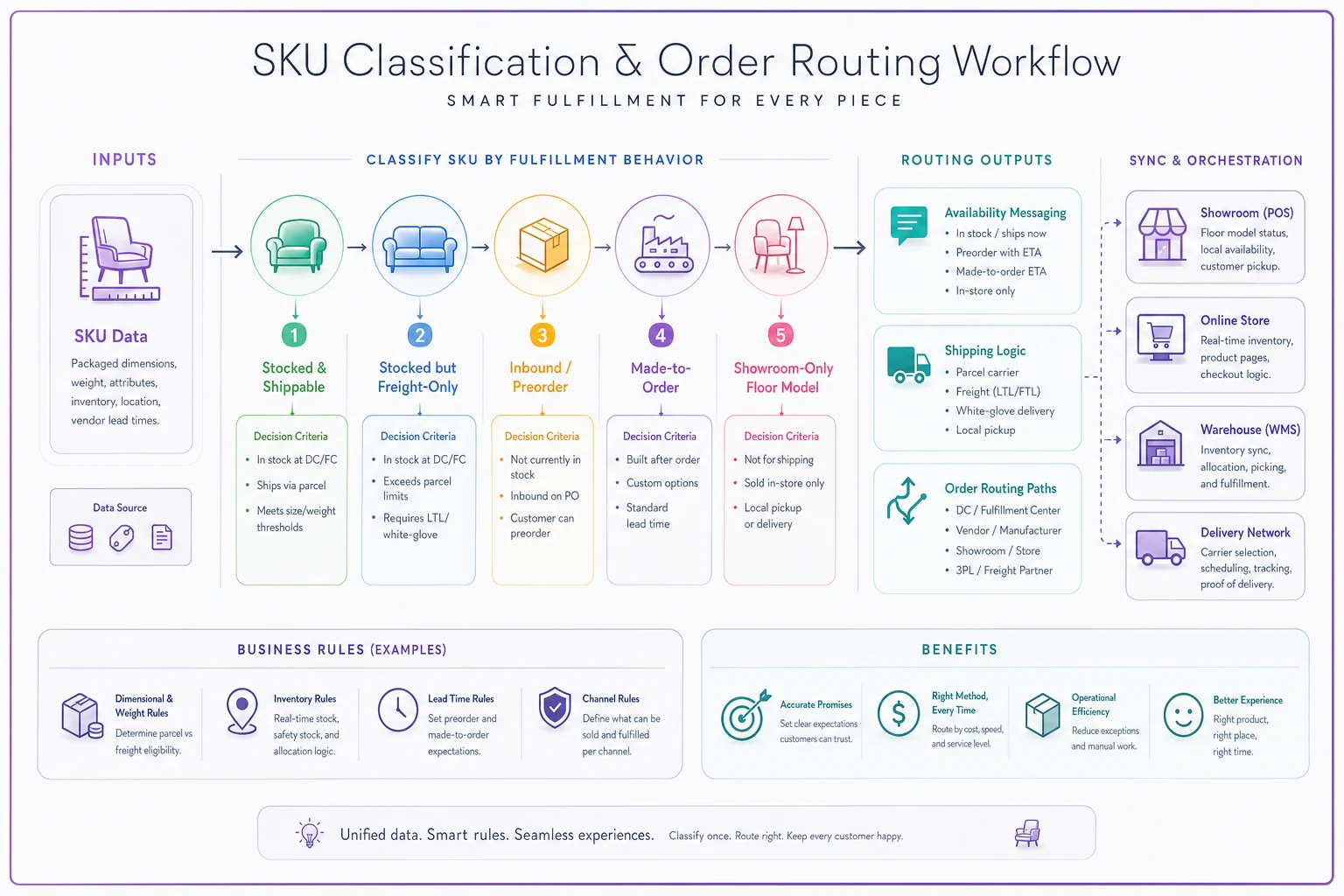
The fix isn't a single policy. It's a set of item-behavior-based policies that different SKUs route through. Furniture inventory isn't uniform, so the rules shouldn't be either.
-
Stocked & shippable — on hand, standard delivery path
-
Stocked but freight-only — on hand, requires LTL or two-person delivery, DIM-weight pricing
-
Inbound / preorder — not on hand, known ETA, deposit + terms required
-
Made-to-order — production lead time, non-standard cancellation terms
-
Showroom-only floor model — display unit, sale requires explicit governance
Each class gets its own availability message, its own shipping logic, and its own order-routing path. This single change eliminates most of the "In Stock" lies.
Visualizing the classification-to-routing workflow.
DIM-weight availability and shipping messaging
For anything freight-only, availability messaging should communicate two things: a realistic delivery window and a freight cost that reflects DIM weight, not parcel weight.
Practically, this means your SKU data has to carry real packaged dimensions and a shipping class. Stores that get burned on freight almost always have missing or guessed dimensional data. The fix is boring but critical — accurate packaged L×W×H and weight on every bulky SKU, feeding a freight rule that quotes by cube.
Require packaged dimensions at SKU onboarding so freight quotes are based on cube, not guesses.
Preorder routing rules
Preorder and made-to-order SKUs should never enter the standard fulfillment queue. They need a separate routing path that:
-
Confirms the item's fulfillment class at the point of order
-
Applies the correct deposit and terms automatically
-
Sets an expected-availability date the customer sees before they pay
-
Holds the order in a preorder state — not the ready-to-pick queue
-
Triggers fulfillment only when the inbound unit is received and reconciled
The most common preorder failure is a system that confirms an order as fulfillable when the item is still six weeks out.
Showroom vs online availability governance
This is where you decide, deliberately, how a single physical unit is exposed. A few workable governance patterns:
-
Reserve floor models offline — floor units are not sellable via the web channel at all; only the sales team can write them up
-
Buffer stock rule — the last unit of any SKU is pulled from online availability automatically and reserved for showroom close-outs
-
Real-time sync with a claim lock — whichever channel writes the order first places an immediate hold visible to the other
Which one you pick depends on how much of your revenue is online versus in-store. Most stores never actually chose — they just let both channels see the same number and hoped for the best.
SLA and order-routing templates worth standardizing
Once items are classified, you can attach service-level commitments to each path instead of promising the same thing to everyone. A basic template structure:
By fulfillment class, define:
-
Availability message shown to customer
-
Shipping/delivery method and cost logic
-
Deposit and payment terms
-
Confirmation-to-fulfillment SLA
-
Cancellation and reschedule policy
-
Which team owns exceptions
A made-to-order dining set might carry a 40% deposit, a 10–14 week window, non-refundable-after-production terms, and a delivery scheduling handoff that only opens once the item lands. A stocked accent chair carries none of that friction. Same store, completely different rules — and that's correct.
A real scenario
A three-location furniture retailer with a growing online channel — roughly $6M in annual revenue — was running everything on one global availability rule. Online showed the same stock number as the showrooms, and shipping was a flat estimate.
Over a quarter they tracked the leaks: somewhere around 30–40 orders a month required a follow-up call because the item was actually inbound or already sold in-store, freight losses on underquoted bulky items ran $2k–$3k monthly, and their delivery team was eating reschedules from orders that were never really ready.
They didn't overhaul anything exotic. They classified their catalog into the five fulfillment behaviors, split online and showroom availability with a floor-model reserve rule, added packaged dimensions to bulky SKUs so freight quoted on cube, and moved preorders into a separate routed queue with proper deposits.
Double-sale calls dropped to a handful a month. Freight stopped being a surprise line item. The delivery team's ready-to-schedule list actually meant ready. Nothing dramatic — just the difference between rules that matched the product and rules that didn't.
Where software fits (and where it doesn't)
You can enforce a lot of this manually at small scale, and honestly the policy design matters more than the platform regardless of where you start. The rules are the thing. But the coordination problem — keeping showroom, online, warehouse, and delivery all working off the same real availability, with the right routing per item class — stops being humanly maintainable past a few locations.
That's where an operational platform with AI-assisted routing earns its place: classifying SKUs by fulfillment behavior, holding preorders in the right state, syncing availability across channels with a claim lock, flagging freight mismatches before they hit margin. Not as a magic fix — as the thing that keeps your explicit rules actually enforced when volume outpaces manual coordination. The policy is yours. The software just stops it from quietly eroding.
The takeaway for owners and managers
Generic omnichannel rules aren't badly designed — they're designed for a different kind of product. The moment your inventory is bulky, high-ticket, freight-billed, and often built to order, a single global availability rule guarantees a steady stream of small operational failures that never quite trip an alarm.
The retailers who fix this don't add complexity — they add specificity. They stop pretending a sectional and a scatter cushion should follow the same fulfillment logic. Classify your SKUs by how they actually behave, attach real availability messaging, freight, deposits, and SLAs to each class, and decide deliberately how showroom and online share physical units. Do that, and most of the hidden costs you've been absorbing as "just part of the business" turn out to have been optional all along.
Ready to elevate your furniture business?
Join 500+ furniture retailers using Hosyly to increase efficiency, improve customer satisfaction, and grow revenue.