



Most furniture retailers don't realize they have an order-to-cash problem until the accountant and the sales floor are describing the same order as two completely different things. Sales says it's "sold." Finance says there's a $900 deposit sitting in a liability account and nothing recognized. The customer says they paid in full six weeks ago through a BNPL provider. All three are technically right, and that's exactly the problem.
The core issue with furniture order-to-cash is lead time. When you're selling a sofa that ships from a factory in 14–18 weeks, the gap between "customer pays" and "retailer earns" stretches across months, multiple payment events, and sometimes a BNPL provider who already settled with you before the goods even left the loading dock overseas. Every one of those events needs a state, a trigger, and a journal entry — and if any of those three are missing or misaligned, your AR aging report becomes fiction.
This article walks through how the whole system connects: canonical order states, deposit and installment milestones, revenue-recognition triggers, exception gates, and how each maps to accounting entries and reconciliation. Not as a list of accounting rules — but as an operating system designed to survive long lead times, cancellations, split deliveries, and a finance team that needs to close the books on time.
Why long lead times break the standard retail model
Regular retail order-to-cash is almost boring. Customer pays, you hand over the product, you recognize revenue, done. The cash event and the revenue event happen within seconds of each other. Reconciliation is trivial because there's nothing to reconcile — both sides of the transaction land at the same moment.
-
A deposit taken at point of sale (cash in, revenue not yet earned)
-
A balance payment weeks later, sometimes triggered by a "ready to ship" notice
-
A BNPL settlement where the provider funds you up front and collects from the customer over time
-
A partial delivery (the dining table arrives, the matching chairs are backordered)
-
A customer-caused delay (they're mid-renovation and ask you to hold delivery for two months)
Each of those is a separate financial event sitting on a different side of the revenue line. What shows up across a lot of furniture operations is that the sales system tracks the order beautifully and the accounting system tracks the money beautifully, but nobody owns the mapping between them. That mapping is the actual architecture, and it's usually held together by one person's spreadsheet and institutional memory.
The moment that person goes on vacation during month-end close, the gaps show up.
The canonical order states that actually matter for accounting
You can model a furniture order in a hundred ways, but for order-to-cash purposes you only need the states that change something financial. Vanity states — "customer contacted," "measurement scheduled" — don't belong here. A canonical state, for these purposes, is one that either moves cash or moves revenue.
Eliminate inventory headaches and order delays.
Hosyly streamlines your furniture orders and stock management for seamless store operations.
- Real-time inventory tracking
- Automated order processing
- Customer notifications & engagement
No credit card required
Here's the minimal set that holds up across most long-lead operations:
| Order State | Cash Position | Revenue Position | Typical Trigger |
|---|---|---|---|
| Quoted | None | None | Quote issued, no commitment |
| Deposit Taken | Deposit received (liability) | Deferred | Customer pays deposit |
| Confirmed / PO Placed | Deposit held | Deferred | Supplier PO issued |
| Funded (BNPL) | Full amount received from provider | Deferred | BNPL settlement lands |
| Balance Due | Awaiting balance | Deferred | "Ready to ship" notice |
| Balance Paid | Full cash collected (liability) | Deferred | Customer pays balance |
| Delivered / Accepted | Cash held | Recognized | Proof of delivery + acceptance |
| Partially Delivered | Cash held | Partially recognized | Line-level delivery |
| Cancelled | Refund owed / forfeit | Reversed | Cancellation request |
| Closed | Settled | Final | Reconciliation complete |
The important insight is that cash and revenue move on different triggers. A customer can be 100% paid up and you've still earned nothing until acceptance. BNPL sharpens this further — you can have the provider's money sitting in your bank and zero recognized revenue for three months. If your bookkeeping treats "money received" as "sale made," your revenue is overstated and your deferred liability is understated. That's the kind of thing that looks fine until an accountant or a lender actually reads the balance sheet.
If you've already built a solid order orchestration control plane for bulky furniture retailers, these financial states should sit on top of it as a thin layer — not as a competing system. The orchestration layer knows where the goods are. The order-to-cash layer translates that into where the money is.
Deposit and BNPL milestones, mapped to journal entries
This is where most of the quiet errors live, so it's worth getting specific.
Standard deposit flow. Customer orders a $4,200 sectional, pays a 30% deposit of $1,260.
-
Deposit taken
Debit Cash $1,260 / Credit Customer Deposits (liability) $1,260. Nothing hits revenue.
-
Balance paid at ready-to-ship, $2,940
Debit Cash $2,940 / Credit Customer Deposits $2,940. The liability account now holds the full $4,200. Still no revenue.
-
Delivered and accepted
Debit Customer Deposits $4,200 / Credit Revenue $4,200, and the COGS entry fires against inventory.
The mistake that keeps showing up is skipping step one's liability treatment and booking the deposit straight to revenue. On a single order it's harmless. Across a showroom carrying 150–200 open orders, each sitting in a deferred state for 3–4 months, it quietly inflates your top line by tens of thousands and leaves you with no clean way to reconcile when orders cancel.
BNPL flow is where it gets genuinely tricky. The provider funds you up front, minus their fee. Same $4,200 sofa, provider fee of 4.5%.
-
BNPL settlement lands
Debit Cash $4,011 / Debit BNPL Fee Expense $189 / Credit Customer Deposits $4,200. You've received the money but still owe the product, so the full amount stays as a liability — not revenue.
-
Delivery and acceptance
Debit Customer Deposits $4,200 / Credit Revenue $4,200.
The subtle part: the customer might cancel after the BNPL provider has already paid you. Now you owe a refund to the provider, not the customer, and the chargeback mechanics differ by provider. If your deposit policy doesn't distinguish between "customer-funded" and "provider-funded" liabilities, your refund workflow sends money to the wrong party. The broader question of when BNPL even makes sense is worth a separate look — this piece on how to evaluate BNPL and installment options for high-ticket furniture covers the credit-exposure side that pairs with the accounting mechanics here.
Revenue-recognition triggers that survive partial delivery
The clean version of revenue recognition is "recognize on acceptance." The real version is messier because furniture orders split.
A customer buys a bedroom set: bed frame, two nightstands, a dresser. The frame and nightstands arrive in week 12. The dresser is delayed to week 19. What do you recognize?
If your order model only recognizes at the order level, you're stuck. Recognize everything early and you're wrong — you haven't delivered the dresser. Recognize nothing until the last piece lands and you're also wrong, plus it distorts your monthly revenue timing. The correct approach is line-level recognition tied to line-level acceptance.
That means each order line carries its own:
-
Allocated price (the order total split across lines by relative standalone value)
-
Delivery status
-
Acceptance proof
-
Recognition trigger
When the frame and nightstands are accepted, you recognize their allocated portion — say $1,850 of a $2,600 order — and the remaining $750 stays deferred until the dresser arrives. The deposit liability drains proportionally.
The operational catch most retailers hit: their point-of-sale system sold the bedroom set as one line with one price. There's no allocated standalone value per component, so there's no clean way to split the recognition. This is a master-data problem disguised as an accounting problem. If your SKUs don't carry individual prices even when sold as a bundle, partial-delivery recognition is basically impossible and someone will fudge it — which is exactly what auditors eventually find.
Exception gates: where the system is supposed to stop and ask
Exceptions are the whole reason this needs to be an architecture and not a checklist. A healthy order-to-cash system has gates that refuse to advance an order until a condition is met. Those gates protect you from the two expensive failure modes: recognizing revenue you haven't earned, and collecting cash you can't reconcile.
The gates that matter most for long-lead furniture:
-
Deposit gate. No supplier PO is placed until the deposit clears. Placing factory orders on unpaid deposits is how retailers end up holding slow-moving inventory nobody paid for.
-
Balance gate. No delivery scheduling until the balance is collected or a financed balance is confirmed funded. Trucks rolling on unpaid balances is a working-capital killer.
-
Acceptance gate. No revenue recognition until proof of delivery plus a signed or digital acceptance exists. "The driver thinks he dropped it off" is not acceptance.
-
Cancellation gate. No refund issued until the refund path (customer vs. BNPL provider vs. forfeit deposit) is resolved and inventory disposition is decided.
-
Reconciliation gate. No order moves to Closed until the sum of its cash events equals the sum of its recognized revenue plus any fees, refunds, or forfeits.
The reconciliation gate is the one people skip, and it's the most important. It's the mathematical check that says: for this order, does everything tie out? Cash in, minus fees, minus refunds, should equal revenue recognized plus deposits forfeited plus deposits still deferred. If it doesn't balance to zero, the order isn't done — no matter what the sales floor says.
A worked example across a long lead time
Running one order all the way through is where the timing lessons actually show up.
Order: Custom sectional + ottoman, $5,600 total. Sectional allocated at $4,900, ottoman at $700. Customer pays 30% deposit, finances the balance through BNPL, and the ottoman ships five weeks after the sectional.
Week 0 — Deposit taken, $1,680. Debit Cash $1,680 / Credit Customer Deposits $1,680. Supplier PO released (deposit gate cleared). Revenue: $0.
Week 2 — BNPL funds the balance, $3,920 at 4.5% fee. Debit Cash $3,744.40 / Debit BNPL Fee $175.60 / Credit Customer Deposits $3,920. Liability now holds $5,600. Revenue: $0.
Week 14 — Sectional delivered and accepted. Debit Customer Deposits $4,900 / Credit Revenue $4,900, plus COGS against inventory. Liability now holds $700 (the ottoman). Revenue to date: $4,900.
Week 19 — Ottoman delivered and accepted. Debit Customer Deposits $700 / Credit Revenue $700. Liability now $0. Revenue: $5,600.
Week 20 — Reconciliation gate. Cash received $5,600 (as $1,680 + $3,920). Fees $175.60. Revenue recognized $5,600. Deposits remaining $0. It ties. Order moves to Closed.
Notice that revenue landed in two different months, across two different line items, while the cash landed in the first two weeks. If anyone had booked the $5,600 as revenue in week two when the money arrived, three months of financials would have been wrong — and a week-14 cancellation of the ottoman would have required unwinding recognized revenue, which is the kind of mess auditors hate and lenders notice.
What breaks at scale
One order is manageable by hand. The architecture matters because of volume and simultaneity.
-
The deferred liability balance becomes unauditable by hand. Nobody can manually prove that the Customer Deposits account equals the sum of undelivered order value.
-
Month-end close slows to a crawl because someone is reconstructing which orders crossed into "accepted" during the period.
-
Cancellations and partial deliveries pile up as unresolved exceptions, and the AR aging report quietly fills with orders that aren't really receivables anymore.
This connects directly to working capital. Every dollar sitting in deferred-but-funded liability is cash you're holding against goods you haven't delivered — and how you treat it affects how much you can safely redeploy. The inventory-to-capital model for furniture retailers gets into the broader relationship between order states and cash availability; the order-to-cash layer is essentially the ledger-level view of that same money.
Where software earns its keep (and where it doesn't)
A spreadsheet can model this for one order. It cannot enforce it across hundreds. The value of a proper platform isn't that it does accounting — your accounting system already does that — it's that it keeps the order state and the financial state locked together so neither can drift independently.
-
It watches the gates automatically, so an order physically can't advance to delivery scheduling while the balance is unpaid.
-
It fires the right journal entries at the right trigger, so an acceptance confirmed in the field creates the recognition entry without someone remembering to key it in.
-
It runs the reconciliation check continuously instead of once a month, flagging the handful of orders that don't tie so your team investigates 6 orders instead of re-checking 180.
That last point is the real value. Most of the work in order-to-cash isn't the 95% of orders that behave — it's finding the 5% that don't. Automation that surfaces exceptions early is worth far more than automation that processes the easy ones faster.
What software won't fix: bad master data. If your SKUs don't carry standalone prices, if your bundles aren't decomposed, if your deposit policy doesn't distinguish customer-funded from provider-funded liabilities — no platform saves you from that. Those are policy decisions you have to make before any system can help.
A phased implementation roadmap
Don't try to build this all at once. The retailers who get it working treat it as four phases, each of which is useful on its own.
-
Phase 1 — Define the canonical states and liability treatment. Agree that deposits are liabilities, not revenue. Get every open order mapped to one of the canonical states. This alone fixes the overstated-revenue problem. Expect a few weeks and a cleanup of historical orders.
-
Phase 2 — Wire the deposit and BNPL journal mappings. Standardize the entries for each milestone, including the provider-fee and provider-refund paths. Separate customer-funded from provider-funded liabilities in your chart of accounts.
-
Phase 3 — Implement line-level recognition and acceptance proof. This requires your master data to carry per-line pricing. Tie recognition to delivery acceptance, not dispatch. Build the acceptance capture into your delivery workflow.
-
Phase 4 — Turn on the reconciliation and SLA gates. Automate the tie-out check per order. Add SLA timers so exceptions — a balance unpaid past the ready-to-ship notice, an order delivered but not reconciled within a set number of days — get escalated instead of aging silently.
The ordering matters. If you try to automate reconciliation (Phase 4) before you've fixed liability treatment (Phase 1), you're just automating wrong numbers faster.
Map every open order to a canonical state before wiring journal mappings—it's the cleanup that makes automation reliable.
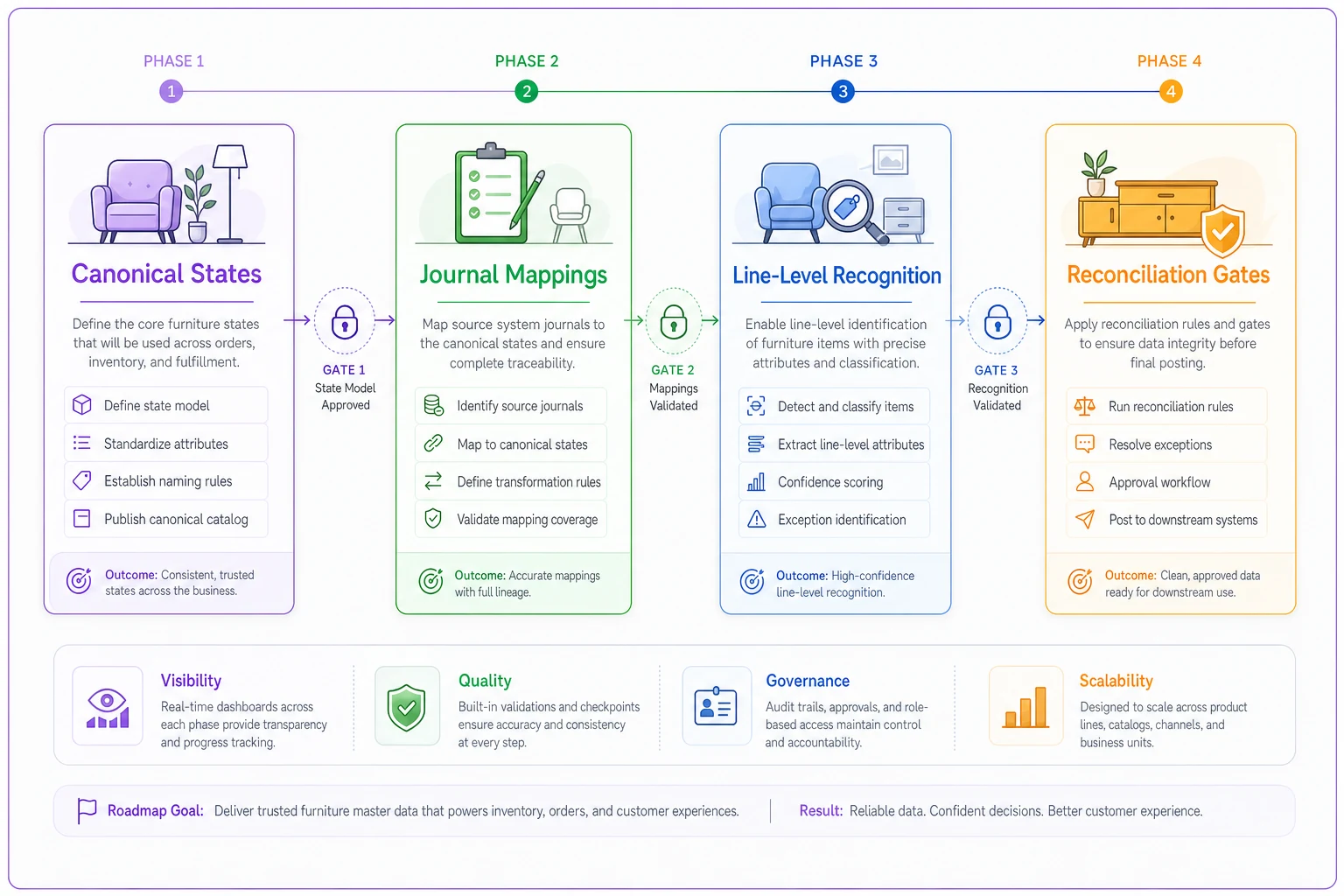
This flow shows the recommended sequence and the gates that prevent advancing with incomplete data.
A short real scenario
A regional retailer with two showrooms was running around 160 open orders at a time — mostly 12–16 week lead times, with roughly a third on BNPL. Their close took about nine business days, largely because one person manually reconstructed which orders had crossed into "delivered" each month and chased down mismatches between the deposit liability account and open order value.
The recurring pain wasn't fraud or big errors. It was drift. Deposits occasionally booked to revenue, BNPL refunds sent to customers who'd been funded by the provider, and a deferred liability balance that was off by a few thousand dollars every month with no obvious source.
After separating liability accounts by funding source, moving to line-level recognition, and running a per-order tie-out, the stray differences mostly disappeared — caught at the order level the moment they appeared rather than discovered at close. Close dropped to around four days. The more valuable outcome was quieter: when a lender asked for a clean breakdown of recognized revenue versus customer deposits, they could produce it in an afternoon instead of a week of reconstruction.
When this level of structure is overkill
If you're a smaller shop selling mostly in-stock items with short turnarounds and few deposits, this is more architecture than you need. The whole point of this system is managing the gap between cash and delivery — if that gap is a few days, there's not much to reconcile.
It becomes worth building when you consistently carry dozens of open long-lead orders, when BNPL is a meaningful share of your sales, when partial deliveries are common, or when a lender or auditor is starting to ask harder questions about deferred revenue. If month-end close is routinely painful and your AR aging has orders on it that aren't really receivables, that's the signal you've outgrown the spreadsheet and one person's memory.
The honest test: can you, right now, prove that your customer-deposit liability account exactly equals the value of goods you've been paid for but haven't delivered? If that answer takes more than a few minutes, the architecture above is probably the fix — and the money leaking through the gaps is almost certainly more than the cost of closing them.
Ready to elevate your furniture business?
Join 500+ furniture retailers using Hosyly to increase efficiency, improve customer satisfaction, and grow revenue.