


Most furniture retailers treat BNPL and installment plans as a marketing lever — "add a payment option, close more sofas." That framing is where the trouble starts. Payment financing isn't a marketing decision. It's a treasury and operations decision that happens to boost conversion. When you think about it that way, you start asking better questions: Who eats the fraud risk? When does cash actually land in your account? What happens to a made-to-order piece when the customer's plan gets declined halfway through production?
Get those wrong and the "free conversion boost" quietly erodes your margin, ties up cash you thought you had, and — in the worst cases — leaves you holding a custom sectional nobody else will buy.
This is a systems piece. The goal is to show how vendor selection, risk controls, margin math, and internal communication all connect, because in real operations they fail together, not separately.
The core problem: financing shifts risk, it doesn't remove it
Every BNPL or installment product does one thing — it moves the timing and ownership of risk. The question is where it moves and whether you noticed.
-
Non-recourse third-party BNPL (Affirm, Klarna, Afterpay style). The provider pays you, minus a merchant fee, and owns the credit risk. Your exposure is mostly fraud, chargebacks, and refund friction.
-
Recourse or partial-recourse programs. You get better rates, but if the customer defaults, some of that risk bounces back to you. Furniture retailers get burned here more than most categories because tickets are large and delivery windows are long.
-
In-house / store-card financing. You keep the full margin and the full risk. Great when it works, brutal on cashflow and collections when it doesn't.
The mistake across furniture businesses isn't picking the "wrong" model. It's picking one without mapping it against their SKU mix. A store that's 80% in-stock accent pieces has a completely different risk profile than one selling made-to-order dining sets with 10-week lead times. Same financing product, wildly different exposure.
Why this breaks differently for made-to-order vs in-stock
With an in-stock SKU, financing risk is short and contained. Customer applies, gets approved, you deliver from stock, the provider settles. If the plan is declined, you simply don't ship. Your only real exposure is a return or a chargeback after delivery.
Eliminate inventory headaches and order delays.
Hosyly streamlines your furniture orders and stock management for seamless store operations.
- Real-time inventory tracking
- Automated order processing
- Customer notifications & engagement
No credit card required
With a made-to-order SKU, there's a gap — sometimes 6 to 12 weeks — between "financing approved" and "cash fully recognized and product delivered." A lot can go wrong in that stretch:
-
The customer's approved limit changes before delivery
-
The provider re-runs risk and the plan collapses
-
The customer cancels mid-production and disputes the deposit
-
Delivery slips past the provider's settlement window and the transaction ages out
A typical scenario: a retailer sells a $4,200 custom sectional on a "0% for 12 months" plan. Production starts. At week 5 the customer's financing gets flagged, the deal unwinds, and now there's a half-built, non-returnable frame in the supplier's queue. The retailer either eats the cost or fights to convert the customer to a different payment method — usually at a discount. One unwind like that can wipe the margin off three or four clean sales.
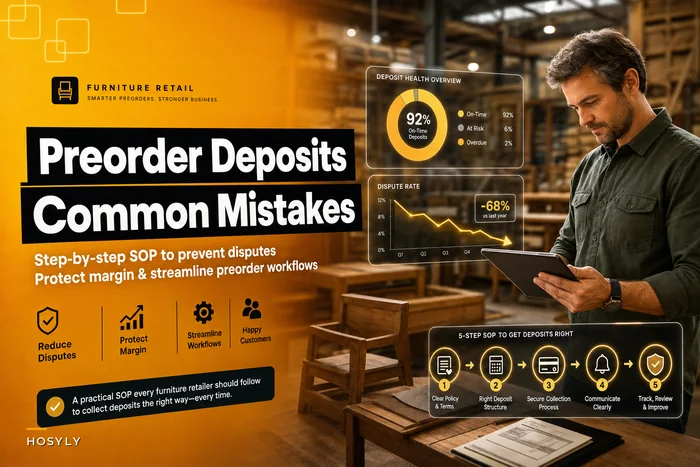
If you're already running deposit controls on custom orders, this is the same discipline extended into financing. It connects directly to the failure modes in common preorder deposit mistakes furniture retailers make — financing doesn't replace a deposit policy, it has to sit on top of one.
The vendor-selection matrix
Don't evaluate providers on headline merchant fee alone. That number is the most visible and the least important. Score each candidate across the dimensions that actually affect your cash position and risk exposure.
| Criteria | Why it matters for furniture | What to look for |
|---|---|---|
| Recourse structure | Determines who eats default | Non-recourse for high-ticket custom; recourse only if margins can absorb it |
| Settlement timing | Affects working capital | Days-to-cash after delivery, not after approval |
| Approval rate on high tickets | Low approval = wasted floor time | Ask for their approval % in the $2k–$8k band specifically |
| Refund / cancellation handling | Made-to-order cancellations are common | Clean partial-refund flow, deposit carve-outs supported |
| Merchant fee | Direct margin cost | 3%–6% typical; higher on 0% promo plans |
| Chargeback protection | Fraud on big tickets is expensive | Fraud liability shift, delivery-confirmation acceptance |
| Delivery-window tolerance | Custom orders take weeks | Settlement window that survives a 10-week lead time |
| Integration with your order data | Prevents manual reconciliation errors | Ties approval status to the order record, not a separate portal |
That last row is the sleeper. When financing status lives in a separate provider dashboard and your order status lives in your own system, staff make decisions on stale information — starting production on an order whose financing quietly lapsed. That disconnect is where most exposure actually enters the business.
The margin and cashflow math (worked examples)
Financing fees are usually quoted as a percentage, which makes them feel small. Model them in dollars against your real margin and the picture changes.
Example 1 — In-stock recliner, $1,600 retail
-
Cost of goods
$960 (40% gross margin = $640)
-
BNPL merchant fee at 4.5%
$72
-
Net margin after fee
$568
-
Margin erosion
~11% of your gross
Annoying but survivable, and the cash lands fast because you deliver from stock within days.
Example 2 — 0% promotional plan on a made-to-order sectional, $4,200 retail
-
Cost of goods
$2,520 (40% gross margin = $1,680)
-
0% promo merchant fee at 8%
$336
-
Net margin after fee
$1,344
-
Margin erosion
~20% of your gross
-
Plus cash isn't fully recognized until delivery, 8–10 weeks out
Now layer in the risk. If even 1 in 20 of these custom deals unwinds mid-production and you recover only 60% of the cost, the effective margin on the whole cohort drops well below what the fee alone suggests. This is why blanket "0% financing storewide" promos quietly hurt custom-heavy stores — the SKUs with the longest exposure carry the highest fees and the highest cancellation risk at the same time.
The rule of thumb that holds up: reserve aggressive 0% offers for in-stock, fast-settling SKUs, and use standard interest-bearing plans (where the provider carries the cost) on made-to-order. Match the financing product to the risk profile of the SKU, not to a store-wide banner.
Risk controls that actually hold
Controls fail when they're policies on paper but not enforced in the actual workflow. A few that hold up in practice:
-
Never start production on a made-to-order item until financing settles the deposit portion and the plan is confirmed active. Approval ≠ funded.
-
Set a delivery-window ceiling per provider. If a provider's settlement window is 90 days and your lead time is 84, one supplier delay drops you out of the window. Don't finance long-lead custom through short-window providers.
-
Require delivery confirmation (signed POD or photo) before final settlement so chargeback protection actually applies. On bulky goods this also ties into your damage-claim evidence trail.
-
Cap in-house financing exposure as a share of monthly revenue. Many mid-size stores keep in-house receivables under 15%–20% of monthly sales. Past that, you're operating as a lender, not a furniture store.
-
Re-verify financing status at the "release to delivery" gate, not just at point of sale. Weeks pass; things change.
Re-verify financing status at the "release to delivery" gate, not just at point of sale. Weeks pass; things change.
These aren't tips to sprinkle in — they're gates in a single flow. Miss one and the others don't protect you.
The operational comms flow that limits exposure
This is the piece retailers most often skip, and it's where credit exposure quietly compounds. Financing touches sales, production/supplier, delivery, and finance — and if those four aren't sharing the same status in real time, someone acts on old information.
-
Point of sale Sales rep records financing type and provider on the order. Order is flagged "financing pending — do not release."
-
Approval + deposit settlement Finance confirms funds/plan active. Only then does status flip to "cleared for production."
-
Production trigger Made-to-order goes to the supplier only after step 2. In-stock can be picked immediately.
-
Mid-production checkpoint (custom only) For lead times over roughly 6 weeks, re-verify plan status at the midpoint. Catch unwinds before the frame is finished.
-
Release-to-delivery gate Re-confirm financing active and settlement window still open. Attach POD requirement.
-
Final settlement Delivery confirmed → final funds recognized → order closed.
The failure most stores never diagnose: sales and production communicate through a chat thread or a verbal handoff, while financing status lives in the provider's portal. A rep tells the warehouse "it's approved, go" — but confirming that was step 2's job, not step 1's. The order goes into production on an approval that later collapses.
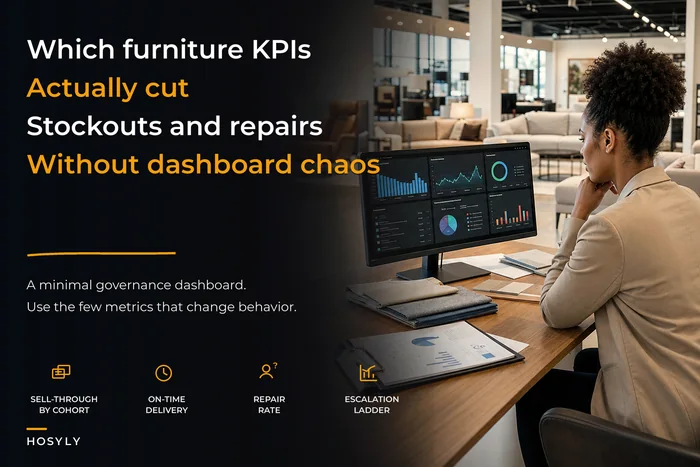
Centralizing status on the order record itself fixes this. It's the same coordination discipline behind the furniture KPIs that reduce showroom stockouts and repairs — the businesses that stay out of trouble are the ones where every function reads the same real-time status instead of a stale copy. Operational software with AI-assisted checks can flag when an order's financing status and production status contradict each other — for example, a "cleared for production" custom order whose plan lapsed — before anyone starts building. Not replacing judgment, just catching the contradictions that slip through in a busy showroom.
Visual summary of the operational comms flow:
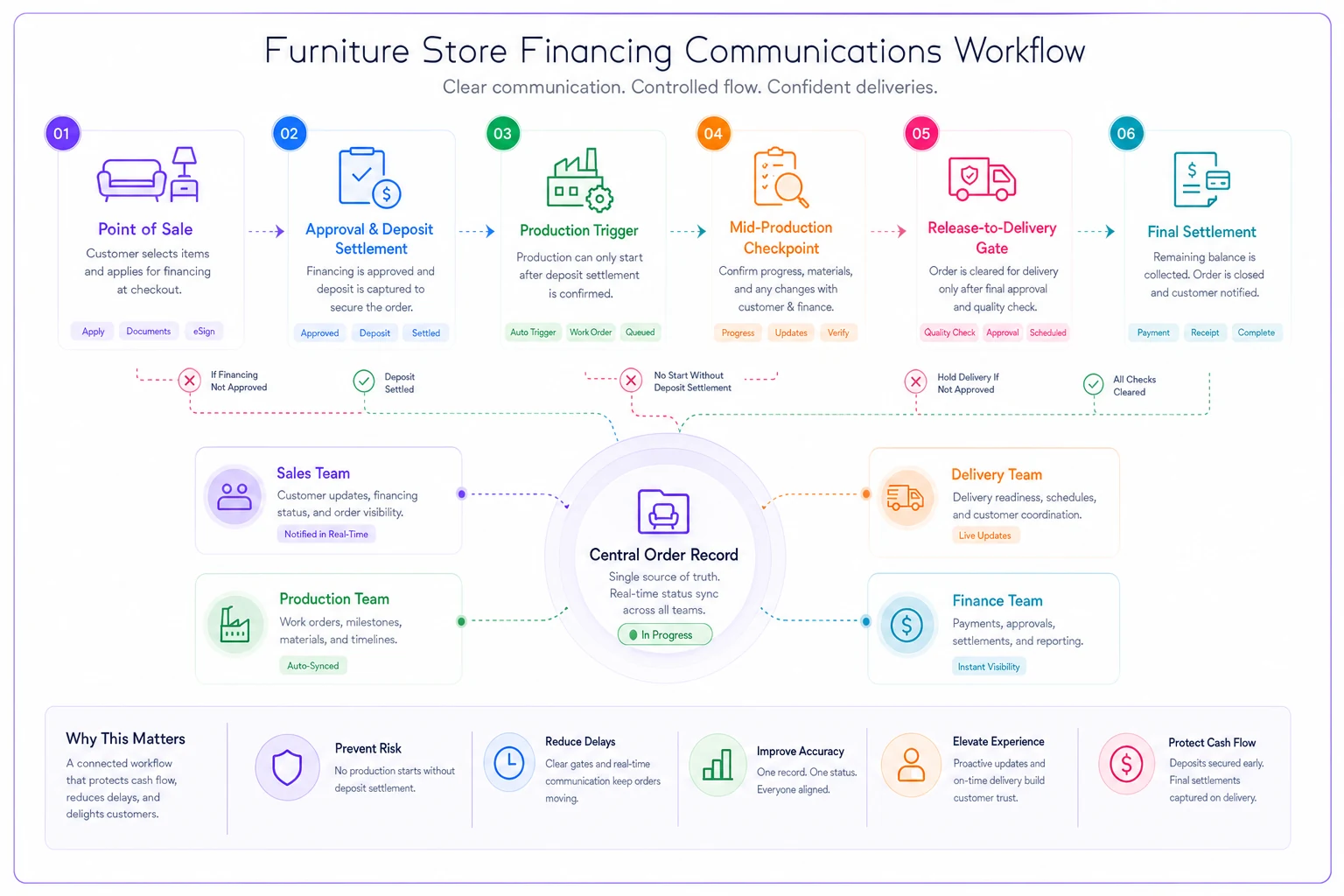
The diagram highlights the gates and the central order status that stop production when financing hasn't truly settled.
A real scenario
A mid-size independent furniture store — one showroom, roughly $340k–$380k in monthly sales, split about 55% in-stock and 45% made-to-order — rolled out storewide 0% financing to lift close rates. Conversion climbed noticeably in the first quarter.
Then the problems surfaced. On custom orders, several financing plans unwound between approval and delivery. Two customers disputed deposits. One custom dining set around $3,800 got stranded when the plan collapsed at week 6; they recovered a bit over half the cost through a heavily discounted floor sale.
Between merchant fees on the 0% custom plans and a handful of unwinds, the store estimated it gave back somewhere in the range of $9k–$12k over about five months — most of the conversion gain, gone. Not a disaster in absolute terms, but painful when you realize it was entirely avoidable.
The fix wasn't dropping financing entirely. They split the program: kept 0% on in-stock, moved custom to a non-recourse interest-bearing plan where the provider carried the cost, and added the mid-production re-verification checkpoint. They also refused to trigger production until deposit settlement cleared. Unwinds mid-production basically stopped, margin erosion on custom dropped back to fee-only levels, and they kept most of the conversion lift on the in-stock side where it was clean money.
When this makes sense — and when it doesn't
When offering financing makes sense:
-
Your average ticket is high enough that customers genuinely need it to buy
-
You're mostly in-stock or fast-settling, so exposure windows are short
-
You can enforce a production gate tied to settlement
When it's a bad idea:
-
You're custom-heavy with long lead times and using recourse or in-house financing without reserves
-
Your financing status can't be seen alongside order status, so staff act on stale info
-
You're running storewide 0% because a competitor does, without modeling the fee hit per SKU type
Who should NOT run in-house financing at all:
Stores without a real collections process, without a receivables cap, and without the cash cushion to wait out defaults. In-house financing turns you into a small lender, and lending without underwriting discipline is how furniture retailers quietly go under while their sales numbers still look healthy.
Pulling it together
Financing is one of the few levers that touches conversion, margin, cashflow, and risk simultaneously — which is exactly why it can't be owned by whoever runs marketing.
The retailers who use BNPL and installment plans well aren't the ones offering the most aggressive terms. They're the ones who match the payment product to the SKU's risk profile, gate production on real settlement, and make sure sales, supply, delivery, and finance are all reading the same status instead of guessing.
Run a proper furniture BNPL evaluation with that lens — vendor matrix, per-SKU margin math, enforced controls, and a comms flow that closes the gaps — and financing becomes what it's supposed to be: a way to close more high-ticket sales without lending your own margin to the customer for free.
Ready to elevate your furniture business?
Join 500+ furniture retailers using Hosyly to increase efficiency, improve customer satisfaction, and grow revenue.