



Most furniture retailers collect deposits wrong. Not the amount — the timing. They take 50% deposits on custom orders, feel secure about commitment, then wonder why cash flow craters three months later when suppliers demand final payment but customers ghost delivery attempts.
The preorder deposit process for custom furniture breaks at predictable points. Stores take deposits too early, reserve inventory incorrectly, use vague contracts, update customers randomly, and panic when cancellations hit during peak lead times. Each mistake compounds into operational chaos that drains working capital and destroys margins.
Why deposit timing matters more than deposit amount
Traditional furniture retail teaches you to secure commitment upfront. Get that 50% deposit, lock the order, move to the next sale. Except this creates a three-month gap between when you receive cash and when you need it most — during final supplier payments and delivery coordination.
A mid-sized furniture store handling around 40 custom orders monthly faces this pattern constantly. Customer places an $8,000 custom sectional order in January, pays $4,000 deposit. Supplier requires 30% down immediately ($2,400), leaving $1,600 for operations. Come April, the supplier wants the final 70% ($5,600) but the customer still owes $4,000. The store is floating $1,600 per order across dozens of transactions simultaneously.
The math destroys working capital. Forty orders averaging $6,500 each means floating somewhere around $65,000 monthly while waiting for final customer payments. Miss three delivery attempts or face two cancellations, and suddenly you're sitting on $20,000 in unreturnable inventory.
Smart stores restructure deposit timing into three phases:
-
30% at order confirmation (covers supplier deposit)
-
30% at production start (maintains cash flow)
-
40% two weeks before delivery (ensures customer availability)
This keeps cash aligned with actual expenses instead of creating massive float periods.
Inventory reservation mechanics that prevent double-selling disasters
Reservation systems fail when they don't account for production variability. Most stores mark items "reserved" at deposit collection, then discover three months later that the fabric discontinued or the frame design changed slightly. Now you're explaining to customers why their "reserved" item looks different than what they ordered.
Eliminate inventory headaches and order delays.
Hosyly streamlines your furniture orders and stock management for seamless store operations.
- Real-time inventory tracking
- Automated order processing
- Customer notifications & engagement
No credit card required
The failure happens in the tracking. Stores use spreadsheets showing order date, customer name, item SKU, expected delivery. But suppliers change specifications constantly. A walnut finish becomes "dark walnut." The "platinum gray" fabric shifts to "storm gray." Small changes cascade into customer disputes.
Reservation confirmation process:
-
Collect initial deposit
-
Submit exact specifications to supplier within 24 hours
-
Receive written confirmation of availability and specifications
-
Create a detailed reservation record including supplier confirmation number, exact materials, finishes, and dimensions confirmed, production slot assignment, expected completion date range, and photos of approved samples
-
Send customer confirmation package with all details
-
Set automated check-ins at 30, 60, and 90 days
One store reduced reservation errors from roughly twelve monthly to about one by requiring suppliers to provide production slot numbers immediately after deposit. No slot number, no reservation. It forced suppliers to actually verify availability instead of assuming.
Contract terms that protect both sides during six-month lead times
Standard furniture contracts fail because they assume normal retail timelines. Custom furniture operates differently — six-month lead times mean circumstances change dramatically between order and delivery. Jobs transfer, divorces happen, houses sell. Your contract needs flexibility while still protecting margins.
Most stores use generic contracts stating deposits are non-refundable after production starts. Customers sign, forget the terms, then explode when life circumstances change in month four. You're stuck choosing between destroying a customer relationship or eating thousands in custom inventory costs.
The graduated cancellation structure acknowledges reality — early cancellations barely impact operations, late cancellations devastate them. Customers understand paying more for last-minute changes while appreciating early flexibility.
Essential contract provisions for long lead times:
| Contract Element | Standard Version | Improved Version |
|---|---|---|
| Cancellation window | "Non-refundable after production" | "Full refund minus 15% within 14 days, 50% refund days 15-30, 25% credit days 31-60, non-refundable after day 60" |
| Delivery flexibility | "Must accept within 30 days" | "Free storage 30 days, $50/week storage days 31-90, forfeit after 90 days" |
| Change orders | "No changes after confirmation" | "Minor changes (under $500) allowed until production start for 10% fee" |
| Price protection | Not mentioned | "Quoted price locked for 180 days despite material increases" |
| Communication requirements | Not specified | "Customer must acknowledge monthly updates or order subject to cancellation" |
Getting these terms in place upfront removes most of the ugly conversations that happen mid-production.
Customer update cadence that reduces anxiety and angry calls
Six months feels like forever when you're waiting on furniture. Customers order excited, receive nothing for weeks, anxiety builds, then they call demanding updates you don't have. The store wastes hours fielding calls while customers grow increasingly frustrated.
Standard monthly updates don't work because production doesn't move linearly. Nothing happens for eight weeks, then suddenly everything happens in week nine. Customers receiving "still in queue" messages two months running assume you've forgotten their order entirely.
Effective update scheduling matches production reality:
-
Week 1 after order Confirmation package with all specifications, timeline, and next update date
-
Week 3 "Your order entered our production queue. Supplier confirmed materials arriving [date]"
-
Week 8 "Production beginning next week. Attached photo shows your actual fabric/wood samples"
-
Week 12 "Your piece entered production yesterday. Expected completion [date range]"
-
Week 16 "Production 70% complete. Quality check scheduled [date]"
-
Week 20 "Final assembly complete. Scheduling delivery coordination"
-
Week 22 "Ready for delivery. Please confirm availability for [proposed dates]"
Updates accelerate as production advances. Early updates are sparse because nothing's happening yet. Later updates increase frequency because that's when customers need reassurance most.
Between scheduled updates, set auto-responses for common questions — "Where's my order?" gets an automated status pulled from the reservation system, delivery date changes go to a self-service rescheduling link, and cancellation inquiries pull current terms based on order date. This approach cut customer service calls by roughly 60% at one store while actually improving satisfaction scores.
Cancellation handling that preserves relationships and margins
Cancellations during long lead times are where most stores get it wrong. Harsh policies protect margins but destroy reputation. Lenient policies preserve relationships but kill profitability. The balance comes through structured escalation and clear documentation.
When customers cancel month five of a six-month custom order, most stores panic. They either cave completely (eating $4,000 in costs) or stand firm on non-refundable terms (losing future referrals). Neither approach actually optimizes long-term value.
Cancellation response framework:
-
Express understanding
-
Review current order status
-
Explain actual costs incurred
-
Present options based on contract terms
-
Document everything
If the customer pushes back, calculate exact costs already committed, offer creative alternatives like store credit, transferring order to showroom floor, or finding another buyer, then negotiate middle ground if relationship value exceeds current loss, and set a firm deadline for decision.
Real example: a customer ordered a $12,000 custom dining set and wanted to cancel in month four due to job loss. The store had already paid $7,200 to the supplier. Instead of enforcing the non-refundable clause, they offered to list the piece on the showroom floor at a 15% markup — the customer would receive a refund minus 25% if sold within 60 days, or could accept delivery at 40% discount if not sold. The piece sold in three weeks. Customer got $8,000 back, store made $1,800 profit, and the customer left a positive review instead of a scorched-earth one.
Implementation templates and exact language
Abstract frameworks mean nothing without concrete tools.
Deposit Collection Email Template:
Subject: Your [Product Name] Order Confirmation - Important Timeline Information Hi [Customer Name], Your custom [product] order is confirmed! Here's what happens next:
-
Item
[Specific product with all customizations]
-
Total Price
$[Amount]
-
Deposit Paid Today
$[Amount]
Production Timeline:
-
Supplier confirmation
Within 48 hours
-
Production start
Week of [Date]
-
Expected completion
[Date range]
-
Delivery window
[Date range]
Payment Schedule:
-
Today
$[Amount] (30% deposit) ✓
-
[Date]
$[Amount] (30% production payment)
-
[Date]
$[Amount] (40% final payment - 2 weeks before delivery)
You'll receive updates at these milestones: [List specific dates] Important: Please save this email. Your order number [#] is required for all future correspondence. Questions? Reply directly or call [number]. [Signature]
Cancellation Communication Template:
Subject: Re: Cancellation Request for Order [#] Hi [Customer Name], I understand circumstances change, and I want to find the best solution for your situation. Your order status:
-
Ordered
[Date]
-
Current production stage
[Status]
-
Costs committed to date
$[Amount]
Based on our terms and your order timing, here are your options: Option 1: [Specific refund amount or percentage] Option 2: [Store credit amount] Option 3: [Alternative solution] I know this isn't what you planned, but I want to minimize any impact while being fair to both sides. Please let me know by [date] which option works best, or if you'd like to discuss alternatives. [Signature]
Monthly Update Template:
Subject: Update #[X] - Your [Product] Order Progress Hi [Customer Name], Quick update on your custom [product]: Current Status: [Specific stage] Recent Progress: [What happened since last update] Next Milestone: [What happens next] Timeline Status: [On track/Adjusted] [Include photo if available] Next update scheduled: [Date] No action needed from you. Questions? Just reply to this email. [Signature]
All templates above should be copied verbatim during initial rollout to ensure consistent customer expectations.
Operational software that prevents these mistakes automatically
Manual tracking across dozens of custom orders guarantees mistakes. Spreadsheets can't handle the complexity of deposits, production stages, customer communications, and cancellation terms across varying lead times.
Modern furniture operations benefit from AI-powered operational software that manages the preorder deposit process automatically. The platform tracks every order through its complete lifecycle — from initial deposit through final delivery — while handling customer updates and payment scheduling without manual intervention.
When a customer places an order, the system immediately generates contracts with appropriate terms, schedules the three-phase payment structure, sends supplier confirmations, and creates the entire communication timeline. No manual spreadsheet updates, no forgotten follow-ups, no confusion about cancellation terms at month five.
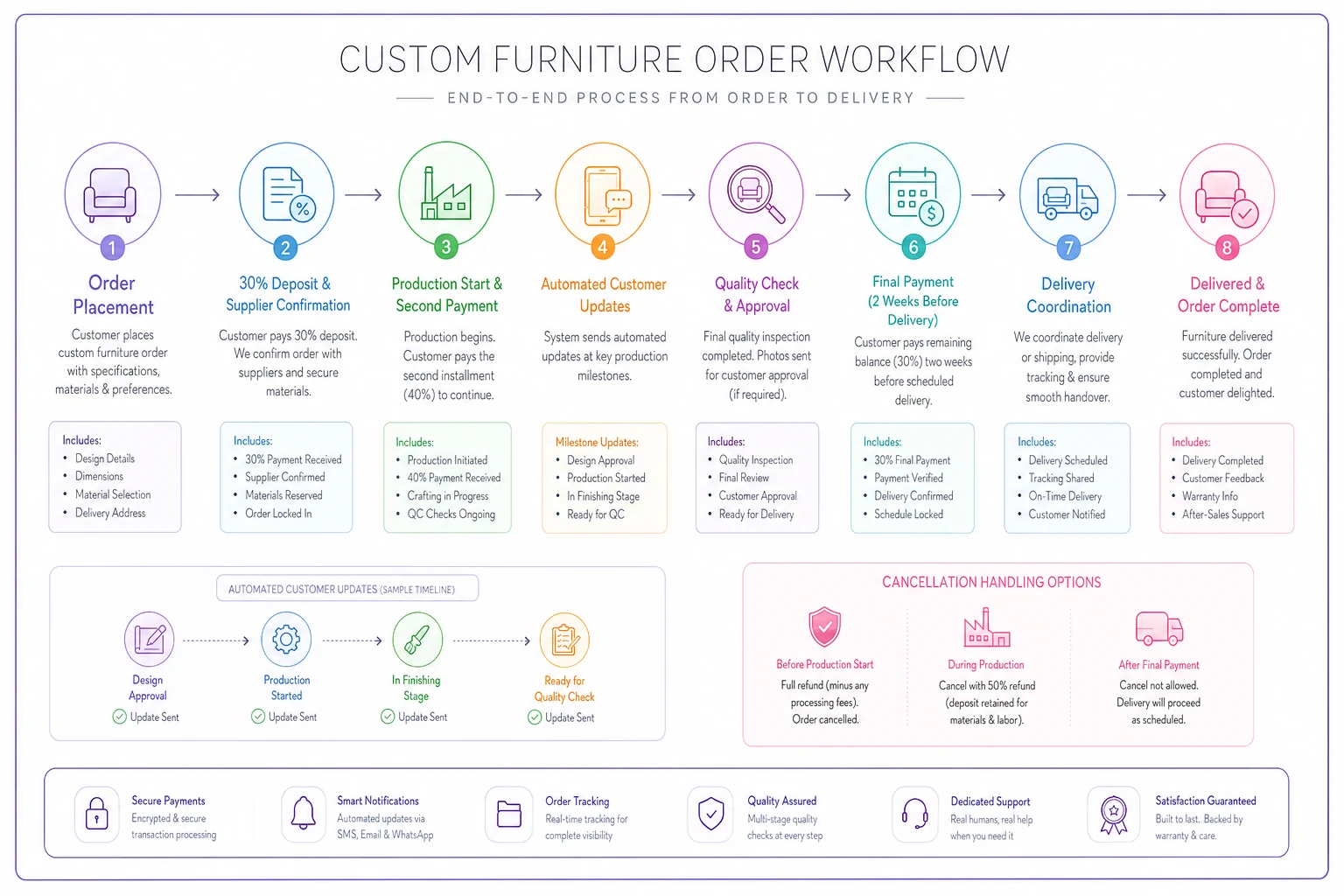
For cancellation handling, the operational software calculates exact refund amounts based on timing and contract terms, presents options to customers, and tracks resolution. Store owners get real-time cash flow projections that account for pending deposits, upcoming supplier payments, and potential cancellation risks — all in one place.
Instead of juggling emails, spreadsheets, and paper contracts, everything lives in one system that enforces consistency while cutting manual work significantly.
Making this work in your store
Start with deposit timing restructuring. Most stores resist moving away from 50% upfront because it feels like reduced commitment. The improved cash flow and reduced cancellation friction more than compensate — but test it with five orders before rolling out completely.
Next, implement the communication cadence exactly as outlined. Don't customize it yet. Run the standard schedule for 30 orders and track customer feedback. The acceleration pattern tends to match customer anxiety curves more closely than most store owners expect.
Then train staff on cancellation handling options. Role-play different scenarios. Make sure everyone understands when to hold firm versus when flexibility actually serves long-term value. Document every cancellation resolution — patterns emerge faster than you'd think.
The biggest resistance usually comes from suppliers who prefer large upfront deposits. Push back. Explain that sustainable ordering patterns require aligned cash flow. Most suppliers prefer consistent orders over large irregular deposits once they understand the logic.
Custom furniture inherently carries risk. Extended lead times mean life changes happen between order and delivery. The goal isn't eliminating that risk — it's managing it intelligently while maintaining customer relationships and protecting margins. The framework above does exactly that, turning a chaotic process into something predictable that scales as order volume grows.
Ready to elevate your furniture business?
Join 500+ furniture retailers using Hosyly to increase efficiency, improve customer satisfaction, and grow revenue.