


Most furniture retailers don't lose orders because their systems are bad. They lose orders because their systems don't talk to each other at the right moments. A sofa gets marked "delivered" in the WMS while the POS still shows it in transit. A made-to-order sectional clears the supplier's dock but nobody tells the installer until the customer calls asking why two guys with a truck showed up when they were promised a full assembly crew. The order technically exists in five places. It just doesn't exist as one coherent thing.
That's the gap a control plane fills. Not another app. A coordination layer that owns the state of every order and enforces the rules about what has to be true before an order moves to the next step. Think of it less as software you buy and more as the operational nervous system connecting everything you already run.
This article walks through what that layer actually looks like for bulky furniture: the canonical order lifecycle, where reconciliation has to happen, the SLA gates that stop bad handoffs, remediation ladders for when things break, and a realistic phased roadmap so you're not trying to boil the ocean in month one.
Why order state falls apart in furniture specifically
Furniture is one of the worst categories for order orchestration, and it's worth naming why before designing anything.
A t-shirt order has maybe three states: paid, shipped, delivered. A furniture order can have twenty. Deposit taken, balance due, supplier PO issued, in production, in transit to your DC, received and inspected, staged, scheduled for delivery, out for delivery, delivered, assembled, inspected on-site, customer signed off, warranty registered. And that's the happy path. Add a damaged panel, a partial delivery on a 3-piece order, or a customer reschedule, and the number of possible states explodes.
Every one of those transitions lives in a different system:
-
The POS knows the sale happened and how much was collected.
-
The OMS should know the full order composition and lifecycle — but often it's just a glorified order log.
-
The WMS knows what physically arrived and where it's stored.
-
The 3PL or your own delivery ops knows routing and appointment status.
-
The installer (in-house or subcontracted) knows whether the job actually got done and signed off.
Across most furniture operations, no single system owns the whole picture. Each one owns a slice, and the slices don't agree. The customer service rep ends up being the control plane — a human refreshing four tabs to answer "where's my couch."
That works at 40 orders a month. It falls apart somewhere around 150–200 active orders, which is exactly when most growing retailers stop being able to hire their way out of the problem.
The canonical order lifecycle: one definition everyone shares
The first job of a control plane is defining the order lifecycle — a canonical set of states that every system maps into, even if each system internally uses different language.
Eliminate inventory headaches and order delays.
Hosyly streamlines your furniture orders and stock management for seamless store operations.
- Real-time inventory tracking
- Automated order processing
- Customer notifications & engagement
No credit card required
Below is a workable canonical lifecycle for a bulky furniture order. The point isn't to copy this exactly; it's to have one agreed model that all your systems reconcile against.
| Canonical State | What it means | System that emits the event | What must be true to enter |
|---|---|---|---|
ORDER_CREATED | Sale captured, deposit collected | POS | Payment authorized, customer contact valid |
SOURCING | PO issued to supplier or allocated from stock | OMS | Every line item has a fulfillment path |
IN_PRODUCTION | MTO items being built | Supplier feed / OMS | Supplier acknowledged PO with a date |
INBOUND | En route to your DC | 3PL / supplier | Ship confirmation with tracking |
RECEIVED | Physically at DC, inspected | WMS | Inspection passed, no damage flag |
STAGED | Consolidated, ready to schedule | WMS | All lines of the order present |
SCHEDULED | Delivery + install appointment booked | Delivery ops | Customer confirmed slot, crew assigned |
OUTFORDELIVERY | On the truck | Delivery ops / 3PL | Manifest built, route locked |
DELIVERED | Dropped at address | Delivery crew | POD captured |
INSTALLED | Assembled and placed | Installer | Install checklist complete |
CLOSED | Signed off, warranty registered | OMS | Customer sign-off, no open exceptions |
The single most valuable thing this table does isn't the states themselves. It's the "what must be true to enter" column. That's the difference between a status tracker and a control plane. A status tracker records what happened. A control plane refuses to let an order advance until the preconditions are actually met.
Here's a quick visual of the canonical lifecycle and the control plane workflow.
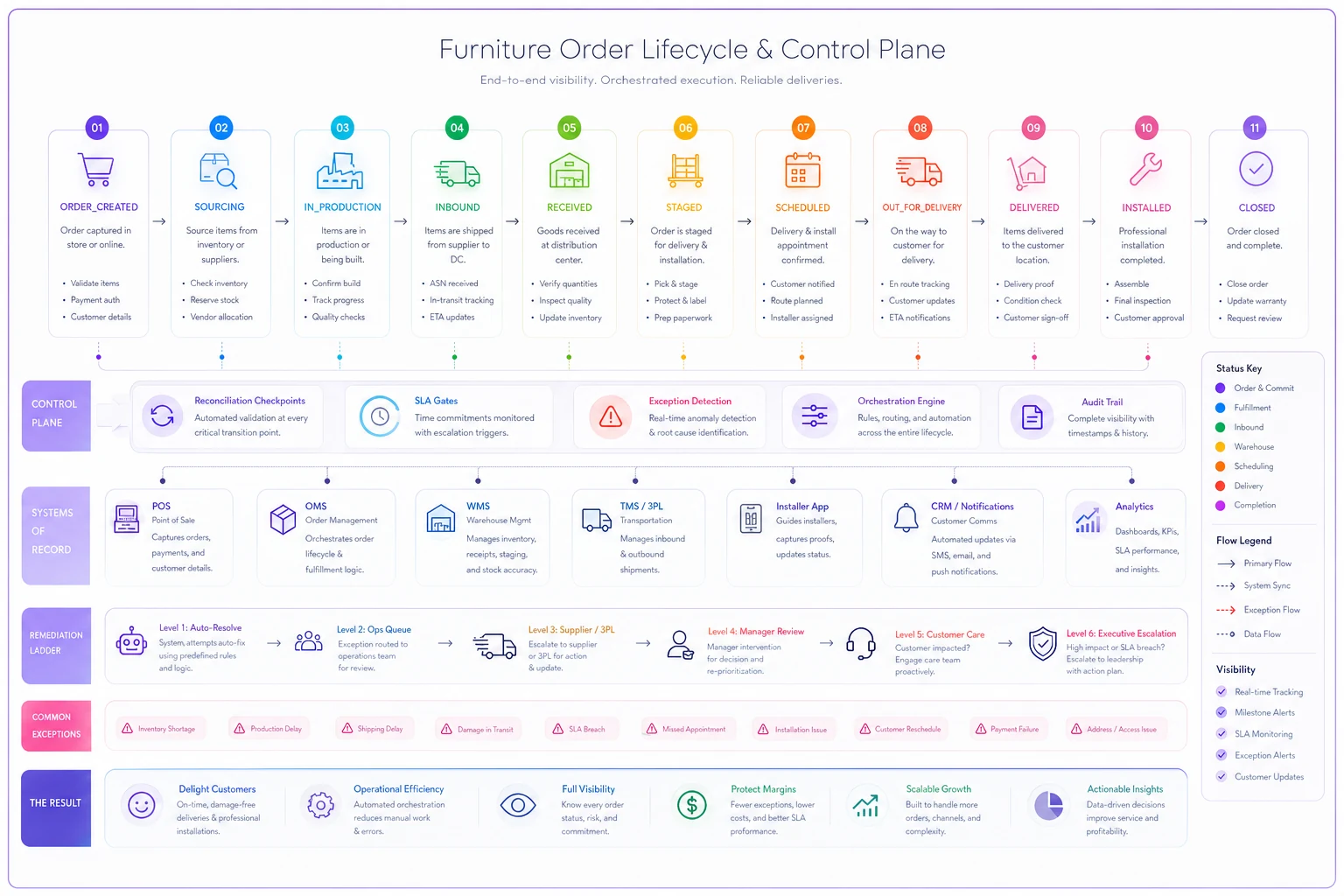
A common failure looks like this: an order jumps to SCHEDULED because a rep booked a delivery slot, but the third chair in a dining set is still IN_PRODUCTION. The control plane should block that transition — you can't schedule a full-order delivery when the order isn't STAGED. That one rule alone kills a large share of failed deliveries.
Reconciliation points: where systems must agree
A control plane doesn't just move orders forward. It constantly checks that the systems agree with each other at specific points. When they disagree, that's an exception, and exceptions are where money leaks.
The reconciliation points that matter most in furniture:
1. Sale vs. fulfillment path (POS ↔ OMS). Every line on the receipt needs a sourcing decision. The classic break: an accessory or add-on gets sold at POS but never gets a PO or allocation because it wasn't set up as a stocked SKU. Weeks later the customer's sectional is ready and the matching ottoman is nowhere. This is really a data problem underneath — and it ties directly into master data governance and reconciliation for bulky furniture SKUs, because reconciliation is impossible if the same SKU means three different things in three systems.
2. Expected vs. received (OMS ↔ WMS). The PO says 3 cartons; 2 arrived; the third is on a backorder nobody flagged. Without reconciliation, the order sits in RECEIVED looking complete when it's actually short.
3. Physical inventory vs. promised availability (WMS ↔ POS). This is the false-availability problem. Floor sample counts as sellable stock, it gets sold twice, and now you're calling a customer to apologize.
4. Delivered vs. installed vs. accepted (Delivery ↔ Installer ↔ Customer). A crew marks DELIVERED, leaves, and the install never happened because the subcontractor's schedule fell through. Without a reconciliation gate here, the order looks closed while a very unhappy customer sits next to unassembled boxes.
The pattern across all four: reconciliation isn't a monthly accounting task. It has to run at the moment of each state transition, because the cost of catching a mismatch goes up the further downstream you find it. A short PO caught at RECEIVED costs a phone call. The same short PO caught at OUTFORDELIVERY costs a wasted truck, a two-person crew, and a customer's trust.
SLA gates: turning promises into enforceable checkpoints
Every state transition should carry a time budget. An SLA gate is a rule that says "this order should move from state A to state B within X hours, and if it doesn't, someone gets alerted before the customer notices."
Furniture SLAs worth wiring in:
-
PO acknowledgment supplier confirms the PO and gives a date within 48 hours of
SOURCING. No ack → escalate. -
Inbound aging an order sitting in
INBOUNDpast its expected ship-plus-transit window flags automatically instead of silently rotting. -
Staging completion once the first carton hits
RECEIVED, the full order should reachSTAGEDwithin a defined window. Long gaps mean a split order that needs attention. -
Schedule-to-deliver time between
SCHEDULEDandOUTFORDELIVERYshouldn't drift. Reschedules should decrement a counter, not disappear. -
Delivery-to-install if you split delivery and installation, the gap between
DELIVEREDandINSTALLEDneeds a hard ceiling.
Fire SLA gates that are trending late (e.g., at 60–75% of the window) rather than only at the deadline so teams have time to act.
The thing most retailers miss: SLA gates are only useful if they fire before the deadline, not after. A gate that tells you an order is late is a report. A gate that tells you an order is trending late — supplier hasn't acked at hour 30 of a 48-hour window — is a control. The whole value is buying yourself reaction time.
Remediation ladders: what happens when a gate trips
An alert with no defined next step just becomes noise. Within a few weeks, everyone mutes the channel. The fix is a remediation ladder — a predefined escalation path per exception type, where each rung has an owner and a time limit before it climbs.
Here's a remediation ladder for a tripped PO acknowledgment SLA:
-
Hour 0–24 (auto) system re-sends the PO to the supplier's primary contact and logs it.
-
Hour 24–48 (buyer) if still no ack, the assigned buyer gets a task, not an email — a task that blocks their queue until resolved.
-
Hour 48–72 (buyer + alternate source) buyer either gets confirmation or triggers the dual-sourcing path for that SKU.
-
Hour 72+ (manager) order flagged to purchasing manager, and the customer-facing team gets a heads-up that the promised date is at risk — before the customer calls.
The same ladder logic applies to a failed delivery, a damaged-on-arrival flag, or a missed install. For damage specifically, the remediation path should feed straight into your evidence process — the same discipline described in this photo-evidence and escalation workflow for transit damage, where capturing proof at the exact moment of the exception is what lets you recover the claim later.
What makes ladders work is that they're automatic and unavoidable. The order can't quietly stall in a broken state, because every state has a maximum dwell time and every exception has an owner whose queue it lands in. No exceptions fall through a gap in the org chart because nobody defined who owns them.
Sample event and API contracts
You don't need to be technical to insist on this, but you do need your systems — or your vendor — to agree on a shared event shape. When each system emits and consumes the same event structure, the control plane can reconcile them. When they don't, you're back to humans copying data between tabs.
{ "event": "order.state.changed", "orderid": "ORD-48213", "fromstate": "RECEIVED", "tostate": "STAGED", "timestamp": "2026-03-14T09:22:00Z", "sourcesystem": "WMS", "lineitems": [ { "sku": "SEC-GRY-3PC", "expectedqty": 3, "receivedqty": 3, "damageflag": false } ], "sla": { "gate": "staging_completion", "status": "within" }, "actor": "wms.dock.scan" }
And a reconciliation query the control plane runs on that event: does the OMS agree that all lines are present? If receivedqty doesn't match the PO's expectedqty across lines, emit order.exception.raised instead of allowing STAGED.
The two contracts you cannot skip:
-
State-change events (who moved the order, from what, to what, and whether preconditions held).
-
Exception events (what mismatch was found, severity, and which remediation ladder to trigger).
Everything else — inventory sync, appointment updates, POD capture — can be layered on later. But if those two contracts are clean, you have a real control plane. If they're not, you have five systems and a prayer.
A realistic phased roadmap
Nobody should try to integrate OMS, WMS, POS, 3PL and installers simultaneously. That's how six-month projects become eighteen-month projects. The sequencing that actually works:
Phase 1 — Define and observe (weeks 1–4). Agree on the canonical lifecycle. Don't automate anything yet. Just map each system's internal statuses to your canonical states and start reading events. The goal is visibility: one dashboard showing every order's true state. You'll be surprised how many orders are already sitting in impossible states.
Phase 2 — Reconcile the money-losing seams (weeks 4–10). Wire up the two highest-cost reconciliation points first — almost always POS↔OMS sourcing (so nothing gets sold without a fulfillment path) and OMS↔WMS receiving (so short orders get caught at the dock). These two alone prevent the majority of failed deliveries.
Phase 3 — Add SLA gates and remediation ladders (weeks 8–16). Now that state is trustworthy, add time budgets and escalation paths. Start with PO acknowledgment and delivery scheduling, since those cause the most customer-visible failures.
Phase 4 — Extend to delivery and install (weeks 14–22).
Bring the last mile fully into the plane: POD capture, install sign-off, and the delivery-to-install reconciliation gate. This is also where crew coordination matters — the scheduling discipline in two-person delivery scheduling for bulky furniture plugs directly into the SCHEDULED → OUTFORDELIVERY → DELIVERED transitions.
Phase 5 — Close the loop (ongoing).
Warranty registration on CLOSED, exception analytics to find your most frequent ladder triggers, and supplier scorecards built from acknowledgment SLA data.
The order of these phases matters more than the timeline. You reconcile before you set SLAs, because an SLA on top of untrustworthy state just generates false alarms. Skipping ahead on that sequence is the single most common way these projects stall out.
When a control plane actually makes sense
It makes sense when: you're running more than a couple hundred active orders at a time, you sell multi-piece and made-to-order items, you use outside 3PLs or subcontracted installers, and your customer service team spends real hours reconciling systems by hand. If failed deliveries and "where's my order" calls are a weekly fire drill, you've outgrown the tab-refreshing approach.
It's a bad idea when: you're doing modest volume with mostly in-stock, single-piece items and a delivery crew you can eyeball across the warehouse. At that scale, the coordination overhead of building this exceeds the pain it removes. A shared spreadsheet and a whiteboard genuinely work at 30–50 orders a month.
Who should not start here: anyone whose SKU data is a mess. If the same sofa has three different SKUs across POS, WMS, and your supplier feed, no control plane can reconcile it — you'll be automating chaos. Fix the master data foundation first; reconciliation is downstream of clean identifiers.
A real scenario
A mid-sized retailer running two showrooms and a shared DC was handling somewhere around 220–260 active orders at any given time, most of them multi-piece sets with a chunk of made-to-order mixed in. Their failed-or-partial delivery rate was hovering around 12–14% — trucks going out with incomplete orders, install crews arriving before all pieces were staged, and a steady drip of customer complaints.
The root cause wasn't any single system. It was that "order complete" was decided by whoever booked the delivery, not by whether the order was actually ready. Nothing enforced the precondition.
They didn't rip anything out. They mapped a canonical lifecycle, wired the OMS↔WMS receiving reconciliation, and added one hard gate: no order could reach SCHEDULED unless every line was STAGED. That's it — one gate and one reconciliation point in the first pass.
Within about two months, failed-and-partial deliveries dropped to roughly 4–5%. The customer service load didn't vanish, but the "where's my couch" calls fell off noticeably because orders stopped advancing into states they hadn't earned. A wasted bulky delivery with a two-person crew runs real money, and cutting that failure rate by two-thirds paid for the whole effort inside a quarter.
The takeaway
The systems most furniture retailers already own aren't the problem. The missing piece is a coordination layer that owns order state, enforces what has to be true at each handoff, and refuses to let orders advance on hope.
Define the canonical lifecycle. Reconcile at the seams where money leaks. Put time budgets on transitions. Give every exception an owner and an escalation path. None of that requires ripping out what you have — it requires agreeing on a shared model that everything else maps into.
Start small: one lifecycle definition and the two reconciliation points that cost you the most. The control plane earns its keep not by doing more, but by making sure nothing important slips between the systems you're already paying for.
Ready to elevate your furniture business?
Join 500+ furniture retailers using Hosyly to increase efficiency, improve customer satisfaction, and grow revenue.