



Most furniture retailers don't have a SKU problem. They have a SKU record problem — meaning the same sofa exists in five systems with five slightly different versions of the truth. The POS says it's in stock. The WMS says it's staged. The website says "ships in 3-5 days." The marketplace listing quotes a weight that's off by 40 lbs, which quietly changes the freight class. And the customer finds out something's wrong when a two-person crew shows up with a truck that's too small for the crate.
This is the part of the business nobody wants to own because it's invisible until it isn't. You can survive sloppy master data when you're running one showroom and 300 SKUs. Add a second location, a marketplace channel, or a dropship supplier, and those cracks turn into daily fires. So this is a systems piece — how the whole thing holds together, where it breaks under scale, and what a real governance setup looks like for bulky items specifically.
If you've already read our minimal SKU data spec for bulky furniture, think of this as the layer above it: not which fields you need, but how you keep those fields true across every system, over time.
The core problem: there is no single source of truth, only conflicting copies
There isn't one "master SKU." There's:
-
The version the buyer typed into the PO
-
The version the supplier sent in a spec sheet PDF
-
The version someone re-keyed into the POS
-
The version the ecommerce team wrote for the product page (with marketing-friendly dimensions rounded to the nearest inch)
-
The version the 3PL created when the pallet arrived
Each copy drifts. Not because anyone is careless, but because every system has its own required fields, its own character limits, and its own person entering data under time pressure. A sectional that's genuinely 112" wide gets listed as "9 ft" on the site, "112 in" in the WMS, and "111.5" on the freight label because someone measured the box instead of the product.
None of those are technically wrong in isolation. Together they're a liability. The whole point of bulky furniture master SKU governance is to designate exactly one record as canonical — the version that wins every argument — and then define how every other system receives, transforms, and reports back to it.
Designing the canonical SKU record
The canonical record is the master version that every downstream system derives from. It doesn't live in your POS or your WMS — both of those are consumers. The canonical record sits above them, and it holds two kinds of fields: identity fields (what the product is) and operational fields (what it takes to move, store, and sell it).
Eliminate inventory headaches and order delays.
Hosyly streamlines your furniture orders and stock management for seamless store operations.
- Real-time inventory tracking
- Automated order processing
- Customer notifications & engagement
No credit card required
For bulky items, the operational fields matter far more than most retailers treat them. A missing "requires two-person delivery" flag is the difference between a completed install and a $180 redelivery charge nobody budgeted for.
| Field group | Example fields | Owner | Change frequency |
|---|---|---|---|
| Identity | canonical SKU, supplier SKU, product name, category, material | Buyer / Merch | Rare |
| Physical | assembled dims, boxed dims (per carton), carton count, weight per carton, total shipping weight | Buyer + Receiving verify | Rare, but critical |
| Freight | freight class, stackable Y/N, pallet position count | Logistics | Occasional |
| Fulfillment | delivery type (parcel / LTL / white-glove), two-person flag, install required Y/N, install time est. | Ops | Occasional |
| Availability | lead time, backorder policy, dropship Y/N, source location | Planning | Frequent |
| Channel | marketplace title limits, restricted-region flag, listing status | Ecommerce | Frequent |
Change frequency varies wildly across those groups. Identity and physical fields almost never change once verified — but when they do, the blast radius is enormous. Availability fields can change hourly. Your governance rules need to treat those two categories completely differently, which is where most retailers go wrong: they apply the same casual "just update it in the system" approach to a lead-time tweak and a weight correction, even though one is routine and the other reprices freight on every open order.
The physical-field verification step nobody does
The single highest-leverage rule in this whole playbook: no physical field becomes canonical until receiving verifies it against a real unit. Supplier spec sheets are wrong constantly — sometimes because they list the product dimension instead of the shipping carton, sometimes because a factory changed packaging and never told anyone.
Require a receiving photo and a measured dimension entry before any physical field reaches 'verified' status.
A typical example: a dresser's carton grows by 3 inches after the supplier adds foam corner protection. Nobody updates the record. Your delivery routing software still assumes the old dimensions, so the crew builds a load that physically doesn't fit, and two stops down the route get pushed to the next day. That's a governance failure disguised as a logistics failure.
Catalog syndication: rules for pushing the truth outward
Once you've got a clean canonical record, syndication is the act of pushing it to every channel — website, marketplaces, POS, WMS — in the shape each one requires. The mistake is treating syndication as a one-time export. It's a continuous, rule-based transformation.
Good syndication rules answer three questions for every field, per channel:
-
Does this channel get this field at all? (Your marketplace doesn't need install time; your delivery system absolutely does.)
-
How is it transformed? (Canonical stores "112 in"; the website displays "9'4\""; the freight system needs it in whole inches rounded up.)
-
Is this field allowed to be edited downstream? (Almost always
no. If someone edits a dimension directly in Amazon or Wayfair, that edit must be flagged, not silently kept.)
That third rule is the one that saves you. Drift happens because a well-meaning ecommerce coordinator "fixes" a title or dimension directly in the marketplace, and now that listing disagrees with canonical — but nobody knows, because there's no reconciliation catching it. Syndication has to be one-directional for controlled fields, and any downstream edit should generate an exception, not a quiet override.
This connects directly to why one-size-fits-all omnichannel rules quietly bleed margin on bulky items — different channels genuinely need different transformations of the same underlying record, and pretending they're identical is how you end up promising parcel delivery on a 200 lb armoire.
Change control: not every field deserves the same friction
You can't put a four-person approval workflow on lead-time updates — you'd grind planning to a halt. But you also can't let anyone silently change a weight field that reprices freight on 40 open orders. The answer is tiered change control.
Tier 1 — Routine (self-service, logged): availability, lead time, listing status. One person edits, system logs who and when. No approval needed.
Tier 2 — Reviewed (single approver): freight class, delivery type, install flags. Requires a second set of eyes because these touch fulfillment cost and routing.
Tier 3 — Controlled (approver + downstream check): physical dimensions, weight, carton count, canonical SKU itself. These require verification evidence (a receiving photo or measurement) and a check for open orders the change affects.
The numbered process for a Tier 3 field:
-
Requester submits the change with a reason and evidence (measured value, photo, supplier notice).
-
System identifies all open orders and active listings referencing the current value.
-
Approver reviews impact — e.g., "this weight change bumps freight class on 12 in-transit orders."
-
Approver accepts or rejects; accepted changes get an effective date.
-
Syndication pushes the new value to all channels on the effective date.
-
A reconciliation check confirms every system reflects the new value within the window.
The insight most retailers miss: change control isn't about slowing things down, it's about knowing what a change touches before you make it. The impact-assessment step in item 3 is worth more than the approval itself.
Mapping canonical fields to POS, WMS, and marketplace events
This is where governance stops being a spreadsheet exercise and becomes operational. Every canonical field should map to the events it participates in — because a field is only as good as the moments it gets read.
For each field, ask: which event breaks if this is wrong?
-
Weight / dims → read at freight quoting, load-building, and marketplace shipping-cost events. Wrong here = mispriced delivery and failed route builds.
-
Two-person / install flags → read at delivery scheduling and crew assignment. Wrong here = single-person crew, aborted install.
-
Availability / source location → read at add-to-cart, order-promising, and allocation events. Wrong here = overselling and false availability.
-
Freight class → read at PO creation and outbound shipment. Wrong here = margin leaking silently on every shipment.
The workflow, described plainly: a customer adds a sectional to cart. The cart event reads availability and source location from the syndicated canonical data. Order placement fires an allocation event against the WMS. The WMS reads carton count and dims to reserve pallet positions. Delivery scheduling reads the two-person and install flags to assign the right crew and time block. Every one of those handoffs assumes the underlying field is true. Break one field and you don't get one error — you get a chain of them, each further from the root cause and harder to diagnose.
That's why "just fix the data" never works as a permanent solution. You have to fix the event a field feeds, not just the field.
Here's a simple diagram of that workflow.
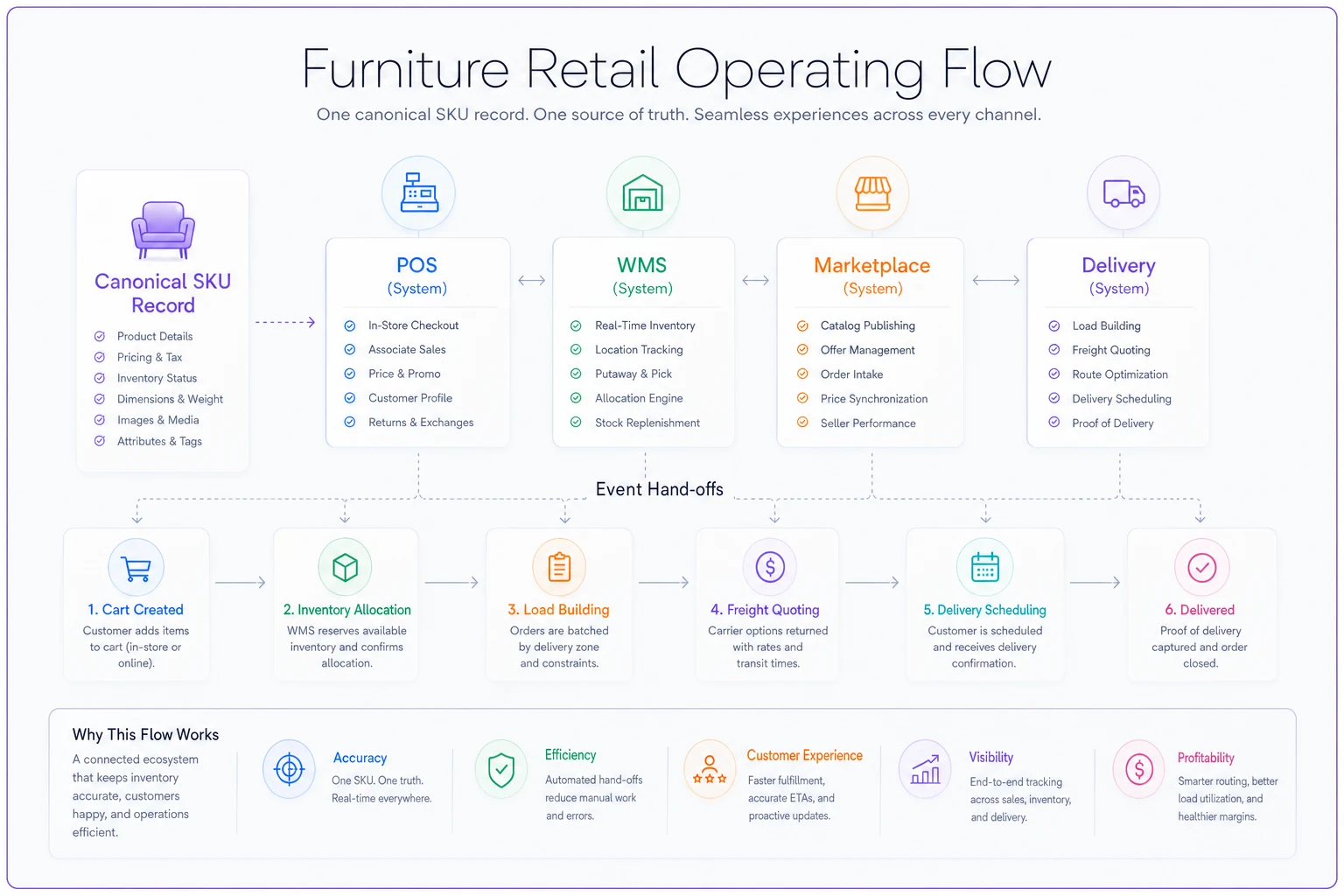
The diagram emphasizes how one canonical field (e.g., weight/dims) is read across multiple events and where failures cascade.
Reconciliation windows: catching drift before customers do
Reconciliation is the scheduled comparison of canonical against every consuming system to catch drift. Cadence depends on how fast a field changes and how expensive being wrong is.
A practical schedule:
-
Availability & lead time near-real-time or hourly. Fast-moving, high cost-of-error.
-
Listing status & price parity daily. Catches unauthorized downstream edits.
-
Physical & freight fields weekly full sweep. These rarely change, so weekly is enough — but the sweep must be complete, not sampled.
-
Full canonical audit monthly. Every field, every SKU, every channel, with documented sign-off.
The pattern worth internalizing: reconcile frequently on fields that change often, and audit thoroughly on fields that change rarely. People instinctively do the opposite — they obsess over daily price checks and never re-verify a weight field from three years ago that's been quietly wrong since the supplier switched packaging.
Error-budget SLAs: deciding what "accurate enough" means
You will never hit 100% data accuracy across thousands of bulky SKUs and multiple channels. So set an error budget instead of chasing perfection — an explicit tolerance per field category, tied to the cost of being wrong.
-
Physical/freight fields error budget near zero. A wrong weight costs real money on every shipment. Target 99%+ accuracy, remediate within 24 hours of detection.
-
Availability fields small budget acceptable. Occasional drift is inevitable with fast-moving changes; target correction within the reconciliation window.
-
Descriptive/marketing fields larger budget. A slightly off product description won't fail a delivery. Fix in the normal cadence.
When you blow the budget on a critical category — say, freight-class errors spike after a big supplier onboarding — that's your signal to pause and fix the process, not just the records. The error budget turns "our data is messy" into a measurable, prioritizable operational metric.
A real scenario: two locations, one marketplace, and a drift problem
A mid-size retailer running two showrooms added a marketplace channel and a dropship line from one supplier. Within a couple months they were seeing a rough pattern: around 6-8% of bulky orders were hitting some kind of fulfillment exception — wrong crew size dispatched, freight repriced after the sale, or a "ships in 5 days" promise that was actually 3 weeks because the dropship lead time never synced.
The root cause wasn't any single system. The marketplace listings had been edited directly by the ecommerce coordinator, the dropship lead times lived only in a supplier email thread, and receiving had never re-verified carton dimensions after the supplier switched packaging.
They did three things. Designated a single canonical record with receiving-verified physical fields. Made marketplace syndication one-directional so downstream edits became flagged exceptions instead of silent overrides. Set an hourly reconciliation on availability and a weekly sweep on physical fields.
Fulfillment exceptions dropped to roughly 2-3% over the following quarter. The bigger win was quieter: the ops manager stopped spending mornings diagnosing why an order went sideways, because exceptions now pointed straight at the field that drifted and who changed it.
Remediation playbooks: what to do when a field is wrong
Detection without a fix plan just creates anxiety. Every critical field should have a one-line remediation playbook so nobody is improvising during a live problem.
-
Weight/dims wrong, orders in transit freeze affected loads, re-verify against physical unit, recalculate freight, notify delivery scheduling, update canonical with evidence.
-
Availability oversold pause the listing, contact affected customers with revised dates before they call you, adjust allocation rules.
-
Marketplace edit detected revert to canonical, notify the editor, log the exception, and if it recurs, revoke direct edit access.
-
Dropship lead time drift confirm current lead with supplier, update canonical, re-promise open orders proactively.
The through-line: fix the record, notify the affected event, and log the cause — always all three. Skipping the log is why the same errors keep coming back; you never see the pattern.
When heavy governance is worth it — and when it isn't
When it makes sense: you're running more than one location, selling on at least one marketplace, or using any dropship or dual-sourcing arrangement. Multiple channels reading the same fields is exactly when drift gets expensive.
When it's overkill: a single showroom, a few hundred SKUs, no marketplace. A well-maintained spreadsheet and a disciplined receiving-verification habit will carry you further than a full governance stack. Don't build tiered change control for a business where one person enters all the data anyway.
Who should not do this: anyone trying to fix data problems by buying software before defining which record is canonical. Tooling amplifies whatever process you feed it. Point a syndication platform at three conflicting sources of truth and you'll just spread the errors faster and more consistently.
Where tooling actually helps
Once your canonical record and rules exist, the manual version becomes unsustainable at scale — nobody can hand-reconcile thousands of SKUs across four channels every week. This is where AI-assisted operational platforms earn their place: flagging when a downstream edit diverges from canonical, catching a weight change that would reprice open orders before anything ships, surfacing lead-time drift from supplier communications rather than waiting for a customer complaint.
The value isn't automation for its own sake — it's that reconciliation and exception-catching happen continuously in the background instead of depending on someone remembering to run the weekly sweep. But the tooling only works on top of clean governance rules. Get the canonical record and change-control tiers right first; the automation is what keeps them honest as you grow.
Bringing it together
Bulky furniture punishes bad master data harder than almost any other retail category, because a wrong field doesn't just misprice a widget — it sends the wrong crew, in the wrong truck, on the wrong day, while the customer is standing there watching. The retailers who stay sane as they add locations and channels are the ones who decided early that there is exactly one canonical version of each SKU, that physical fields get verified against real units, and that every downstream system either receives that truth or raises its hand when it disagrees.
Start with the canonical record. Layer on syndication rules and tiered change control. Set reconciliation windows matched to how fast each field moves, and error budgets matched to how much being wrong costs. Do that, and the daily "why did this order go sideways" investigations mostly disappear — replaced by a system that tells you which field drifted, who changed it, and what it touched.
Ready to elevate your furniture business?
Join 500+ furniture retailers using Hosyly to increase efficiency, improve customer satisfaction, and grow revenue.