



Most margin leakage in furniture retail doesn't happen because someone priced a sofa wrong. It happens because the same sofa is priced three different ways across three channels, and nobody owns the gap between them. The showroom tag says one thing, your Shopify store says another, and the marketplace listing quietly repriced itself overnight because a repricer rule fired on a competitor who's selling a lookalike at a loss.
You don't feel this as one big hit. You feel it as a slow bleed — a return that eats the delivery margin, a marketplace promo that stacked on top of your own sale, a fulfillment fee that didn't get recalculated when the order shipped from a different node. By the time it shows up in the month-end P&L, it's untraceable. You know margin slipped. You just can't point to where.
The fix isn't tighter pricing. It's a control plane — a governing layer that decides which channel an order routes to, when prices are allowed to change, what guardrails block a bad move before it happens, and what escalates to a human when something's off. For anyone running channel governance furniture marketplace operations across more than one selling surface, this is the difference between scaling cleanly and scaling your chaos.
Where the leakage actually hides
Before fixing anything, it helps to name the specific places furniture margin disappears across channels. These aren't theoretical — they're recurring patterns that show up once a retailer runs more than one channel at real volume.
-
Routing leakage. An order comes in on the marketplace but gets fulfilled from the node with the highest cost-to-serve, because routing defaults to "closest warehouse" instead of "lowest landed cost."
-
Repricing leakage. An automated repricer drops a price to win a buy-box or match a competitor, but never checks the floor that accounts for delivery, install, and the marketplace's own commission.
-
Promo stacking. A site-wide 10% code lands on top of a marketplace coupon the retailer forgot was still live. Now you're 22% off on a product with a 31% gross margin.
-
Fulfillment-fee drift. Delivery and install fees are set per channel but calculated on stale assumptions. When fuel surcharges or crew costs move, the fees don't.
-
Return asymmetry. A marketplace return policy is more generous than your own, so customers buy on your site and return through the easier channel — and the reverse logistics cost gets booked to the wrong P&L.
What connects all of these: each one is a decision that currently has no owner and no rule. Someone set it once and walked away. The control plane exists to make those decisions explicit, consistent, and reviewable.
Why this breaks worse as you add channels
A single-channel retailer rarely has this problem. One price, one fulfillment path, one return policy. The math is legible.
Eliminate inventory headaches and order delays.
Hosyly streamlines your furniture orders and stock management for seamless store operations.
- Real-time inventory tracking
- Automated order processing
- Customer notifications & engagement
No credit card required
Add a second channel and it feels manageable — you just mirror everything. The trouble starts around the third channel, or when one channel starts running its own promotional calendar you don't fully control (which is almost every marketplace). Now you have combinatorial complexity: price × channel × promo × fulfillment node × return path. The number of states explodes, and human attention doesn't scale with it.
What shows up in furniture operations specifically — because the items are bulky, high-ticket, and expensive to move — is that the fulfillment dimension makes channel governance harder than it is in, say, apparel. A pricing mistake on a $40 lamp is annoying. A routing mistake on a $2,400 sectional that ships from the wrong node and eats $180 in extra freight is a different problem. The stakes per transaction are high enough that you can't just absorb the leakage and make it up on volume.
This is also why generic omnichannel rules fail furniture retailers. Treating a dining table like a t-shirt — same return window, same "ship from anywhere" logic, same blanket free-shipping threshold — quietly destroys margin. We've written about the hidden cost of one-size-fits-all omnichannel rules in more depth, and the control plane is essentially the structured answer to that problem: differentiated rules, enforced automatically, per channel and per item class.
The four layers of a channel control plane
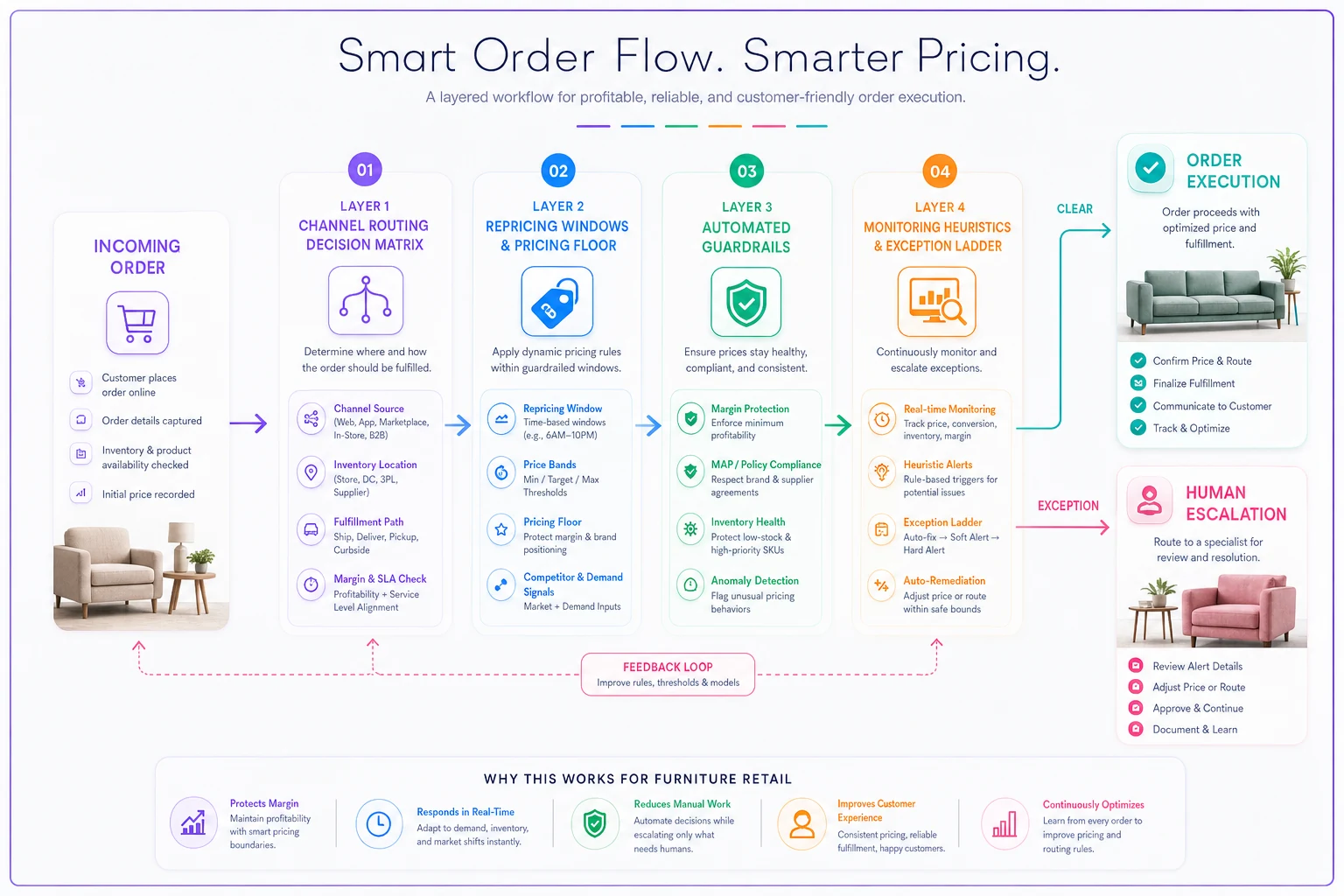
Think of the control plane as four stacked layers, each answering a different question. You can build these incrementally — most retailers already do pieces of this manually without calling it a system.
Here's a quick diagram to visualize the flow through the layers.
1. The channel routing decision matrix
This answers: when an order arrives, where does it fulfill from, and is this channel even the right place to sell this unit?
| Factor | Why it matters | Typical rule logic |
|---|---|---|
| Landed fulfillment cost | Freight dominates margin on bulky items | Route to lowest total cost node, not nearest |
| Node inventory vs. demand | Avoid stranding showroom demo units | Protect showroom stock below threshold |
| Channel commission | Marketplace takes 8–15% off the top | Deprioritize high-commission channel when margin is thin |
| Delivery SLA by region | Failed/late deliveries trigger refunds | Only route if node can hit promised window |
| Return rate by channel | Some channels return 2–3x more | Factor expected reverse cost into routing |
The matrix doesn't need to be exotic. It needs to be written down and applied the same way every time. The failure mode isn't a bad matrix — it's no matrix, where routing is decided ad hoc by whoever processes the order that day.
2. Repricing windows and the pricing floor
Automated repricing is where furniture retailers get burned most predictably. A repricer that chases the buy-box without a hard floor will, sooner or later, sell you into a loss.
The fix is two-part: windows and floors.
Repricing windows control when prices are allowed to move. Letting an algorithm reprice continuously, 24/7, means you can't audit what happened or why. A saner setup: prices can adjust within defined windows (say, twice daily), and any move outside a set percentage band pauses for review instead of auto-executing.
The floor is non-negotiable. For every SKU on every channel, there's a landed-margin floor the price cannot cross — and that floor has to include the channel's commission, the expected delivery and install cost, and a return reserve. This is the discipline we laid out in pricing governance for bulky furniture SKUs; the control plane is where that governance gets enforced rather than just documented.
One pattern worth watching: retailers set a floor based on product margin and forget that the same SKU has different floors per channel because commissions differ. Your site floor and your marketplace floor should not be the same number.
3. Automated guardrails
Guardrails are the rules that block a bad action before it executes. They sit between intent and execution.
-
No price below channel-specific landed floor. Hard block, no exceptions without approval.
-
No stacking of more than one promotional discount on a single order without a flag.
-
No routing to a node that can't meet the stated delivery SLA for the destination.
-
No listing goes live without delivery/install fees populated for that region.
-
No markdown on a SKU that's already flagged for clearance through another channel — avoid cannibalizing your own recovery plan.
That last one connects directly to how you sequence disposition. If you're moving aged stock, you don't want a live repricer undercutting your planned clearance sequencing on a different surface. Guardrails keep your deliberate strategy from being overridden by an automated reflex.
4. Monitoring heuristics and exception ladders
Guardrails prevent known bad moves. Monitoring catches the unknown ones — the drift you didn't write a rule for yet.
-
Gross margin on any channel drops more than ~4 points week-over-week
-
A single SKU's price diverges more than ~8% across channels
-
Return rate on a channel spikes above its trailing 90-day average
-
Fulfillment cost per order on a node climbs while order mix is unchanged
-
Buy-box win rate jumps suddenly (often means you repriced too aggressively)
When a heuristic trips, it feeds an exception ladder — a defined escalation path so nothing sits in limbo. Without that ladder, exceptions pile up in a Slack thread or someone's inbox and get resolved inconsistently, if at all.
A working exception ladder
Here's a concrete escalation structure you can adapt. The point is that every exception has a clear owner and a time limit before it climbs.
-
Auto-flag (minute 0). The monitoring rule fires. The affected listing or order is tagged and, if it's a pricing or routing exception, temporarily held at the last known-good state.
-
Tier 1 review — operations associate (within 4 hours). Checks for obvious causes: stale fee data, a promo that should have expired, a competitor doing something irrational. Resolves or escalates.
-
Tier 2 review — channel/pricing owner (same day). Handles anything touching the floor, a multi-channel price divergence, or a routing change that affects cost-to-serve. Can override a guardrail with a logged reason.
-
Tier 3 — merchandising + finance (within 48 hours). For structural issues: a floor that's set wrong, a channel that's structurally unprofitable, a return policy mismatch that needs a policy fix rather than a one-off patch.
The discipline that matters most is the logged reason at Tier 2. Every override should leave a trail. Six weeks later, when you're trying to understand why margin slipped on a product line, the override log tells you exactly which decisions were made outside the rules and why. Without it, you're back to untraceable bleed.
A realistic scenario
A mid-sized furniture retailer running a showroom, their own website, and two marketplaces watched blended gross margin slide from the low 40s toward the mid-30s over a couple of quarters, with no obvious cause. Sales volume was fine. Nothing in the P&L screamed.
When they actually traced it, three things were happening simultaneously. Their marketplace repricer had been quietly matching a competitor on roughly 40 SKUs, drifting several of them below true landed margin once commission and freight were counted. A recurring 10%-off email code was stacking on marketplace coupons for a chunk of overlapping customers. And about a fifth of marketplace orders were routing to a node that added somewhere between $90 and $140 in extra freight per order, because the routing logic defaulted to inventory availability rather than landed cost.
None of these were catastrophic alone. Together they were leaking a few margin points across a meaningful slice of revenue — somewhere in the low-to-mid five figures per quarter, mostly invisible until someone went looking.
Putting a control plane in place didn't require new pricing talent. It required channel-specific floors with a hard block, repricing confined to twice-daily windows with an auto-pause outside an 8% band, a guardrail against promo stacking, and a landed-cost-first routing matrix. Within about two months, blended margin recovered most of the gap — and exceptions started surfacing in days instead of being discovered a quarter late.
When a formal control plane makes sense
This level of structure isn't for everyone.
It makes sense when you're running three or more selling surfaces, your SKUs are high-ticket enough that per-transaction mistakes hurt, and you've noticed margin drifting without a clear culprit. It also makes sense the moment you turn on any automated repricing — automation without guardrails is how most of this leakage starts.
It's probably overkill when you're single-channel, you have a small enough catalog to govern by hand, or your products are low enough value that the leakage is genuinely immaterial. Don't build a four-tier exception ladder for a 60-SKU shop selling off one website.
Who should not rush into this: retailers whose underlying cost data is a mess. A control plane enforces floors and routes orders on landed cost — if your fulfillment costs and commissions aren't clean, you'll just automate decisions off bad numbers faster. Get the cost-to-serve math trustworthy first, then build the governing layer on top.
How this ties into the rest of the operation
The reason to think of this as a control plane and not a pile of individual rules is that the four layers only work when they share the same source of truth. Your routing matrix, your floors, your guardrails, and your monitoring all need to read from the same cost, inventory, and commission data. When they don't — when pricing lives in one spreadsheet, routing in the warehouse manager's head, and returns in a third system — the gaps between them are exactly where margin leaks.
This is where operational software earns its place: not as a magic pricing brain, but as the layer that holds the rules consistently, applies them the same way across every channel, catches the exceptions no human would notice at 2 a.m., and keeps the override log that makes month-end explainable instead of mysterious. The automation isn't the point. The consistency is. The software just makes consistency achievable at a scale where human attention runs out.
The retailers who get channel governance right aren't the ones with the cleverest repricing algorithm. They're the ones who decided, deliberately, which decisions get made by rule, which get made by a person, and what happens in the gap between the two. Build that layer, keep the log honest, and the slow bleed you couldn't trace becomes a set of decisions you can actually see — and fix.
The retailers who get channel governance right aren't the ones with the cleverest repricing algorithm. They're the ones who decided, deliberately, which decisions get made by rule, which get made by a person, and what happens in the gap between the two. Build that layer, keep the log honest, and the slow bleed you couldn't trace becomes a set of decisions you can actually see — and fix.
Ready to elevate your furniture business?
Join 500+ furniture retailers using Hosyly to increase efficiency, improve customer satisfaction, and grow revenue.