



That sectional sitting in your warehouse for eight months isn't just tying up $3,400 in capital. Every week you hold it, you're burning roughly $42 in storage costs, watching recovery value slip around 2%, and blocking space that could move newer inventory through your clearance channels.
Most furniture retailers approach clearance backwards. They start with the easiest option—usually the showroom floor at 40% off—then work down through increasingly desperate channels until something sells. By the time that sectional reaches a third-party liquidator, you're recovering maybe $800 on a piece that cost you $2,100.
The real problem isn't which channels you use. It's having no clear triggers for when to move inventory between them, no real calculation of logistics costs, and no rules for which items should skip certain channels entirely based on their bulk and condition.
Why furniture clearance becomes a logistics nightmare
The typical clearance decision looks simple enough. Item hasn't sold in 90 days? Mark it down. Still sitting at 120? Deeper discount. At 180 days, send it to auction.
Furniture throws unique wrenches into that progression. A bedroom set might need $280 in white-glove delivery to reach a refurb buyer 40 miles away. A slightly damaged dining table could sell at full recovery through your outlet—if you had space and could justify the $95 transport cost. Meanwhile, your third-party reseller cherry-picks items, your auction house charges 22% commission plus pickup fees, and every channel requires different staging, photography, and documentation.
What starts as a clearance strategy turns into a logistics puzzle where one wrong channel decision flips a profitable recovery into a loss.
The hidden costs that kill furniture recovery rates
Standard clearance math looks at sale price versus original cost. Furniture requires a completely different calculation—one most retailers miss until they're already underwater.
Eliminate inventory headaches and order delays.
Hosyly streamlines your furniture orders and stock management for seamless store operations.
- Real-time inventory tracking
- Automated order processing
- Customer notifications & engagement
No credit card required
Consider a leather recliner that cost you $1,450. Four months without a sale, and you're evaluating options:
| Channel | Potential Sale Price | Direct Costs | Net Recovery |
|---|---|---|---|
| Floor discount (40% off) | $1,740 | $0 | $1,740 |
| Outlet store | $1,200 | $85 transport + $45 staging | $1,070 |
| Refurb program | $950 | $120 repair + $95 delivery | $735 |
| Third-party reseller | $680 | $55 transport + 15% commission | $523 |
| Auction | $520 | $75 pickup + 22% commission | $331 |
Those numbers assume everything goes smoothly. That floor discount might consume another two months of showroom space. The outlet could take three weeks to sell through. The refurb program might require warranty coverage you hadn't accounted for.
Worse, most furniture stores track none of these actual recovery costs. They see a $950 refurb sale as better than a $680 reseller transaction—missing that the reseller actually nets $200 more after logistics.
Building your clearance decision tree
Effective clearance sequencing requires specific, measurable triggers based on item characteristics, time in inventory, and total recovery potential. Not general guidelines—actual criteria.
Your first decision point is condition and bulk. A pristine sofa might flow straight to your outlet, while a scratched coffee table needs refurb assessment first. Oversized pieces—sectionals, bedroom sets—need special routing rules because transport costs can hit 15% or more of recovery value.
-
Week 1–8
Premium floor space
— New arrivals stay in prime showroom positions. No discounts yet, but start tracking view-to-purchase ratios. Items getting fewer than 30 customer interactions per week get flagged for repositioning. -
Week 9–12
First markdown zone
— Move to secondary floor space with 15–20% off. This catches price-sensitive buyers without training customers to wait for deeper cuts. Calculate your carrying cost here—at typical furniture margins, you're losing money if something sits past week 12. -
Week 13–16
Channel evaluation
— This is where most stores get it wrong. Instead of automatically deepening discounts, evaluate three paths: outlet transfer if space is available and item condition is A-grade, refurb program if damage is minor and repairable under $150, or bundle opportunity with newer inventory. -
Week 17–20
Aggressive recovery
— Now you're in loss-mitigation mode. Calculate total sunk costs including storage, opportunity cost, and depreciation. The target isn't profit anymore—it's minimizing total loss. Third-party resellers become attractive here despite lower prices because they eliminate ongoing costs immediately. -
Week 20+
Final disposition
— Auction or donation. And yes, donation is a real option. The tax write-off combined with eliminated storage costs often beats auction proceeds after fees.
This flow maps the routing decisions by age, condition, and logistics cost.
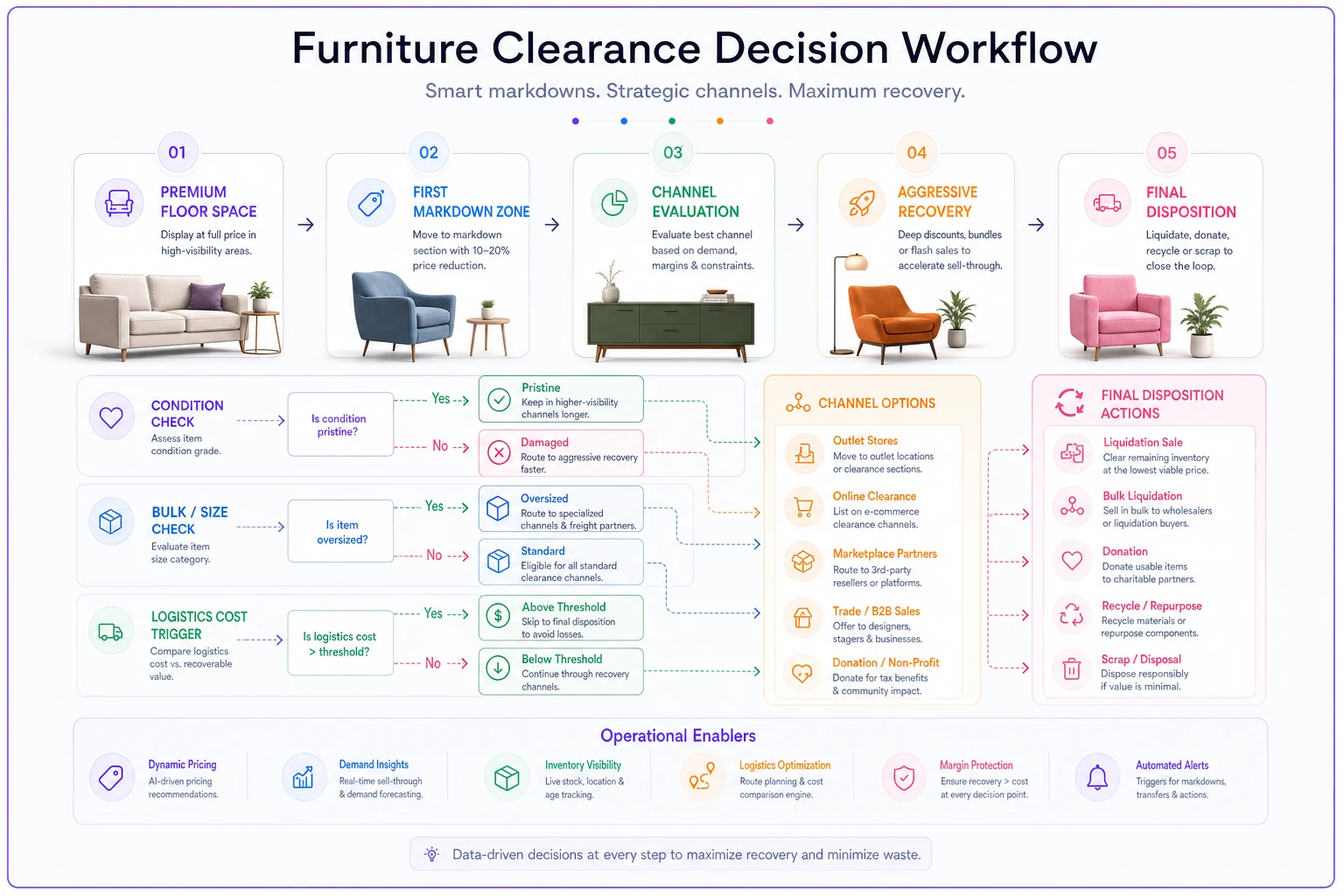
Most stores skip straight from markdown to liquidation and wonder why their recovery numbers are so bad. Working through each stage systematically changes that.
Managing logistics costs across clearance channels
Transport and handling costs vary significantly between channels, and furniture's bulk makes that variation business-critical.
Your outlet store might be 15 miles away, costing $85 per truckload for internal transport. Sending that same truckload to a refurb facility 30 miles away costs $180 because they require scheduled appointments and won't take mixed loads. Third-party resellers might pick up for free—but only if you hit their minimum value threshold of around $2,500 per load.
Batch shipments by destination to reduce per-item transport costs and meet reseller minimums when possible.
Smart sequencing accounts for batching. Instead of sending individual pieces through channels as they age, you accumulate channel-specific inventory until transport makes financial sense. That means holding a week-17 recliner for a few extra days if it fills a truck to your outlet rather than paying partial-load rates.
The math gets complicated fast. A dining set might pencil out at $1,400 recovery for outlet transfer. But if you're only filling 40% of a truck, your effective transport cost jumps from $85 to $212, dropping net recovery below what the third-party reseller would pay anyway. Most stores never actually do this math—they just see the sale price and call it a win.
Staging rules that prevent clearance bottlenecks
Different channels require different prep, and furniture's size makes staging mistakes expensive.
Your showroom floor needs minimal work—maybe a quick vacuum and polish. That same sofa heading to your outlet needs full cleaning, fresh photography, updated price tags, and warranty documentation. Send it to refurb without proper damage documentation and you'll spend three days arguing over repair scope. Ship to auction without dimensional photos and they'll either lowball the listing or reject it entirely.
Here's what staging actually involves by channel:
Outlet staging:
-
Deep clean (budget around 20 minutes per piece)
-
New photography if the item is over 60 days old
-
Printed spec sheets showing original and outlet pricing
-
Warranty transfer documentation
-
Load consolidation area (need at least 200 sq ft)
Refurb staging:
-
Detailed damage photography with measurements
-
Repair estimate from your service team
-
Cost-not-to-exceed agreement before shipping
-
Quality standards documentation
-
Return logistics plan if repairs go over budget
Reseller staging:
-
Inventory manifest with model numbers
-
Original purchase documentation
-
Clean, accessible loading area
-
4-hour pickup window commitment
-
Mixed-load organization if combining smaller items
Auction staging:
-
Professional photography (budget $25–50 per lot)
-
Detailed condition reports
-
Dimensional documentation
-
Reserve price agreements
-
Pickup scheduling flexibility—usually a 7–10 day window
Skipping proper staging saves maybe two hours upfront and costs days of back-and-forth negotiation, revised pricing, and logistics delays. It's one of those shortcuts that feels efficient until you're dealing with the fallout.
When to break your own sequencing rules
Rigid channel sequencing sounds good in theory. In practice, profitable clearance requires knowing when to override it.
Season changes override time-based triggers. That outdoor furniture set might be 16 weeks old in October—technically ready for outlet transfer. But holding until March for your spring floor refresh could mean full-price sales instead of 40% recovery. Five months of storage runs you roughly $200, but an $1,800 difference in recovery makes waiting the obvious call.
Bulk orders create completely different economics. A hotel replacing their furniture might buy your entire clearance inventory at 35% of retail—below your usual outlet pricing, but with zero logistics costs and immediate payment. When someone offers $45,000 for inventory you'd recover $52,000 on through mixed channels over three months, the time value of money plus eliminated logistics often favors taking the bulk deal.
Space constraints force channel jumping too. If your outlet is full and new inventory arrives next week, a week-14 sectional might go straight to reseller instead of waiting for outlet space to open. The $400 difference in recovery beats paying emergency storage or turning away incoming profitable inventory.
Recovery tracking most stores miss
Tracking clearance performance requires more than sale prices. You need total recovery metrics that account for all costs and time.
-
Days from clearance trigger to final sale
-
Total transport and staging costs
-
Storage costs during the clearance period
-
Opportunity cost of space utilized
-
Staff time for channel-specific preparation
-
Return or warranty claim rates by channel
One furniture store discovered their refurb channel—despite returning 65% of original cost—actually lost money after repair costs, extended storage during refurb, and a 12% return rate from quality issues. Their "worst" channel, donation, actually performed better when you factored in tax benefits and eliminated storage costs.
That kind of tracking reveals real patterns. Leather items might recover better through auction than outlet because of collector demand. Assembled furniture could net higher prices through reseller channels than your own outlet because buyers sometimes trust third-party condition assessments more than retailer claims. You don't find that out from headline recovery percentages—you find it from tracking the full picture.
Technology and clearance optimization
Manual clearance decisions work fine until you're juggling 200+ SKUs across five channels with different logistics windows and staging requirements. Miss one sequencing trigger and you're looking at the difference between profitable recovery and straight losses.
Modern furniture operations use systematic triggers and automated channel routing to manage this. Not full automation—furniture still needs human judgment for condition assessment and exceptions—but consistent operational workflows that don't rely on someone remembering to audit aging inventory every week.
The most effective approach combines rule-based sequencing with exception handling. Your furniture clearance channel playbook triggers based on age, condition codes, and seasonal factors. Overrides stay available for bulk opportunities, space constraints, or market timing.
This structure eliminates the most common failure points: items aging past their optimal channel window, logistics costs eating recovery value, and staging bottlenecks preventing timely disposition. When every piece follows consistent evaluation criteria with clear escalation triggers, clearance stops being a loss-mitigation exercise and starts functioning like an actual profit center.
The clearance metrics that actually matter
Forget tracking simple recovery percentages. Effective clearance management requires understanding channel velocity, total cost recovery, and opportunity impacts.
Channel velocity tells you how quickly each option actually moves inventory. Your outlet might average 21 days to sale, while auction takes 35 days including staging and pickup windows. That two-week difference represents roughly $90 in carrying costs for a typical dining set—enough to swing channel decisions.
Total cost recovery includes every expense from clearance trigger to final payment. A $2,400 bedroom set selling for $1,400 through your outlet might look like 58% recovery. Add $140 in transport, $60 in staging labor, $180 in storage during the outlet period, and $45 in additional photography, and actual recovery drops to around 44%. Meanwhile, a "terrible" 35% reseller offer nets out around 31% after minimal logistics—a much smaller gap than the headline numbers suggest.
Opportunity impact might be the most overlooked metric. Every week a clearance item occupies outlet space blocks a potentially faster-moving piece from that channel. A sectional tying up 60 square feet for five weeks doesn't just cost storage—it blocks roughly $3,500 in potential sales from better-performing inventory.
Making clearance sequencing work tomorrow
The difference between profitable and painful furniture clearance isn't about finding better channels. It's about knowing which items belong where, moving them at the right triggers, and calculating true recovery after all logistics costs.
Start by mapping your actual clearance channels with real costs. Not theoretical percentages—actual transport quotes, real staging time, measured storage costs. Build clear triggers for when items move between channels, with specific rules for bulky items where logistics costs can exceed recovery value.
Most importantly, track total recovery, not just sale prices. That "successful" refurb program might be bleeding money after repair and logistics costs. The "desperation" auction channel could be your most profitable option for certain categories. You won't know until you measure the complete picture.
Your clearance playbook doesn't need to be perfect. It needs consistency, clear triggers, and actual cost tracking. Get those three things right and clearance shifts from a necessary evil to a manageable—sometimes even profitable—part of your operation.
The sectional that's been sitting for eight months? You now know exactly when to move it, where it should go, and what you'll actually recover after logistics costs. That's the difference between clearance that slowly bleeds your margins and clearance that protects them.
Ready to elevate your furniture business?
Join 500+ furniture retailers using Hosyly to increase efficiency, improve customer satisfaction, and grow revenue.