



Most furniture retailers treat aftercare the way they treat the loading dock: necessary, slightly annoying, and definitely not where the money gets made. Warranty claims get absorbed. Service techs get paid whether they're busy or not. Parts sit in a back room with no SKU, no price, and no owner. And the whole thing shows up on the P&L as a vague drag on gross margin that nobody wants to look at too closely.
The frustrating part is that aftercare is one of the few areas of a furniture business with structurally high margins — if you productize it. A $180 reupholstery touch-up on a sofa you sold two years ago is almost pure contribution margin once your tech is already in the truck. The problem isn't demand or margin potential. The problem is that aftercare lives as a series of one-off favors instead of a product line with a taxonomy, a price list, fulfillment options, and a P&L you can actually forecast.
This is a blueprint for building that. We'll go taxonomy → kitization → fulfillment options → attach experiments → margin waterfalls, with worked numbers and bookkeeping templates along the way. The goal is to get to a point where aftercare isn't "the thing we do to keep customers happy" but a line item your bookkeeper can report on monthly and your service lead can be held accountable for.
Why aftercare stays stuck as a cost center
The reason this happens across almost every mid-sized furniture operation is structural, not lazy. Aftercare sits in the gap between three departments that don't talk the same language.
Merchandising thinks in SKUs and margin per sqm. Fulfillment thinks in routes and crews. Finance thinks in cash and AR. Aftercare touches all three but belongs to none of them, so it defaults to whoever picks up the phone — usually a sales associate improvising a price, or a service manager eating the cost to avoid a bad review.
-
Service calls get quoted differently depending on who answers
-
Parts get pulled from stock with no cost capture, so repairs look "free"
-
Warranty vs. billable gets decided emotionally, not by policy
-
There's no revenue line for aftercare, so nobody optimizes it
The deeper issue is that aftercare has no taxonomy. If you can't name and categorize the work, you can't price it, kit it, staff it, or forecast it. Everything downstream — pricing, margin analysis, attach-rate experiments — depends on first building a clean classification of what aftercare actually is.
Step 1: Build the aftercare taxonomy
Before you can commercialize anything, you need a shared vocabulary for the work. A good taxonomy separates aftercare into categories that have genuinely different cost structures, because that's what drives pricing and fulfillment later.
Eliminate inventory headaches and order delays.
Hosyly streamlines your furniture orders and stock management for seamless store operations.
- Real-time inventory tracking
- Automated order processing
- Customer notifications & engagement
No credit card required
Here's a working taxonomy that holds up across most retailers:
| Category | Example | Cost driver | Typical margin profile |
|---|---|---|---|
| Consumable / protective | Fabric protection kit, leather conditioner, touch-up pen | Product cost only, no labor | Very high (60–75%) |
| Self-service repair | Replacement feet, cushion inserts, hardware packs | Parts + light pick/pack | High (50–65%) |
| In-home minor service | Tighten frame, adjust recliner mechanism, re-level | Labor + travel | Medium (35–50%) |
| In-home major service | Reupholster seat, replace spring deck, motor swap | Labor + parts + travel + time risk | Variable (20–45%) |
| Warranty-covered | Manufacturer defect repair | Recoverable from supplier | Net-neutral to positive if claimed properly |
The single most useful move here is separating warranty-covered from billable at the taxonomy level, not at the invoice level. Most retailers decide this reactively, call by call. When you classify it upfront, you can route warranty work to supplier recovery and billable work to a priced service product. If you're still blurring these two, the earlier piece on turning warranty claims into service revenue covers the SLA side of that split in detail.
Worth flagging: the categories with the highest margin — consumables and self-service parts — are almost always the ones retailers neglect most, because they feel too small to bother with. That instinct is backwards. The small, high-margin, low-labor categories are exactly what fund the service team.
Step 2: Kitization — turn loose work into sellable units
A taxonomy tells you what the work is. Kitization turns it into something with a SKU, a cost, and a price. This is where most of the operational leverage lives.
The principle is simple: anything you do more than a handful of times a month should be a kit, not an improvisation. A "recliner won't recline" service call shouldn't be re-diagnosed from scratch every time. It should map to a kit — the common failure parts, the labor time estimate, the price, and the diagnostic checklist.
-
The parts (with captured cost, not "from the back room")
-
A standard labor time
-
A fixed or banded price
-
A fulfillment method (ship, in-home, customer-installable)
-
A warranty-or-billable default
Kitizing parts properly is its own discipline — getting min/max levels right so you're not holding dead stock or stocking out on the parts you need weekly. The breakdown on sizing spare-parts kits with min/max and reorder triggers is the companion to this; without that stocking logic, your service kits will either tie up cash or fail on availability.
A worked kit example
-
Insert cost (landed)
~$42 per cushion
-
Zipper/cover rework parts
~$8
-
Labor
0.4 hrs at a loaded tech cost of ~$38/hr = ~$15
-
No travel if customer-installable (ship-to-home option)
Fully loaded cost for a two-cushion kit: roughly $122. Price it at $249 shipped and you're sitting around 51% contribution margin before overhead. Offer an in-home install upsell at +$89, and because the tech is already routing nearby, your incremental cost is mostly travel time — the attach lifts blended margin rather than diluting it.
Set min/max around weekly usage for common kit parts to avoid both dead stock and stockouts.
The pattern: kitization converts tribal knowledge into a repeatable unit economics model. Once a repair is a kit, you can forecast demand, stock parts to it, and — critically — measure its margin.
Step 3: Fulfillment options as a pricing lever
One repair can be delivered three different ways, and each has a completely different cost-to-serve. Retailers who offer only one fulfillment method leave margin on the table and lose sales to friction.
The three core fulfillment modes:
-
Ship-to-customer (self-install) lowest cost, highest margin, but only works for parts the customer can handle. Great for feet, hardware, cushion inserts, touch-up kits.
-
In-home scheduled service highest customer value, but carries travel and scheduling cost. Margin depends entirely on route density.
-
Depot / bring-in underused in furniture, but viable for smaller items and reupholstery. Lower travel cost, customer bears the transport friction.
Route density is the hidden variable in in-home service margin. A single in-home visit with 40 minutes of driving each way is a margin-killer. The same visit, batched with three others in the same zip cluster, is highly profitable. Your fulfillment pricing shouldn't be flat — it should nudge customers toward the lowest-cost viable mode.
-
Ship kit, self-install
$249
-
In-home install (next available route day)
$338
-
In-home install (customer-chosen day)
$389
That third option prices in the lost density. Customers who want convenience pay for it; customers who are flexible let you batch them. Either way, you're not absorbing the scheduling cost silently.
Step 4: Attach experiments — funding the service team
This is the part that separates aftercare-as-afterthought from aftercare-as-product-line: attach rate. The whole economic case for staffing a service team rests on how often you can attach aftercare to a primary sale or a prior customer.
An attach experiment is a structured test of where and when you offer aftercare, measured against a baseline. The common failure is offering everything at checkout and nowhere else. In real operations, the highest-converting attach points are often after the sale, not during it.
-
Delivery-day offer — the crew is in the home, the product is new, protection kits attach well here
-
90-day follow-up — "how's the sofa?" with a conditioning/maintenance offer
-
Checkout add-on — fabric protection, extended service plans
-
Reactive service call — upsell a maintenance plan when they call about one issue
How to run a clean attach experiment
-
Pick one attach point and one offer (e.g., delivery-day fabric protection at $129)
-
Run it for a fixed window — say 6–8 weeks — against the period before
-
Track attach rate (% of eligible orders that bought), not just revenue
-
Track margin contribution, not gross sales
-
Only then layer in a second offer or point
A realistic early result: moving delivery-day protection attach from near-zero to around 12–15% of eligible deliveries. On roughly 200 deliveries a month at $129 with ~65% margin, that's somewhere in the range of $2k–$3k of monthly contribution from one attach point — enough to meaningfully offset a service tech's loaded cost. That's the funding mechanism. You don't justify the service team on repair revenue alone; you justify it on the attach economics across the full customer base. The customer-lifetime profit model for aftercare goes deeper on how these attach points compound over a customer's relationship with you.
Step 5: Build the margin waterfall
Once you have priced kits and fulfillment options, you need to see where the margin actually leaks. A margin waterfall walks a repair from list price down to true contribution, stage by stage, so you can see which stage is eating you.
| Stage | Amount | Running margin |
|---|---|---|
| List price | $389 | — |
| Less parts (landed) | –$74 | $315 |
| Less tech labor (1.1 hr loaded) | –$42 | $273 |
| Less travel/route allocation | –$48 | $225 |
| Less scheduling/admin overhead | –$18 | $207 |
| Less warranty-leakage reserve | –$12 | $195 |
| True contribution | $195 (50%) |
The value of laying it out this way is that it makes the leak points obvious. In this example, travel/route allocation is the single biggest controllable cost after parts and labor. That tells you exactly where to focus: route batching, zip-cluster scheduling, and the fulfillment-mode pricing from Step 3.
The "warranty-leakage reserve" line is one people skip, and it quietly wrecks aftercare P&Ls. It's the cost of work you should have billed or recovered from a supplier but didn't — because the taxonomy wasn't clean or the claim paperwork wasn't filed. If this reserve line is large, your problem isn't pricing; it's classification discipline upstream.
Bookkeeping impact: make it show up on the P&L
None of this matters if aftercare stays invisible in your books. The most common reason aftercare never gets optimized is that there's no revenue account for it — it's buried in "other" or netted against cost of service.
-
Revenue accounts Aftercare – Consumables, Aftercare – Parts, Aftercare – Service (billable), Aftercare – Service Plans
-
COGS accounts Aftercare Parts Cost, Aftercare Labor, Aftercare Travel/Route
-
Contra/reserve Warranty Recovery (contra-expense), Warranty Leakage Reserve
With this structure, your bookkeeper can produce a monthly aftercare P&L that stands on its own. You can see contribution by category, watch attach-driven revenue grow, and hold the service lead accountable to a margin number instead of a vague "keep customers happy" mandate.
The behavior change this creates is subtle but real: once parts pulled from stock hit an Aftercare Parts Cost account, "free" repairs stop looking free. That single piece of visibility tends to tighten warranty-vs-billable discipline faster than any policy memo.
A real scenario
A regional furniture retailer with two showrooms and roughly 200 deliveries a month ran their service operation as pure cost absorption. One service tech, no aftercare revenue line, warranty and billable work blended together, parts pulled from stock with no cost capture. On paper, service looked like a ~$5k/month overhead drain.
They spent a quarter building the basics: a taxonomy separating warranty from billable, five kitized repairs for their most common issues, a three-tier fulfillment menu, and one attach experiment — delivery-day fabric protection.
The numbers after about four months weren't dramatic, but they were real. Delivery-day protection attached on roughly 13% of eligible deliveries. Billable service — now priced consistently from kits instead of improvised — brought in close to $4k–$5k monthly where it had been near zero. Warranty recovery improved because defect work was finally being classified and claimed instead of eaten. The service tech, previously a line item they talked about cutting, ended up roughly margin-neutral to slightly positive on a fully loaded basis.
No giant revenue jump. Just a cost center that stopped bleeding and started paying for itself — mostly from work they were already doing but never capturing.
When this makes sense — and when it doesn't
Productizing aftercare isn't universally worth it. It makes sense when:
-
You have enough delivery/service volume to batch routes (density is everything)
-
You sell products with recurring, predictable failure modes
-
You already employ or subcontract service labor you're paying for regardless
-
Your average ticket is high enough that aftercare attach moves real money
It's premature when your volume is too low to batch in-home visits, when your product mix is so varied that you can't kitize common repairs, or when you have no reliable parts supply to stock kits against. Forcing a service-plan program onto a shop doing 20 deliveries a month just creates overhead without the economics to support it.
-
When your volume is too low to batch in-home visits
-
When your product mix is too varied to kitize common repairs
-
When you have no reliable parts supply to stock kits against
And it's genuinely the wrong move if your core operation isn't stable yet. Aftercare commercialization is a layer on top of clean master data, reliable fulfillment, and decent parts stocking. If those foundations are shaky, fix them first — aftercare will only amplify the chaos.
Making it repeatable
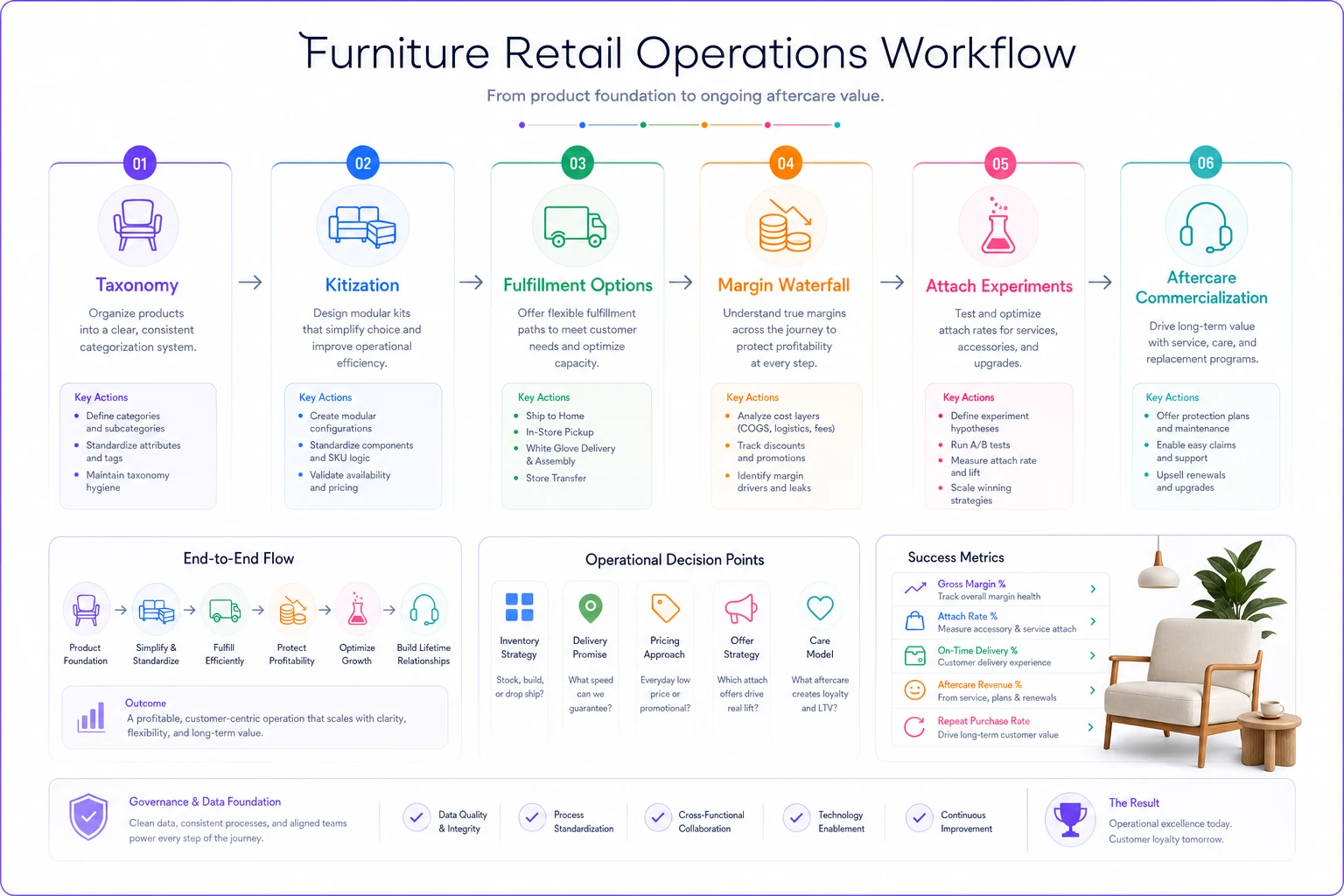
The reason to build this as a system rather than a set of tactics is that aftercare commercialization only compounds when the pieces connect. The taxonomy feeds the kits. The kits feed the fulfillment menu. The fulfillment menu feeds the margin waterfall. The attach experiments fund the team. And the bookkeeping structure makes all of it visible enough to manage.
Coordinating this across merchandising, fulfillment, and finance is where it gets operationally heavy — which is exactly why aftercare tends to live in the cracks. Keeping kit definitions, parts stocking levels, service pricing, attach data, and the resulting P&L in one connected workflow rather than scattered across a spreadsheet, a POS, and someone's memory is what separates aftercare that gets optimized monthly from aftercare that quietly reverts to improvised favors within a quarter.
Here's a simple visual of the connected workflow.
The retailers who get this right stop thinking of aftercare as the price of keeping customers happy. They treat it as a product line with a taxonomy, a price list, a margin target, and an owner — and it funds the very service team that makes the rest of the customer experience work.
The retailers who get this right stop thinking of aftercare as the price of keeping customers happy. They treat it as a product line with a taxonomy, a price list, a margin target, and an owner — and it funds the very service team that makes the rest of the customer experience work.
Ready to elevate your furniture business?
Join 500+ furniture retailers using Hosyly to increase efficiency, improve customer satisfaction, and grow revenue.