



Walk into any furniture showroom during warranty season — usually 13-15 months after major sale periods when warranties start expiring — and you'll see the same scene play out. Customer walks in with a claim on a $2,800 sectional. Sales associate looks confused. Manager gets pulled from the back. Twenty minutes of digging through paperwork. Phone call to the manufacturer. "We'll get back to you in 3-5 business days."
Meanwhile, that same store probably has two delivery crews sitting idle on Tuesday afternoons, a service tech who only works weekends, and three different warranty tiers that nobody on the floor can actually explain. That warranty claim could've been a $180 service appointment — scheduled automatically, handled by the regular crew, parts already in stock. Instead it becomes a margin-eating mess that ends with either an angry customer or eating the full replacement cost.
Why warranty management breaks down at scale
When you're selling 30 pieces a month, warranty claims feel manageable. Customer calls, you remember selling them that dining set, you handle it personally. Fine.
But somewhere around 150-200 pieces monthly, the wheels start coming off. Not because of volume alone — it's because furniture warranties operate across three completely different timelines that almost never sync up.
First timeline: customer expectations. They bought protection, something broke, they want it fixed this week.
Second timeline: manufacturer terms. Structural defects covered 5 years. Fabric 1 year. Mechanisms 3 years. Different claim processes for each, response times anywhere from 48 hours to 3 weeks depending on the vendor.
Third timeline: your actual service capacity. Techs available Tuesdays and Thursdays. Parts arriving in 7-10 days. Upholstery guy covering your area every other week.
These timelines collide exactly when the customer is already frustrated. Add in confusion about what's actually covered — customers never read the fine print — and you've got a reliable recipe for operational chaos.
Service tiers that actually make operational sense
What most stores get wrong about warranty tiers: they copy manufacturer categories instead of building around their own service capabilities.
Eliminate inventory headaches and order delays.
Hosyly streamlines your furniture orders and stock management for seamless store operations.
- Real-time inventory tracking
- Automated order processing
- Customer notifications & engagement
No credit card required
Manufacturer tiers usually look like Bronze (1 year), Silver (3 years), Gold (5 years). Clean for lawyers, useless for operations.
What works better is building tiers around response time and service type, not duration. Think airline boarding groups rather than insurance policies.
Priority tier: Next-business-day response, covers everything including cosmetic issues, loaner furniture available. Price at 12-15% of purchase price.
Standard tier: 3-5 day response, covers functional issues and structural defects, basic cleaning included. Price at 7-9% of purchase price.
Basic tier: 7-10 day response, structural defects only, customer handles cleaning before service. Price at 3-4% of purchase price.
Align pricing and promised response windows so each tier maps cleanly to specific delivery or service slots to avoid overpromising.
Each tier maps to specific operational capacity. Priority tier customers get Tuesday/Thursday slots. Standard tier gets regular delivery windows. Basic tier gets bundled into route optimization when it fits.
One store running this model saw average warranty claim resolution drop from 18 days to 6, while service revenue jumped by roughly $14k monthly. The key wasn't better warranties — it was aligning warranty promises with actual service capacity.
Warranty triage rules that prevent most disputes
Most warranty disputes happen because nobody made a clear decision upfront about what category a claim falls into. Claims bounce between sales, service, and management until someone makes an arbitrary call.
Build your triage system around three categories, each with clear next steps:
Covered Service: Anything explicitly listed in the warranty terms. Route directly to service scheduling. No additional approvals needed.
Goodwill Repair: Close calls, loyal customers, or issues that are technically customer fault but cheaper to fix than argue about. Requires one manager approval, capped at $200 per incident or $400 annually per customer.
Decline with Alternative: Not covered, but offer paid service at 30% discount. If they decline, document and close.
| Claim Type | Initial Response | Decision Maker | Next Step | Documentation |
|---|---|---|---|---|
| Obvious defect | Same day | Service desk | Schedule immediately | Photo + claim form |
| Wear and tear | Within 24 hours | Floor manager | Offer paid service | Photo + usage timeline |
| Damage during delivery | Within 2 hours | Delivery manager | Schedule priority fix | Delivery photos + signatures |
| Customer damage | Within 48 hours | Store manager | Goodwill or paid service | Detailed incident report |
| Manufacturer defect | Within 24 hours | Warranty admin | Coordinate with vendor | Vendor claim + photos |
Every path has a specific decision maker and a timeline. That's what kills disputes — clear ownership and fast response. A store implementing this framework saw warranty disputes drop from around 12 per month to 3, while actually spending less on warranty service overall.
The partner network problem
Unless you're doing $5M+ annually, you can't afford to handle every repair type in-house. But relying on outside partners creates its own mess.
Most stores end up with a patchwork of service partners: the upholstery guy who's great but only available Wednesdays, the refinishing shop that takes 3 weeks minimum, the mechanism specialist covering six stores across three counties. Coordinating between them is painful.
The fix isn't finding better partners — it's building clear handoff rules that work regardless of who's involved.
Start with service zones. Map every ZIP code you deliver to into one of three categories:
-
Primary zone Your team handles everything
-
Secondary zone Your team handles simple repairs, partners handle complex
-
Partner zone Everything goes to partners
Then create standard work packages for each repair type. Include photos, measurements, customer history, and specific outcome requirements. No more "customer says it's broken" emails to partners.
One regional chain built this system across 8 stores and 23 service partners. Average completion time dropped from 22 days to 11, and partner dispute rates fell by roughly 70%. Partners fail when they don't have clear information and expectations. Give them both, and that loose network starts functioning like an actual operation.
Converting warranty claims into recurring revenue
Most stores treat warranty service as a one-time transaction. Customer has a problem, you fix it, done. But warranty customers are literally raising their hand saying they care enough about this furniture to pay for protection.
These are your most qualified service prospects. They've already bought from you, they value their furniture, and they're willing to pay for peace of mind.
The conversion happens in three stages:
Stage 1: During the warranty claim. While fixing their issue, document everything else you notice. Loose joints on other pieces. Fabric that needs protection. Mechanisms due for maintenance. Don't try to upsell during the service call — just document.
Stage 2: The follow-up package. Within 72 hours of completing the warranty service, send a "health report" covering all their furniture. Include photos, specific observations, and preventive maintenance recommendations. Price a complete care package at roughly 40% less than individual services.
Stage 3: The maintenance contract offer. For customers who bought extended warranties, offer to continue coverage as an annual service contract when the warranty expires. Price it at 60-70% of the original warranty cost, but now include preventive maintenance visits.
A store group tracking this conversion saw about 22% of warranty customers move to service contracts, adding roughly $38k in annual recurring revenue per location. The surprising part: customers on service contracts had 40% fewer warranty claims. Preventive maintenance actually works.
When warranty automation makes sense — and when it's premature
The temptation when warranty operations get chaotic is to immediately throw software at the problem. That's usually the wrong move. Automation only works when you have clear processes to automate. Otherwise you're just creating faster chaos.
You're probably ready for a dedicated warranty management platform when:
-
You're processing more than 20 warranty claims monthly
-
You have at least 3 different warranty tiers or programs
-
Multiple people touch each claim — sales, service, admin
-
You work with outside service partners
-
Warranty disputes are eating more than 10 hours weekly of management time
Once those conditions are true, the right AI-powered operational software changes how the whole thing runs. Claims intake becomes self-service — customers submit online with photos, automatically routed to the right queue based on issue type and warranty tier. Triage gets faster because the system can flag damage types from photos, check warranty terms, and route obvious cases without human review. Scheduling coordinates across internal teams, partner availability, and parts inventory before offering appointment slots.
One furniture group implemented this across 12 stores. Warranty processing time dropped from 6 days to 1.5 days average, and service revenue increased by roughly $180k annually. More importantly, the warranty administrator role shifted from firefighting to actually improving service quality — which is what you want from a person in that seat.
Here's a rough picture of how claims flow through an automated warranty operation:
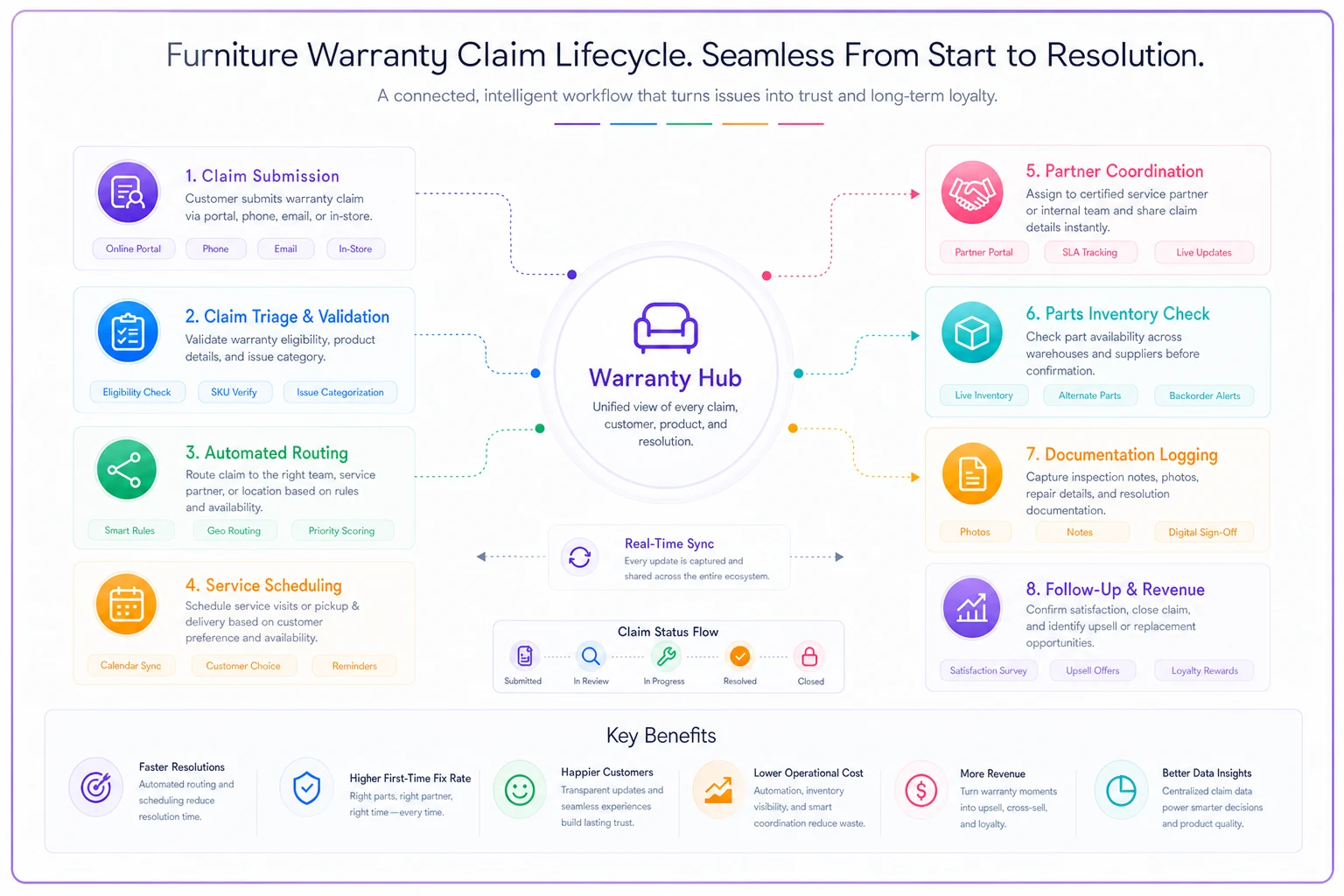
This diagram highlights the main handoffs: intake, automated triage, scheduling, partner coordination, and follow-up for revenue conversion.
Common mistakes that derail warranty operations
Mistake 1: Letting sales reps make warranty promises
Sales reps will promise anything to close a deal. "Oh, that's definitely covered" becomes "sorry, wear and tear isn't included" six months later. Fix: Only printed warranty terms matter. Train sales to say "let me confirm that's covered" and check the actual documentation.
Mistake 2: Waiting for parts before scheduling service
Customer calls with a warranty issue. You order parts. Parts arrive in 2 weeks. Then you schedule service. Total time: 3-4 weeks. Customer frustration: guaranteed. Fix: Schedule the appointment immediately for when parts are expected to arrive. If parts are late, reschedule once. Better to reschedule than leave them waiting with no timeline.
Mistake 3: Not tracking warranty cost by SKU
That beautiful Italian leather sectional might have strong margins, but if you're eating $500 in warranty claims per unit, those margins disappear fast. Track warranty costs by SKU monthly. When items consistently trigger expensive claims, it might be time to discontinue them rather than keep absorbing the warranty costs.
Mistake 4: Fighting every manufacturer warranty claim
Yes, manufacturers try to deny claims. No, fighting every denial isn't worth it. Set a threshold — usually $300-500 — below which you just handle it yourself. Document everything, track patterns, and use that data to negotiate better terms annually or switch vendors.
These aren't rare edge cases. Every multi-location furniture retailer runs into all four of them eventually, usually within the same quarter.
Building warranty operations that scale
The difference between warranty chaos and warranty revenue isn't about having perfect processes — it's about building operations that can flex with volume while holding clear service standards.
Start with the basics: clear tiers, simple triage rules, defined partner handoffs. Track everything, especially what's costing you money versus generating revenue. When patterns emerge — certain SKUs always break, certain partners always delay, certain claim types always escalate — adjust the system.
Most furniture retailers treat warranties like necessary evils. Admin headaches that come with the territory. But warranty claims are really service opportunities with built-in customer commitment. Customers have already paid for protection. They want their furniture fixed. They trusted you enough to call first.
Just like forecasting slow-moving SKUs, warranty management is about finding patterns in what seems like chaos. Once you spot them — which claims always escalate, which customers always buy service, which partners always deliver — you can build operations that turn warranty headaches into actual service revenue.
The stores that recognize this flip warranties from cost centers into profit centers. Same claims, same customers, same furniture. The only difference is treating warranty management as an operational system that drives revenue rather than an insurance program that prevents losses.
Define clear service tiers. Build simple triage rules. Create partner handoffs that actually work. Track what matters. Scale what works, fix what doesn't. Your warranty program already has customers who trust you, products that need service, and protection they've paid for — the operational structure to turn those ingredients into recurring revenue is the only thing missing.
Ready to elevate your furniture business?
Join 500+ furniture retailers using Hosyly to increase efficiency, improve customer satisfaction, and grow revenue.