


You know that feeling when a customer brings in their wobbly dining chair for a quick repair, and you have to tell them it'll be three weeks because you need to order a $0.40 furniture glide? Meanwhile, you've got seventeen replacement glass panels for a discontinued coffee table series gathering dust in the back room.
Furniture spare parts inventory is strange. Unlike floor models where you're tracking whole units, spare parts live in this operational blind spot — hundreds of tiny SKUs that each cost pennies but can hold up thousand-dollar repair jobs. Most furniture stores either ignore parts inventory entirely and order everything on-demand, or they go overboard and treat it like regular stock management.
The real challenge isn't just having parts. It's knowing which parts to stock, how many to keep, and when to reorder before you run out. Stores that get this right typically see repair turnaround drop from two or three weeks down to same-day or next-day. That difference is what separates repairs as a break-even obligation from repairs as an actual revenue stream.
Why Standard Inventory Models Break Down for Furniture Parts
Regular furniture inventory follows predictable patterns. You sell a sofa, you order another sofa. But parts inventory runs on completely different logic. A single dining set might have twelve different potential replacement parts — bolts, cam locks, levelers, corner brackets — and each one has wildly different failure rates.
Take cam locks. In a typical month, you might use around forty across various repairs. Then someone brings in a wobbly entertainment center and suddenly you need eight just for that one job. Your predictable usage pattern just got blown up by a single customer.
That volatility is why traditional min/max formulas don't hold up here. The calculations that make sense for bedroom sets fall apart for spare parts because they assume consistent demand. Parts demand is lumpy, clustered around specific furniture lines, and sometimes tied to seasonal damage patterns nobody plans for.
What tends to work is classification-based stocking — grouping parts by usage patterns and stocking accordingly. A furniture glide (high usage, low cost, universal fit) needs completely different stocking logic than a specific bracket for one desk model (low usage, medium cost, model-specific). Treating them the same is where things go sideways.
The Three-Tier Parts Classification System
Here's the framework that holds up across different store operations:
Eliminate inventory headaches and order delays.
Hosyly streamlines your furniture orders and stock management for seamless store operations.
- Real-time inventory tracking
- Automated order processing
- Customer notifications & engagement
No credit card required
Tier 1: Universal High-Runners
Parts that fit multiple furniture types and get used constantly. Furniture glides, standard cam locks, common wood screws, felt pads, universal brackets. These move almost daily.
Tier 2: Line-Specific Commons
Parts specific to your active furniture lines but with regular enough usage to justify stocking. Replacement hardware for current bedroom sets, specific brackets for your dining collections, particular fasteners for your office furniture lines.
Tier 3: On-Demand Specials
Everything else. Discontinued model parts, specialty fasteners, unique brackets, custom components. Order these as needed — the carrying cost and storage space don't justify stocking them.
The classification drives your stocking strategy. Tier 1 gets aggressive min/max levels because stockouts hit daily operations directly. Tier 2 gets moderate stocking based on how popular that furniture line actually is. Tier 3 stays at zero stock, supported by strong supplier relationships for fast ordering.
Knowing which tier a part belongs to is honestly half the battle. Most stores skip this step entirely and then wonder why their parts budget keeps ballooning without improving service speed.
Building Repair Kits That Actually Match Reality
Once parts are classified, the next move is building standardized repair kits. Most stores try to manage individual parts, which creates a nightmare of tiny SKUs to track. Pre-building kits for common repair scenarios is a much cleaner approach.
A typical dining chair repair kit might include four cam locks, four cam bolts, eight wood screws in two sizes, four furniture glides, two corner brackets, and a wood glue packet. Package those in labeled bags. Instead of pulling seven different parts for every chair repair, your technician grabs one kit. Anything unused goes into an "orphan parts" bin that gets periodically re-kitted.
The operational impact is real. Repair time drops because technicians aren't hunting for individual components. Inventory counts become manageable — you're counting twenty chair repair kits instead of 140 individual parts. Reordering simplifies because you trigger on kit quantities, not individual part levels.
Your kit mix should reflect actual repair patterns. Track repairs for a couple of months and the clusters become obvious. Maybe 35% of repairs are dining chairs, 25% are drawer slides, 20% are table wobbles, and the rest is random. Build your kit inventory to match those ratios rather than guessing.
Setting Min/Max Levels That Prevent Both Stockouts and Overstock
Most furniture stores guess at quantities or apply generic formulas without ever looking at actual usage. The right min/max levels need to account for three things: typical usage rate, supplier lead time, and the real cost of a stockout versus carrying costs.
For Tier 1 universal parts, your minimum should cover two weeks of peak usage plus headroom for one big repair job. If you typically use 30 furniture glides per week but occasionally get hit with a commercial client needing 100 for their conference room chairs, your minimum might be around 160 glides — two weeks at 30 equals 60, plus one big job equals 100.
Your maximum for Tier 1 should be your minimum plus one full reorder quantity. If glides come in boxes of 500, your maximum becomes 660. That sounds like a lot until you factor in what a stockout actually costs. A fifty-cent part shortage that delays a $200 repair job makes moderate overstock look pretty reasonable.
Tier 2 parts need tighter controls because they're line-specific. Minimum equals one week of typical usage plus enough for one average repair. Maximum equals minimum plus the smallest reasonable order quantity. For brackets that only fit your Riverside dining collection, you might keep 8 minimum, 20 maximum.
The real optimization happens when you align reorder points with supplier minimums and shipping thresholds. If your hardware supplier offers free shipping at $200, you batch reorders to hit that threshold. Carrying costs get partially offset by shipping savings, which changes the math on how much overstock is acceptable.
Reorder Triggers That Account for Supplier Reality
Setting reorder points means nothing if the actual reordering process is broken. Here's a real example with cam locks:
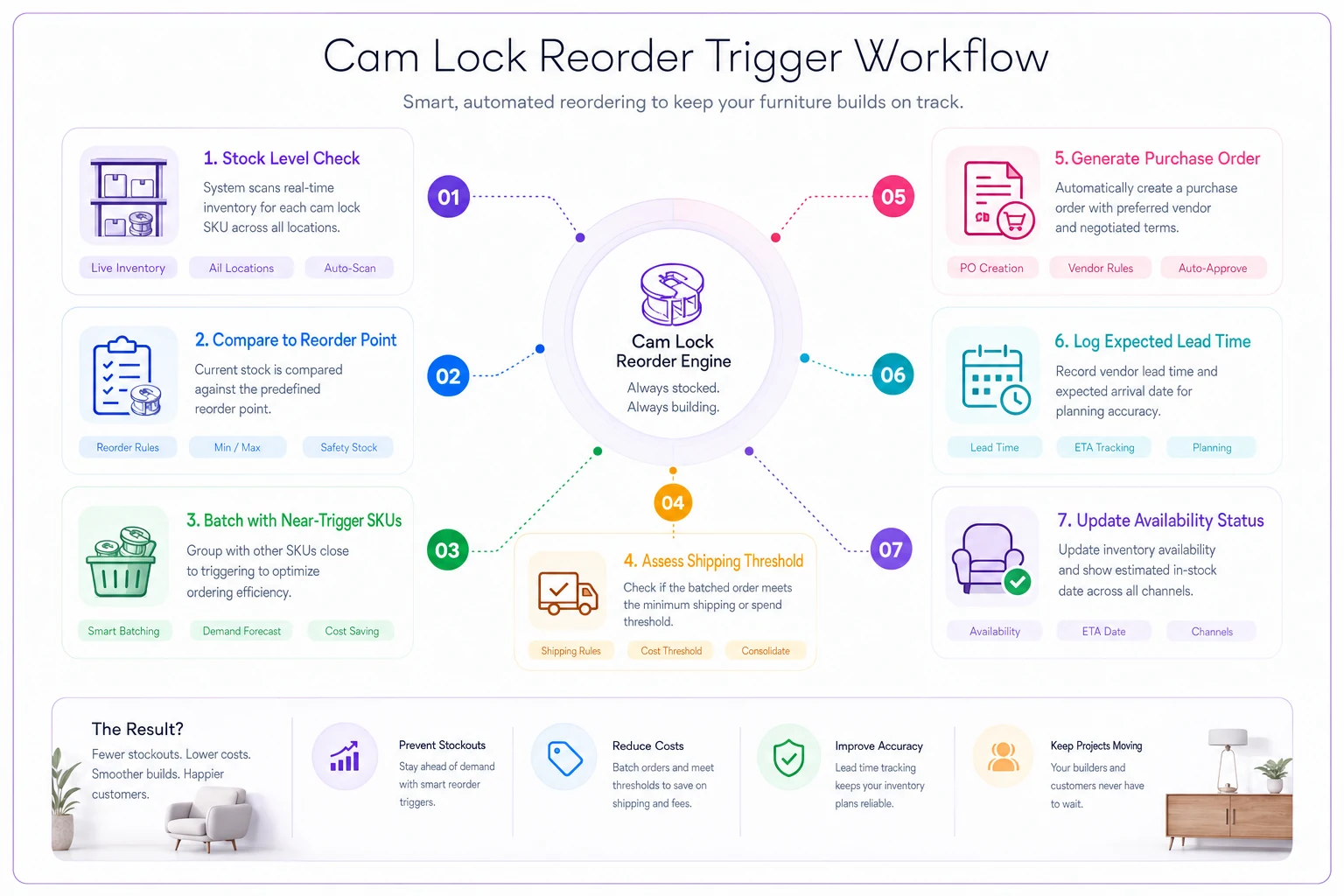
This graphic maps the cam lock reorder process from the initial stock check through batching orders and updating availability.
Current state:
-
Usage
roughly 40 per month, but can spike to 80
-
Supplier lead time
5 business days
-
Minimum order
200 units
-
Current stock
275 units
Calculation: Peak weekly usage = 20 (80 per month / 4 weeks) Lead time coverage = 20 × 1.5 weeks = 30 units Safety stock = one major repair = 50 units Reorder point = 30 + 50 = 80 units
But here's where reality hits. Your supplier has a $200 minimum order. Cam locks cost $0.30 each, so 200 units only gets you to $60. You need to bundle with other parts to hit the minimum — which means your reorder trigger isn't just about cam locks. It's about total order value across multiple SKUs.
Stores that handle this well maintain a supplier dashboard showing all parts approaching reorder points. When any single part hits its trigger, you check what else is running low and batch the order. This sometimes means ordering a few things slightly early, but the shipping savings and reduced admin time more than justify it.
Reorder triggers also need seasonal adjustment. Dining chair repairs spike after the holidays. Outdoor furniture hardware depletes fast in spring. November's reorder point for dining chair parts might need to be double what it is in July.
Supplier Sourcing for On-Demand Parts
Not every part deserves shelf space. For Tier 3 on-demand parts, you need reliable sourcing that minimizes customer wait time without building inventory you don't need.
The first move is maintaining multiple supplier relationships with different strengths. Your primary hardware supplier might be great for standard fasteners with two or three day shipping. But for a specific bracket from a discontinued Bernhardt dresser, you might need a specialty parts supplier who carries deeper obsolete inventory.
Keeping a simple supplier capability matrix saves time when something urgent comes up:
| Supplier | Strength | Lead Time | Minimum Order | Payment Terms |
|---|---|---|---|---|
| FastParts Co | Universal hardware | 2-3 days | $200 | Net 30 |
| Furniture Parts Plus | Discontinued items | 5-7 days | $100 | Credit card |
| Local Hardware | Emergency same-day | Same day | None | Cash/card |
| Original manufacturers | Exact replacements | 10-14 days | Varies | Varies |
When a customer needs an unusual part, you can quickly identify the best sourcing option based on urgency and cost. Sometimes paying $20 for overnight shipping on a $5 part makes sense if it saves a $500 repair job.
Build actual relationships with supplier reps, not just accounts. They often know about alternative parts that work as substitutes — that discontinued bracket might have a universal replacement that fits perfectly. These relationships matter most when you need something obscure on short notice.
For truly rare parts, consider informal arrangements with furniture stores in non-competing markets. That store two states over might have exactly the glass panel you need sitting in dead stock. A simple parts-trading arrangement can solve availability problems without anyone overbuilding inventory.
Common Mistakes That Inflate Parts Inventory Costs
Even stores that understand parts classification fall into expensive traps. The biggest one is treating all stockouts equally. Running out of universal felt pads that delay five repairs is a completely different problem from running out of a specific bracket affecting one customer. Yet many stores panic-order everything at premium shipping rates regardless.
Another costly pattern is not tracking part usage by furniture line. Stores stock parts for furniture lines they're actively retiring, building inventory for pieces they won't sell anymore. Your parts strategy needs to stay connected to your floor model strategy, or you end up carrying dead weight on both sides.
The "just in case" mentality quietly kills parts inventory ROI. Theoretically, someone might need that specific hinge for a 2019 discontinued entertainment center. But holding $50 worth of model-specific parts for five years on the off chance of one repair doesn't make operational sense.
Poor organization compounds everything. When technicians can't find parts quickly, they assume you're out and trigger unnecessary orders. Then you've got 400 cam locks spread across six locations in your stockroom because everyone keeps reordering instead of looking.
Creating Self-Adjusting Reorder Systems
Static min/max levels go stale fast. The dining sets you sold heavily last year might be discontinued now, but you're still stocking parts based on old patterns. Building adjustment into your process prevents that drift.
-
Log usage monthly — document every parts pull with date, quantity, and repair type
-
Review reorder points quarterly — if cam lock usage drops from 40 to 25 per month consistently, lower the trigger
-
Adjust for furniture line changes — when you phase out a collection, reduce or eliminate corresponding parts stock
-
Factor in seasonal patterns — drawer slides spike in August when college students rough-handle dorm furniture; sofa leg repairs cluster after January holidays
-
Reassign tiers as usage shifts — a part that was Tier 3 last year might deserve Tier 2 stocking if a new popular collection uses it regularly
This sounds obvious but requires discipline. Most stores set parts levels once and never revisit them. Three months of usage logs reveal patterns that feel almost embarrassing in hindsight — you were sitting on the wrong parts the entire time.
For stores running AI-powered operational software, these adjustments can happen automatically. The system tracks usage patterns, flags emerging trends, and surfaces updated reorder points based on actual data rather than estimates. It can also factor in which furniture lines you're promoting or phasing out, keeping your parts investment aligned with where sales are actually going.
Parts inventory is dynamic. What works in Q1 might be completely wrong for Q3.
Making Parts Inventory a Profit Center
Most furniture stores treat parts and repairs as a necessary evil — something they offer to keep customers happy but not a real revenue source. That mindset leads to underinvestment in parts systems. Stores that manage spare parts properly, though, often see repair services generate somewhere in the 8–12% of gross profit range, with minimal floor space requirements.
The shift starts with pricing. Many stores price repairs at parts cost plus minimal labor, essentially breaking even. But customers weighing repair versus replacement aren't particularly price-sensitive about parts costs — they care about speed and convenience. A customer facing a $1,200 dining set replacement will pay $75 for same-day repair without much hesitation, even if the parts cost $8.
Speed is the differentiator. When competitors are quoting two-week repair times because they're still ordering parts, same-day service commands premium pricing. That preparation — having parts pre-kitted and ready — is what makes repairs profitable rather than just an obligation.
Bundling repairs with delivery and setup is another underused move. When you're already delivering new furniture, offer to fix existing pieces at the same time. Your delivery team is on-site anyway, and batching multiple repairs in one trip is efficient. It increases average ticket size and usually generates genuine appreciation from customers.
Track repair-to-purchase conversions too. Customers who get fast, professional repairs tend to come back for future purchases. They've seen how you operate and trust it. That loyalty doesn't always show up in repair revenue directly, but it shows up in lifetime customer value.
Building Your Initial Parts Inventory From Scratch
Starting a parts inventory system feels overwhelming when you're staring at hundreds of possible SKUs. The better approach is to start narrow and expand based on actual demand rather than trying to stock everything upfront.
-
Run a two-week repair log first — document every repair request, whether completed or not, noting what parts you needed, what had to be ordered, and what caused delays
-
Identify your top ten most-requested parts — these become your Tier 1 universals; order enough for one month of peak demand on each
-
Pull assembly instructions for your top five selling collections — build a parts list for common failure points; these become your Tier 2 inventory, stocked at two or three repairs per collection
-
Keep everything else at zero — Tier 3 on-demand until usage patterns prove otherwise
This approach typically requires somewhere between $1,500 and $2,500 in initial parts inventory for a standard furniture store. That's less than the margin on two bedroom sets, but it opens up an entirely new service revenue stream without a major capital commitment.
You'll over-order some items initially. That's fine. Having slight excess on universal parts early on is far less damaging than missing repair opportunities while the system is still getting established.
Operational Software That Handles the Complexity
Managing hundreds of small parts with different reorder points, multiple suppliers, and varying lead times eventually overwhelms manual tracking. Spreadsheets work early on but don't scale cleanly as your parts operation grows.
AI-powered operational platforms change the picture. Instead of manually checking stock levels and calculating reorder points, the system monitors usage patterns continuously, flags when you're approaching reorder triggers, and factors in supplier lead times and minimum orders automatically.
The efficiency gain comes from integrated workflows. When a customer requests a repair, the system checks parts availability instantly. If everything's in stock, it generates a repair ticket with parts already allocated. If something's missing, it identifies the fastest sourcing option and gives you an accurate timeline to share with the customer right away.
These platforms also help with the orphaned inventory problem — tracking which parts correspond to which furniture lines and alerting you when you're stocking components for discontinued models. That kind of alignment between your sales strategy and your service inventory keeps your parts investment focused on what actually generates return.
The Bottom Line on Furniture Spare Parts Inventory
Proper parts inventory management turns repairs from an operational headache into a profitable service line. The key is recognizing that parts require completely different thinking than regular furniture inventory. Universal classifications, pre-built kits, and reorder triggers that get revisited regularly create a system that maintains service quality without excessive investment.
Start with your highest-usage universal parts. Build from actual repair data, not assumptions. Adjust regularly based on real patterns. And accept that slight overstock on critical universal parts costs far less than losing repair jobs and customer trust. Stores that get this right aren't trying to stock every possible part. They're strategically stocking what matters, maintaining supplier relationships for everything else, and using better systems to manage the complexity. That balance — between preparation and flexibility — is what turns spare parts from a cost center into a genuine competitive advantage.
Ready to elevate your furniture business?
Join 500+ furniture retailers using Hosyly to increase efficiency, improve customer satisfaction, and grow revenue.