


Most furniture retailers pick a 3PL the same way they pick a dentist — a referral, a quick quote comparison, and a gut feeling. That works fine for parcel. It falls apart the moment you're handing a stranger a $2,400 sectional, a three-flight walk-up, and a customer who took a half-day off work to be home.
The problem with bulky and white-glove delivery is that the failure modes are expensive and invisible until they hit you. A carrier can quote you a great per-stop rate and then quietly rack up damage claims, missed appointment windows, and "customer unreachable" redeliveries that don't show up in their sales pitch. By the time you see the pattern, you've already got six months of angry reviews and a damaged-goods pile in your warehouse.
This post is narrow on purpose. It's about 3PL selection for bulky furniture — specifically, how to score carriers before you sign, what SLA clauses you actually need (with penalty and acceptance triggers), and how to run a performance pilot that gives you real data instead of a honeymoon period. No general logistics advice. Just the furniture-specific stuff that gets skipped.
Why furniture 3PL selection breaks differently
Parcel carriers live and die on cost-per-package and transit time. For bulky and white-glove, those two metrics barely matter. What matters is the stuff that's hard to measure at quote time:
-
Can the crew handle a two-person carry up stairs without gouging the drywall?
-
Do they call ahead, show up in the window, and actually assemble the piece?
-
When something arrives damaged, do they document it or just leave it and run?
-
How fast do they turn around a redelivery when the first attempt fails?
None of that shows up on a rate sheet. And the pattern worth noticing: carriers with the lowest per-stop quote almost always have the weakest crews, because crew quality is their biggest cost lever. They cut it. So the cheap quote is frequently a signal, not a bargain.
A typical example: a mid-size retailer switches to a carrier that's $14 cheaper per delivery. On ~900 deliveries a month that looks like $12k+ in savings. Three months in, their damage rate has crept from around 2% to nearly 6%, redeliveries are up, and the "savings" have been eaten alive by claims, re-dispatch costs, and refunds. The per-stop line item went down. Cost-to-serve went up.
Build a procurement-ready carrier scorecard first
Before you talk to a single carrier, decide how you're going to score them — otherwise every sales conversation will drag you toward whatever that carrier happens to be good at. A scorecard keeps the comparison honest and apples-to-apples.
Eliminate inventory headaches and order delays.
Hosyly streamlines your furniture orders and stock management for seamless store operations.
- Real-time inventory tracking
- Automated order processing
- Customer notifications & engagement
No credit card required
Weight the categories around what actually hurts in furniture delivery. Here's a structure that's held up well:
| Category | What you're measuring | Suggested weight |
|---|---|---|
| First-attempt delivery rate | % delivered on the first scheduled trip | 25% |
| Damage rate | Damaged-on-arrival as % of items delivered | 20% |
| On-time window compliance | Arrivals inside the promised window | 15% |
| White-glove execution | Assembly, placement, debris removal done correctly | 15% |
| Communication/pre-call rate | % of deliveries with a confirmed pre-call | 10% |
| Claims handling speed | Avg days to resolve a damage claim | 10% |
| Capacity flexibility | Ability to absorb surge weeks | 5% |
The weights matter more than most people realize. If you weight cost at 40% — which a lot of procurement templates do by default — you'll systematically pick the carrier most likely to damage your inventory. Notice cost isn't even a scored line here. Handle it as a separate gate: shortlist carriers who clear a quality bar, then compare price among the survivors. Flip that order and you're just rationalizing the cheapest bidder.
Force every carrier to report on the same definitions.
"On-time" means nothing if Carrier A counts a 4-hour window and Carrier B counts "same day." Write your definitions into the RFP so their self-reported numbers are comparable before the pilot even starts.
SLA clauses that actually have teeth
Most furniture delivery SLAs describe expectations with no consequences. "Carrier will maintain a 95% on-time rate" is a wish, not a clause. A real SLA has three parts for every metric — a target, a trigger, and a consequence.
The clauses worth fighting for
1. First-attempt delivery floor with a redelivery penalty. Set a minimum first-attempt success rate (say 92%). When a failed attempt is the carrier's fault — crew no-show, late past the window, wrong truck for the item — the redelivery is on them, not billed to you. The key is defining fault clearly, because carriers will try to classify every failure as "customer not home."
2. Damage acceptance and penalty triggers. Define damage-on-arrival measured monthly. Below your threshold (e.g., 3%), business as usual. Above it, a per-incident penalty kicks in on the overage. Above a hard ceiling (e.g., 7% for two consecutive months), you get a termination-for-cause right without penalty. That ceiling is what gives you leverage mid-contract.
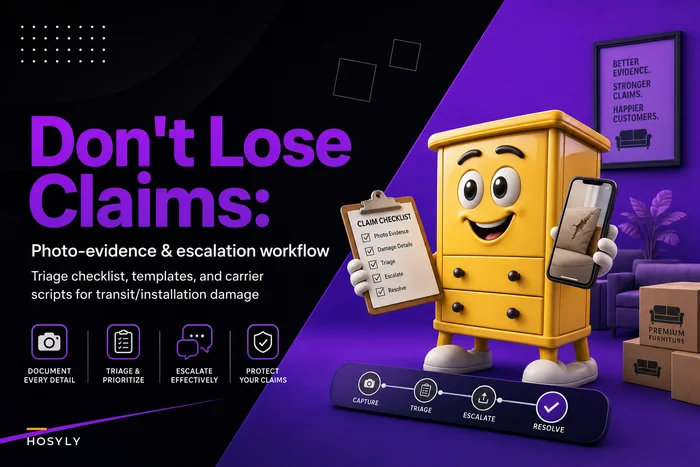
3. Documentation requirement tied to claims. This one saves real money. Require photo documentation at delivery for any item flagged as damaged — no photos, carrier eats the claim. This stops the "he-said-she-said" that lets carriers deflect liability back onto you. Your internal side of this matters too; a tight photo-evidence and escalation workflow for transit damage is what makes the clause enforceable instead of theoretical.
4. Communication SLA with a soft penalty. Pre-call compliance (confirmed contact before dispatch) under, say, 90% triggers a review, and chronic failure feeds into the scorecard that governs volume allocation. You don't need a dollar penalty here — threatening to shift volume is usually stronger.
5. Claims resolution clock. Carrier acknowledges a claim within 2 business days and resolves within 15. Miss it and the claim auto-approves in your favor. Without a clock, claims rot for months and you're financing their slowness.
The acceptance trigger people forget
Build in an acceptance gate at the pilot-to-contract transition. Your full-volume contract shouldn't auto-activate — it should only trigger if the carrier hits agreed thresholds during the pilot. Write it as a condition precedent. This flips the default: instead of signing and hoping, you're signing contingent on proof.
Run a pilot that tells you the truth
A pilot's whole job is to surface the problems the sales process hid. Most retailers blow this by running too small, too short, or on their easiest routes — which produces a flattering number that collapses the moment you scale.
Pilot checklist
-
Volume enough to be statistically real — at least 150–250 deliveries, not 30. On 30 deliveries, one bad week is noise; on 200, it's a pattern.
-
Mix include your hard stuff on purpose — stairs, tight urban access, assembly-required items, long rural routes. Don't hand them a cherry-picked easy lane.
-
Duration 4–6 weeks minimum. The first two weeks are always the honeymoon; week four is where crews revert to normal behavior.
-
Same metric definitions as your scorecard, captured from day one.
-
A control group, if you can — run your incumbent in parallel so you're comparing against reality, not against memory.
-
Weekly check-ins, not a single end-of-pilot review. Problems you catch in week two are coachable; problems you find in week six are just regret.
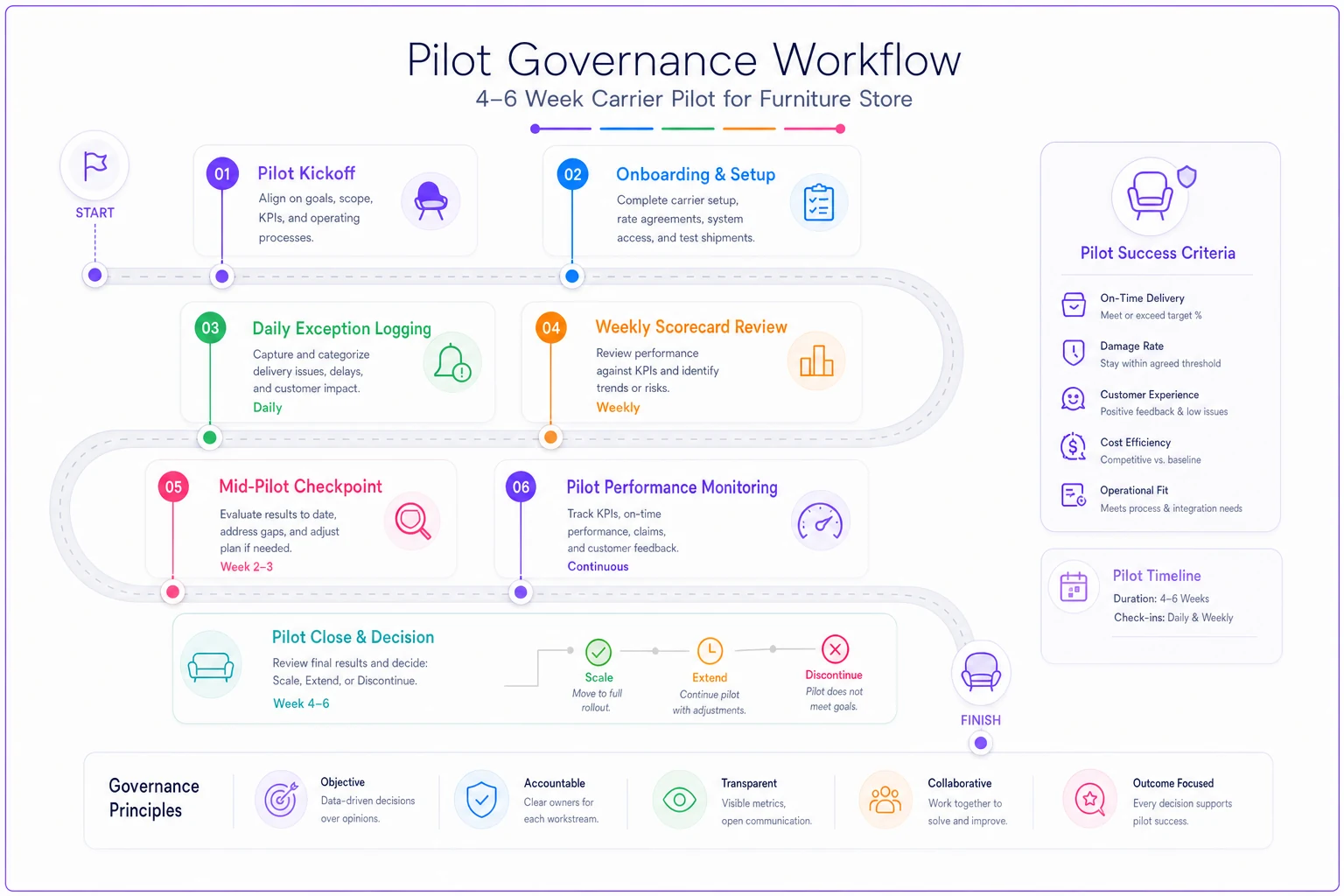
The pilot governance rhythm
Day-to-day governance during the pilot is where it's won or lost. A simple cadence that works:
-
Daily exception log — every failed attempt, damage, or missed window gets logged with a reason code the same day. Reason codes are the whole game; without them you can't tell a crew problem from a routing problem from a product-packaging problem.
-
Weekly scorecard review with the carrier's account rep. Walk the numbers against the targets. Make them explain outliers.
-
Mid-pilot a go/no-adjust checkpoint around week three. If first-attempt rate is sitting at 80% against a 92% target, you don't wait to find out why.
-
Pilot close score against your acceptance thresholds and make the keep/kill call on data, not vibe.
Visualized below: the pilot governance cadence.
Who owns this matters. If the pilot has no single internal owner, it drifts and nobody's watching the exception log. Pair this with your broader workforce and subcontractor governance approach so the carrier's crews are held to the same standard as your in-house teams — otherwise you get two different quality bars and a confusing customer experience.
A real scenario
A regional furniture retailer running about 700 bulky deliveries a month was with a single carrier, no scorecard, no real SLA. Damage claims were running around 5–6% and first-attempt rate hovered near 84%, which meant a steady stream of redeliveries they were partly eating.
They ran a 5-week dual pilot — incumbent against a challenger — on roughly 220 deliveries each, deliberately loaded with stair carries and assembly jobs. The scorecard surfaced two things fast: the challenger's pre-call rate was far higher (around 94% vs the incumbent's ~70%), and that single difference was driving most of the first-attempt gap. The incumbent's crews simply weren't calling ahead, so customers weren't home.
They didn't just switch blind. They took the pilot data back to the incumbent with the pre-call clause and a redelivery penalty, and split volume ~60/40 as a probation setup. First-attempt rate climbed into the low 90s over the next quarter, and redelivery volume dropped enough to roughly offset a slightly higher per-stop rate on the challenger. The win wasn't the cheaper carrier — it was the measurement and the clause that made both carriers behave.
When this level of rigor makes sense — and when it doesn't
When it's worth it:
-
You're doing more than ~300 bulky deliveries a month, where small percentage shifts turn into real money.
-
White-glove is part of your brand promise and damage or complaints hit your reviews directly.
-
You're consolidating from several carriers to one or two and need leverage.
When it's overkill:
-
You're a small shop doing a handful of local deliveries a week. A formal RFP and 220-delivery pilot is more process than the volume justifies — a simple quality agreement and a reliable local crew is enough.
-
You have a single carrier that's genuinely performing and no scale pressure. Don't break what works to run a procurement exercise for its own sake.
Who should not do this: anyone who's going to build a beautiful scorecard and then award the contract on price anyway. If leadership isn't willing to pay a bit more for a lower damage rate, skip the theater and just negotiate the cheapest rate honestly. The scorecard only helps if you're prepared to act on it.
Where the operational load actually lives
None of this works if the data lives in three inboxes and a spreadsheet someone updates when they remember. The reason most retailers never build a real scorecard is that collecting first-attempt rates, damage reasons, and window compliance by hand is tedious — so it just doesn't happen.
When delivery exceptions, reason codes, and claims flow into a single system, the daily exception log stops being a chore and starts being something that's already captured. Failed attempts and damage events tagged with reason codes mean the weekly carrier review practically writes itself, and your SLA penalties become enforceable because you actually have the evidence. The scheduling side matters too — tight two-person delivery scheduling and load-building is what keeps first-attempt rates high regardless of which carrier you land on.
The point isn't the tooling. It's that measurement you can't sustain is measurement you don't have — and an SLA you can't measure is just a paragraph.
Final thought
The carriers you're evaluating have run this sales process hundreds of times. They know exactly which numbers to show you and which to bury.
Your only real defense is deciding what you'll measure before they start talking, writing clauses that cost them money when they underperform, and running a pilot long enough and hard enough to catch the problems the quote never mentioned. Do that, and carrier selection stops being a gamble and starts being a decision you can actually defend.
The carriers you're evaluating have run this sales process hundreds of times. They know exactly which numbers to show you and which to bury.
Your only real defense is deciding what you'll measure before they start talking, writing clauses that cost them money when they underperform, and running a pilot long enough and hard enough to catch the problems the quote never mentioned. Do that, and carrier selection stops being a gamble and starts being a decision you can actually defend.
Ready to elevate your furniture business?
Join 500+ furniture retailers using Hosyly to increase efficiency, improve customer satisfaction, and grow revenue.