


Not every supplier deserves the same level of attention, and treating them like they do is one of the quietest margin killers in furniture retail. The custom sectional line coming off a 14-week factory schedule in Vietnam doesn't need the same governance as the accent pillow vendor you could replace in a weekend. Yet most stores run one flat vendor policy — same payment terms, same follow-up cadence, same "we'll figure it out if something goes wrong" plan — across their entire vendor book.
That works fine until a Tier-1 supplier misses a container and suddenly you've got 40 customers with deposits down and no realistic ship date.
The problem isn't that the supplier failed. Suppliers fail. The problem is you had no tier, no trigger, and no second source ready to catch it.
This piece covers the whole system: segmenting suppliers by risk and revenue impact, attaching real SLA expectations to each tier, defining the exact conditions that trigger alternate sourcing, and having contract language that lets you actually act on those triggers instead of just being annoyed about them.
Why one-size-fits-all vendor management breaks
The reason stores default to flat vendor policies is understandable. When you're small — maybe eight or ten suppliers — you know each rep by name. Coordination happens in your head. You remember that the recliner factory runs long in Q4 and the dining vendor over-promises on lead times. That informal knowledge works at 10 vendors.
At 40 or 60 vendors across multiple categories, it stops working. The knowledge is still there, but now it's spread across three buyers who don't share the same instincts, and the person who "just knew" the recliner factory quit in March. What breaks isn't a single order — it's the coordination layer. Nobody has a consistent read on which vendors are actually reliable versus which ones you've just gotten lucky with.
The financial exposure is uneven too. Your supply base almost always follows a rough concentration where a small number of vendors carry a disproportionate share of both revenue and lead-time risk. A typical mid-size store might find that 6–8 suppliers account for well over half of tied-up customer deposits at any given time. Those are the ones a stockout or delay hurts most, and those are exactly the ones nobody has a written backup plan for.
Segmentation forces that concentration into the open. Once you can see that four vendors carry most of your long-lead risk, the dual-sourcing conversation stops being theoretical.
Building the tiers: revenue impact plus replaceability
The two axes that actually matter are revenue-at-risk and replaceability. Revenue-at-risk isn't just annual purchase volume — it's how much customer money is in motion at any moment (deposits, confirmed orders, showroom-driving hero SKUs). Replaceability is how fast and cleanly you could substitute another source without the customer noticing or the margin cratering.
Eliminate inventory headaches and order delays.
Hosyly streamlines your furniture orders and stock management for seamless store operations.
- Real-time inventory tracking
- Automated order processing
- Customer notifications & engagement
No credit card required
A high-volume vendor you could swap in two weeks is less dangerous than a mid-volume vendor whose product is genuinely unique and runs a 16-week lead time. That second one is where you get burned.
| Tier | Profile | Example SKUs | SLA expectation | Backup requirement |
|---|---|---|---|---|
| Tier 1 — Critical | High revenue-at-risk, low replaceability, long lead | Custom upholstery, signature dining, motion sectionals | 95%+ on-time to confirmed date, weekly production updates, 48-hr response to escalation | Qualified second source required, ideally piloted |
| Tier 2 — Important | Moderate revenue, moderate replaceability | Bedroom sets, casegoods, standard sofas | 90% on-time, biweekly updates, 72-hr response | Named alternate identified, not necessarily piloted |
| Tier 3 — Standard | Lower revenue, high replaceability | Rugs, lamps, standard accents | 85% on-time, exception-based updates | Market substitution acceptable, no formal backup |
| Tier 4 — Transactional | Low value, instantly replaceable | Cushions, small decor, hardware | Best-effort | None |
The mistake stores make here is over-tiering. You don't need eight tiers. Four is plenty, and honestly a lot of stores could run on three. Every tier you add is another set of rules someone has to remember and enforce. The point of segmentation is to concentrate effort where it pays off, not build a bureaucracy.
Worth flagging: tier assignment isn't permanent. A vendor that was Tier 3 becomes Tier 1 the moment you make one of their SKUs a floor hero and start driving traffic to it. Re-tiering should happen on a schedule — quarterly is reasonable — because your assortment shifts faster than your vendor list does.
SLA expectations that mean something
An SLA that says "supplier will deliver in a timely manner" is worthless. It gives you nothing to measure and nothing to enforce. The SLAs that actually change behavior are specific, tied to the confirmed date rather than the original estimate, and connected to a consequence.
For Tier 1, the expectations should cover four things:
-
On-time-to-confirmed-date rate — measured against the date the supplier committed to, not the wishful date from the PO. Target 95%+.
-
Update cadence — weekly production status during the build, with a real status (cut, sewn, in QC, palletized), not "on schedule."
-
Escalation response time — how fast they respond when you raise a problem. 48 hours max for Tier 1.
-
Ship accuracy — right SKU, right finish, right quantity. A "delivered on time but wrong finish" order is a failure, not a partial win.
The nuance most people miss: you have to separate the supplier's miss from transit misses. A factory can ship on time and still have the container sit in a port for three weeks. If you lump those together, you'll punish a good factory and ignore a broken freight lane. Track them separately. This matters directly for how you set safety stock — if your lead-time variability is coming from transit and not production, that changes your buffer math entirely, which we cover in more depth in the piece on volatility-adjusted safety stock for bulky furniture.
Alternate-sourcing triggers: the part everyone skips
There's a pattern that shows up constantly. A store knows a supplier is slipping. The updates get vaguer, the ship dates drift, the rep stops calling back. Everyone can feel it. But there's no defined line, so nothing happens until the situation is already a crisis and there's no time to source anywhere else.
Practical triggers for a long-lead Tier 1 SKU:
-
Two consecutive missed confirmed dates on the same SKU within a rolling 6-month window.
-
On-time rate drops below 85% over the trailing quarter (against a 95% target — a 10-point miss is a signal, not noise).
-
Lead time creeps 25%+ beyond the contracted baseline for two consecutive orders.
-
Escalation response exceeds the SLA more than twice in a quarter.
-
A single quality-fail rate above ~4% on shipped units, or any repeat of the same defect.
-
Financial or capacity red flags — the factory asks to change payment terms suddenly, or openly tells you they're over capacity.
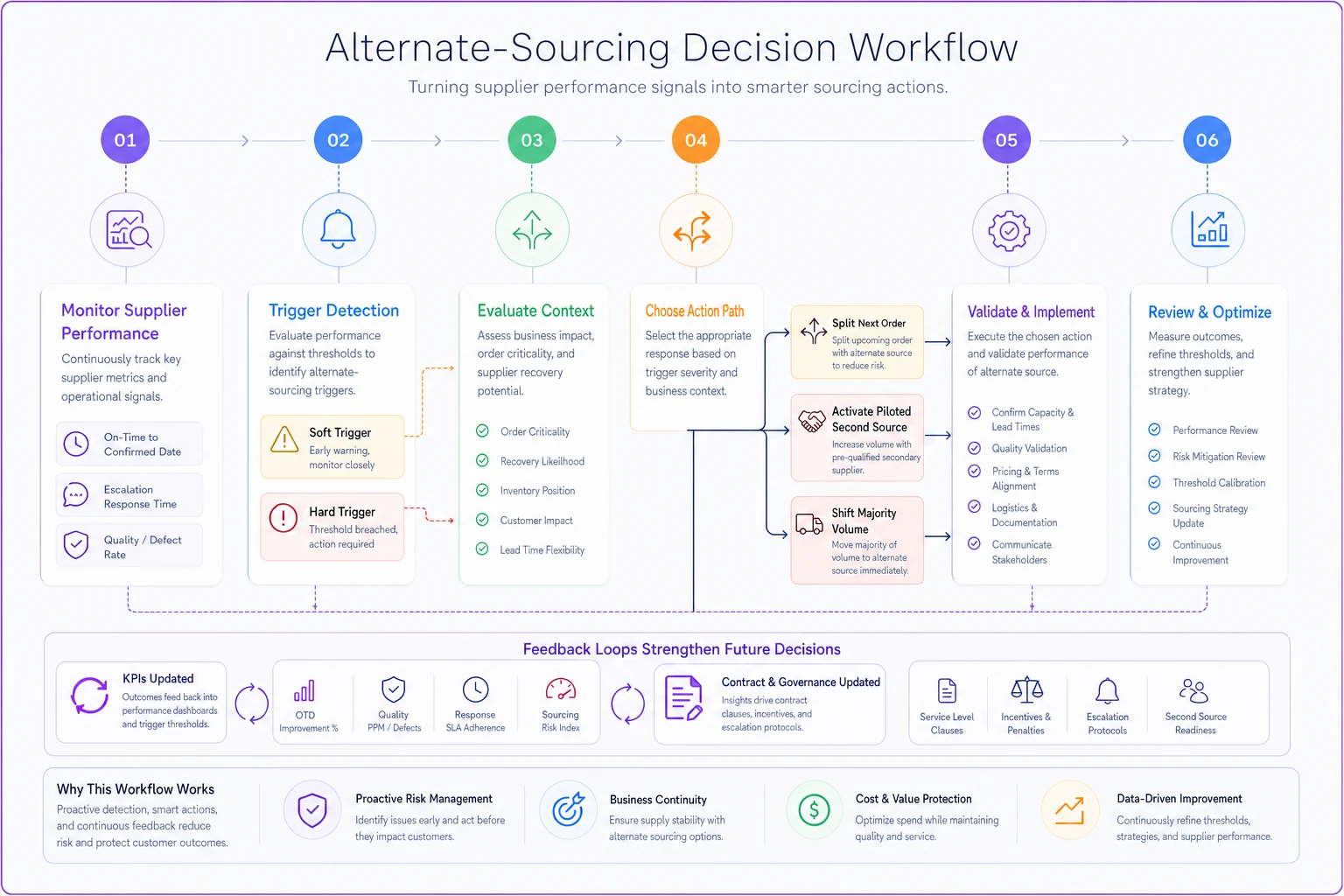
"Activate the backup" doesn't always mean firing the vendor. For a soft trigger, it might just mean splitting the next order 70/30 between primary and secondary to keep the alternate warm. For a hard trigger (like #1 or #5), it means shifting the majority of volume until they earn it back. The graduated response matters — dropping a Tier 1 vendor cold usually costs more than nursing them through a rough patch while you protect yourself with a second source.
This diagram shows the decision flow from trigger detection to action (split order, pilot activation, or full switch).
Solid supplier onboarding discipline pays off on the back end here too. If your second source was properly vetted and SLA'd from the start, activating them under a trigger is a routing decision, not a fire drill.
Contract clause snippets that let you actually act
Triggers are useless if your contract doesn't give you the right to respond. Most furniture supply agreements are written entirely in the vendor's favor — vague delivery language, no reporting obligation, no exit ramp. You want a handful of clauses that turn your operational rules into enforceable rights. These are simplified for illustration; run anything real past an attorney.
Delivery performance and remedy
> "Supplier shall deliver conforming Goods on or before the Confirmed Ship Date. If Supplier fails to meet the Confirmed Ship Date on two (2) or more Purchase Orders within any rolling six (6) month period, Buyer may, without penalty, reduce order volumes or source equivalent Goods from an alternate supplier for affected SKUs."
Reporting and transparency
> "For all Tier 1 SKUs, Supplier shall provide written production status no less than weekly, including current production stage and any anticipated deviation from the Confirmed Ship Date within 24 hours of Supplier becoming aware of such deviation."
Quality and defect threshold
> "If the defect rate on any shipment exceeds four percent (4%) of units, or the same defect recurs across two consecutive shipments, Buyer may reject the affected units, require corrective action, and qualify an alternate source without breach of this Agreement."
Second-source / no-exclusivity
> "Nothing in this Agreement grants Supplier exclusivity. Buyer reserves the right to qualify, order from, and maintain relationships with alternate suppliers for any Goods at Buyer's sole discretion."
That last one sounds obvious but gets left out constantly. Some vendors will quietly assume exclusivity if the contract is silent on it. Spelling out your right to dual-source removes the awkward conversation later.
KPIs that keep the whole system honest
Segmentation and triggers only work if someone's actually watching the numbers. The KPI set should be small enough that a buyer checks it without dreading it:
-
On-time-to-confirmed-date, by tier — the single most important number. Trending, not just current month.
-
Lead-time variance vs. baseline — how much actual lead time is drifting from contracted.
-
Trigger events fired per quarter — if this is zero across all vendors, your triggers are probably too loose.
-
Second-source coverage % — what share of Tier 1 revenue-at-risk has a qualified backup. This is your resilience score.
-
Deposit exposure per vendor — how much customer money is riding on each supplier right now.
-
Defect / quality-fail rate, by tier.
Automate trigger alerts into buyer workflows so the decision to split orders or activate alternates doesn't wait for a meeting.
The one people forget is second-source coverage. It's the metric that tells you whether all this segmentation actually reduced your risk or just documented it. If 60% of your Tier 1 revenue-at-risk has a real backup this year versus 20% last year, that's the win.
Keeping these current across dozens of vendors is genuinely tedious by hand, which is exactly why it doesn't get done. This is one of the more practical places to lean on operational software that pulls PO dates, confirmed dates, and receipts together and flags a trigger the moment it's crossed — so the alternate-sourcing decision surfaces on its own instead of waiting for someone to notice the pattern in a spreadsheet two weeks later. The tooling isn't the strategy; it just removes the excuse for the strategy not happening.
A realistic pilot: adding a second source without disrupting the primary
You don't add a second source by placing a giant test order and hoping. You run a controlled pilot, small enough that a failure is survivable.
Real scenario. A single-location store, roughly $6M in annual sales, had one motion-sofa factory carrying about 30% of their upholstery revenue-at-risk. That factory's on-time rate had slid to the low 80s over two quarters, and lead times crept from 12 to nearly 15 weeks. Customer deposit refunds tied to late delivery were running somewhere around $8k–$12k a quarter, plus the harder-to-measure cost of walked customers.
They ran a second-source pilot over about four months:
-
Shortlisted three alternates against the same SLA spec the primary was held to — not just price.
-
Ordered a small qualification batch (around a dozen units across two frame styles) from the top candidate.
-
Ran those units through the same acceptance checks as any incoming order — dimensions, finish match, packaging integrity, transit damage.
-
Placed a live customer order split — kept the primary on the bulk, routed roughly 20% of new motion orders to the pilot vendor.
-
Measured for one full order cycle against the same KPIs.
-
Scaled the split to about 40/60 once the pilot vendor cleared two clean cycles.
By the end, on-time to confirmed date across the combined sourcing sat back in the low 90s, deposit-related refunds dropped to roughly half of where they'd been, and — maybe more important — the primary factory tightened up once they realized volume was actually moving. Having a warm second source changed the negotiating dynamic without a single confrontation.
When dual-sourcing is worth it — and when it isn't
When it makes sense: high revenue-at-risk, long lead times, low replaceability, and any vendor showing early trigger signals. If a delay means dozens of customers with deposits stuck, you need a backup regardless of how good the relationship feels today.
When it's a bad idea: genuinely unique product where a "second source" would mean a visibly different product your customers would notice and reject. Also skip it for Tier 3 and Tier 4 — spreading small commodity orders across two vendors just kills your volume pricing and adds coordination overhead for no real resilience gain.
Who should not do this yet: if you can't reliably measure on-time-to-confirmed-date for your current vendors, you're not ready to add sources. You'll just have two suppliers you can't hold accountable instead of one. Get the measurement layer working first, then segment, then dual-source the tiers that warrant it.
The system, not the spreadsheet
The trap with all of this is treating it as a one-time project — you build the tiers, draft the clauses, run a pilot, and then it ossifies. Six months later the tiers are stale, the triggers never fire because nobody's watching, and you're back to informal knowledge sitting in three buyers' heads.
What holds up over time is the loop: segment vendors by revenue-at-risk and replaceability, attach SLAs that are specific enough to measure, define triggers that fire on their own, back those triggers with contract rights, and re-tier on a cadence as your assortment shifts. Each piece props up the others. SLAs without triggers are just documentation. Triggers without contract rights are just frustration. Contract rights without a piloted second source are just leverage you can't use.
Get the loop running and supplier failures stop being emergencies. They become routing decisions you already planned for — which is exactly what supplier segmentation in furniture retail is supposed to buy you.
Ready to elevate your furniture business?
Join 500+ furniture retailers using Hosyly to increase efficiency, improve customer satisfaction, and grow revenue.