



Walk into any furniture showroom and you'll find at least one sales rep hedging on lead times. "The factory says 12 weeks, but honestly, I'd plan for 16." That buffer isn't pulled from thin air — it's accumulated scar tissue from years of supplier management problems that quietly compound into customer disappointment.
The furniture supplier onboarding process sits at the heart of this. Most retailers treat it like paperwork when it's actually the foundation of your entire operational rhythm. Get it wrong and every downstream process breaks: inventory planning, customer expectations, cash flow, showroom refresh cycles. The damage multiplies in ways that take months to fully understand.
What makes furniture particularly brutal is the combination of bulky logistics, high ticket prices, and custom variations. A clothing retailer can absorb a late shipment by shuffling inventory. When your custom sectional in charcoal gray with a left-facing chaise arrives three weeks late, damaged, or in the wrong configuration, you've got a very specific customer problem that can't be solved with substitution.
Why furniture retailers struggle with supplier discipline
The furniture industry runs on relationships. Your grandfather bought from this mill. Your biggest competitor uses that factory. Everyone knows everyone at market. This creates a dynamic where formal processes feel like an insult to long-standing partnerships.
I've watched furniture stores operate on nothing more than verbal agreements and handshake deals with suppliers they've known for decades. It works fine until it doesn't — usually when ownership changes, a key contact leaves, or market conditions shift. Suddenly that reliable partner who "always took care of you" starts missing deadlines, shipping incomplete orders, or changing terms without notice.
Scale makes this worse. A single-location showroom might manage five core suppliers plus a handful of specialty vendors. By the time you're running three locations with distinct market positioning, you're juggling 20-plus suppliers with different lead times, minimums, quality standards, and communication styles. The informal approach that worked at $2M revenue becomes a coordination mess at $15M.
The other problem is category complexity. Your upholstery supplier operates completely differently from your case goods vendor. Leather suppliers have their own inspection requirements. Custom shops need different SLAs than import container vendors. Most retailers either oversimplify with one-size-fits-all contracts or overcomplicate with custom terms for every vendor that nobody actually tracks.
Sample acceptance protocols that actually work
Furniture damage happens at three points: manufacturing, packaging, and transit. Your sample acceptance protocol needs to catch problems at the source before they enter your supply chain.
Eliminate inventory headaches and order delays.
Hosyly streamlines your furniture orders and stock management for seamless store operations.
- Real-time inventory tracking
- Automated order processing
- Customer notifications & engagement
No credit card required
Start with dimensional tolerance. A sofa at 84" instead of 82" might seem minor until it doesn't fit through a customer's doorway. Set specific tolerances by product type — typically ±1" for upholstered goods, ±0.5" for case pieces, ±0.25" for modular components that need to align. Document these in a simple grid that suppliers sign off on.
Color and finish matching requires physical samples, not photos. Maintain a sample library of approved finishes for each supplier, updated annually or when you add new SKUs. Wood stains drift over time as suppliers change formulas or sources. That "honey oak" from a few years back may look noticeably different today. Require suppliers to ship finish samples with any new production run for verification against your library.
The inspection process itself needs clear ownership. Many retailers assume suppliers will self-inspect, but that creates obvious conflicts. A better approach: require photo documentation at specific checkpoints — frame assembly before upholstery, finished piece from four angles, close-ups of high-wear areas like arm rests and cushion seams, hardware installation, final packaging. These photos become your evidence trail when problems arise.
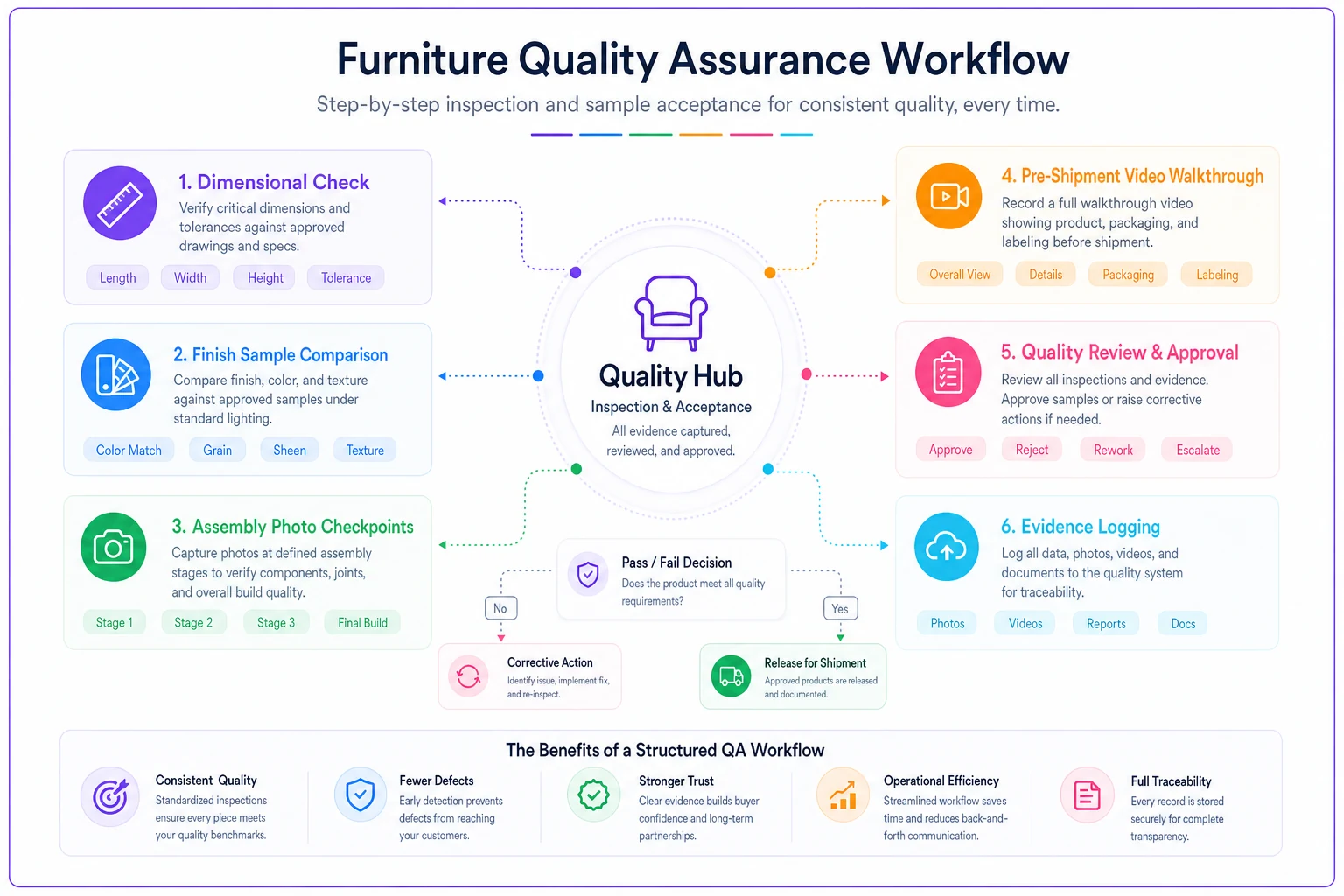
Use this simple workflow during supplier QC to ensure consistent acceptance.
For high-value or high-risk SKUs — anything over $3,000 retail or with a history of issues — implement pre-shipment video walkthroughs. Have the supplier's QC team record a short video showing the piece from all angles and demonstrating moving parts. It takes almost no time on their end but catches problems that photos miss.
Packing requirements that prevent showroom delays
Furniture arrives at your dock in various states of assembly. Some pieces come ready to floor. Others need legs attached, cushions inserted, or significant setup. Your packing requirements need to protect the product while actually accounting for how your team receives it.
The standard packing mistake is focusing only on damage prevention while ignoring operational efficiency. That dining table arrived intact, sure — but it took two people 45 minutes to unpack because of excessive shrink wrap, nested cardboard, and unmarked hardware bags.
Create packing templates by product category. Upholstered furniture needs breathable wrap to prevent moisture buildup, corner guards, and cushions separately bagged but attached to the frame. Case goods require edge protection, drawer stops, and hardware in labeled bags taped inside the cabinet. Dining sets need chairs nested efficiently with leg caps and fabric covers.
Label everything with operational context — not just "SKU 47281" but "WESLEY SOFA - GRAY - 2 BOXES - LEGS IN BOX 2." Your receiving team should know what they're handling before they open anything. Include assembly time estimates on the outer packaging: "SETUP: 15 MIN - 2 PERSON." This helps your team plan their day and flag pieces that need immediate assembly versus those that can wait.
Label everything with operational context — not just "SKU 47281" but "WESLEY SOFA - GRAY - 2 BOXES - LEGS IN BOX 2."
The most overlooked aspect is returnability. If your team destroyed the original packaging to display a piece, return shipping costs triple. Require packaging that can be reasonably preserved and reused — avoid glue where tape works, use reusable corner guards instead of custom-molded foam, design boxes that break down flat for storage.
Pallet specifications for bulky furniture logistics
Pallets seem simple until you're dealing with furniture. Standard 48"×40" pallets don't work for 96" sofas. Overseas containers use different standards than domestic trucking. Your dock might handle 5,000 pounds but your showroom freight elevator tops out at 2,500.
Start with weight distribution. Furniture pallets get dangerously top-heavy. A bedroom set stacked vertically can tip during forklift movement. Require suppliers to maintain a center of gravity no higher than 36" and mark any pallet over 1,500 pounds with weight warnings. Include stacking diagrams for multi-piece sets showing exactly how components should be arranged.
Double-stacking rules prevent costly mistakes. Some suppliers love to maximize container space by stacking pallets two high. This works in their warehouse with 20-foot ceilings and heavy-duty forklifts. It doesn't work at your location with 12-foot clearance and a basic pallet jack. Specify maximum stack heights based on your actual facility constraints, not industry defaults.
Mixed SKU pallets create receiving headaches. You ordered six dining sets and four console tables. They arrive mixed across five pallets, requiring a full unload to sort inventory. Mandate single-SKU pallets for orders under 10 pieces, mixed pallets only for full container loads — and only with detailed pallet maps showing what's where.
For oversized pieces — sectionals, entertainment centers, large dining tables — require custom crating with integrated pallet bases. The crate becomes the pallet, designed for your specific handling equipment. Include forklift pocket dimensions (typically 7" high × 48" wide × 4" deep) and mark entry points clearly.
Temperature cycling damages more furniture than impact does. Wood expands and contracts. Leather cracks. Veneer delaminates. Require plastic overwrap for all pallets with desiccant packs for leather goods and climate-sensitive materials. A few dollars in materials prevents hundreds in damage claims.
Building SLAs that match furniture retail realities
Generic SLAs fail in furniture because they don't account for the cascading impact of delays. When a sofa arrives two weeks late, you don't just have an upset customer. You've potentially lost a companion sale, disrupted your delivery schedule, tied up warehouse space with partial orders, and created follow-up work across sales, operations, and customer service.
Structure SLAs around total order completion, not individual pieces. If a customer orders a five-piece dining set, the clock doesn't stop when four chairs arrive. It stops when the complete, undamaged set is ready for delivery. This prevents suppliers from shipping partials to technically meet deadlines while practically failing your customer.
Lead time management connects directly to your broader operational planning, but your SLA needs specific triggers. Standard lead time is 8–10 weeks? Fine. At week 6, supplier provides a production status update. Week 8, shipping confirmation with tracking. Week 10, financial penalties begin. Week 12, you have the right to source elsewhere at the supplier's expense.
The penalty structure needs teeth without being punitive. Furniture margins don't support massive chargebacks, but token amounts don't change behavior. Graduated penalties tend to work well:
-
Weeks 1–2 of delay 2% of order value per week
-
Weeks 3–4 5% per week
-
Beyond week 4 10% per week
Cap total penalties at 25% to maintain the relationship while preserving accountability.
Penalties alone don't fix anything, though. Include positive incentives for consistency. Suppliers who maintain 95% on-time delivery for a quarter earn preferred payment terms. Those who hit 98% get priority placement in your showroom rotation. These incentives often motivate better than penalties.
Quality SLAs also need specific defect categories. "Damaged" is too vague. Define structural defects (frame, springs, hardware) versus cosmetic issues (minor scratches, fabric pulls) versus specification errors (wrong size, color, configuration). Each category gets different remedies: full replacement, repair credit, or a discount to sell as-is.
Creating effective penalty structures without destroying relationships
Penalties in furniture feel personal because relationships run deep. That mill owner's family has been supplying you for 15 years. Heavy-handed enforcement poisons these relationships fast.
The key is making penalties about process, not punishment. Frame them as performance adjustments that help both parties identify and fix problems. When you charge back for a late shipment, earmark it for process improvement — better tracking systems, QC training, expedited shipping when needed.
Document everything but enforce selectively. Track every violation but only apply penalties for patterns, not isolated incidents. A supplier ships late once in 18 months due to a hurricane? Waive it. Three late shipments in a quarter? That's a pattern.
-
First violation Documented warning and root cause discussion
-
Second violation Partial penalty (50%), remainder waived if clean for 60 days
-
Third violation Full penalty plus mandatory operational review
This gives suppliers room to correct course without immediate financial pressure.
Create penalty pools that fund customer recovery. Instead of keeping chargebacks as margin, use them to expedite replacements, upgrade customers to better products, or cover compensation. When suppliers see penalties going directly to fix the problems they caused, they're more likely to accept them as fair.
The nuclear option — terminating a supplier — should be clearly defined but rarely triggered. Set specific thresholds: five consecutive SLA violations, three major quality incidents in six months, or one catastrophic failure affecting multiple customers. Clear termination criteria actually strengthen relationships by removing ambiguity about where the line is.
Quarterly business reviews that drive improvement
Most furniture retailers either skip supplier reviews entirely or turn them into complaint sessions that accomplish nothing. Effective quarterly reviews focus on what's changing going forward, not relitigating what went wrong.
Structure reviews around three areas: performance metrics, process improvements, and upcoming challenges. Spend roughly 20% on past performance, 30% on current issues, 50% on future planning. This keeps meetings productive.
Performance metrics should go both directions. Track their on-time delivery, quality scores, and SLA compliance — but also share your metrics: payment timeliness, forecast accuracy, order consistency. Suppliers are more receptive to feedback when they see you holding yourself accountable too.
Bring in frontline voices. Your warehouse team knows which suppliers pack properly. Sales knows which products generate complaints. Customer service knows which vendors respond quickly to issues. Rotating different staff through these reviews adds perspective and builds cross-functional supplier relationships over time.
The improvement planning section needs specific commitments with deadlines. "We'll improve quality" is meaningless. "We'll implement a new QC checkpoint by March 1st, targeting a 50% reduction in fabric defects by end of Q2" creates accountability. Document it and revisit at the next meeting.
Use reviews to share market intelligence both ways. Tell suppliers what styles are selling, what customers are requesting, where competitors are gaining ground. Ask about raw material costs, production capacity, new techniques they're exploring. The best supplier relationships become actual strategic partnerships where information flows in both directions — not just complaints flowing one way.
The compound effect of supplier discipline on showroom operations
When supplier onboarding runs properly, the entire showroom operation improves in ways that seem unrelated but directly connect. Sales confidence increases when delivery promises can actually be kept. Customer deposits become easier to manage when order timing is predictable. Warehouse crews develop rhythm when receiving schedules stabilize.
The biggest shift happens in how you plan showroom refreshes. With reliable suppliers, you can commit to seasonal floor changes knowing new products will arrive on schedule. That lets you clear old inventory with proper lead time instead of panic discounting when new goods show up early — or holding dead stock when they're late.
Cash flow smooths out too. Predictable delivery means predictable invoicing means better payment planning. Your finance team can actually forecast working capital needs instead of constantly reacting to the latest shipment problem.
Customer lifetime value improves when service consistency increases. That couple who bought a dining set might come back for a bedroom suite if their first experience was smooth. One bad delivery — late, damaged, incomplete — and they're shopping elsewhere next time, regardless of how much they liked the showroom.
Your team also stays longer when operations run well. Constantly apologizing for supplier failures burns out good salespeople. Dealing with damaged goods exhausts warehouse crews. Supplier discipline reduces the daily friction that makes furniture retail harder than it needs to be.
Implementation strategy for existing supplier relationships
Implementing new requirements with existing suppliers requires careful change management. You can't just email new SLAs and expect compliance. Suppliers who've worked with you for years deserve a thoughtful transition.
Start with your top five suppliers by volume. Schedule in-person meetings to discuss challenges you're both facing. Frame new requirements as mutual problem-solving, not mandates. Most suppliers want to perform better but don't know specifically what needs to improve.
Phase requirements in over six months:
-
Months 1–2 Share new documentation and get feedback
-
Months 3–4 Begin tracking performance without penalties
-
Months 5–6 Soft launch penalties at 50% rates
-
Month 7+ Full implementation
This gives suppliers time to adjust without shocking their operations.
Offer support for compliance. If you require photo documentation, provide a template showing required angles. If you want specific packing methods, consider sending your warehouse manager to train their team. Small investments in supplier capability pay off in long-term performance.
Grandfather certain terms for loyal partners while modernizing others. That family mill who's supplied you for 20 years might keep their payment terms while adopting new quality standards. Show respect for the history while insisting on operational improvement going forward.
Be prepared to lose one or two suppliers who won't adapt. Some vendors genuinely can't meet modern requirements — equipment too old, processes too manual, mindset too fixed. Better to part ways professionally than maintain relationships that drag down your operations.
Technology's role in modern supplier coordination
The right operational software transforms supplier management from constant firefighting into predictable process. But furniture retailers often implement technology badly — either over-automating and losing the personal touch, or under-utilizing tools that could solve real problems.
AI-powered operational platforms now handle the coordination tasks that eat up your team's day: automatic PO generation based on sales velocity, deadline tracking with escalation alerts, quality issue pattern recognition across shipments, document management that keeps SLAs, photos, and communications in one place. These aren't futuristic capabilities — they're increasingly standard for furniture operations running at any real scale.
The real value comes from connecting supplier data to the rest of your business. When your system knows a dining set will arrive late, it can automatically notify sales, adjust the customer's expected delivery date, and flag alternatives if they want something sooner. When quality issues spike for a particular SKU, the platform flags it for removal from the website and showroom floor until resolved.
That said, don't strip humans out of supplier relationships. Technology should handle tracking, alerting, and documentation while your team focuses on relationship building, problem-solving, and strategic planning. The best furniture retailers use AI-powered operational tools to free up time for more supplier visits, better market attendance, and deeper partnership development — not to replace the relationship side entirely.
Modern platforms also let smaller retailers compete more effectively. You might not have the volume for dedicated vendor managers, but the right software can give you enterprise-level supplier visibility and control without the overhead.
Measuring what matters
Success in furniture supplier onboarding isn't just about on-time delivery percentages. The metrics that matter connect to actual business outcomes.
Track showroom lead time — total days from customer order to delivery completion. This compound metric captures your entire supplier ecosystem's performance. If it's trending up, something's breaking somewhere. Segment by supplier, category, and price point to find where.
Monitor partial order rates. How often do orders arrive incomplete, requiring multiple deliveries to satisfy one customer? This hidden cost kills margins through duplicate delivery expenses and customer frustration. Anything above 5% signals packing or coordination problems worth investigating.
Quality issues need categorization beyond "defective":
| Defect Type | Root Cause | Remedy |
|---|---|---|
| Manufacturing defects | Supplier production process | Training, QC checkpoints |
| Shipping damage | Packaging failure | Packing spec updates |
| Specification errors | Order communication breakdown | Process and documentation review |
Measure supplier responsiveness, not just compliance. How quickly do they acknowledge POs? Respond to quality complaints? Provide tracking? A supplier who hits delivery dates but takes five days to answer emails still creates daily friction.
Customer lifetime value by initial product source is one of the more revealing metrics. That leather supplier with higher prices might be worth every cent if their customers return at a significantly higher rate. Conversely, the cheapest supplier might generate one-time buyers who disappear after a quality disappointment.
The path forward
Furniture supplier onboarding might look like back-office bureaucracy from the outside, but it determines your showroom's entire operational tempo. Get it right and your business runs with predictable rhythm that customers notice. Let it drift and you're constantly apologizing, adjusting, and losing margin to urgent fixes.
Start with one new requirement this month. Maybe it's photo documentation for high-value items. Maybe it's monthly performance scorecards for your top three suppliers. Or your first real SLA with penalties that actually mean something. Don't try to fix everything at once.
The furniture retail landscape keeps getting more competitive. Customers expect delivery precision alongside boutique-level service. The only way to consistently deliver both is through operational discipline that starts with how you onboard and manage suppliers. Those lead times that frustrate your sales team aren't acts of nature — they're symptoms of supplier relationships that need structure, accountability, and ongoing attention.
Every day you delay formalizing supplier relationships is another day customers choose someone else because a competitor can actually deliver when they say they will.
Start with one new requirement this month. Maybe it's photo documentation for high-value items. Maybe it's monthly performance scorecards for your top three suppliers. Or your first real SLA with penalties that actually mean something. Don't try to fix everything at once.
The furniture retail landscape keeps getting more competitive. Customers expect delivery precision alongside boutique-level service. The only way to consistently deliver both is through operational discipline that starts with how you onboard and manage suppliers. Those lead times that frustrate your sales team aren't acts of nature — they're symptoms of supplier relationships that need structure, accountability, and ongoing attention.
Every day you delay formalizing supplier relationships is another day customers choose someone else because a competitor can actually deliver when they say they will.
Ready to elevate your furniture business?
Join 500+ furniture retailers using Hosyly to increase efficiency, improve customer satisfaction, and grow revenue.