


Most furniture retailers calculate safety stock wrong for their bulky SKUs. They plug average lead times into standard formulas, order extra units "just in case," then wonder why their warehouse lease keeps expanding while cash flow stays tight.
It gets worse with container shipments from overseas manufacturers. A sectional sofa arriving 3 weeks late doesn't just mean one delayed order — it means 12-15 customers waiting, showroom displays sitting empty, and sales reps making awkward phone calls about "unexpected shipping delays."
When standard safety stock formulas fail furniture stores with 16-week container shipments
Standard safety stock math assumes lead times follow predictable patterns. Furniture lead times don't. Your supplier might ship on schedule for 8 months, then suddenly delay three consecutive containers because their foam supplier ran short, port congestion hit Vietnam, or Chinese New Year stretched longer than planned.
Most furniture stores respond by either holding excessive safety stock (killing margins) or running lean and disappointing customers when delays hit. Both approaches stem from using the wrong hedging calculations for this specific industry.
Why furniture lead times swing wildly (and standard formulas can't handle it)
Furniture supply chains have volatility triggers most other retail categories never deal with. A clothing retailer managing 4-week lead times from Bangladesh can adjust quickly. When you're shipping container loads of bedroom sets with 14-18 week lead times, small disruptions cascade into massive problems.
Eliminate inventory headaches and order delays.
Hosyly streamlines your furniture orders and stock management for seamless store operations.
- Real-time inventory tracking
- Automated order processing
- Customer notifications & engagement
No credit card required
The volatility shows up in predictable places. Factory production schedules in Vietnam and Malaysia often slip during monsoon season when power outages affect smaller suppliers. Container availability tightens every September through November as holiday merchandise fills ships. Port delays at Long Beach can quietly add 2-3 weeks without anyone flagging it until the shipment is already late.
Then there's the furniture-specific complexity. Your dining table order needs matching chairs from a different factory. The upholstery fabric comes from a third supplier. If any component runs late, the entire shipment waits. Standard deviation calculations don't capture these interdependencies — they just average things out and move on.
Container economics make everything harder. You can't order 20% more units as a buffer when each container costs $8,000-12,000 to ship. Those three extra sofas sitting in your warehouse represent real tied-up capital that could fund your next marketing push or cover two months of payroll.
The real cost breakdown when you get volatility hedging wrong
A typical 2,500 square foot furniture showroom ordering from overseas faces brutal economics when lead time volatility hits. Take a real scenario from a Denver furniture store's recent quarter.
They ordered 24 units of a popular L-shaped sectional, expecting 14-week delivery based on historical averages. The container arrived after 19 weeks. During those extra 5 weeks, eight confirmed buyers cancelled and took their $2,400 deposits to competitors. Another six customers switched to lower-margin floor models, cutting profit by roughly $300 per unit. The sales team spent around 35 combined hours making apology calls and offering discounts to keep people from walking.
The financial hit went beyond lost sales. They paid $1,800 monthly for overflow warehouse space while waiting on the delayed container. Rush shipping on replacement inventory from a domestic supplier cost $3,200 extra. Staff overtime for emergency receiving and setup added another $950.
The hidden damage hurt worse. Google reviews mentioned "long wait times" four times that month. The showroom sat with empty spots for three weeks, making the store look picked-over. Sales momentum on that product line dropped noticeably even after stock arrived, taking two months to recover.
Total measurable cost from that single delay: around $31,000. Before counting reputation damage, stressed staff, or the owner's time managing the crisis instead of running the business.
This pattern repeats across furniture retail constantly. Stores either eat these costs regularly or overcompensate with bloated inventory that destroys cash flow. The solution isn't choosing between bad options — it's using volatility-adjusted calculations designed specifically for bulky, long-lead-time products.
Volatility-adjusted safety stock formula for furniture retail
Standard safety stock formulas assume normal distribution of lead times. Furniture doesn't follow normal distribution — it follows what operations researchers call a "fat-tailed distribution" with occasional extreme delays. Here's how to calculate safety stock that actually works for furniture.
Start with the baseline volatility-adjusted formula: Safety Stock = Z-score × √(Lead Time × Demand Variance + Average Demand² × Lead Time Variance × Adjustment Factor)
The adjustment factor is what makes this work for furniture specifically. Calculate it by tracking your last 12 shipments' actual vs planned lead times, counting how many exceeded planned time by more than 25%, and applying the appropriate multiplier:
-
1. 0-2 delays
Factor = 1.0
-
2. 3-4 delays
Factor = 1.3
-
3. 5+ delays
Factor = 1.6
Working calculation for a queen bedroom set
Monthly demand: 8 units Standard lead time: 16 weeks (4 months) Demand variance: 3 units Lead time variance: 3 weeks Service level target: 95% (Z-score = 1.65) Past year delays >25%: 4 occurrences
Adjustment factor = 1.3
Safety Stock = 1.65 × √(4 × 9 + 64 × 0.75 × 1.3) Safety Stock = 1.65 × √(36 + 62.4) Safety Stock = 1.65 × 9.92 Safety Stock = 16.4 units (round to 17)
Compare that to the standard formula without adjustment: only 11 units. Those 6 extra units are the difference between disappointed customers and reliable fulfillment.
For sectional sofas with modular pieces, calculate each component separately then take the maximum. A 5-piece sectional where corners have the highest variability needs safety stock based on corner piece volatility, not the average across all pieces.
Alternate supplier trigger rules that actually work
Relying on single suppliers for long-lead furniture items is operationally risky. Maintaining alternate suppliers costs money — samples, relationship management, minimum orders. The key is knowing exactly when to activate them, not just keeping them as a vague fallback.
Build trigger rules based on cumulative delay risk, not individual shipments. Track a rolling 90-day "delay score" for each primary supplier:
-
On-time delivery
-1 point
-
1-7 days late
+1 point
-
8-14 days late
+3 points
-
15+ days late
+5 points
When the score hits +6, place your next order with the alternate supplier immediately. Don't wait for the current delayed shipment to arrive. This prevents cascade failures where multiple delays compound and suddenly you're 6 months behind on a key SKU.
| Delay Score | Action |
|---|---|
| 0 to +3 | Continue primary supplier |
| +4 to +5 | Request expedited production |
| +6 to +8 | Split next order 50/50 |
| +9 or higher | Full alternate activation |
The 50/50 split phase matters more than people realize. It keeps the relationship with your primary intact while building volume with the alternate — which prevents the alternate from treating you as a sporadic, low-priority customer when you actually need them urgently.
Price differences between suppliers need factoring too. If your alternate costs 20% more, calculate the break-even point. Usually, accepting higher cost on 30% of orders beats losing sales on 10% of orders. A Portland furniture store found that paying $280 extra per sofa to their backup supplier saved roughly $1,900 in lost margin per stockout event.
Document specific alternate activation triggers for each product category. Bedroom furniture might tolerate longer delays than dining sets approaching Thanksgiving. Category-specific rules beat blanket policies every time.
Building pilot hedges for your highest-risk SKUs
Some furniture SKUs deserve special protection beyond safety stock calculations. Your best-selling recliner, the sectional featured in your TV ads, the dining set that anchors your showroom — these need pilot hedging programs before you roll out broader volatility protection.
Start with your highest-margin, fastest-moving item that also has volatile lead times. For most furniture stores, that's either a popular sofa style or a bedroom set. Build a three-tier hedge specifically for this SKU:
-
Tier 1
Volatility-adjusted safety stock
(calculated above) -
Tier 2
Domestic quick-ship backup
-
Tier 3
Floor model rotation system
The domestic backup requires finding a U.S.-based supplier who can deliver a similar (not identical) product within 2-3 weeks. Margins drop from around 55% to roughly 35%, but that beats losing the sale entirely. Maintain a standing relationship with minimum quarterly orders to ensure priority when you need emergency stock.
Floor model rotation works specifically well in furniture retail. Instead of keeping the same floor model for 6 months, rotate every 8-10 weeks and pre-sell the outgoing model at a slight discount. This creates buffer inventory without the warehouse storage costs.
Rotate floor models on a set schedule and pre-sell outgoing models to convert showroom inventory into short-term buffer stock without added warehouse expense.
An Austin furniture retailer pilot-hedged their top-selling gray sectional — typically moving 12 units monthly with a 16-week lead time from Vietnam. Their previous approach was 15 units safety stock, with frequent stockouts and frustrated customers.
-
Volatility-adjusted safety stock
19 units
-
Domestic backup supplier
Relationship with North Carolina manufacturer, $400 higher cost per unit
-
Floor rotation
3 units cycling every 10 weeks
-
Results after 6 months
zero complete stockouts (vs 3 previously), domestic backup activated twice at $4,800 in extra cost, 8 floor models sold at 92% of regular margin, customer satisfaction scores improved noticeably, and they applied the same approach to 4 more SKUs.
The pilot proved the hedging math worked for their specific operation. They rolled out adjusted calculations across their top 20 SKUs, customizing each based on margin impact and lead time patterns.
When to break your own hedging rules
Every hedging model eventually meets reality and loses. Knowing when to override your calculations prevents rigid adherence to formulas that have stopped making sense.
Seasonal imperatives: Patio furniture arriving late in May means missing 40% of annual sales. Override safety stock limits and order from expensive domestic suppliers. The math changes completely for seasonal categories.
Showroom gaps: Empty showroom space costs more than excess inventory. If your main sectional display sits empty, customers start wondering if you're going out of business. Keep showroom SKUs stocked even when calculations suggest cutting orders.
Supplier relationship shifts: When your reliable vendor of 5 years sells to a private equity firm, hedging rules need immediate adjustment. Ownership changes, management turnover, factory relocations — all of these trigger a recalculation.
Market disruption events: Port strikes, raw material shortages, currency collapses. These require throwing out historical data entirely. After the Suez Canal blockage, lead time variance became meaningless for months.
-
1. Is this a seasonal SKU with a narrow selling window?
-
2. Is this a showroom anchor piece?
-
3. Has the supplier had major changes recently?
-
4. Are there known disruptions affecting this supply chain?
-
5. Would a stockout affect other SKU sales (set completion)?
Three or more "yes" answers mean override the formula and order conservatively. Document every override decision — it refines future calculations in ways that raw data alone doesn't capture.
How the hedging process fits together
Before getting into tooling, it helps to see how these decisions flow in sequence. Most stores treat ordering, supplier tracking, and safety stock as separate tasks. They're not — each one feeds the next.
Suggested flow: Monitor supplier delay scores → Compare against trigger thresholds → Update safety stock calculation with adjustment factor → Decide: primary supplier, split order, or full alternate activation → Document override if applicable → Reassess next quarter
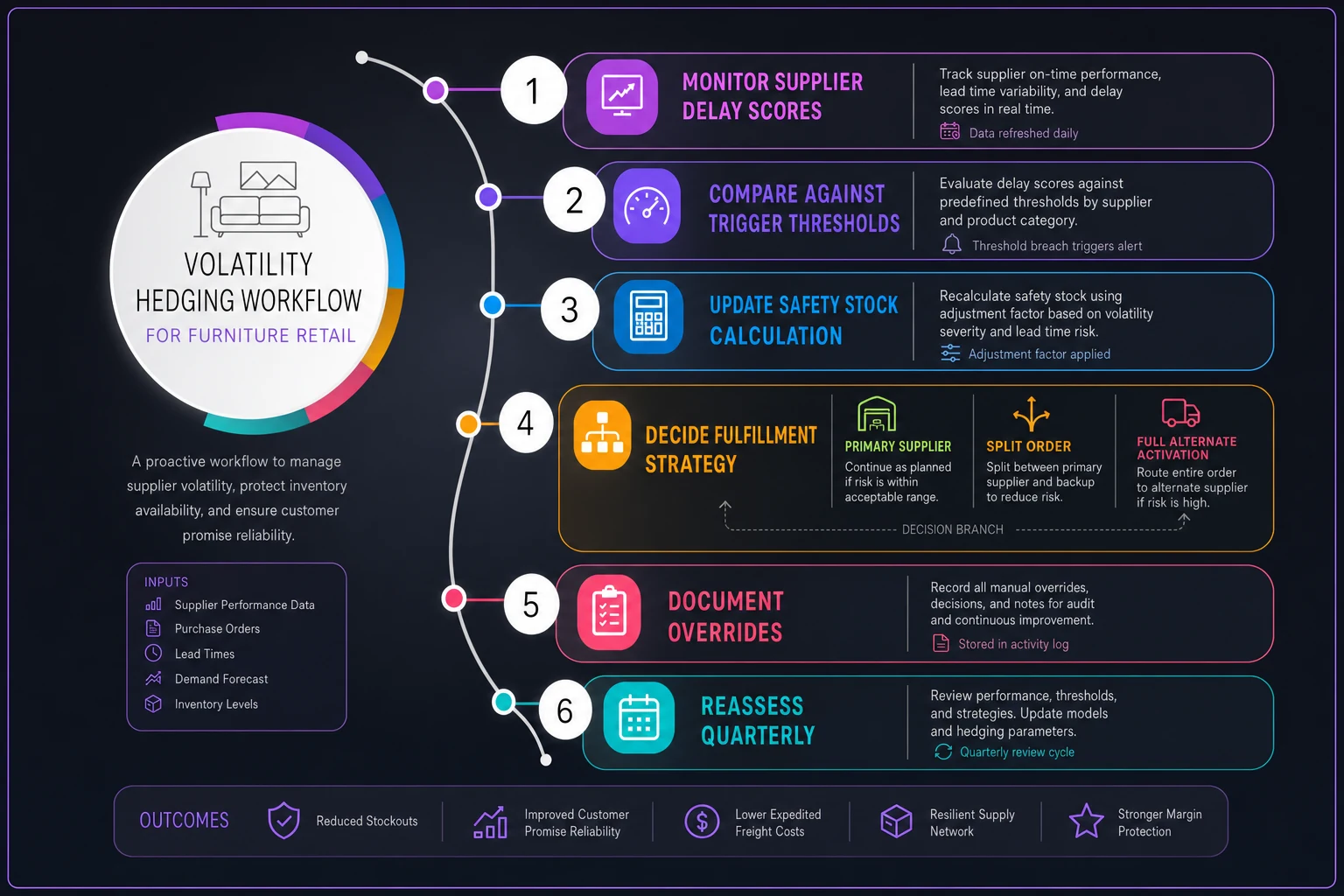
Running this as a consistent process — even manually at first — closes most of the gaps that lead to panic ordering or excess stock. The decisions are cleaner when everyone on the team knows what triggers what, and the documentation alone tends to surface patterns you wouldn't notice otherwise.
Software tools vs spreadsheet calculations
Most furniture stores still track lead times in spreadsheets, which creates a surprising amount of operational overhead. Every Monday morning, someone manually updates arrival dates, recalculates safety stock, and emails suppliers for status updates. This manual work creates errors and delays exactly when you need rapid response.
The calculation complexity for volatility-adjusted safety stock pushes Excel to its limits. You need historical lead time data, demand variance tracking, adjustment factors, alternate supplier triggers, and override rules all working together. One furniture retailer's safety stock spreadsheet grew to 47 tabs before it started crashing regularly — which is funny until it crashes on a Friday afternoon when you're trying to place an order.
Modern operational platforms handle these calculations automatically. When a container tracking system shows delays, safety stock adjusts immediately. When delay scores hit trigger points, alternate supplier notifications go out without anyone manually flagging it. The system maintains historical patterns while adapting to current conditions.
The real value isn't just automation — it's pattern recognition across your entire inventory. Software spots correlations that are easy to miss manually. Maybe all your Vietnamese suppliers delay simultaneously during certain months. Maybe specific product categories have hidden seasonality affecting lead times. These insights improve hedging beyond what formulas alone provide.
The platform approach also connects hedging decisions to other parts of the business. When you activate an alternate supplier, the system adjusts margin forecasts, updates sales team pricing, and modifies marketing inventory flags. That coordination prevents the chaos of manual override decisions rippling through your operation unnoticed.
For smaller furniture stores, even basic automation beats complex spreadsheets. Start with automated lead time tracking and trigger alerts. Add calculation modules as your operation grows. The goal isn't perfect optimization — it's consistent, reasonable hedging that prevents major stockouts without destroying cash flow.
ROI reality check on volatility hedging
Implementing volatility-adjusted safety stock requires upfront investment and ongoing discipline. Before committing, run realistic ROI calculations for your specific operation.
-
Software/automation setup
$15,000-25,000 first year
-
Additional inventory carrying cost
$35,000-50,000
-
Alternate supplier relationships
$8,000-12,000
-
Staff training and process changes
60-80 hours
Against these costs, measure prevented losses:
-
Avoided stockout events
8-10 per year at roughly $8,000 each
-
Reduced expedited shipping
$20,000-30,000 annually
-
Decreased customer churn
3-4% improvement
-
Fewer overtime hours managing crises
200+ hours
Most stores break even within 8-10 months, then see ongoing benefits. Success requires actual commitment to the process though. Half-implementing volatility hedging often costs more than doing nothing — you get the carrying costs without the stockout protection.
The stores that succeed with hedging share a few common traits. They track actual lead times carefully, not just promised dates. They maintain real relationships with alternate suppliers through regular small orders. They review and adjust formulas quarterly based on actual performance, not just set things up once and walk away.
Training sales staff on hedging reality matters too. When customers ask about delivery times, staff can confidently explain the protection systems in place. That transparency tends to turn potential frustration into trust.
The path forward for furniture retail inventory
Lead time volatility isn't going anywhere in furniture supply chains. Container shipping keeps getting more complex. Supplier consolidation continues. Raw material availability swings unpredictably. Standard inventory management breaks under these pressures.
Furniture retailers who implement proper volatility hedging gain a real edge. While competitors scramble during delays, you're fulfilling orders from properly calculated safety stock. Your sales team focuses on selling instead of apologizing. Cash flow becomes more predictable even when lead times aren't.
Start with one high-impact SKU. Calculate volatility-adjusted safety stock using the formulas above. Set up alternate supplier triggers. Track results for one quarter. The data will tell you whether your specific operation benefits from broader implementation.
Most furniture stores find their gut-feel inventory decisions were off by 30-40% — sometimes holding too much, sometimes too little, but rarely the right amount for actual volatility patterns. Mathematical hedging feels complicated at first but delivers real operational simplicity. When your biggest supplier delays a shipment, you follow predetermined triggers instead of making panic decisions at 9pm on a Thursday.
The furniture stores navigating supply chain chaos well have stopped hoping for steady lead times and started planning for volatility. They've turned unpredictability from a crisis trigger into a manageable operational variable. In an industry where everyone faces the same supply chain challenges, superior hedging calculations become a genuine competitive advantage.
Ready to elevate your furniture business?
Join 500+ furniture retailers using Hosyly to increase efficiency, improve customer satisfaction, and grow revenue.