

Most showroom "tests" aren't tests. Someone moves the sectional closer to the entrance, sales feel better that month, and the change becomes permanent. Nobody checked whether foot traffic was up, whether a competitor closed, or whether the weather just stopped being miserable. Three months later the same thing happens in reverse, and nobody can tell you if anything actually worked.
The problem with furniture showrooms specifically is that your test cell is expensive and slow. You can't spin up a variant overnight like a landing page. Moving a 9-foot dining set, re-lighting a vignette, and reprinting signage takes real labor. So when you finally do run a change, you want to know — with some confidence — whether it moved conversion per square meter or whether you just got lucky.
This is a framework for running honest showroom A/B tests on bulky furniture without needing a data team. It's built around conversion-per-sqm as the north-star metric, realistic sample sizes for stores that see hundreds (not millions) of visitors a week, and clear roll-back rules so a bad test doesn't quietly bleed margin for two months.
Why furniture showroom testing breaks (and why most retailers give up)
Three things make showroom A/B testing harder than typical retail experimentation.
First, low sample volume. A busy independent furniture store might see 400–900 unique groups through the door a week. Compare that to an ecommerce page getting tens of thousands of sessions. Low volume means small differences are statistically invisible — you need a meaningful lift to detect anything at all.
Second, the zone is the unit, not the store. You rarely test the whole showroom at once. You test a zone — say, the 40 sqm sectional area — and you measure conversion for that zone. That keeps your test clean, but it also means your denominator (visitors who actually entered that zone) is smaller still.
Third, attribution lag. Furniture is a considered purchase. Someone walks the sectional zone on a Saturday and buys three weeks later after measuring their living room twice. If your test window is two weeks, half your conversions land outside it and your data looks worse than reality.
What tends to happen is owners either don't test at all, or they run "tests" with no control, no fixed window, and no stop rule — which is worse, because it produces confident-sounding conclusions built on noise.
The one metric that matters: conversion per sqm
Everything here ties to conversion-per-sqm, not total sales. A zone can sell more just because you crammed more SKUs into it or gave it more floor. That's not efficiency — that's real estate you're paying rent on.
Eliminate inventory headaches and order delays.
Hosyly streamlines your furniture orders and stock management for seamless store operations.
- Real-time inventory tracking
- Automated order processing
- Customer notifications & engagement
No credit card required
Define it tightly before you test anything: Zone conversion per sqm = (orders attributed to the zone in the window) ÷ (zone area in sqm)
You'll also want a secondary metric: zone draw-in rate (visitors who entered the zone ÷ total store visitors). A layout change can improve conversion by pulling in fewer-but-more-qualified shoppers, and you want to see that mechanism, not just the outcome.
If you've already worked through showroom layouts that lift conversion per sqm, this testing framework is the measurement layer that tells you which of those layout changes actually earned their space.
Sample metrics: what you actually track
Keep the tracked metrics short. More metrics means more ways to fool yourself.
| Metric | Definition | Why it's here |
|---|---|---|
| Zone conversion per sqm | Zone orders ÷ zone sqm, per window | Primary decision metric |
| Zone draw-in rate | Zone visitors ÷ store visitors | Explains how conversion changed |
| Attach rate | % of zone orders that added an accessory/upsell | Catches margin effects |
| Dwell proxy | Avg. staff-logged engagements per day in zone | Early signal before orders land |
| Avg. order value (zone) | Order value for zone-attributed sales | Guards against "more sales, lower ticket" |
The dwell proxy matters more than people expect. Because furniture conversion lags, orders are a slow signal. Engagements — a salesperson actually sitting a customer down on the sofa, pulling a fabric swatch — show up immediately. If engagements collapse in week one, you don't need to wait four weeks to know something's wrong.
Required sample sizes (the part everyone skips)
Here's the uncomfortable math. With a conversion rate around 8–12% at the zone level and the visitor volumes most independents see, you cannot reliably detect a lift smaller than roughly 20–25% relative change in a 4-week window. Smaller lifts exist and are real, but you won't prove them — so don't try to.
-
To detect a ~25% relative lift in zone conversion
you generally need around 250–350 zone visitors per variant, which for a mid-traffic zone is about 3–4 weeks.
-
To detect a ~15% relative lift
you're looking at 700–900+ zone visitors per variant — often 6–8 weeks, and only realistic for high-traffic zones near the entrance.
-
Below ~10% lift
don't bother with a formal test. Make the change if it's cheap and monitor the trend; you'll never hit significance before the season shifts underneath you.
A practical rule worth leaning on: if the expected lift is small and the change is cheap, just ship it. Reserve formal A/B tests for changes that are expensive, risky, or hard to reverse — a full re-lighting of a zone, pulling a hero SKU, a signage or pricing display change that affects perceived value.
The two cleanest ways to run the test:
-
Sequential (same zone, before vs after) — easier logistically, but vulnerable to seasonality. Use only for 4-week windows inside a stable period, never across a holiday or sale.
-
Parallel (two comparable zones, or two locations) — cleaner statistically if the zones are genuinely similar in traffic and category. This is where multi-location retailers have a real advantage.
This is where multi-location retailers have a real advantage.
The 4–8 week test template
Here's the cadence that balances statistical honesty against the slowness of furniture buying.
-
Week 0 — Setup - Freeze the control. Document current layout with photos and a sqm measurement. - Define the single variable you're changing (signage, hero SKU, lighting, price display, vignette styling). One variable. If you change three things and conversion moves, you've learned nothing you can act on. - Set the decision threshold and roll-back rule up front, in writing.
-
Weeks 1–2 — Burn-in and leading signals - Watch the dwell proxy and draw-in rate daily. - Do not make decisions on orders yet — too early, attribution lag. - Roll-back only triggers here if there's a clear operational problem (traffic drops, signage confuses customers, staff report friction).
-
Weeks 3–4 — Primary read - Orders from the first two weeks start landing. Begin tracking zone conversion per sqm. - For a 25%-lift test, this is often your decision window.
-
Weeks 5–8 — Extension (for smaller lifts or lagging categories) - Only extend if your target lift is modest or the category has a long consideration cycle (dining, bedroom sets). - Accessories and smaller-ticket zones usually don't need the extension; sofas and case goods often do.
Window rule: never run a test window that straddles a promotion, a holiday weekend, or a major local event. It contaminates both the control and the variant. Pause and resume rather than run through it.
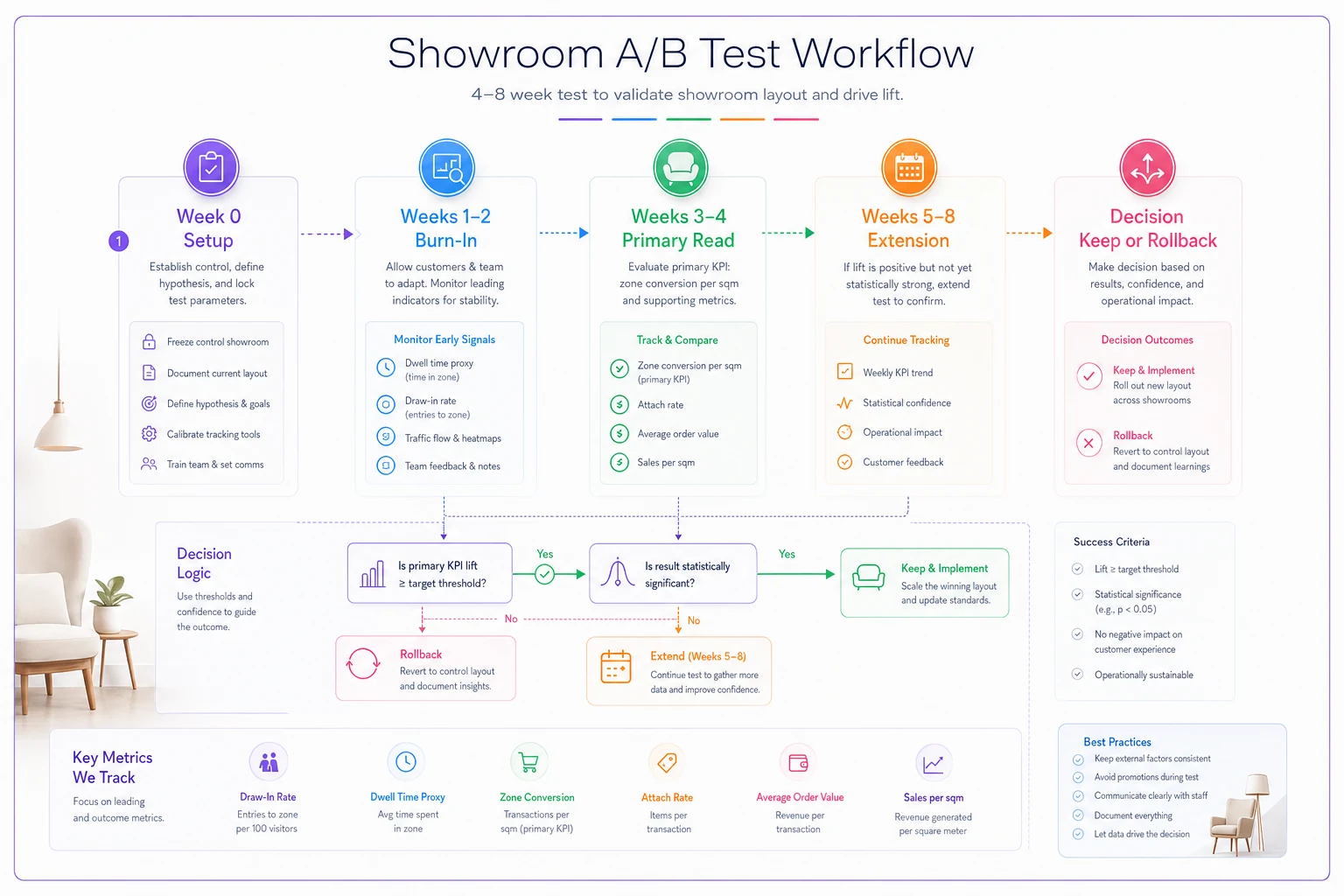
The sequence above looks clean on paper, but in practice week two is where most tests quietly die — someone moves a prop "just temporarily," a floor manager pulls a piece for a customer, and by week three the variant you're measuring isn't the variant you set up. Lock down the zone physically if you have to.
Lock down the zone physically during the test to keep the variant consistent.
The sequence above looks clean on paper, but in practice week two is where most tests quietly die — someone moves a prop "just temporarily," a floor manager pulls a piece for a customer, and by week three the variant you're measuring isn't the variant you set up. Lock down the zone physically if you have to.
Signage templates for clean tests
Signage is the cheapest, fastest variable to test in a showroom, which makes it the best place to start building the testing habit. The trap is sloppy copy that changes two things at once — a price and a benefit claim — so you can't tell which moved the needle.
-
Control current sign, as-is.
-
Variant A — benefit-led lead with the outcome ("Sleeps two comfortably. Fits a 3m wall.") Nothing about price changes.
-
Variant B — proof-led lead with social proof or warranty ("10-year frame warranty. Our #1 selling sectional.")
-
Variant C — spec-clarity lead with the dimensions and config most people ask staff about anyway.
Only run two of these at a time against control, in comparable zones. Dimension and config clarity tends to win more often than retailers expect — a huge share of walk-away objections in furniture are silent "will it fit?" doubts the customer never voices.
Roll-back rules: kill a bad test fast
A test that's clearly failing shouldn't run to its natural end "for the data." Define hard stops before you start.
-
Operational stop (any week) customer confusion, staff friction, or a safety/flow issue. Roll back immediately, note the reason.
-
Leading-signal stop (end of week 2) if draw-in rate or dwell proxy drops more than ~20% versus control with no plausible external cause, roll back. You don't need orders to confirm a zone people are avoiding.
-
Primary-metric stop (end of week 4) if zone conversion per sqm is trending negative versus control by a margin beyond normal week-to-week swing, roll back rather than extend.
-
No-signal stop (end of window) if there's no detectable difference either way, revert to control by default. "No evidence it helped" means don't keep the more expensive or more labor-intensive variant.
That last rule matters most. The natural bias is to keep a change because you already did the work. Defaulting to control protects you from that.
A real scenario
A single-location furniture retailer — roughly 650 sqm, somewhere between 500 and 700 walk-in groups a week — kept rotating their sofa hero display on gut feel. Their 44 sqm front sofa zone was their most expensive real estate and they had no idea if it was earning it.
They ran a parallel-style test by splitting across two comparable 4-week periods inside a quiet stretch (post-holiday, pre-spring). Control: existing vignette with a price-led sign. Variant: same hero SKU, same price, but a dimension-and-config-clarity sign plus one accent chair pulled in to create a "complete room" read. One meaningful variable cluster, held steady.
Weeks 1–2, the dwell proxy ticked up — staff logged more sit-downs in the zone. By week 4, zone conversion per sqm was up somewhere in the high-teens to low-20s percent versus the control period, and attach rate rose because the accent chair started selling alongside the sofa. Average order value held. They kept the variant.
More importantly, they finally had a repeatable way to judge the next change instead of arguing about it. The number isn't the point. The point is they stopped making permanent, expensive floor decisions on vibes.
When this makes sense — and when it doesn't
Run a formal test when:
-
The change is expensive or labor-heavy to reverse (lighting, major re-fixturing, pulling a hero SKU).
-
The zone is high-value real estate and you've been guessing.
-
You have two genuinely comparable zones or locations to run parallel.
Skip the formal test and just ship when:
-
The change is cheap, reversible, and low-risk.
-
Expected lift is small — you'll never reach significance before conditions shift.
-
You're mid-promotion or mid-holiday. Wait for a stable window.
Who should not do this yet: If you can't reliably count zone visitors and attribute orders back to a zone, don't start with A/B tests — start with measurement. A test on top of bad data just gives you confident wrong answers. Get basic zone traffic counts and order attribution working first, then layer the experiments on top.
Making the measurement actually stick
The hard part of showroom testing isn't the statistics — it's the discipline. Freezing a control, logging one variable, holding the window, honoring the roll-back rule. Most stores fail on the logging: the dwell proxy and zone attribution get recorded inconsistently, staff forget, and by week four the data has too many holes to trust.
This is where a shared operational system actually earns its keep — not as a magic button, but as a consistent place to log zone engagements, tag orders to the zone that sold them, and keep the before/after comparison honest so you're not reconstructing it from memory three weeks later. Operational platforms with light automation can flag when a test window overlaps a scheduled promotion, or prompt staff to log zone engagements so your leading signals stay clean. The value isn't the technology — it's that the test doesn't quietly fall apart halfway through.
Testing also pairs naturally with the harder question of what belongs on the floor in the first place. If you're still working out which samples deserve prime real estate before you start optimizing them, it's worth revisiting whether you're selling the wrong floor samples — because A/B testing a zone built around the wrong hero SKU just optimizes the wrong thing faster.
Start small
Pick one zone. Pick one variable. Pick a stable 4-week window with no sales or holidays in it. Write down your decision threshold and your roll-back rule before you touch anything. Run it, read it honestly, and revert to control if there's no real signal.
Do that three or four times and you'll have something most furniture retailers never build: a floor that gets measurably more productive every quarter, decision by decision, instead of drifting on whoever last had a strong opinion about where the sectional should go.
Do that three or four times and you'll have something most furniture retailers never build: a floor that gets measurably more productive every quarter, decision by decision, instead of drifting on whoever last had a strong opinion about where the sectional should go.
Ready to elevate your furniture business?
Join 500+ furniture retailers using Hosyly to increase efficiency, improve customer satisfaction, and grow revenue.