

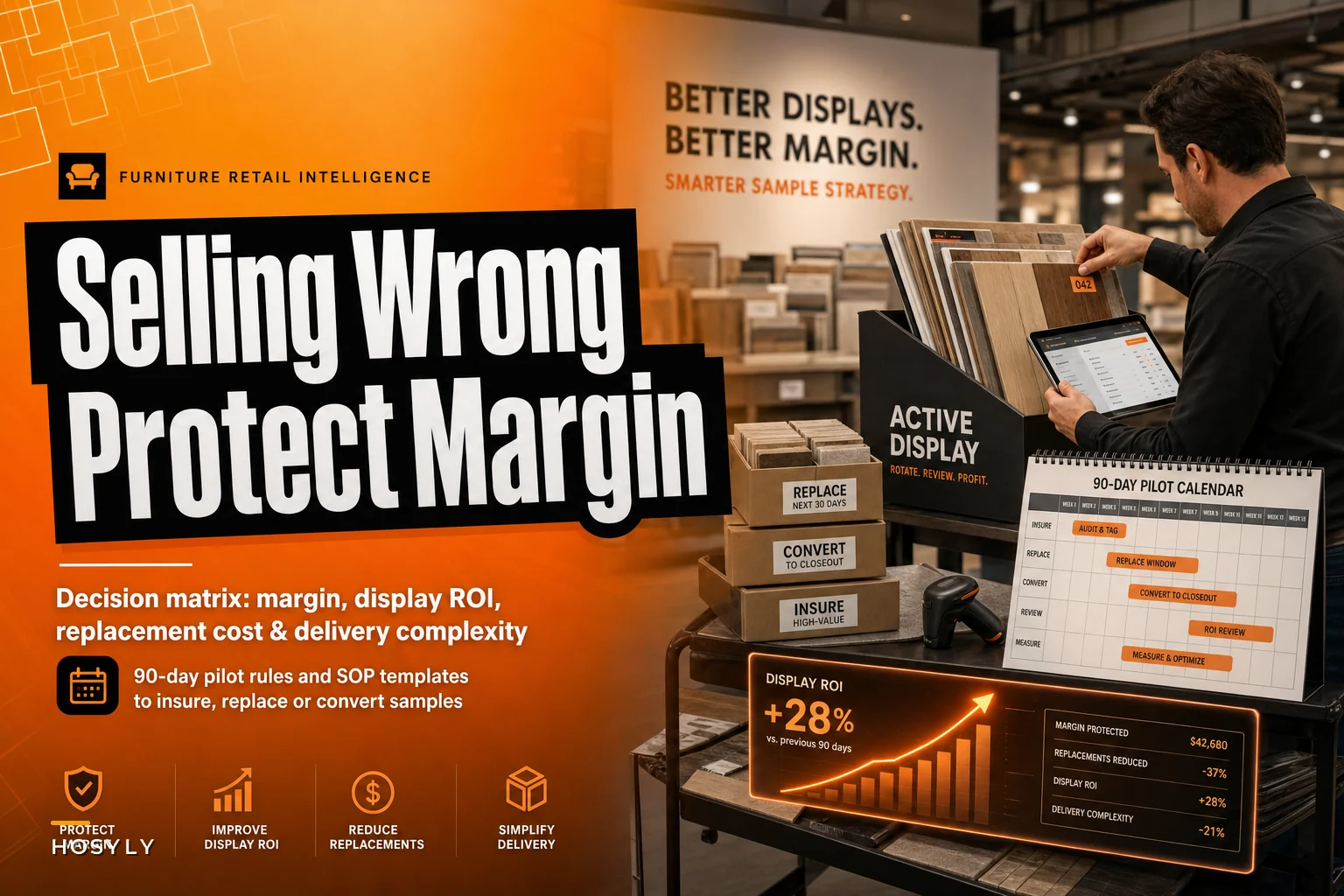

There's a moment that happens in almost every furniture showroom — usually near the end of a slow quarter — when someone in the back office looks at the floor and asks: "Can we just sell that sofa? We need the cash." And most of the time, nobody stops to ask whether that specific sample is the right one to sell.
That's the actual problem. Not whether to sell floor samples — everyone does — but which ones, when, and at what point the math flips against you. Because the sample that's easiest to move off the floor is frequently the worst one to let go, and the one gathering dust in the corner is often the one you should have converted three months ago.
This isn't about the repair-or-replace question when a sample gets damaged. That's a different decision. This is about a healthy, undamaged sample sitting on your floor right now, and the four-way choice you're making every single month whether you realize it or not: keep it, insure it, replace it, or convert it to sellable stock.
The decision most stores make by accident
Here's what usually happens. A sales manager needs to hit a number. A customer falls in love with the display model. The store offers 15% off "the floor sample," everyone's happy, and the sofa goes out the door that week.
Feels like a win. But nobody checked three things:
-
Whether that model was still driving new sales because it was on the floor
-
What it costs and how long it takes to get a replacement sample in
-
Whether the margin on the floor-model discount actually beat what the display contributed to other sales
What shows up across a lot of showrooms is that the samples people rush to sell tend to be the high-visibility, high-traffic anchor pieces — the ones customers touch first, sit on, and use as their reference point for the whole category. Those are exactly the pieces you don't want gone for six weeks while a replacement ships.
Meanwhile, the slow, dated sample in the corner — discontinued fabric, no replacement pipeline, near-zero influence on traffic — just sits there depreciating because nobody wants to discount it aggressively enough to move it.
The instinct is backwards. And it's backwards because the decision gets made emotionally (cash now, happy customer) instead of on the numbers that actually matter.
The four numbers that should drive the call
Every floor sample decision comes down to four inputs. Not ten. Four.
Eliminate inventory headaches and order delays.
Hosyly streamlines your furniture orders and stock management for seamless store operations.
- Real-time inventory tracking
- Automated order processing
- Customer notifications & engagement
No credit card required
-
Margin on the sample if sold as-is. What you'd net after the floor-model discount, minus any reconditioning.
-
Display ROI. How much this specific unit contributes to category sales by being visible and touchable. Harder to measure, but you know your anchors.
-
Replacement cost and lead time. What it costs to put an identical or equivalent sample back on the floor — and how many weeks of empty space that creates.
-
Delivery and handling complexity. Whether this piece is a two-person nightmare, a sectional with 40 parts, or a clean single-carton item that's easy to swap.
The insight isn't in any one number. It's in how they combine. A high-margin sample that's easy to replace and easy to deliver? Sell it. A low-margin anchor piece with a 10-week replacement lead time and a two-person delivery requirement? Keep it on the floor and stop letting the sales team give it away.
Here's the matrix we use as a starting point:
| Display ROI | Replacement Lead Time | Sell Margin | Recommended Action |
|---|---|---|---|
| High (anchor) | Long (6+ weeks) | Any | Keep — protect the display, block floor-model sales |
| High (anchor) | Short (under 3 weeks) | Healthy | Convert & replace — sell it, reorder same day |
| Low | Any | Healthy | Convert to stock — move it, don't backfill |
| Low | Any | Thin/negative | Clear — it's dead display space |
| High-value, fragile | N/A | N/A | Insure & keep — coverage cheaper than exposure |
The "insure" row is the one most stores skip entirely. If you've got a $6k–$9k designer piece on the floor getting sat on by kids and spilled on all day, the annual cost of covering it against display damage is often trivial compared to eating a full write-down when it gets wrecked. More on that below.
Why the "just sell it" reflex costs more than it looks
Walk through the real cost of converting the wrong sample, because it hides in places the P&L doesn't show cleanly.
Say you sell your best-selling sectional off the floor at a 20% discount. On a $4,000 retail piece, that's $800 of margin you gave up versus selling a fresh one from stock. Fine — call it the cost of a quick sale.
But now the floor is empty for 8 weeks while a replacement ships. During those 8 weeks, customers walk the sectional aisle and see a gap. They can't sit on it. They can't feel the fabric. They can't see the scale in a real room setting. In a lot of showrooms, one display drives a meaningful share of that category's conversions. Lose it for two months and you don't just lose the $800 — you lose some number of full-margin sectional sales that would've closed because a customer could experience the product. That number is usually bigger than the discount you gave, and it never shows up as a line item. It just shows up as a soft month you can't quite explain.
The floor-model discount is visible. The display-gap revenue leak is invisible. Stores optimize for the visible number and quietly bleed the invisible one.
When converting a sample to sellable stock actually makes sense
Converting is the right call more often than people think — you just have to be selective about which ones.
It makes sense when:
-
The model is being discontinued or refreshed, and you won't be reordering samples anyway
-
Replacement lead time is short enough that the floor gap is measured in days, not weeks
-
The piece has low display influence — it's not what draws people into the category
-
You're carrying too much of that SKU in the back and the sample is just another unit of aging inventory
-
Reconditioning cost is low — no reupholstery, no deep cleaning, minimal wear
It's a bad idea when:
-
The sample is a category anchor with real pulling power
-
Replacement lead time is long and you have no equivalent to swap in
-
The delivery is complex enough that "selling the floor model" turns into a logistics headache that eats your discount in handling costs
-
The fabric or finish is discontinued and can't be reordered as a fresh sample
The cleanest rule of thumb: convert samples you weren't going to replace anyway. If your instinct after selling it is "we need to get another one on the floor fast," that's a sign you should have kept the original.
The insure decision nobody plans for
Insurance — or more accurately, a display-damage reserve — is the quietest tool in this whole framework, and it's consistently underused.
High-ticket samples on an active floor take real abuse. Motion recliners get cycled thousands of times. Leather gets scratched. Light finishes get scuffed. A portion of your premium samples will get damaged badly enough that you can't sell them at anything close to full value.
The mistake is treating each of those as a surprise write-off. Damage to floor samples isn't really random — it's predictable at the category level. You know roughly how many premium pieces will take a hit each year. So instead of absorbing it as a shock, you build a small reserve against your highest-exposure samples, or you actually insure the truly expensive ones.
A practical test: if the annual expected damage cost on a sample exceeds what it would cost to formally cover or reserve for it, insure it. For most stores this only applies to the top slice — pieces at $5k and up that live in high-touch zones. Everything else gets absorbed into normal display depreciation.
A pilot you can run in one category this quarter
Don't roll this out across the whole store at once. Pick your worst category for floor-sample chaos — usually sectionals or motion — and run a 90-day pilot with tight rules.
Pilot rules:
-
Freeze anchor sales. Identify the 3–5 samples in the category that drive the most traffic and conversions. No floor-model discounts on those without manager sign-off, full stop.
-
Tag every sample with its four numbers. Sell margin, display tier (anchor / mid / low), replacement lead time in weeks, delivery complexity (simple / moderate / complex).
-
Set a conversion trigger. Any low-display sample sitting past its target rotation window — say 6–9 months — automatically becomes a convert-or-clear candidate.
-
Reorder same-day on approved conversions. If a sample gets sold and needs backfilling, the replacement order goes in the same day. No floor gaps drifting for weeks because the paperwork sat.
-
Log every damaged sample. Track it by category so you can build your insure/reserve list from real data instead of guesses.
Run that for a quarter, measure the category's margin per square meter and conversion rate against the prior period, and you'll have a clear read on whether the rules hold up before you expand them.
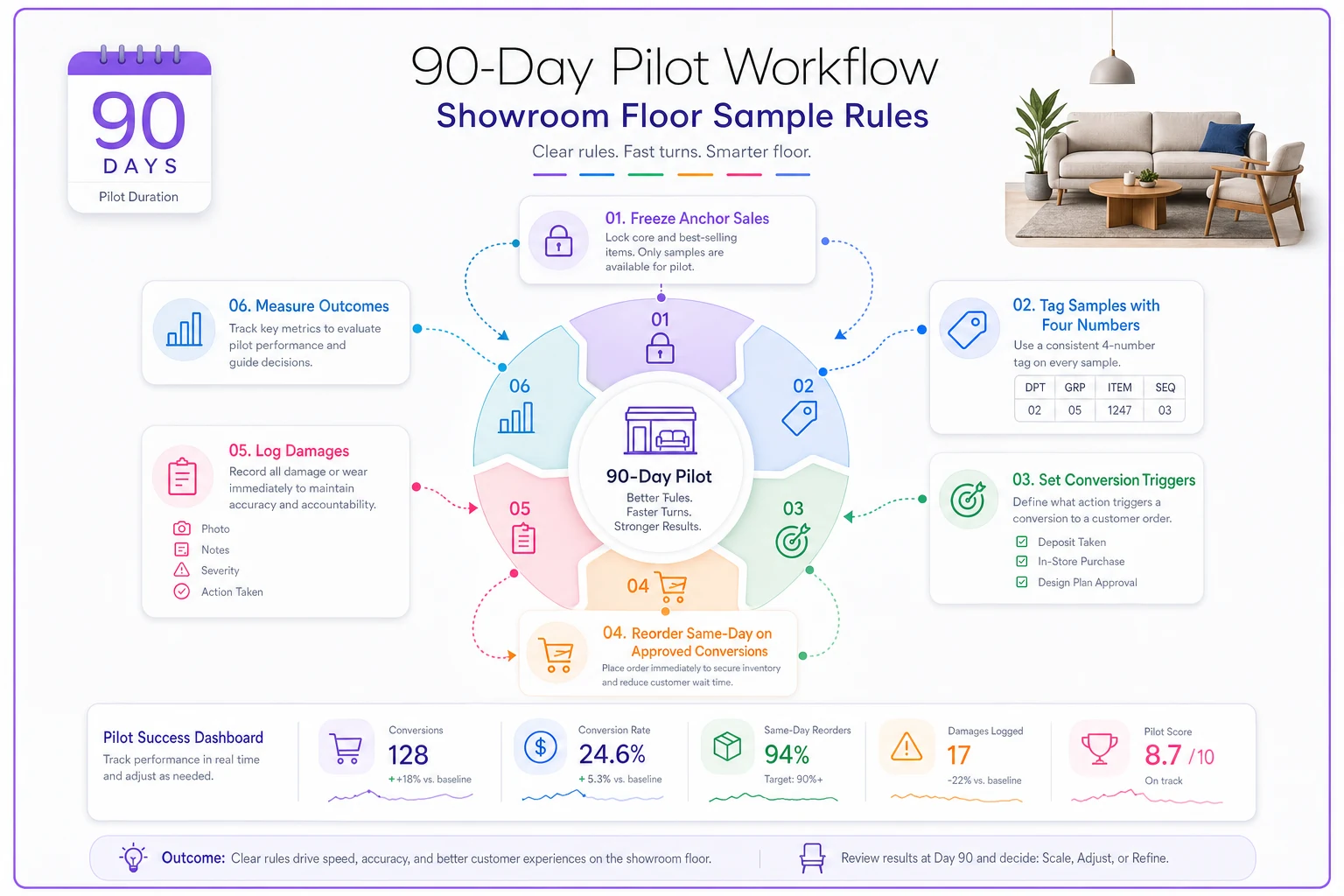
This diagram summarizes the 90-day pilot steps and where to log metrics.
A simple SOP your floor staff will actually follow
The framework only works if the person on the floor can make the call in ten seconds without calling three people. Keep the SOP short enough to fit on a laminated card:
-
Customer wants a floor model? Check the sample's display tier tag first.
-
Anchor piece? Offer to order fresh from stock instead. Only sell the floor model with manager approval.
-
Mid or low tier? Check replacement lead time. Under 3 weeks or being discontinued → clear to sell. Reorder same day if backfilling.
-
Any piece over your insure threshold? Confirm it's on the covered list before anything else, so damage during the sale doesn't fall through the cracks.
-
After any conversion log it, and if backfilling, place the replacement order immediately.
Laminate the SOP card and keep copies at the POS for quick reference.
That's it. The point isn't complexity — it's making sure the fast, emotional "just sell it" reflex runs through one quick filter before the sofa leaves the building.
A real scenario
A mid-sized furniture store — three locations, strong in sectionals and motion — kept converting floor samples reactively whenever cash got tight. Over about a year they'd sold roughly a dozen anchor pieces at 15–20% off, then scrambled to backfill, often leaving key displays empty for a month or more at a stretch.
After tagging their samples by display tier and freezing anchor sales without approval, the pattern shifted. They still converted samples — actually a few more than before — but now it was the low-display, short-lead pieces and discontinued models, not the traffic drivers. Anchor displays stayed intact.
The result over the next two quarters wasn't dramatic on paper, but it was real: category conversion held steadier, the unexplained soft months in sectionals mostly disappeared, and margin per square meter in the pilot category improved by a few points. The biggest change was qualitative. The team stopped making a $4,000 decision on a gut feeling and started running it through four numbers first.
Where the effort actually pays off
The stores that get this right aren't the ones with the fanciest system. They're the ones who stopped treating floor samples as either "permanent displays" or "cash on legs" and started treating each one as a small asset with its own margin, its own display job, and its own replacement math.
Once you tag samples with those four numbers and enforce even a loose version of the matrix, the decisions get boring — and boring is exactly what you want. The anchor stays on the floor doing its job. The dead sample gets cleared before it depreciates further. The premium piece is covered before it gets wrecked. And the "we need cash, sell the sofa" conversation stops targeting the one display you can least afford to lose.
That's the whole game with showroom floor sample rules for furniture: make the call on the numbers, protect the displays that actually sell, and convert the ones you were never going to keep anyway.
Ready to elevate your furniture business?
Join 500+ furniture retailers using Hosyly to increase efficiency, improve customer satisfaction, and grow revenue.