



Floor samples take abuse. That's their job. But figuring out when to repair versus replace them requires more than eyeballing the damage and making a gut call. Most furniture stores handle this inconsistently, which leads to unnecessary write-offs, wasted repair budgets, and showrooms filled with damaged merchandise that quietly hurts sales.
The real challenge isn't deciding whether a torn cushion is worth fixing. It's building a systematic approach that accounts for repair costs, resale potential, insurance thresholds, showroom space value, and the hidden cost of keeping damaged samples on display at all. Without clear decision gates, stores either sink money into samples that should've been written off months ago, or they prematurely dump inventory that could've moved profitably with minor repairs.
The hidden economics of damaged floor samples
A damaged floor sample costs you money three different ways, and most stores only track one of them.
First, there's the obvious discount hit when you eventually sell it. A sectional with visible wear might need a 30-40% markdown to move. On a $3,800 piece, that's over $1,500 in lost margin.
Second, damaged samples reduce the perceived value of everything around them. Customers assume a showroom with beat-up furniture reflects the quality they'll actually receive. That perception spreads beyond just the damaged piece.
Third—and most overlooked—is the opportunity cost of showroom real estate. Every month that damaged sectional sits there, it's blocking space that could display something at full margin. In a typical 8,000 square foot showroom, each display spot needs to generate roughly $2,800 per month to cover rent, utilities, and overhead. A damaged sample sitting for three months waiting on repairs has cost you around $8,400 in opportunity alone, regardless of whether you eventually fix it.
This is why the repair versus replace decision needs structure. The real question isn't "can we fix this?" It's "does fixing this make more sense than our alternatives?"
Condition scoring that actually drives decisions
Most condition assessment systems fail because they're too subjective. "Good," "Fair," and "Poor" mean different things to different people on different days. You need scoring tied directly to repair costs and resale impact.
Eliminate inventory headaches and order delays.
Hosyly streamlines your furniture orders and stock management for seamless store operations.
- Real-time inventory tracking
- Automated order processing
- Customer notifications & engagement
No credit card required
Here's a framework that actually works:
Category A - Surface Issues (Score 1-3)
-
Minor scratches, scuffs, or fabric pills
-
Repair cost
Under 5% of retail price
-
Resale impact
5-10% discount needed
-
Decision
Always repair
Category B - Functional Problems (Score 4-6)
-
Torn fabric, broken hardware, minor structural issues
-
Repair cost
5-15% of retail price
-
Resale impact
15-25% discount needed
-
Decision
Repair if under warranty or high-margin item
Category C - Major Damage (Score 7-9)
-
Frame damage, extensive upholstery issues, multiple problems
-
Repair cost
Over 15% of retail price
-
Resale impact
30-50% discount needed
-
Decision
Usually replace or liquidate
Category D - Write-off Territory (Score 10)
-
Irreparable damage or repair cost exceeds 25% of retail
-
Resale impact
Over 50% discount or unsellable
-
Decision
Insurance claim or disposal
The key is training your team to score consistently. Take photos of damage in each category and build a visual reference guide. When someone calls something Category B, everyone else should agree it's Category B.
Building repair cost thresholds that protect margins
The 15% rule gets thrown around a lot—don't spend more than 15% of retail value on repairs. But this oversimplifies things considerably.
Your repair threshold should factor in:
Current margin structure: A sofa with 55% margin can absorb more repair cost than one at 35% margin. Calculate thresholds based on protecting minimum acceptable margins, not retail prices.
Time in showroom: A sample that's been on display for eight months has already earned its keep. You can justify higher repair costs than on something that's barely been out of the box.
Replacement availability: If your supplier has a 16-week lead time, paying more for repairs might beat waiting on new inventory.
Seasonal timing: Spending $600 to repair outdoor furniture in February means it sits repaired but unsold until May. The same repair in April makes a lot more sense.
Here's a practical threshold matrix:
| Item Age | Margin >50% | Margin 35-50% | Margin <35% |
|---|---|---|---|
| 0-3 months | Up to 20% | Up to 15% | Up to 10% |
| 3-6 months | Up to 15% | Up to 12% | Up to 8% |
| 6-12 months | Up to 12% | Up to 10% | Write-off |
| Over 12 months | Up to 10% | Write-off | Write-off |
These percentages apply to your landed cost, not retail price. A $2,000 retail sofa that cost you $900 landed can justify $180 in repairs if it's under three months old with solid margins.
Insurance claims versus internal write-offs
A lot of furniture stores leave insurance money on the table by not understanding their coverage triggers. Most commercial policies cover "sudden and accidental" damage to inventory, but the definition matters more than people realize.
Customer damage during browsing? Usually covered. Wear from normal display use? Usually not. Damage during delivery to the showroom? Covered. Gradual deterioration? Not covered.
The threshold for filing matters too. If your deductible is $1,000 and you've got a $3,800 sectional with $1,200 in damage, filing makes sense. But factor in the administrative time and potential premium increases. Some stores set an internal threshold of 2x the deductible before filing a claim.
Track patterns in your damage claims. If you're seeing recurring delivery damage, that's an operational problem to fix, not an insurance strategy to lean on. One store filed twelve claims in a year for delivery damage, watched their premiums jump 40%, then discovered their crew was using improper tie-down techniques. Fixing the root cause eliminated most of the claims entirely.
Document everything immediately. Photos when damage is discovered, written descriptions, repair estimates. Insurance companies regularly deny claims filed weeks after damage occurred because documentation is weak or missing. A simple one-page incident report that staff complete whenever damage gets discovered goes a long way.
The repair log that reveals patterns
Tracking repairs without learning from them is just paperwork. Most repair logs capture what broke but miss why it broke and whether fixing it actually paid off.
Here's a repair log structure worth using:
Basic Information
-
SKU and product details
-
Date damage discovered
-
Damage category (A through D)
-
Photos attached
Damage Analysis
-
Suspected cause (customer, delivery, design flaw, normal wear)
-
Location in showroom (high-traffic, corner, entrance)
-
Days on display before damage
Repair Decision
-
Estimated repair cost
-
Estimated time to complete
-
Alternative options considered
-
Decision made and reasoning
Outcome Tracking
-
Actual repair cost
-
Actual completion time
-
Final selling price
-
Days to sell after repair
-
Margin achieved
Pattern Indicators
-
Similar damage on this SKU before? (Yes/No)
-
Similar damage in this location before? (Yes/No)
-
Repair vendor performance (1-5 scale)
After six months, patterns start showing up. Maybe all your leather damage happens in the sunny southwest corner. Maybe a specific sofa model consistently develops frame issues. Maybe your upholstery vendor takes twice as long as quoted every single time.
Rotate entrance displays monthly to reduce concentrated damage and catch patterns earlier.
One store found that 60% of their fabric damage happened on pieces displayed within eight feet of their entrance. They started rotating entrance displays monthly and cut repair costs by around $11,000 a year. Without the tracking, they'd never have spotted it.
When showroom space value trumps repair economics
Sometimes the math says repair, but the operation says replace.
Consider a dining set that needs $400 in repairs with a two-week turnaround. The numbers might support fixing it—12% of the $3,200 retail price. But if that dining display typically generates $3,500 in monthly revenue and you'll lose two weeks of display time, you're giving up $1,750 in potential sales to save a $400 repair.
Seasonal timing makes this messier. Patio furniture damaged in September faces completely different economics than the same damage in March. By September, you're heading into slow season anyway. The opportunity cost of that display space drops. March damage means missing peak selling season entirely.
Space productivity also varies by showroom zone. Premium spots near the entrance or along main pathways tend to generate significantly more revenue than back corners. A damaged piece in a premium spot needs faster resolution than the same issue tucked away somewhere low-traffic.
Some stores create "repair zones"—designated areas for pieces awaiting repair or being sold as-is with visible damage. This keeps damaged goods from contaminating premium display space while maintaining some selling potential. Mark these pieces clearly with the damage description and the discount being offered. Customers actually appreciate the transparency when it's paired with a meaningful price reduction.
Decision gates that prevent analysis paralysis
The biggest problem with repair decisions usually isn't making the wrong choice—it's taking too long to make any choice. Every day spent debating adds carrying costs and opportunity costs.
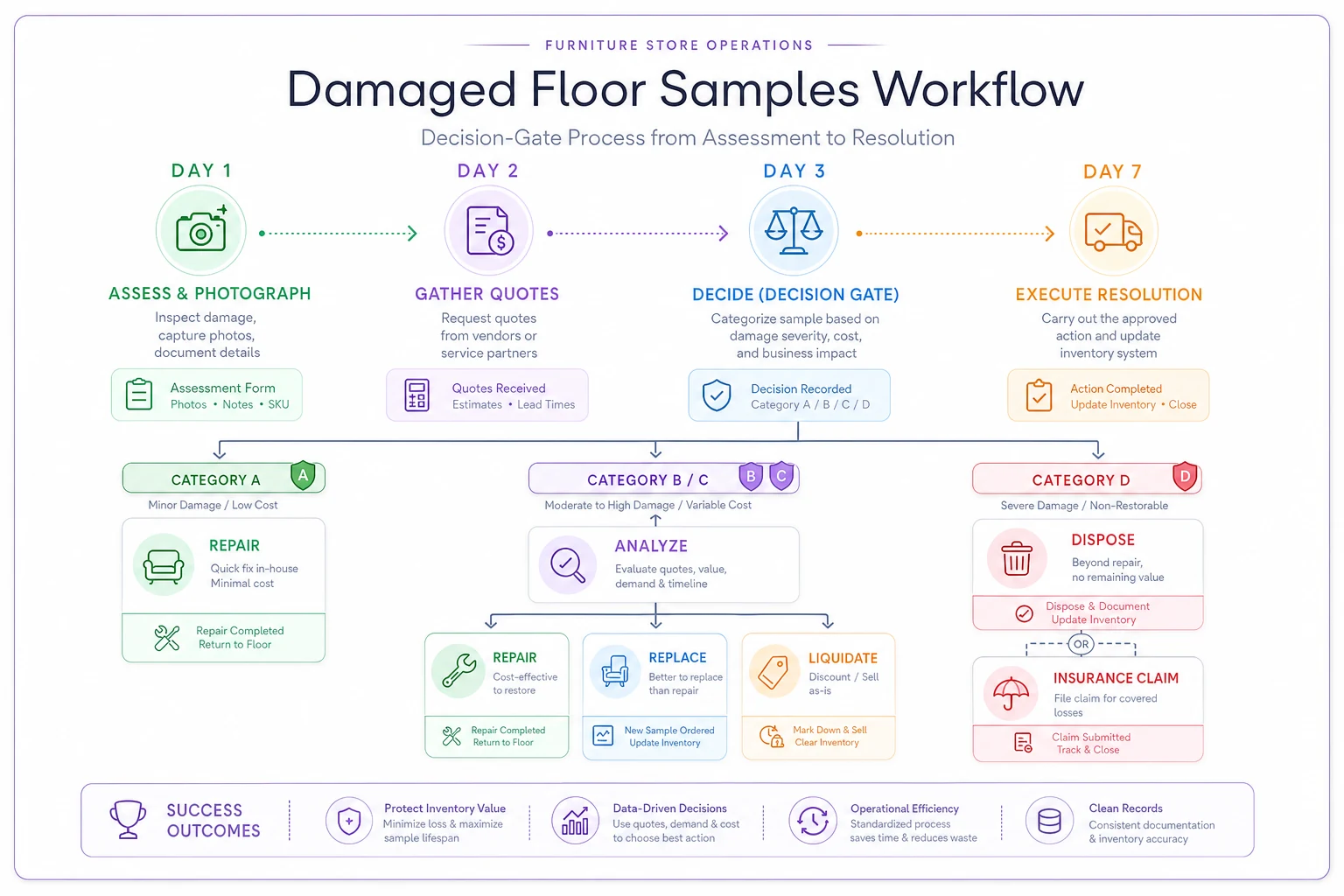
24-Hour Assessment Gate Within one day of damage discovery, score the condition and estimate repair costs. Category A means repair immediately. Category D means start the disposal process. Only Category B and C need deeper analysis.
72-Hour Decision Gate For Category B and C damage, make the repair/replace/liquidate call within three days. Gather repair quotes, check replacement availability, calculate the economics. After 72 hours, decide and execute. No exceptions.
7-Day Resolution Gate If you choose repair, the piece should be off the floor and in repair within a week. If you choose liquidation, it should be priced and moved to clearance within a week. Damaged pieces sitting in limbo destroy value.
Build these gates into your operational workflow. When damage gets reported, it triggers an automatic task sequence. Day 1: assess and photograph. Day 2: gather quotes if needed. Day 3: decide. Day 7: verify execution. This stops damaged pieces from becoming permanent showroom fixtures while everyone avoids making the call.
A decent decision made quickly beats a perfect decision made three weeks late. Train managers to use the framework confidently, not agonize over edge cases.
Tying repairs to sales velocity and margin goals
Not all SKUs deserve the same repair investment. Your bestsellers and high-margin pieces warrant different treatment than slow-movers you're trying to clear.
Track sales velocity by SKU. A sectional that typically sells within 30 days deserves more repair investment than one averaging 120 days on floor. You'll recoup repair costs faster and free up space sooner.
Margin structure matters too. A dining set with 65% margins can absorb a $500 repair and still deliver acceptable profits. The same repair on a 35% margin piece might wipe out profits entirely.
Create SKU categories for repair decisions:
Stars (High velocity, high margin): Repair aggressively, up to 20% of cost
Workhorses (High velocity, moderate margin): Standard repairs, up to 15% of cost
Margin Builders (Low velocity, high margin): Selective repairs, up to 12% of cost
Problem Children (Low velocity, low margin): Minimal repairs, under 8% of cost
This prevents over-investing in slow movers while under-maintaining winners. Your repair budget generates better returns when concentrated on pieces that sell quickly at healthy margins.
Review these categories quarterly. Items shift as trends change. Last season's star can easily become this season's problem child. Adjust repair investment accordingly.
This approach also helps with vendor negotiations. When you can show a supplier that a specific SKU is a consistent seller with strong margins, you have more leverage pushing for better repair support or warranty coverage. They want to protect successful products too.
Transforming repair tracking into operational intelligence
Most furniture stores treat repairs as isolated incidents rather than operational data worth analyzing. But repair patterns reveal problems you can prevent, not just fix.
Connect repair data to other operational metrics. Do pieces from certain vendors need more repairs? Does damage correlate with how items are displayed or where they're positioned? Are specific delivery crews generating a disproportionate share of damage claims?
One store found that 40% of their upholstery repairs traced back to a single vendor whose fabric quality had quietly declined. Armed with that data, they negotiated a retroactive credit and higher quality standards going forward. Without systematic tracking, they'd have just kept repairing pieces and eating the cost indefinitely.
Repair patterns can also reveal training gaps. If multiple pieces show the same type of frame damage, maybe the team needs better guidance on floor model assembly. If fabric tears concentrate in high-traffic areas, maybe you need protective policies or a rethink on traffic flow.
Use repair data for inventory planning too. If certain SKUs consistently need repairs after 60 days on display, factor that into your rotation schedule. Maybe you need two floor models to rotate, or maybe that SKU shouldn't be on the floor at all—just sold from catalog.
Your repair log becomes an early warning system. When multiple pieces show the same problem, you can proactively inspect remaining floor models and potentially prevent damage before it happens rather than reacting after the fact.
Building this into your operational rhythm
Making repair-or-replace decisions consistently requires integration into daily operations, not special meetings when problems pile up.
Set a weekly damage review as a standing agenda item. Every Monday, review all damage discovered the previous week, check the status of items currently in repair, and verify that disposal decisions got executed. This rhythm prevents damaged inventory from quietly accumulating while everyone assumes someone else is handling it.
Assign clear ownership for each stage. Floor staff identify and report damage. A designated manager scores conditions and gathers repair quotes. The owner or GM makes final calls on anything over a set threshold. Finance tracks outcomes and reports monthly on repair ROI.
Create simple tools anyone can use without thinking too hard about it. A one-page damage assessment form. A repair threshold chart posted in the back office. A vendor contact list for quick quotes. The easier you make the process, the more consistently it gets followed.
AI-powered operational software can help systematize this entire workflow if your team struggles to maintain the discipline manually. Good platforms can automatically trigger assessment tasks when damage gets reported, route approvals based on dollar thresholds, track repair timelines, and flag when decisions are dragging past your target timeframes. It removes the mental burden of managing damaged inventory across multiple pieces simultaneously.
For broader context on how deposit and preorder decisions interact with floor sample economics, it's worth reading about common preorder deposit mistakes furniture retailers make and how to retire slow-moving furniture SKUs without surprising customers.
Your floor samples will take damage—that's not avoidable. But how you handle that damage determines whether it's a minor cost of doing business or a meaningful drain on profitability. Build the framework, train the team, track the outcomes.
The stores that handle this well don't avoid damage. They just respond to it faster and more systematically than everyone else. In a business where margins are tight and showroom space is expensive, that discipline shows up directly in the bottom line.
Ready to elevate your furniture business?
Join 500+ furniture retailers using Hosyly to increase efficiency, improve customer satisfaction, and grow revenue.