

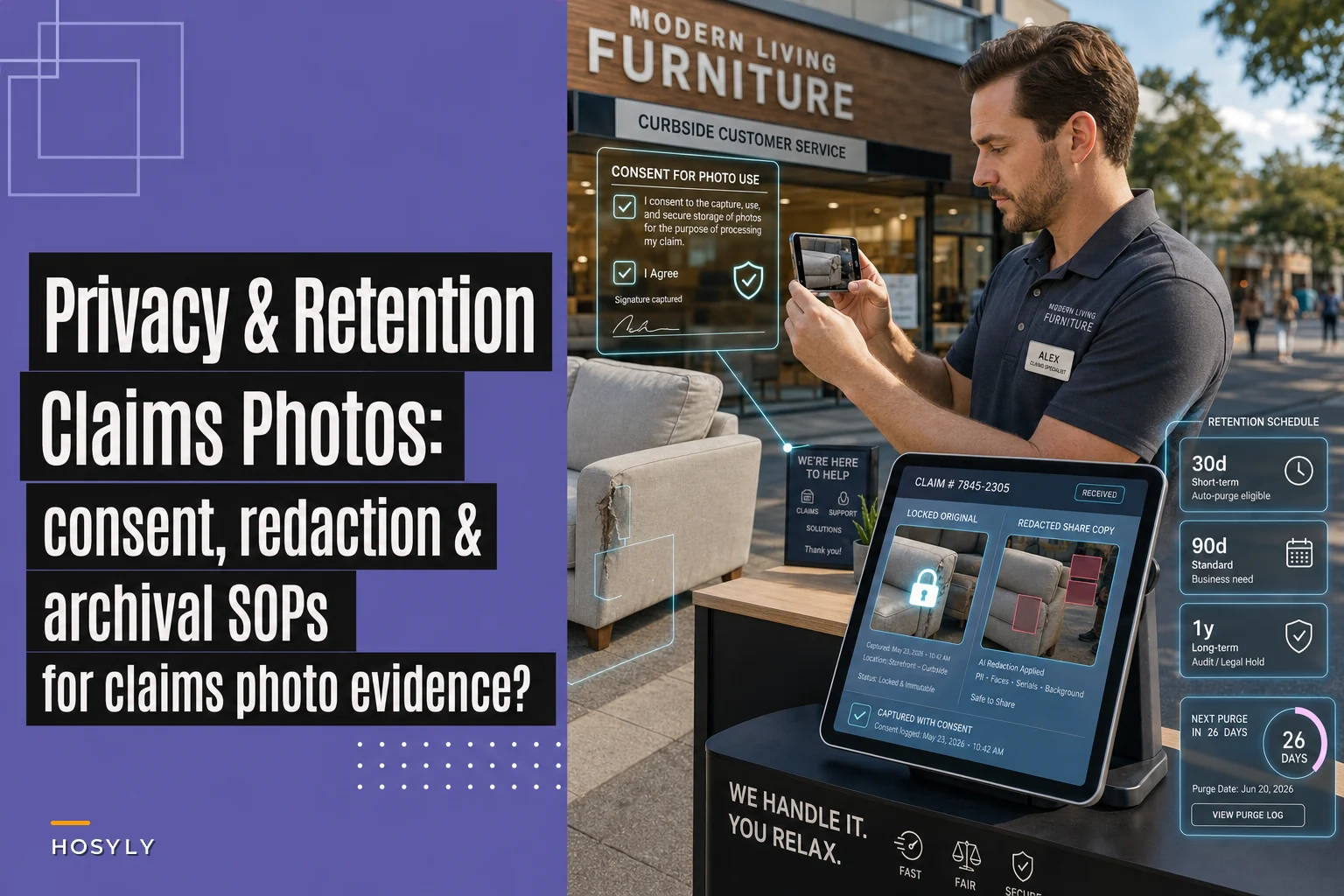

If you process transit-damage or warranty claims, you're sitting on a pile of customer photos right now. Phones full of sofa close-ups, hallway shots, delivery doorsteps, living rooms with kids' toys in the frame. Most furniture retailers treat these the way they treat receipts — keep everything forever, never look at it again, hope nobody asks about it.
That works fine until a carrier disputes a claim from 14 months ago and you can't find the photos. Or a customer asks why you still have interior shots of their house. Or your insurer requests originals and all you have are compressed thumbnails that got crushed when someone forwarded them through three WhatsApp chats.
This is a narrow problem, but it has a clean operational answer. Photos that hold up as evidence when you need them, deleted or locked down when you don't, with consent handled so it's not awkward later. Here's how to map it out.
The core tension: evidence wants permanence, privacy wants deletion
Every photo in a claims workflow is pulling in two directions.
For a claim to stick with a carrier or supplier, the photo needs to be original, timestamped, and traceable. Blurry screenshots and forwarded images lose metadata, and once the EXIF data is gone, a carrier's adjuster can — and will — argue the photo isn't tied to your delivery date. The evidence side of this is covered in detail in the photo-evidence and escalation workflow for transit damage, so the capture mechanics won't be repeated here.
For privacy, the opposite is true. The longer you hold a photo of someone's home, the more exposure you carry — a data request, a breach, a confused customer, a staff member scrolling through old delivery albums. A sectional photographed in a customer's living room captures far more than the sofa: faces, address details, sometimes a laptop screen or a prescription bottle on the counter.
The whole SOP is just managing that tension deliberately instead of by accident.
Map every capture point to a retention bucket
The mistake most stores make is treating all claim photos as one undifferentiated pile. Photos get captured at very different moments, for very different reasons, and they don't all deserve the same retention.
Eliminate inventory headaches and order delays.
Hosyly streamlines your furniture orders and stock management for seamless store operations.
- Real-time inventory tracking
- Automated order processing
- Customer notifications & engagement
No credit card required
Here's the breakdown worth mapping before you write any policy:
| Capture point | What it's really for | Evidentiary value | Retention bucket |
|---|---|---|---|
| Pre-dispatch / warehouse condition shot | Proves item left undamaged | High (shifts liability to carrier) | 90 days after delivery, then purge if no claim |
| Delivery handoff / proof-of-delivery | Proves condition at the door | High during claim window | 180 days, then purge if no claim |
| Customer-submitted damage photo | Basis of the claim itself | Very high | Life of claim + 2 years |
| In-home installation photo | Shows workmanship / site condition | Medium | 1 year, then purge |
| Warranty inspection photo | Supports repair/replace decision | High if claim escalates | Life of warranty claim + 2 years |
| "For reference" photos staff snap casually | Usually none | Low / liability only | Delete within 30 days or don't capture |
That last row is where most of the privacy risk actually lives. Staff snapping "just in case" photos that never attach to a claim, sitting in personal camera rolls indefinitely. No evidentiary value, pure downside. The first rule of a good retention SOP: if a photo isn't tied to a claim or a dispatch record, it shouldn't exist past 30 days.
Stores that capture photos directly into a structured claims record — tied to an order number — almost never have the "random photos in staff phones" problem. The ones relying on texting photos around are the ones sitting on thousands of orphaned images nobody can account for.
Consent: get it once, phrase it plainly, log it
You don't need a legal essay. You need a short, clear statement the customer sees or hears at the moment photos get taken, plus a record that it happened.
Two moments matter: when a customer submits a photo, and when your crew takes one in their home.
Snippet for customer-submitted claim photos
> "To process your damage claim, please upload photos of the affected item. By submitting photos, you agree we may store and share them with our delivery partners, suppliers, or insurers solely to assess and resolve your claim. We keep claim photos for up to two years after your claim closes, then delete them. You can request deletion of any photo that isn't needed for an open claim."
Snippet for in-home photos taken by your crew
> "We'd like to take a couple of photos of the item and the area around it to document condition. These are only used for delivery and claim records. Is that okay?"
If the customer says no, that's fine — note it, and fall back to photographing only the item itself, angled to exclude as much of the room as possible. Forcing it creates far more risk than the photo is worth.
The log part is non-negotiable. A consent you can't prove is a consent you don't have. At minimum, record: order number, timestamp, who captured, and consent yes/no. That single line protects you more than any amount of policy language.
Redaction rules: capture clean, don't clean up later
The cheapest redaction is the one you never have to do — because the photo was framed properly in the first place.
Keep a short gallery of acceptable framing examples in the delivery app for crew reference.
-
Fill the frame with the item. A damage photo should be mostly the damaged thing, not the room.
-
No faces, ever. If a person is in the shot, retake it.
-
No screens, documents, or mail. Laptop screens, open letters, prescription labels — reframe to exclude.
-
Avoid children entirely. If a child is in frame, wait or reangle. There's no claim scenario where a child needs to be in the photo.
-
House numbers only when needed. Proof-of-delivery sometimes requires the door; it rarely needs a readable street sign or neighbor's window.
For photos that do capture sensitive detail but are still needed — a damage shot where a desk with paperwork is unavoidable — the rule is: blur or crop before the photo leaves your system to a third party. Your supplier and carrier need to see the broken armrest, not the customer's tax return on the background.
A redaction workflow that actually holds up in practice:
-
Original stays locked in the claim record, untouched — this is your evidentiary copy.
-
A redacted or cropped version gets generated for anything sent externally.
-
The redacted version is tagged "shared — external," the original "evidence — internal only."
-
Never email the original. Share a redacted copy or a time-limited access link.
The distinction between an internal evidentiary original and an external shareable copy is the most useful concept here. Keep them separate and you solve both problems at once: carriers can't argue tampering because the original is pristine, and you're not spraying unredacted home interiors across three vendors' inboxes.
Retention timelines that actually match claim reality
Retention periods shouldn't be guessed. They should track the actual windows your claims live inside.
Work backward from the longest realistic dispute. For most furniture retailers:
-
Carrier damage claims usually need to be filed within 5–15 days and resolve within a few months. But chargebacks and disputed resolutions can resurface up to a year out.
-
Warranty claims can reopen far later — a repair that fails, a replacement that arrives damaged again.
-
Legal or liability exposure on installation-related issues can stretch longer depending on your region.
A sensible default set:
-
Clean dispatch/delivery photos with no claim raised
purge at 90–180 days.
-
Photos tied to a closed claim
keep 2 years after close, then delete.
-
Photos tied to an open claim
keep until closed, then start the 2-year clock.
-
Casual or unattached photos
30 days max, then gone.
The non-obvious part: purging on schedule matters as much as keeping. A store that keeps everything forever isn't being careful — it's accumulating liability. If a dispute arises on a 14-month-old delivery and your SOP says those photos purge at 180 days, "we no longer hold that image under our retention policy" is a clean, defensible answer. Keeping it "just in case" means you now have to produce it, explain why it still exists, and justify why you held an interior photo of someone's home for two-plus years.
A real scenario
A mid-size retailer running around 120–150 deliveries a week kept every photo their crews took, forever, scattered across two shared drives and several staff phones. No consent logging, no redaction, no retention schedule.
They hit two problems in the same quarter. First, a carrier disputed a damaged-dresser claim and asked for the original. The only copy left was a WhatsApp-forwarded thumbnail with no metadata, and they absorbed roughly a $600 loss because they couldn't prove dispatch condition. Second, a customer asked why staff still had photos of her bedroom from a delivery 11 months earlier — which turned into an uncomfortable afternoon and a hasty scramble to find and delete everything.
After mapping capture points to buckets, they changed three things: originals locked into the order record at capture, a one-line consent checkbox in the delivery app, and an automatic purge of unattached photos at 30 days and no-claim delivery photos at 180. Within a couple of months the orphaned-photo pile was essentially gone, claim originals stopped disappearing, and the carrier dispute rate they actually won improved noticeably because they finally had clean, timestamped originals to send. Not a dramatic revenue story — just meaningfully less risk and a lot fewer lost claims.
When a strict SOP like this makes sense — and when it's overkill
It makes sense when you're running enough delivery and claim volume that photos pile up fast, when you deal with carriers or suppliers who dispute claims, or when crews routinely photograph inside customers' homes. At that scale, the orphaned-photo risk and the lost-original risk are both real money.
It's probably overkill when you're doing a handful of deliveries a month, customers submit their own photos through one clean channel, and nothing ever gets taken inside a home. In that case, a simple "keep claim photos 2 years, delete the rest" rule and a one-line consent note covers you fine. Don't build a 12-step redaction process for five claims a quarter.
Who should not half-do this: anyone sharing customer photos with external suppliers or insurers. If photos leave your building, the internal-original versus redacted-shared-copy split isn't optional — it's the whole point. Sending unredacted home interiors to vendors is the exact exposure these SOPs exist to prevent.
Putting it together
Good claim-photo hygiene isn't about keeping more or keeping less — it's about keeping the right photo, at the right quality, for the right amount of time, with a consent record behind it.
Here's a simple workflow visualization.

Map your capture points to buckets. Lock originals as evidence and share only redacted copies externally. Get consent in one plain sentence and log it. Set purge dates that match how long claims actually live, and then actually follow through. If your crews are also dealing with transit damage upstream, tightening the physical side pairs well with this — the supplier pallet and packing templates reduce the number of damage photos you need in the first place, which is the best privacy control of all: fewer claims, fewer photos, less to protect.
Good claim-photo hygiene isn't about keeping more or keeping less — it's about keeping the right photo, at the right quality, for the right amount of time, with a consent record behind it.
Ready to elevate your furniture business?
Join 500+ furniture retailers using Hosyly to increase efficiency, improve customer satisfaction, and grow revenue.