



You order a container of sofas from your overseas supplier. Six weeks later, they arrive at your warehouse with torn fabric, bent legs, and crushed corners. The supplier points to the freight forwarder. The freight forwarder points to rough handling at port. Meanwhile, you're stuck with $18,000 worth of damaged inventory and customers who've been waiting on their orders for a month and a half.
This plays out constantly across furniture retail operations, and it almost always traces back to the same root cause: vague packaging specifications that leave suppliers guessing. The real problem isn't that suppliers want to cut corners. It's that most furniture retailers send purchase orders with lines like "pack securely for ocean freight" or "use standard export packaging." That's like telling someone to "cook dinner" without mentioning you're feeding 20 people with food allergies.
Why furniture packaging standards fail at the supplier level
Most furniture retailers assume their suppliers understand how to package bulky items for international transit. After running operational reviews for dozens of furniture importers, the picture looks pretty different.
Your supplier in Vietnam packages dining sets differently than your supplier in Malaysia. Not because one is better or worse — because they're working from completely different assumptions about what "adequate protection" means. The Vietnamese factory might double-box everything because they once had a claim rejected. The Malaysian factory uses minimal padding because their previous customer never complained. Without explicit standards, each supplier fills the gap based on:
-
Whatever worked for their last customer
-
The cheapest materials available locally
-
Their own claim history (which you never see)
-
What their packaging vendor recommends
Then add the complexity of furniture categories. A glass coffee table needs fundamentally different protection than an upholstered ottoman. Yet most retailers send the same generic packaging requirements to all suppliers regardless of product type.
The chaos compounds when you receive mixed containers. Some pieces arrive pristine. Others look like they went through a demolition derby. You file claims, argue about responsibility, implement "fixes" that don't address anything, and repeat the cycle next quarter.
The real cost breakdown when packaging fails
Track what actually happens when a container of bedroom furniture arrives with 15% damage due to inadequate packaging.
Eliminate inventory headaches and order delays.
Hosyly streamlines your furniture orders and stock management for seamless store operations.
- Real-time inventory tracking
- Automated order processing
- Customer notifications & engagement
No credit card required
You ordered 40 bed frames at $450 landed cost each. Six arrive with structural damage. Here's where costs cascade:
Direct losses:
-
Six damaged units at $450 = $2,700 write-off
-
Freight cost allocation for damaged units = $360
-
Warehouse labor for inspection and segregation = $240
Hidden operational costs:
-
Customer service handling complaints = 12 hours at $25/hour = $300
-
Arranging replacement orders = 8 hours at $35/hour = $280
-
Storage of damaged units until disposal = $180/month
-
Lost sales from stockouts = approximately $3,600 in margin
Relationship costs:
-
Supplier dispute resolution meetings = 6 hours
-
Freight forwarder claim documentation = 4 hours
-
Insurance claim filing and follow-up = 8 hours
-
Renegotiating packaging specs = 3 hours
Total impact from one bad container: roughly $8,000–$12,000, not counting the reputation damage when customers receive damaged goods or face delays.
Multiply that across your annual container volume. A mid-size furniture retailer bringing in 30–40 containers a year could easily lose $200,000+ to packaging-related damage. Most of it preventable.
Building archetype-specific packaging templates
The most effective furniture retailers don't send generic packaging instructions. They create detailed templates for each product archetype that specify exactly how items should be protected, palletized, and marked.
Here's how to structure these templates for maximum clarity:
Upholstered furniture template
Primary protection requirements:
-
Plastic wrap
minimum 80-micron thickness, full coverage including bottom
-
Corner protectors
EPE foam minimum 20mm thickness on all corners
-
Intermediate layer
corrugated cardboard sleeve, minimum 5mm thickness
-
External identification
SKU label visible through clear section of wrap
Palletization rules:
-
Maximum stack height
2 units for sofas, 3 units for chairs
-
Orientation
backs facing outward, seats toward center
-
Separator material
honeycomb cardboard between stacked units
-
Pallet type
heat-treated wood, 4-way entry, maximum 1,200mm x 1,000mm
Load stability requirements:
-
Stretch wrap
minimum 6 layers, 50% overlap, include pallet base
-
Strapping
polyester, minimum 2 horizontal bands if stacked
-
Weight distribution
heaviest pieces on bottom, maximum 500kg per pallet
Case goods and wood furniture template
Surface protection:
-
Primary wrap
PE foam sheet, minimum 3mm thickness
-
Edge protection
L-shaped cardboard profiles on all exposed edges
-
Hardware protection
bubble wrap individual packages, secure inside drawers
-
Glass/mirror components
crate separately with minimum 50mm foam surround
Boxing specifications:
-
Corrugated strength
minimum 275 lb test for items over 30kg
-
Internal padding
maintain 50mm clearance on all sides
-
Moisture protection
silica gel packets, 1 per 0.5 cubic meter
-
Box marking
fragile stickers on 4 sides, orientation arrows, weight indicators
Special handling for assembled pieces:
-
Leg removal
detach and wrap separately when height exceeds 1,400mm
-
Door/drawer securing
tape shut with low-tack tape, add "do not open" labels
-
Shelf positioning
remove loose shelves, wrap separately, mark installation position
Metal and glass furniture template
Impact protection:
-
Glass panels
minimum 10mm foam sheets both sides, rigid corner protectors
-
Metal frames
bubble wrap minimum 10mm thickness, double layer on corners
-
Welded joints
additional padding at stress points
-
Powder-coated surfaces
protective film application before any other packaging
Crating requirements:
-
Items over $800 value
full wooden crate with internal bracing
-
Crate construction
plywood minimum 12mm thickness, internal frame 50mm x 50mm timber
-
Shock absorption
foam inserts to prevent any movement within crate
-
Crate marking
shock indicators, tilt watches on 2 sides
Each template should include visual diagrams or reference photos showing correct packaging methods. Suppliers respond better to visuals than text descriptions, especially across language barriers. That part gets overlooked constantly.
A simple workflow diagram helps suppliers follow the steps.
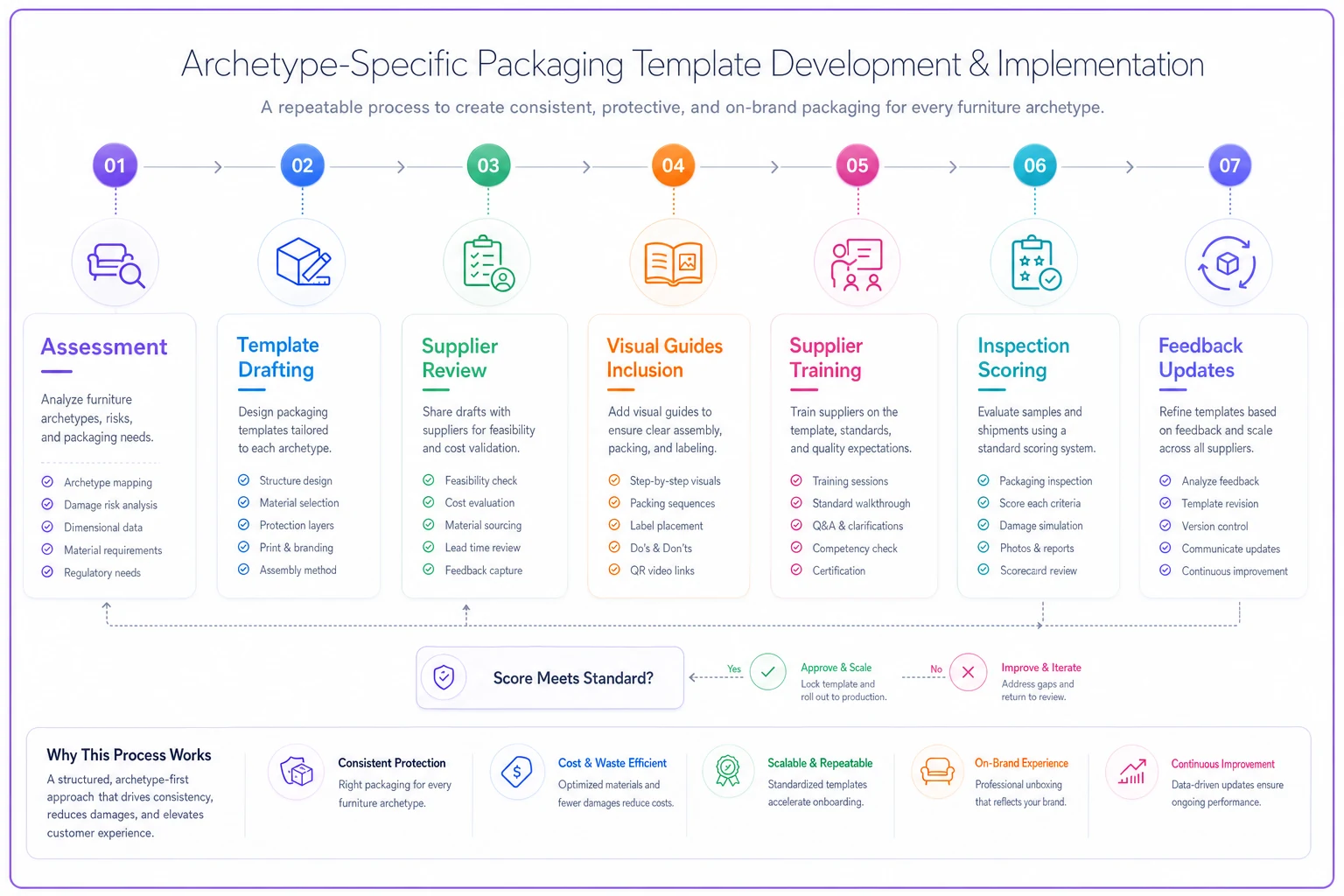
Use visuals to reduce back-and-forth and align expectations.
The inbound inspection checklist that catches problems early
Creating packaging templates only works if you verify compliance when shipments arrive. Most furniture retailers do cursory receiving checks that miss packaging deficiencies until damage has already happened.
An inspection protocol that actually works:
Pre-opening documentation:
-
Photograph all four sides of pallets before unwrapping
-
Note any visible crushing, water stains, or tears
-
Check shock/tilt indicators if present
-
Document container seal numbers and condition
Layer-by-layer inspection:
-
Outer wrap Check for adequate coverage, note any exposed areas
-
Intermediate protection Verify corner protectors present and intact
-
Primary packaging Assess material quality against specified standards
-
Product condition Inspect for damage that correlates with packaging gaps
Systematic recording:
-
3 points
Exceeds specified standards
-
2 points
Meets all requirements
-
1 point
Minor deviations noted
-
0 points
Failed to meet critical requirements
Track scores by supplier and product type. Patterns emerge quickly. That Malaysian supplier might consistently score 0 on corner protection. The Vietnamese supplier might excel at moisture protection but fail on palletization.
This data becomes the basis for real supplier conversations. Instead of vague complaints about "poor packaging," you show up with specific numbers: "Your corner protection compliance is at 42% and damaged corners cost us $3,400 last quarter." That's a conversation worth having.
Linking packaging failures to penalty structures
Most furniture retailers treat packaging problems as quality issues rather than compliance failures. That framing has no teeth — suppliers end up viewing packaging specs as suggestions rather than requirements.
Retailers who actually reduce transit damage tie packaging compliance to financial consequences through their vendor agreements.
Graduated penalty structure based on failure types:
| Packaging Failure Type | First Occurrence | Second Occurrence | Third Occurrence |
|---|---|---|---|
| Missing corner protection | Warning + retraining | 2% of shipment value | 5% of shipment value |
| Inadequate moisture barrier | $200 flat fee | $500 flat fee | Order cancellation right |
| Wrong pallet dimensions | Repalletization cost | 2x repalletization cost | Supplier pays air freight |
| No shock indicators (when required) | $100 per container | $300 per container | Mandatory inspection fees |
The key detail: penalties must be automatic, not negotiable. Build them into your purchase order terms. When packaging scores fall below threshold, penalties trigger without needing a meeting or an argument.
One furniture importer implemented this system and saw packaging compliance jump from around 60% to 95% within six months. Not because suppliers suddenly cared more about quality — because the financial impact became predictable and avoidable through compliance.
Creating the feedback loop that prevents repeat failures
The biggest operational gap in furniture packaging isn't the standards themselves — it's the feedback disconnect between damage discovery and supplier awareness.
Most retailers discover damage, file a claim, send an angry email, then move on. The supplier never sees the actual damage patterns, never understands the root cause, and never changes their approach. The cycle just repeats.
Immediate documentation flow:
-
Photos showing packaging failure points
-
Photos showing resulting product damage
-
The specific packaging requirement that was violated
-
Estimated total cost impact
Within 24 hours of discovering damage, compile:
Send this package to three contacts simultaneously:
-
Your supplier's production manager
-
Their packaging supervisor
-
Your account representative
Monthly pattern analysis:
-
Failure rates by product type
-
Most common packaging violations
-
Cost impact by supplier
-
Trending direction (improving or worsening)
Quarterly packaging reviews:
-
Their internal packaging audit results
-
Changes implemented based on your feedback
-
Cost-benefit analysis of packaging improvements
-
Proposals for specification updates
Good suppliers want to avoid damage claims as much as you do. They just need clear standards, consistent feedback, and reasonable time to make changes work.
The supplier scorecard metrics that actually matter
Too many furniture retailers track the wrong packaging metrics. They focus on damage rates without connecting them to specific packaging failures, or measure compliance without factoring in cost impact.
Packaging compliance score: Percentage of shipments meeting all specified standards, weighted by shipment value. A $50,000 container of sofas counts more than a $5,000 shipment of accent tables.
Damage-to-packaging correlation: What percentage of damage traces directly to packaging failures versus true transit damage? This separates controllable problems from everything else.
Cost per packaging failure: Total costs (direct damage, labor, claims processing) divided by number of packaging violations. This shows whether problems are numerous but minor, or rare but expensive.
Improvement velocity: Month-over-month change in compliance scores. A supplier at 70% compliance improving 5% monthly is more valuable than one stuck at 80%.
Response time to feedback: How quickly do suppliers acknowledge and act on packaging problems? Track days from feedback sent to corrective action confirmed.
Run these monthly by supplier and product category. Maybe your outdoor furniture consistently arrives with moisture damage during monsoon season. Maybe one supplier excels at packaging chairs but fails on tables every single time. You won't know without tracking it.
Building your furniture packaging standards program
Rolling out packaging standards feels overwhelming when you're already juggling inventory, sales, and customer service. Start with your highest-risk, highest-value categories and expand from there.
Month 1: Assessment and prioritization
-
Analyze last 12 months of damage claims
-
Identify top 3 problem categories
-
Calculate total cost of packaging-related damage
-
Select pilot supplier group
Month 2: Template development
-
Create detailed specifications for pilot categories
-
Include visual guides and reference photos
-
Get supplier input on feasibility
-
Finalize penalty structure
Month 3: Implementation launch
-
Formal communication to pilot suppliers
-
Training sessions (virtual is fine)
-
Begin inspection scoring
-
Start documentation rhythm
Month 4–6: Refinement and expansion
-
Adjust specs based on real results
-
Add next product category group
-
Roll out to additional suppliers
-
Begin enforcement of penalties
Month 7–12: Optimization
-
Monthly scorecard reviews
-
Quarterly packaging summits with key suppliers
-
Annual specification updates
-
Continuous improvement workshops
Furniture retailers who successfully implement packaging standards typically see a 40–60% reduction in transit damage within the first year. More importantly, the entire supplier relationship shifts from reactive — dealing with damage after the fact — to actually preventing it.
Technology and packaging compliance
Manual tracking of packaging compliance becomes unsustainable fast as your supplier base and SKU count grows. Spreadsheets multiply, photos get lost, feedback falls through cracks.
Modern furniture retailers use operational software to systematize packaging management. When a container arrives, warehouse staff score packaging compliance in real time using mobile devices. Photos attach directly to inspection records. Non-compliance triggers automatic notifications to suppliers with specific violation details.
The same platform tracks patterns across shipments, calculates penalty amounts, and generates monthly scorecards without manual compilation. It turns packaging compliance from a paper-heavy burden into a repeatable operational rhythm.
Some retailers integrate packaging scores directly into their supplier portals, where vendors can see their real-time compliance rates, compare against benchmarks, and access training materials. That kind of transparency drives improvement — no supplier wants to rank last.
The operational improvements from fixing supplier handoffs extend beyond packaging alone. When suppliers clearly understand all requirements — packaging, documentation, timing — the entire supply chain runs more smoothly.
Common packaging standard mistakes to avoid
Certain mistakes show up repeatedly when furniture retailers implement packaging programs:
-
Over-specifying for low-risk items Not every product needs heavy-duty protection. Accent pillows don't need the same treatment as glass tabletops. Over-specification drives up costs without reducing meaningful damage.
-
Under-specifying for high-risk categories Saying "adequate protection" for a $2,000 leather sectional is asking for problems. High-value, damage-prone items need exhaustive specifications.
-
Ignoring local material availability Specifying packaging materials that aren't readily available in your supplier's country causes delays and substitutions. Work with suppliers to identify locally available equivalents that meet your standards.
-
Setting unrealistic timelines Suppliers can't overhaul packaging overnight. If they've used the same methods for years, allow 2–3 months for full compliance. Push too hard and they'll comply superficially without real change.
-
Focusing only on product protection Good packaging specs also account for warehouse handling, customer unboxing, and disposal. Excessive packaging that takes 30 minutes to remove frustrates everyone downstream.
-
Forgetting seasonal variations Packaging needs change with weather. What works during dry season might fail during monsoon months. Build seasonal adjustments into your specifications from the start.
Furniture retailers who get packaging standards right see benefits well beyond reduced damage claims.
The long-term impact on operations
Warehouse operations improve when products arrive consistently packaged. Staff know exactly how to handle each product type. Unloading times drop. Storage becomes more efficient when packaging dimensions are predictable. These aren't dramatic wins individually, but they compound.
Customer satisfaction improves when furniture arrives intact. Consistent packaging also creates better unboxing experiences — customers notice when protective materials come off cleanly without leaving residue or requiring special tools.
Supplier relationships strengthen when expectations are clear and fair. Good suppliers appreciate detailed standards because it eliminates guesswork. They can quote accurately, plan material purchases, and train their teams without ambiguity.
Cash flow improves when damage write-offs decrease. That $200,000 annual loss from packaging failures flows straight to the bottom line when standards are properly implemented and enforced.
Most significantly, your team stops fighting fires. Instead of processing damage claims, negotiating with insurers, and managing angry customers, they're focused on growth.
Making packaging standards stick
The difference between retailers who successfully implement packaging standards and those who don't comes down to consistency and follow-through. Not the quality of the templates — the follow-through.
Standards only work when everyone involved — your team, your suppliers, your freight forwarders — knows you're serious about enforcement. The first time you waive a penalty or accept substandard packaging without consequence, the entire program loses credibility. Suppliers talk to each other, too.
Your warehouse team needs proper tools for inspection. Your purchasing team needs clear escalation procedures. Your suppliers need access to current specifications and their own scorecards. None of this is complicated, but someone has to own it and keep it running consistently.
Packaging standards aren't a one-time project. They're an ongoing operational discipline that needs regular attention and updates as your product range and supplier base evolve. Treat it like a one-time project and it falls apart within a year.
The furniture retailers thriving despite rising freight costs and supply chain complexity are the ones who've turned packaging from an afterthought into a real operational priority. Their products arrive intact. Their claims are minimal. Their suppliers are aligned. Their customers don't wait on replacements.
In an industry where one damaged container can wipe out a month's profit, proper packaging standards aren't optional — they're the difference between profitable growth and death by a thousand damaged deliveries.
Ready to elevate your furniture business?
Join 500+ furniture retailers using Hosyly to increase efficiency, improve customer satisfaction, and grow revenue.