



The scary part about launching a new furniture line isn't the first order. It's the second one. The first order feels manageable — a couple sofas, a few bed frames, maybe a dining set. But somewhere between "let's try it" and "this is doing okay," most stores commit to a full replenishment before they actually know whether the line sells at healthy margin or just moved because it was new and shiny on the floor.
Then three months later you're staring at eight units of a sectional in a color nobody wants, and the vendor minimum for reorder was six, so you technically "had to" buy them.
This piece is about running a proper furniture product launch pilot with real gates — the kind that tell you clearly whether to scale, hold, or kill a line before the cash and floor space are gone. Bulky furniture makes this harder than apparel or décor because your holding costs are brutal, your reorder lead times are long, and a wrong bet eats square footage you can't get back.
The specific trap: "it's selling fine" with no gate to prove it
A new line lands. It gets prime floor placement because it's fresh. Sales staff push it a little harder because they're curious about it too. It moves a few units in the first three weeks.
Somebody looks at that and says "this line is working, let's deepen it." A reorder goes in — usually a bigger one, because the vendor offers better pricing at higher volume.
New floor pieces almost always sell faster in weeks 1–4 than they do in month 3, because:
-
They're getting the best showroom position
-
Staff are actively mentioning them
-
Repeat customers who visit regularly notice the change
Strip those factors away and the line might be selling at half the rate you scaled it for. By then you've got inventory in transit, a display commitment, and a vendor relationship that assumes you're a growing account.
A pilot without a defined stopping point isn't a pilot. It's just buying inventory in two payments.
What a real furniture pilot sample plan looks like
The point of the sample plan is to buy the smallest quantity that still gives you a readable signal. For bulky, high-ticket goods, that number is smaller than most people think — you don't need ten units to learn something, you need enough to survive a short measurement window without stocking out mid-test, which corrupts your data.
Eliminate inventory headaches and order delays.
Hosyly streamlines your furniture orders and stock management for seamless store operations.
- Real-time inventory tracking
- Automated order processing
- Customer notifications & engagement
No credit card required
A workable structure for most furniture categories:
| Category | Pilot floor units | Backstock for pilot | Measurement window | Why this size |
|---|---|---|---|---|
| Upholstery (sofas, sectionals) | 1–2 displayed | 2–3 units | 6–8 weeks | Long consideration cycle, need runway |
| Case goods (dressers, dining) | 1 displayed | 3–4 units | 5–6 weeks | Faster decisions, quicker read |
| Beds / bedroom sets | 1 displayed | 2–3 units | 6 weeks | Bundled sales complicate signal |
| Occasional (accent chairs, tables) | 2 displayed | 4–5 units | 4–5 weeks | Lower ticket, faster velocity |
The backstock exists only to prevent a mid-pilot stockout from ending your test early. You are not pre-committing to a full assortment. If the pilot fails, that small backstock is your entire exposure — clearable through normal channels without pain.
One thing worth flagging: run the pilot with the actual configuration you'd stock long-term, not a stripped-down version. If you pilot a sofa in one fabric and plan to scale it in six, you've tested almost nothing about how the line actually sells.
Sell-through gates: the numbers that decide scale, hold, or kill
A gate is a pre-committed threshold you set before the pilot starts, so the decision isn't emotional later. This matters because once you've displayed something and talked it up, you get attached. Gates protect you from yourself.
Set three gates per line:
Gate 1 — Weekly sell-through rate. Track units sold against units available (floor + backstock). For most mid-ticket furniture, a healthy pilot runs somewhere around 12–20% weekly sell-through on the pilot pool. Below roughly 8% sustained, the line is a hold-or-kill candidate regardless of how nice it looks.
Gate 2 — Margin realized, not margin quoted. This is the one people skip. A line can hit sell-through targets while quietly bleeding margin through discounts, delivery concessions, or a higher-than-expected return rate on bulky items. Track the actual pocket margin per unit sold during the pilot. If the line only closes at 8–10 points below your target margin, scaling it just scales a discount habit.
Gate 3 — Sell-through velocity trend. Is week 4 stronger, flat, or weaker than week 2? For furniture, you want the trend to hold after novelty fades. A line that starts at 18% and settles at 14% is genuinely working. A line that starts at 18% and drops to 6% by week 5 was novelty, not demand.
A line should clear all three gates to earn a scale decision. Clearing one or two means hold and extend the window, not scale.
A simple scoring approach
-
Three gates passed → scale (place full replenishment, expand configurations)
-
Two gates passed → hold (extend pilot 3–4 weeks, no new commitment)
-
One or zero gates passed → pause/kill (clear backstock, free the floor)
Writing this down before the pilot removes the "but I really think it'll pick up" conversation that keeps dead lines alive for another quarter.
Replenishment cadence once a line earns its scale
Passing the gates doesn't mean flooding the floor. Bulky furniture punishes over-ordering harder than almost any retail category — each unit is expensive to hold, hard to move if wrong, and slow to arrive if you're short.
-
First scale order cover roughly 8–10 weeks of proven pilot velocity, not projected growth. Use the settled rate from weeks 4–6, not the novelty spike from weeks 1–2.
-
Second order timing trigger reorder at a lead-time-adjusted point, not on a calendar. If your vendor runs a 7-week lead time, your reorder trigger should fire when on-hand plus in-transit covers less than 8–9 weeks of current velocity.
-
Configuration expansion add fabrics, finishes, or sizes one or two at a time, and treat each addition as its own mini-pilot. A new configuration of a proven frame is not automatically proven.
The mistake stores make here is treating a successful pilot as permission to jump straight to full-catalog depth. Scale in steps. Each step should confirm the velocity holds before the next commitment.
Pro-tip: set your reorder trigger based on lead-time-adjusted coverage (weeks of demand covered by on-hand + in-transit), not calendar dates.
If you're building velocity assumptions for these decisions, the cohort logic in forecasting slow-moving, high-ticket furniture SKUs pairs well with pilot data — the pilot gives you the early read, the cohort rules refine the ongoing order sizing.
A quick-win measurement template you can actually run
You don't need a data team for this. What you need is consistent weekly capture so the gates are based on real numbers instead of gut feel. The minimum fields to track per pilot SKU, weekly:
-
Units available (floor + backstock, start of week)
-
Units sold this week
-
Weekly sell-through % (sold ÷ available)
-
Average selling price achieved
-
Pocket margin per unit (after discounts and delivery concessions)
-
Returns/cancellations this week
-
Days on floor before first sale (captured once)
Seven fields, updated every Monday for the pilot window. That's the whole system. Where this usually falls apart is consistency — someone tracks it for two weeks, gets busy, and the pilot ends with a decision made on vibes.
A quick visual of the weekly measurement and gate decision workflow:
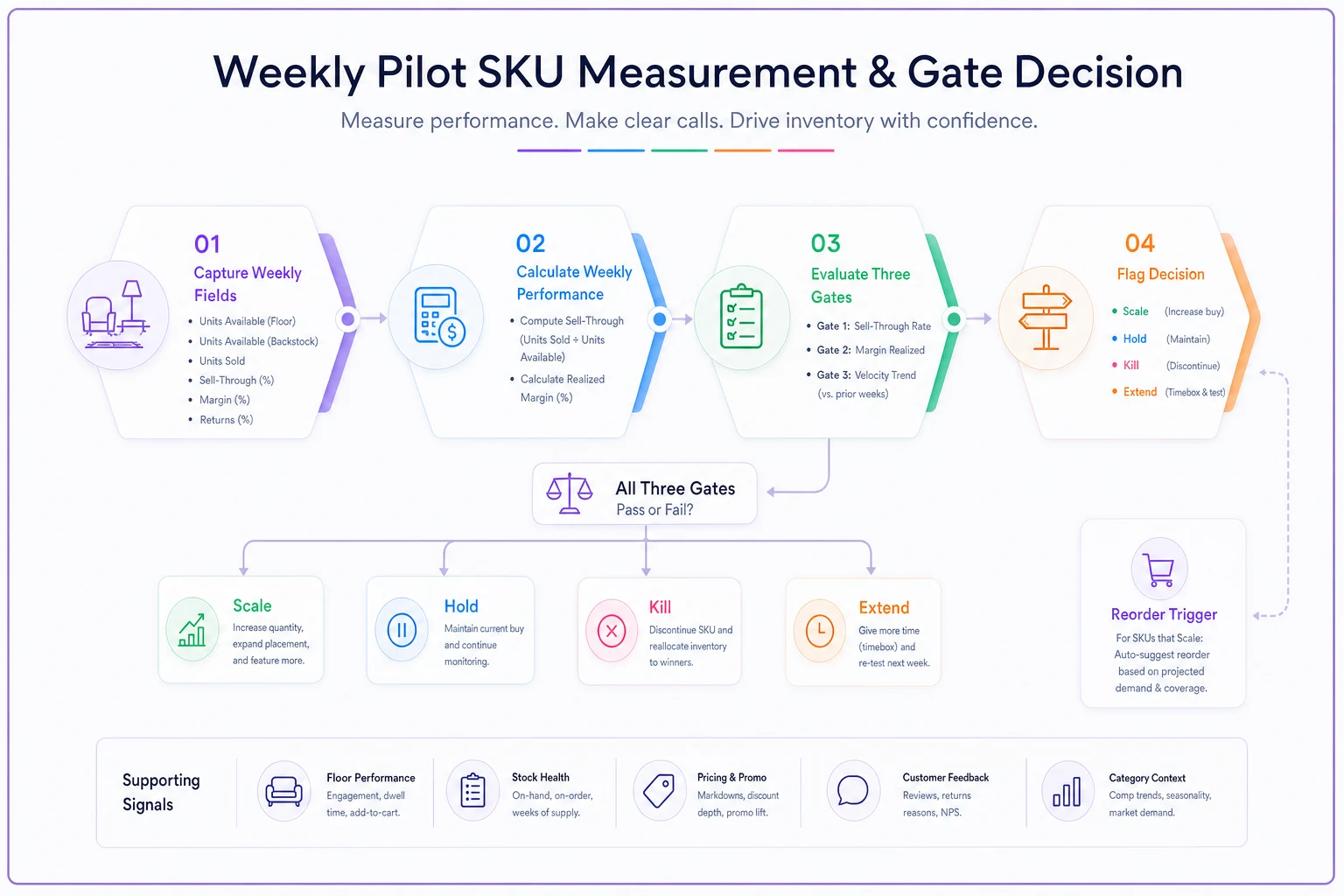
This is the one place where having inventory and sales data flowing into a shared workflow instead of a spreadsheet on one manager's laptop actually changes outcomes. When sell-through, margin, and return data update automatically against each pilot SKU, the gate thresholds can flag themselves — you get a nudge that a line crossed into "hold" or "kill" territory instead of discovering it a month too late during a reorder. The value isn't automation for its own sake; it's that the decision gets made on time, when there's still floor space and cash to protect.
A real scenario: the accent chair line that almost got scaled
A mid-size furniture store — two locations, moderate showroom footprint — brought in a new accent chair line. Four SKUs, piloted with two displayed and about five in backstock across colors.
Weeks 1–3 looked great. Roughly 19% weekly sell-through, staff loved them, and the buyer was ready to commit to a full order across a dozen configurations at the vendor's volume tier.
The gate check caught two problems. First, the velocity trend: by week 5, sell-through had slid to around 7%. The early weeks were mostly regulars noticing something new. Second, and worse, the realized margin was running about 11 points under target — the chairs were closing, but only with a "throw in free delivery" nudge from the sales floor.
Two gates failed. Under the pre-set rule, that meant hold, not scale. The store extended the window four weeks, dropped the delivery concession, and watched sell-through settle around 9% at proper margin — decent, but not the runaway line the first three weeks suggested.
Instead of committing to twelve configurations, they scaled two. The avoided over-order was somewhere in the range of $9k–$12k of tied-up inventory that would've moved slowly at best. The pilot did exactly its job — it turned an emotional "this is a hit" into a measured "this is fine, in two colors."
When a pilot doesn't make sense
Skip the formal pilot when:
-
You're reordering a proven line you've carried for a year — that's replenishment, not a launch
-
The vendor offers full buyback or return-on-unsold terms, which shifts the risk off your balance sheet
-
The line is a customer-driven special order where you're not carrying floor stock at all
Definitely run the full pilot when:
-
The vendor requires meaningful minimums to reorder
-
The line occupies premium floor space you'd otherwise use for proven earners
-
The category has long lead times, so a wrong scale decision locks you in for months
A line that fails its gates isn't a failure of the process — it's the process working. The whole point is to find out cheaply. If a piloted line stalls, fold it into your normal exit process rather than letting it linger; the phased approach in retiring slow-moving furniture SKUs without surprising customers keeps a dead pilot from turning into a floor-clogging write-off.
The one habit that separates stores that scale well
The stores that grow their assortment profitably aren't the ones with the best taste in furniture. They're the ones who decided the scale-or-pause rule before they got attached to the product.
Everything else — the sample sizing, the gates, the cadence — is just discipline around that one commitment.
A pilot only protects you if the decision is mechanical. The moment "let's see how it does" replaces a written threshold, you're back to buying inventory on optimism. Set the gates, capture the weekly numbers, and let the line prove itself before your floor and your cash flow pay for the assumption that it would.
Ready to elevate your furniture business?
Join 500+ furniture retailers using Hosyly to increase efficiency, improve customer satisfaction, and grow revenue.