



Installation day is where furniture retail either keeps its margin or quietly bleeds it. The sale is done, the money's collected, the product is on the truck — and then two installers standing in a customer's living room have to make a judgment call nobody prepared them for. That's the moment that decides whether you eat a second delivery, lose the balance payment, or watch a customer post photos of your crew arguing in their hallway.
Most furniture retailers have detailed SOPs for ordering, allocation, and transit damage. The installation site itself? Usually a vague "use good judgment" and a phone number for the warehouse manager who doesn't pick up. This post is narrow on purpose: it's about the installation conflict resolution SOP for furniture crews — the on-site decisions, the limits you give installers, and the escalation ladder that connects what happens on someone's doorstep back to your operations and accounts systems.
The three disputes that actually happen (and why they're different)
If you listen to what crews actually call the warehouse about, the conflicts aren't random. They cluster into three types, and each one needs a different response. Lumping them together is the first mistake.
Access and building disputes. The elevator is too small. The HOA requires a certificate of insurance the building never asked for in writing. There's no loading zone and the only parking is a $90 ticket waiting to happen. The customer swears the sofa fits through the door, and it doesn't.
Condition and expectation disputes. The customer says the finish looks different from the showroom. A leg is scuffed. They expected the installer to haul away the old couch, and that was never on the order. Or they want the crew to move furniture into three different rooms "while they're here."
Payment and cancellation disputes at the door. The balance is due on delivery and the customer wants to inspect for 20 minutes first. They refuse to sign the completion form. They want to cancel because the color's wrong, and now there's a fully assembled sectional in their living room.
These feel like one problem — "angry customer on site" — but they resolve completely differently. The access problem is logistics. The condition problem is expectation management. The payment problem is accounts. A crew that treats all three the same tends to escalate the ones they could've handled and handle the ones they should've escalated.
Why crews freeze — and why it costs you more than you think
The core issue isn't that installers are bad at their jobs. It's that they're being asked to make financial and policy decisions with zero authority and no clear limits.
Eliminate inventory headaches and order delays.
Hosyly streamlines your furniture orders and stock management for seamless store operations.
- Real-time inventory tracking
- Automated order processing
- Customer notifications & engagement
No credit card required
Think about what a two-person crew is actually weighing in real time. They've got a route with three more stops. They know a return trip burns a half-day. They don't know if the company will cover a $120 re-delivery or dock it from somewhere. They don't know if they're allowed to accept partial payment, waive a haul-away fee, or just tell the customer no. So they either cave to whatever the customer wants — which costs you money and sets precedent — or they dig in and create a scene, which costs you the review.
The freeze usually happens because of one gap: the crew doesn't know their decision ceiling. How much can they give away without calling? What exactly are they allowed to promise? When that's undefined, every minor friction becomes a phone call to a dispatcher who's juggling eight other trucks — and by the time anyone answers, the customer is furious and the crew is 40 minutes behind.
The hidden cost compounds across the route. One 25-minute dispute at stop two doesn't just cost 25 minutes. It pushes stops three and four into dinner hours, triggers "you missed your window" complaints, and sometimes forces a reschedule of the last stop entirely. A single unresolved access dispute can cascade into two missed appointments the same day. The routing math behind this is exactly why tight two-person delivery scheduling matters — a conflict SOP and a routing plan protect each other.
The decision ceiling: give crews real limits in writing
The single most effective fix is boring: write down, per dispute type, exactly what the crew can decide on their own versus what gets escalated. Here's the structure that actually works in the field.
| Situation | Crew can decide alone | Must escalate (and to whom) |
|---|---|---|
| Doesn't fit through door/elevator | Attempt alternate entry (balcony, remove door, legs off) if < 20 min | Hoisting, window removal, or any paid building service → Dispatch |
| Minor cosmetic scuff found on delivery | Note + photo, offer touch-up kit, complete install | Customer refuses delivery over it → Service lead |
| Customer wants extra haul-away not on order | Quote the standard fee, do it if customer agrees to pay | Customer wants it free → Dispatch (up to $X waiver) |
| Customer wants balance "after inspection" | Allow 10-min inspection, then collect per policy | Customer still refuses payment → Accounts hotline |
| Customer wants to cancel on site | Do NOT disassemble; stop work, call | Always → Service lead + Accounts |
| Building demands COI not on file | Call office to email COI within 15 min | Building blocks entry entirely → Dispatch reschedule |
Notice two things. First, the crew gets real authority — a scuff doesn't need a phone call, it needs a photo and a touch-up kit from the truck. Second, anything touching money or cancellation always escalates. That's the line that protects you. A crew should never be the one deciding whether a customer gets a refund or keeps a $2,800 sectional for free.
Set and publish a few real-world examples of waiver use so crews understand what a $X goodwill fix looks like in practice.
The dollar figure in "waiver up to $X" matters. Set it low enough that abuse is capped but high enough that trivial stuff gets solved on the spot. For most mid-ticket furniture retailers, a crew-level goodwill ceiling somewhere around $40–$75 covers the vast majority of "just make it go away" moments without a call. Above that, someone with margin visibility makes the call.
The escalation ladder that doesn't dead-end
An escalation ladder is useless if the next rung doesn't answer. The classic failure is a single warehouse manager as the escalation point — and that person is on the floor, on another call, or off that day. The crew tries once, gets voicemail, and defaults to improvising.
-
On-site resolution (crew, 0–10 min). Crew uses their decision ceiling. Most access and cosmetic issues die here.
-
Dispatch (reachable within ~3 min). Logistics decisions
reschedule, re-route, approve a building service fee, authorize small goodwill waiver. Dispatch has route visibility and a goodwill budget.
-
Service lead (within ~10 min). Anything about refusal, cancellation, or a product the customer won't accept. This person can authorize a return-to-store and knows the restock/cancellation policy cold.
-
Accounts (same-day, often live). Any dispute over the balance payment, deposits, or refunds. The crew never negotiates money — they hand the phone over or the customer gets a callback within a defined window.
Use this quick visual when training crews on who to call next.
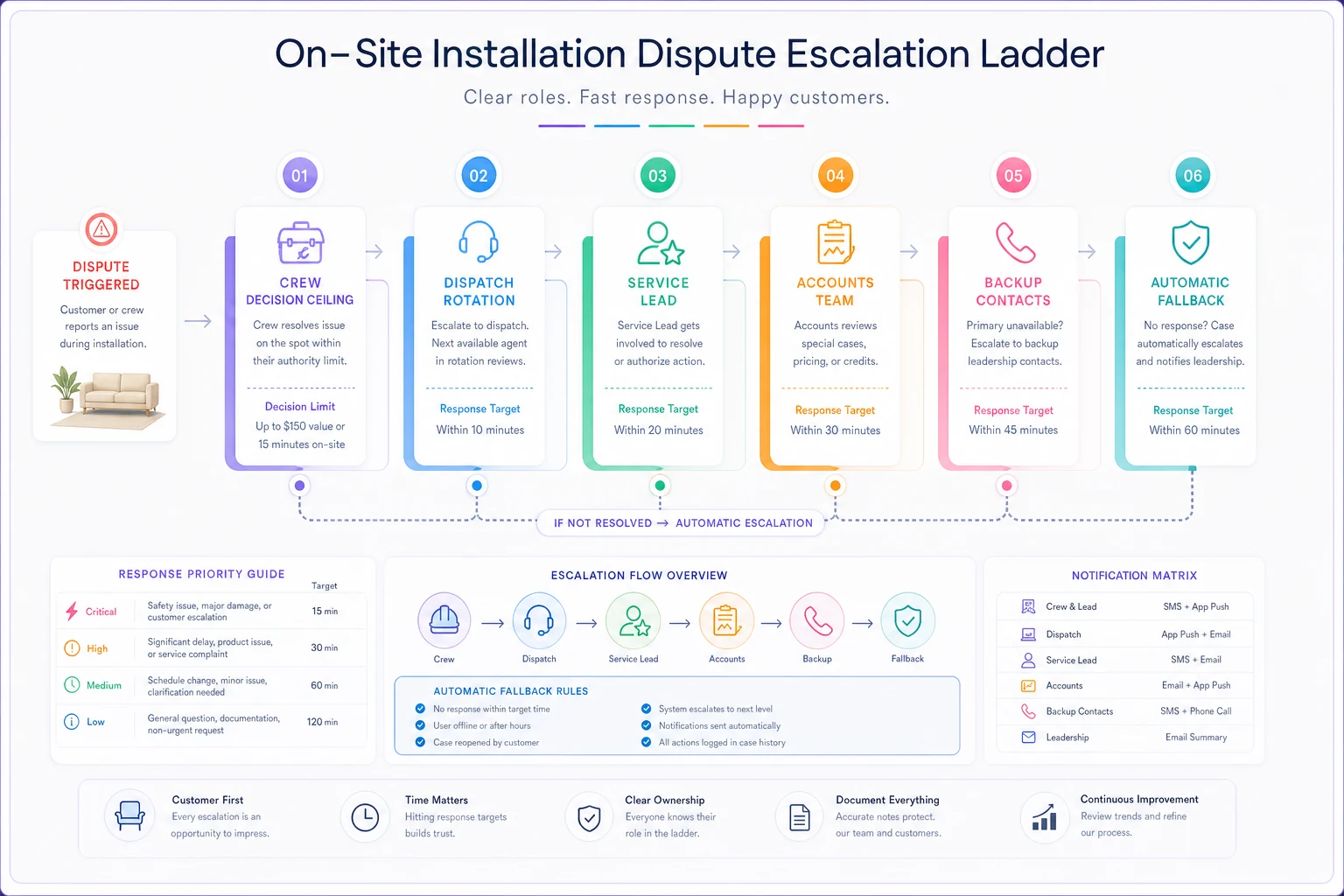
The thing most retailers miss: each rung needs a backup contact and a guaranteed response time. "Call dispatch" means nothing if dispatch is one person. Build a rotation. The crew should always have a name and a number that answers, and if it doesn't answer in the target window, the fallback kicks in automatically.
This is also where vetting pays off. A crew you've properly screened and trained handles rung one far more often, which keeps the whole ladder quiet. If your installers are subcontractors you barely know, every dispute jumps straight to rung three. The standards you set when you vet and govern installers directly determine how much you can trust the first rung to hold.
Templated communications tied to the order, not improvised
The other half of conflict resolution is what gets said. When a crew or dispatcher is stressed and winging it on a cancellation, they overpromise ("yeah, we'll refund everything") or they come across cold ("that's not our policy"). Both cost you.
-
Access reschedule (building/elevator problem) confirms it wasn't the customer's fault, gives the next available window, and reassures them there's no re-delivery fee for a logistics issue on your end.
-
Cosmetic touch-up accepted documents what was found, what the crew did, and that the item was completed in acceptable condition — this becomes your record if they file a claim later.
-
On-site cancellation hold tells the customer their request is logged, what happens next, and the exact timeline for the refund/pickup decision — without the crew committing to a number.
-
Balance-payment reminder at door polite, firm, references the signed order terms, offers the inspection window.
-
Post-dispute follow-up (within 24h) a human check-in after a rough install, which quietly heads off a lot of reviews.
The operational win is linkage. A templated message is useful; a templated message that's automatically attached to the order, logged against the account, and visible to accounts and service is what stops the "wait, what did we promise this customer?" problem three days later. When the conflict, the resolution, and the communication all live on the same order record, the next person who touches that account isn't flying blind.
This is the quiet role of a decent operations platform — not to resolve the dispute for you, but to make sure the decision ceiling, the escalation ladder, and the message that went out are all captured against the order automatically, so a doorstep cancellation doesn't vanish into someone's text messages. Nothing a crew promises on a doorstep should ever be invisible to the people handling the money.
A real scenario: the sectional that almost became a free sofa
A mid-sized furniture retailer with two trucks and around 280–320 installs a month kept hitting the same wall: on-site cancellations and payment standoffs. Crews had no authority and no scripts. When a customer balked, the crew called the warehouse manager, got voicemail, and either left the fully assembled furniture behind "to sort out later" or stood around burning the route.
The breaking case was a $2,800 sectional. The customer wanted to cancel on delivery because the gray "read warmer in person." The crew had already fully assembled it, had no guidance, and nobody picked up at the office. They left it, told the customer someone would call, and no one did for four days. By then the customer had filed a card dispute and left a review. The retailer ended up refunding most of it and eating a pickup.
They rebuilt around three things: a written decision ceiling (crews stop assembly the moment "cancel" is said), a two-deep escalation rotation with a 3-minute dispatch target, and templated messages tied to each order. Over the next quarter, on-site disputes that escalated past dispatch dropped by roughly half, and re-deliveries tied to doorstep conflicts fell from around 11–12 a month to the low single digits. Nothing dramatic — but the chargebacks and "nobody called me back" reviews mostly stopped.
When a tight SOP like this is worth it — and when it isn't
This makes sense when you're running multiple crews, doing more than a couple hundred installs a month, or using subcontractors you can't personally supervise. At that volume, undefined authority and a single escalation point are actively costing you re-deliveries and reviews every month.
This is overkill when you're a single owner-operator delivering a handful of pieces a week and you are the escalation ladder. You'll resolve on the spot because you have full authority and full context. Writing a six-rung escalation flow for a two-person shop is just paperwork nobody reads.
Who should NOT half-build this: anyone who writes the decision ceiling but skips the escalation backups. A ceiling without a reachable next rung just teaches crews that calling is pointless, and they go back to improvising. The ladder and the limits only work together.
The one thing to fix first
If you do nothing else, write down the decision ceiling — per dispute type — and make sure anything touching money or cancellation always escalates to someone who actually answers.
That single document turns the worst moment in your operation, two installers standing in a stranger's living room with a problem, from a coin flip into a process. Everything else — the templates, the logging, the ladder rotation — is just making that first decision reliable at scale.
If you do nothing else, write down the decision ceiling — per dispute type — and make sure anything touching money or cancellation always escalates to someone who actually answers. That single document turns the worst moment in your operation, two installers standing in a stranger's living room with a problem, from a coin flip into a process. Everything else — the templates, the logging, the ladder rotation — is just making that first decision reliable at scale.
Ready to elevate your furniture business?
Join 500+ furniture retailers using Hosyly to increase efficiency, improve customer satisfaction, and grow revenue.