
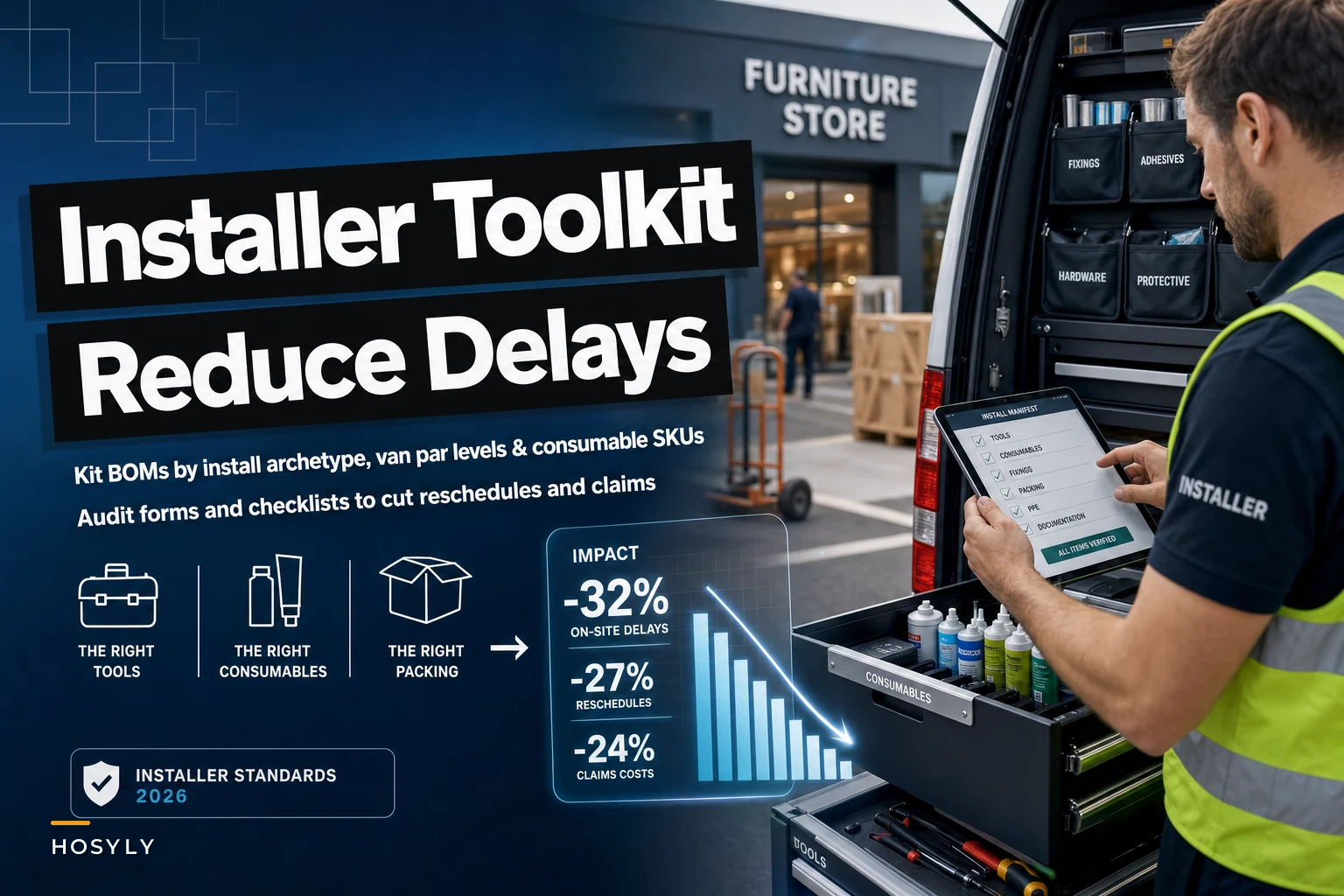

Most on-site delays don't come from bad installers. They come from a crew showing up with the wrong anchor type for a plaster wall, a missing cam-lock replacement for a wardrobe that arrived with a stripped connector, or no felt pads when the customer's floor turns out to be engineered oak instead of carpet. The job gets rescheduled, the customer gets annoyed, and now you've got a second truck roll eating your margin on a sale that was already thin.
The fix isn't "tell the installers to be more prepared." That's vague and it never sticks. The fix is defining what a complete toolkit looks like for each type of install you actually do, setting par levels for the van, and tying a short audit form to the SLA so you can see which crews are running lean before it costs you.
This isn't glamorous work. But if you're a furniture retailer running delivery-and-install, toolkit standardization is one of the highest-leverage things you can do to protect both your reschedule rate and your claims line.
Start by splitting installs into archetypes, not SKUs
The biggest mistake retailers make is trying to build one universal toolkit. You end up with a bloated van that still somehow lacks the one part the job needed. The better approach is grouping installs into a handful of archetypes based on what the physical work actually requires.
-
Flat-pack assembly (wardrobes, bookcases, bed frames) — needs cam-locks, dowels, Allen keys in multiple sizes, replacement screws, wood glue.
-
Wall-mounted / anchored (floating units, mirrors, tall dressers requiring tip-over straps) — needs a stud finder, varied anchors (drywall, masonry, plaster), tip restraints, a decent drill.
-
Modular / sectional seating — needs connector brackets, replacement feet, leveling glides, a rubber mallet.
-
Delicate / finished surface (dining tables, glass, lacquer) — needs blankets, felt pads, microfiber cloths, touch-up markers for the finish tones you sell most.
-
Appliance-adjacent or plumbed (vanities, some kitchen island units) — needs sealant, basic plumbing fittings, shims.
The reason archetypes matter: a crew doing three flat-pack wardrobes in a day has completely different consumable burn than a crew doing two wall-mounted units and a glass dining table. Loading both vans identically guarantees one of them runs short.
Once you have archetypes, build a bill of materials (BOM) per archetype — the exact tools and consumables that install type requires. That BOM becomes the checklist the crew packs against.
Separate "tools" from "consumables" — they fail differently
Tools and consumables cause delays in different ways, so you manage them differently.
Eliminate inventory headaches and order delays.
Hosyly streamlines your furniture orders and stock management for seamless store operations.
- Real-time inventory tracking
- Automated order processing
- Customer notifications & engagement
No credit card required
Tools fail by being missing, broken, or wrong-size. A dead drill battery or a stripped Allen key doesn't run out gradually — it just stops working mid-job. So tools need a start-of-day function check, not a count.
Consumables fail by silent depletion. Nobody notices the felt pads are almost gone until the job that needs twelve only has four. This is where par levels come in. Every consumable in the van should have a min/max, and the crew tops up to max at depot before the first job.
Here's a simplified par-level template for a van running mostly flat-pack and wall-mounted work:
| Consumable SKU | Min (reorder trigger) | Max (van par) | Typical burn/week |
|---|---|---|---|
| Drywall anchors (mixed) | 20 | 60 | ~30 |
| Masonry anchors | 10 | 30 | ~12 |
| Cam-lock replacements | 15 | 50 | ~20 |
| Wood dowels (8mm) | 30 | 100 | ~40 |
| Felt pads (sheet) | 4 | 15 | ~6 |
| Touch-up markers (top 3 finishes) | 1 each | 3 each | ~1 |
| Tip-over straps | 5 | 20 | ~8 |
| Replacement feet/glides | 6 | 20 | ~8 |
The numbers aren't universal — your burn depends on your mix. The point is that you track actual depletion for a few weeks, set the max above a worst-case day, and set the min at the point where you'd want to reorder before the next shift.
One pattern worth noting: the consumables that cause the most reschedules are almost always the cheap ones.
Retailers obsess over tool costs and completely ignore consumable stockouts, which is backwards.
The packing checklist that actually gets used
A checklist only works if it's short enough to run in the two minutes before the van leaves. Long audit forms get ignored and then back-filled with fake checkmarks, which is worse than nothing.
A lean start-of-day pack check for a flat-pack + wall-mount day:
-
Power check — drill + impact driver batteries charged, spare battery in bag.
-
Bit/key check — full Allen key set present, Phillips + flathead bits, 8mm and 10mm drill bits.
-
Anchor top-up — drywall and masonry anchors at van par max.
-
Connector spares — cam-locks and dowels topped up.
-
Surface protection — at least two blankets, felt pad sheet above min.
-
Finish kit — touch-up markers for the day's scheduled SKUs' finishes.
-
Safety — tip-over straps for any tall units on the manifest.
-
Measurement — stud finder working, tape measure, level.
Here's a quick visual of the pack check workflow.
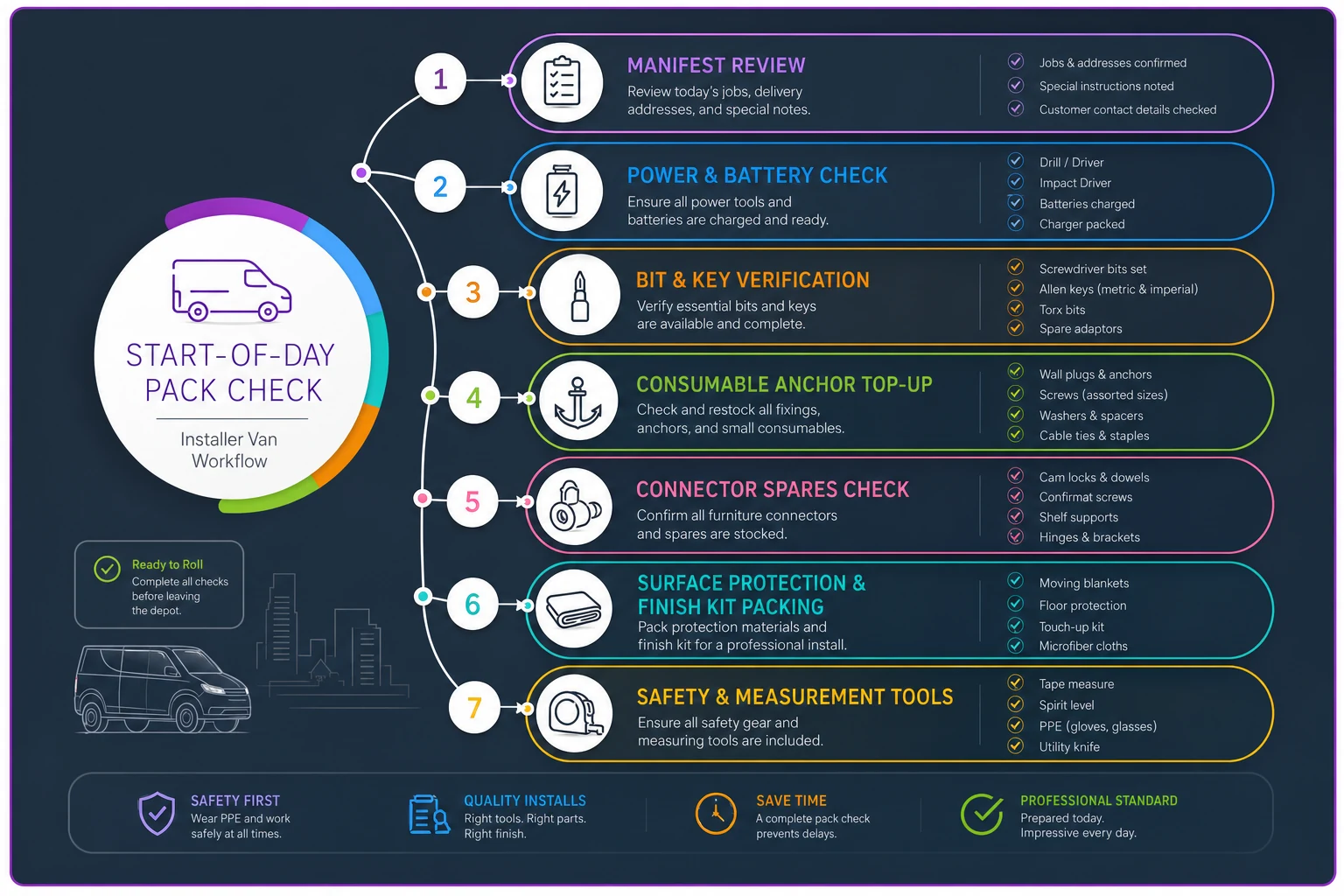
Notice this is tied to the day's manifest, not a generic list. If the schedule has a glass table, the finish/protection section expands. If it's all bedroom flat-pack, the anchor section matters more. The pack check should pull from what's actually booked, not from a static sheet pinned to the van wall.
Tie the audit form to SLA performance, not to blame
Most retailers treat audit forms as discipline tools. Crews figure this out fast, and they game the form. Instead, the audit should connect toolkit completeness to reschedule and claim outcomes so you can see the relationship and fix the system.
A useful end-of-day audit captures only a few fields:
-
Did the job complete first-visit? (Y/N)
-
If no — root cause (missing part / missing tool / damaged item on arrival / customer not ready / access issue).
-
Which consumable, if any, hit min during the day?
-
Any item used from emergency stock?
When you aggregate this over a month, patterns jump out fast. You'll typically find something like: 35% of reschedules trace to missing anchors or connectors — which is a par-level problem, not a crew problem. Or most damage claims come from the two crews without blankets in their pack check, which is a BOM compliance problem.
This logic connects directly to how you govern installers on outcomes rather than gut feel. If you haven't set up the vetting side yet, our guide on how to vet and govern furniture installers to cut liability and repeat installations pairs directly with toolkit audits — the toolkit controls "could they do the job," the governance controls "did they do it right."
A real scenario: the reschedule rate hiding in plain sight
A mid-size furniture retailer running two install crews was sitting at a first-visit completion rate of roughly 80%. On the surface they blamed delivery damage and customers not being home. When they started logging root causes on a simple end-of-day form, the picture changed.
Over about six weeks, they found that close to half of their failed first visits came down to two things: wrong or missing wall anchors, and stripped cam-locks on flat-pack wardrobes that the crew couldn't replace on the spot. Both were consumable stockouts — not damage, not customers.
They did three things. Built an anchor assortment into the van BOM with a proper par level. Added a small bin of replacement cam-locks and dowels sized to their top-selling wardrobe ranges. And made the pack check pull against the day's manifest so wall-mounted jobs always triggered an anchor top-up.
First-visit completion moved into the low 90s within about two months. Each avoided reschedule was saving them somewhere in the range of a few hundred dollars in truck roll and crew time, and the claims tied to "crew used wrong fixing" basically disappeared. The fix cost them maybe a couple hundred dollars in extra consumable stock per van.
When heavy toolkit standardization makes sense — and when it doesn't
When it makes sense: You're running two or more crews, doing a mix of install types, and your first-visit completion is below roughly 90%. At that point the inconsistency between crews is costing real money and standardization pays for itself quickly.
When it's overkill: If you run a single crew doing nearly identical installs every day, a rigid BOM-per-archetype system is more process than you need. A simple topped-up van and a short daily check is enough.
Who should not start here: If your reschedules are mostly driven by delivery damage or items arriving broken, fix the inbound and transit side first — a perfect toolkit can't assemble a cracked panel. Toolkit standards solve "crew wasn't equipped," not "product wasn't deliverable."
Making the par levels self-correcting
The weak point in any par-level system is that burn rates drift. A new product line with a different connector, a seasonal shift toward wall-mounted units, a crew that suddenly does more delicate installs — any of these quietly breaks your maxes, and you're back to stockouts.
The practical fix is reviewing audit data monthly and adjusting. If a consumable keeps hitting min, raise the max. If one never moves, drop it from that van's BOM to cut clutter. Over time your archetype BOMs stop being guesses and start reflecting your actual mix.
For retailers already capturing install events digitally, this gets easier. If your crews are logging completion status and root causes against each job, par-level adjustments can be driven off real data instead of memory. The patterns in how install events map to SLA outcomes are worth getting right — we cover the data side of that in installer event API patterns and SLA mapping for furniture integrations.
Toolkit standardization is a margin lever, not a logistics chore
Every reschedule you prevent is a truck roll you don't pay for, a crew hour you don't waste, and a customer who doesn't leave a review about the installer who "had to come back twice."
Build the BOMs by install archetype. Set honest par levels off real burn data. Keep the pack check short and tied to the day's manifest. Use the audit form to find system gaps, not to point fingers. Do those four things and the reschedules that feel random will turn out to be very predictable — and very fixable.
Ready to elevate your furniture business?
Join 500+ furniture retailers using Hosyly to increase efficiency, improve customer satisfaction, and grow revenue.