

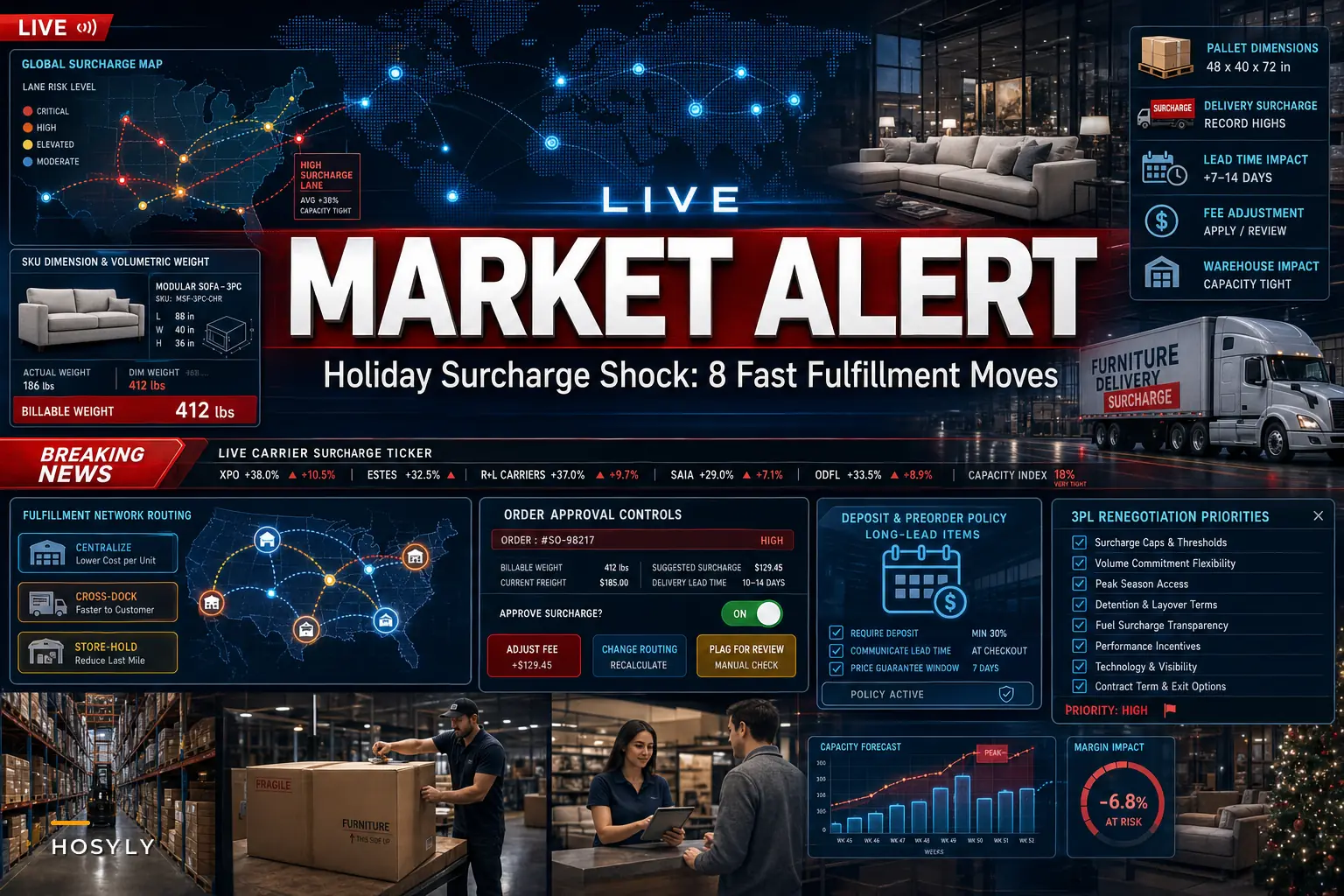

The surcharge letters are already in your inbox. Carriers moved early this year, tying higher fuel fees and peak-season rates to pricier diesel, and Reuters reported that US retailers are staring at record holiday delivery prices heading into the busiest shipping stretch of the year. If you sell sofas, dining sets, or anything that needs two people and a truck, this isn't a parcel-rate footnote — it hits the most expensive part of your cost structure.
For small-parcel retailers, a few extra dollars per package during peak is annoying but survivable. For furniture, the math is brutal. You're already paying for residential delivery, liftgate service, stairs, installation, and the occasional redelivery when nobody's home. Stack peak surcharges on top of a diesel-driven fuel adjustment and your cost-to-serve on a single bulky order can climb $40–$90 before you've touched margin. The scary part: most furniture retailers won't notice until the January reconciliation, long after those orders shipped against last year's assumed costs.
So skip the hand-wringing. Here are eight moves that actually change your margin math between now and the end of the season — ordered roughly by how fast you can pull them off.
1. Re-cost your top 20 delivery lanes before you touch anything else
You can't reprice what you haven't measured. Before you change a single checkout fee, pull your last 60–90 days of bulky deliveries and group them by lane — store-to-metro-zone, or DC-to-region. Then overlay the new surcharge schedule on each lane.
What usually surfaces is uncomfortable: delivery cost isn't evenly distributed. A handful of lanes — typically far-out residential zones and stair-heavy urban deliveries — eat a disproportionate share of the surcharge pain. In a lot of operations, the worst 15–20% of lanes carry something close to half of the total surcharge exposure.
Carrier schedules spell out exactly when the extra fees apply. UPS publishes its demand-surcharge windows and additional-handling thresholds in a detailed peak-season fee document — pay attention to the calendar windows, because a delivery that ships November 30 may carry a different fee than the identical order on December 14. Map those windows against your historical ship-date distribution and you'll see where the real money leaks.
2. Stop treating "free delivery" as a fixed promise
The free-shipping threshold you set in September is now wrong. If your breakpoint was $999 for free local delivery, and your average surcharged bulky delivery now costs $70–$110 all-in, you're subsidizing margin away on every order that barely clears the line.
Eliminate inventory headaches and order delays.
Hosyly streamlines your furniture orders and stock management for seamless store operations.
- Real-time inventory tracking
- Automated order processing
- Customer notifications & engagement
No credit card required
Two practical fixes, depending on your brand:
-
Raise the threshold to reflect the new cost floor. If your blended delivery cost rose ~$30 per order, your breakpoint needs to move enough that orders clearing it actually carry the cost. For many retailers that's a $150–$250 bump on the threshold, not a token $50.
-
Switch high-cost lanes to a flat "white-glove" fee instead of free delivery entirely. Customers accept a clearly labeled delivery-and-setup fee on a $2,000 sectional far more easily than they accept it on a $40 accessory.
The common mistake is changing the number sitewide. Don't. A blanket threshold ignores that your Phoenix metro deliveries and your rural-route deliveries have completely different economics. Zone-based thresholds protect conversion where delivery is cheap and protect margin where it isn't.
3. Shift routing toward store-hold and cross-dock where it genuinely helps
When per-delivery costs jump, the centralization-vs-local-fulfillment question stops being theoretical. A single national DC gives you inventory efficiency but concentrates your exposure to long-haul residential delivery — exactly the leg where surcharges bite hardest. Holding stock closer to the customer, or cross-docking into local last-mile crews, can cut the surcharged miles out of the equation.
This only works for specific SKUs though. Fast-moving, high-volume items with predictable regional demand are solid candidates for store-hold or cross-dock. Slow-moving, high-ticket, made-to-order pieces are not — you'll create carrying cost and spread scarce inventory across locations that can't move it.
For the full decision logic on routing structure and where the breakeven actually sits, the fulfillment-network cost-to-serve model for bulky furniture walks through the working-capital side of this tradeoff in detail. The short version for this season: don't re-architect your whole network in November. Pick the 3–5 highest-surcharge lanes and ask whether a local hold or a regional cross-dock would remove the expensive leg for those specific lanes only.
4. Renegotiate — but renegotiate the right line items
Trying to renegotiate base rates mid-peak rarely goes anywhere. Carriers have zero incentive to cut headline pricing when demand is maxed. What you can often move is the surrounding stuff:
| Line item | Likely negotiable at peak? | What to ask for instead |
|---|---|---|
| Base per-package rate | Rarely | Volume commitment for Q1 in exchange for peak relief |
| Additional-handling fees | Sometimes | Threshold adjustments on your specific carton dims |
| Residential surcharge | Rarely | Routing changes to commercial drop points |
| Redelivery / failed-attempt fees | Often | Appointment-window guarantees to reduce failures |
| Fuel adjustment | Almost never | Nothing — it's formula-driven |
The real leverage isn't the fuel line, which is mechanical. It's the avoidable fees — redelivery, additional handling, address corrections. Those are driven by your data quality and scheduling, not the carrier's pricing. Which leads into the next two moves.
5. Kill failed deliveries, because every one now costs double
A missed delivery was always expensive. With peak surcharges stacked on top, a failed attempt plus a redelivery can easily run $120–$180 on a single bulky order — before you count customer-service time and cancellation risk.
The pattern behind most failed bulky deliveries is pretty consistent:
-
Customer never confirmed the appointment window.
-
Address had a unit number or access note missing from the order.
-
Crew arrived without knowing about stairs, a narrow doorway, or a gate code.
-
Nobody was home, or the piece physically didn't fit.
Every one of those is preventable with better pre-delivery confirmation. A two-touch confirmation — an automated reminder 48 hours out plus a morning-of text with the arrival window — measurably cuts no-shows. For furniture specifically, add a pre-delivery questionnaire capturing stairs, elevator access, and doorway width. The crews stop guessing, and the second-truck-roll charges stop happening.
6. Clean your SKU dimensions so you stop paying additional-handling penalties
Additional-handling and oversize surcharges are triggered by carton dimensions and weight. If your master data lists a bookshelf's carton as 48 inches when it's actually 52, you'll get reclassified and billed the difference — plus a correction fee — after the fact. Multiply that across a peak season and it's a quiet five-figure leak.
Run a quick audit on your highest-volume bulky SKUs:
-
Verify actual carton length, width, height, and weight against what's in your system.
-
Flag anything sitting right under a surcharge threshold — those are the ones a mis-measured inch flips into penalty territory.
-
Check that multi-box items are mapped correctly, so a 3-carton sofa isn't being rated as one oversized unit.
Prioritize SKUs that sit just under surcharge thresholds first — a small measurement correction can eliminate recurring penalty charges.
Boring work. Also one of the highest-return hours you'll spend this month, because it eliminates charges you're paying for nothing — no better service, just bad data.
7. Rewrite your preorder, deposit, and refund policy for a high-surcharge window
Surcharges don't just raise cost — they raise your exposure on cancellations and returns. A returned sectional now carries a surcharged outbound delivery and a surcharged reverse pickup. If your refund policy eats that cost silently, your working capital takes the hit twice.
A few sensible adjustments for the season:
-
Make delivery and installation fees non-refundable once scheduled, stated clearly at checkout. The cost is real the moment the crew is routed.
-
For preorders that will deliver after the surcharge window, lock the delivery fee at the time of order so you're not absorbing a mid-window increase.
-
Tighten your reschedule policy — one free reschedule, then a fee — because every bounce adds a surcharged truck roll.
None of this should feel punitive if you communicate it plainly. The goal is to stop quietly eating costs that were never in your margin assumptions.
8. Protect your margin floor with a per-order profitability check
The most useful thing you can do this season is make sure no bulky order ships below its true cost. That means knowing, at the moment of fulfillment, what the all-in delivery cost is for that specific order on that specific lane in that specific surcharge window — not a blended average from last quarter.
Most furniture retailers can't see this in real time. Costs get reconciled weeks later, so the unprofitable orders have already shipped. This is where an operational platform that ties SKU dimensions, lane data, and current surcharge schedules into your order flow actually earns its keep — not as a magic fix, but because it surfaces the money-losing orders before the truck leaves, when you can still adjust the fee, change the routing, or flag it for review.
Below is a simple workflow showing how SKU, lane, and surcharge data feed an order-approval step.
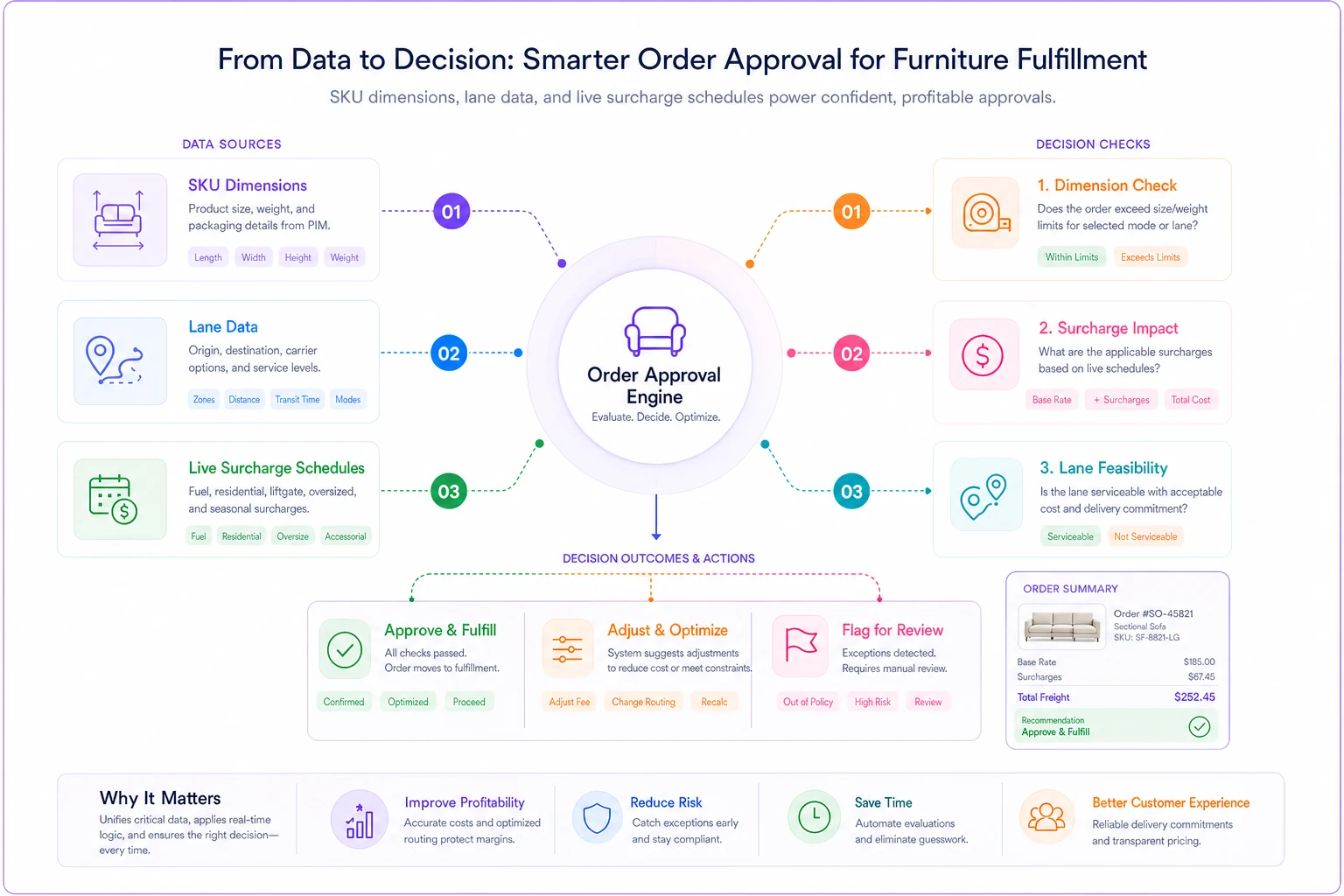
AI-assisted cost checks make this practical at volume. Manually re-costing every order during peak isn't realistic when you're moving hundreds of bulky deliveries a week, and the blended-average approach is exactly what gets retailers into trouble by January. The platforms that handle this well aren't doing anything exotic — they're just connecting data that already exists in your systems and surfacing it at the right moment in the workflow.
A real scenario: regional retailer, three stores, one DC
Picture a mid-sized furniture retailer running three showrooms and a central DC in a single state. Average bulky order value around $1,400. Before adjusting for the new surcharges, their blended delivery cost sat near $62 per order. The new peak fuel and demand fees pushed that toward $92–$98 on their long-haul residential lanes.
-
Re-costed their top 20 lanes and found the far-metro residential routes carried most of the pain.
-
Moved their free-delivery threshold up and switched those far-metro lanes to a flat $129 white-glove fee.
-
Added a 48-hour confirmation plus access questionnaire, which cut failed deliveries noticeably over the first few weeks.
-
Audited carton dims on their 30 top SKUs and corrected a handful sitting just under additional-handling thresholds.
The combined effect wasn't dramatic — it was a recovery of roughly $25–$35 per order on the worst lanes and a meaningful drop in redelivery charges. On a few hundred bulky deliveries through the season, that's the difference between a profitable December and a January surprise.
Where to put your attention first
If you only have a week, do three things: re-cost your worst lanes, fix your free-delivery threshold by zone, and cut failed deliveries with better confirmation. Those three alone claw back most of the surcharge damage without renegotiating a contract or touching your network mid-season.
Holiday delivery surcharges for furniture retailers aren't really a pricing event — they're a visibility problem. The retailers who get hurt are running on blended, stale cost assumptions and can't see which orders are bleeding until the money's already gone. The ones who come out fine can look at a specific order on a specific lane and know, before it ships, whether it's actually making money. Build that visibility now, and next year's surcharge letters will be a lot less scary.
Holiday delivery surcharges for furniture retailers aren't really a pricing event — they're a visibility problem. The retailers who get hurt are running on blended, stale cost assumptions and can't see which orders are bleeding until the money's already gone. The ones who come out fine can look at a specific order on a specific lane and know, before it ships, whether it's actually making money. Build that visibility now, and next year's surcharge letters will be a lot less scary.
Ready to elevate your furniture business?
Join 500+ furniture retailers using Hosyly to increase efficiency, improve customer satisfaction, and grow revenue.