

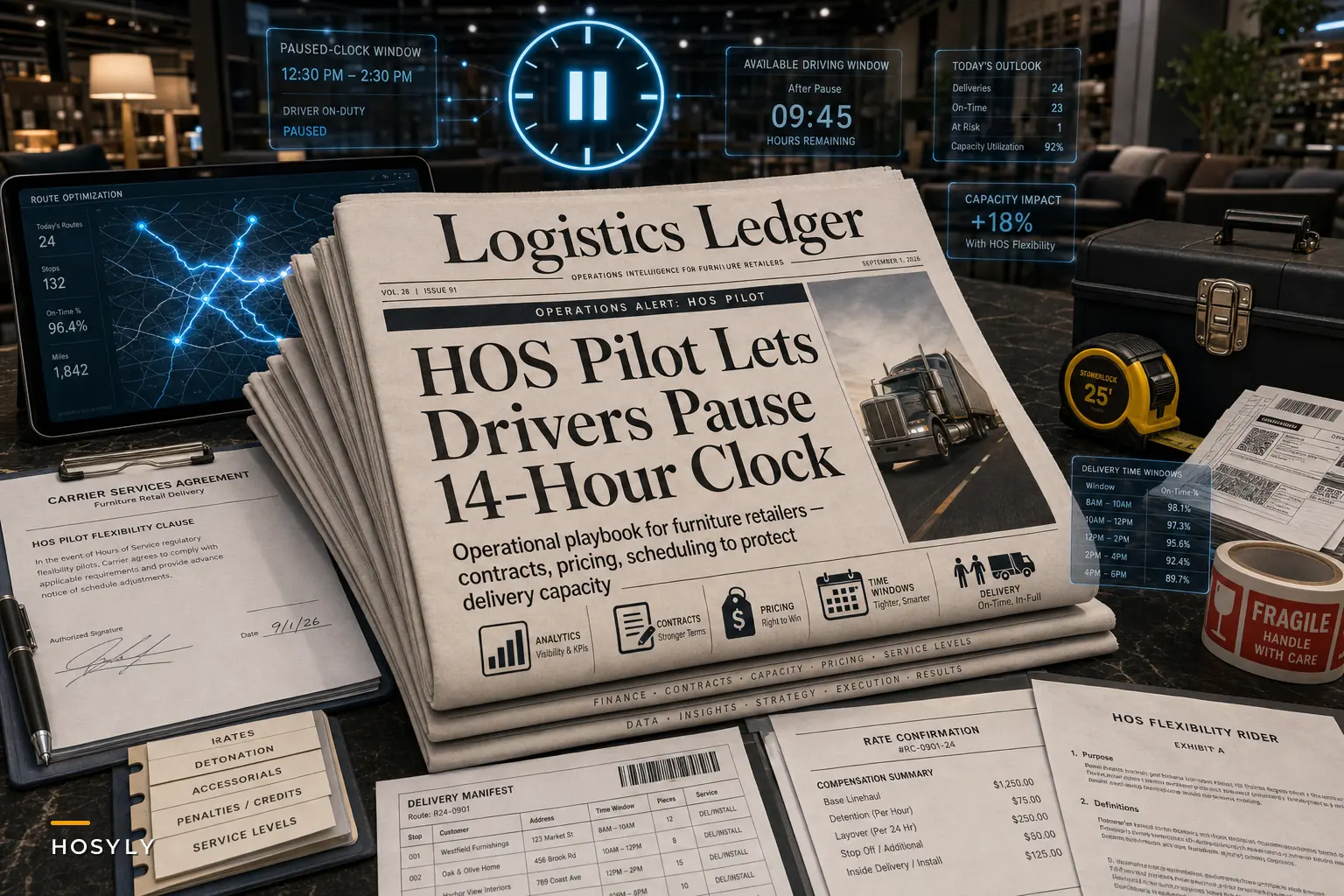

The FMCSA just moved two hours-of-service pilot programs forward. One tests pausing the 14-hour driving window, the other looks at more flexible split-sleeper arrangements. Both wrapped their pre-test phase and are headed toward broader pilots in 2027, according to reporting from TruckingInfo. Nothing is law yet. But the direction is clear enough that furniture retailers moving freight — especially bulky, two-person, appointment-based deliveries — should start thinking through what changes when driver schedules get more elastic.
If you're running delivery through contracted carriers or an in-house crew, this isn't abstract regulatory noise. Flexible hours reshape when trucks are available, how detention gets billed, and who eats the cost when an appointment slips. That's the part that hits your margins, and it's getting less attention than it deserves.
Why flexible hours change the math on furniture delivery specifically
Most freight moves on tight, predictable windows. Furniture doesn't. You've got appointment-based drops, customers who need to be home, buildings with loading dock restrictions, walk-ups, assembly on site, and the occasional refusal at the door. Your delivery is one of the slowest, most variable stops a driver makes all day.
That variability is exactly why hours-of-service flexibility cuts both ways.
On the upside: if a driver can pause the 14-hour clock during a long detention — say, they're stuck waiting 90 minutes because a customer's elevator is out — that pause could preserve their ability to finish the route instead of timing out three stops early. Fewer routes get abandoned mid-day. That's real capacity you're currently losing.
On the harder side: flexible hours give carriers more room to reshuffle. When a carrier can legally restructure a driver's day, the appointment window they promised you becomes softer. The official FMCSA announcement frames this as driver-centered flexibility, and it is — but flexibility for the driver often means less predictability for the shipper who booked a 10am–1pm slot.
The underlying issue: furniture delivery SLAs were built on the assumption that driver hours are rigid. When that rigidity loosens, the whole appointment-guarantee model needs re-anchoring.
The real problem this exposes: your SLAs assume rules that are about to move
Across furniture operations that lean on third-party carriers, delivery SLAs are usually written around a fixed idea of driver availability — X trucks, Y hours, Z stops per route. When you negotiate rates and windows, both sides quietly assume the driver's day is bounded by the current 14-hour rule. Nobody writes it down, but it's baked into the pricing.
Eliminate inventory headaches and order delays.
Hosyly streamlines your furniture orders and stock management for seamless store operations.
- Real-time inventory tracking
- Automated order processing
- Customer notifications & engagement
No credit card required
When that boundary becomes negotiable, two things happen:
-
Carriers gain a lever you don't control. They can extend or restructure driver days in ways that change their cost base — and they'll price accordingly.
-
Detention risk shifts. If a driver can pause their clock during your slow furniture stop instead of losing the whole route, the pressure to bill aggressive detention fees changes. Sometimes lower. Sometimes the carrier just absorbs longer stops and raises base rates instead.
The mistake most retailers will make is treating this as "wait and see." By the time the 2027 pilots produce data, your carrier contracts will have already renewed once or twice. The time to insert protective language is before the rules move, while you still have leverage and while carriers are also uncertain.
A CDLLife summary of the pilot details makes the point that these changes are aimed at giving drivers more scheduling control. That means the party you contract with is about to get more optionality. You want your own optionality written into the contract to match.
Where furniture retailers actually lose money when hours flex
Detention and redelivery costs are the obvious line items, but the losses tend to be more spread out than that. Some of it shows up in failed appointments, some in softer windows that quietly erode your customer experience, and some in crew scheduling that nobody audited because it seemed fine until it wasn't. The table below maps the main leak points and what flexible hours realistically do to each.
| Leak point | What happens today | What flexible hours could do |
|---|---|---|
| Detention on long stops | Driver times out, route gets cut, you pay redelivery | Driver pauses clock, finishes route — but carrier may reprice detention |
| Appointment windows | Tight windows, carrier honors them | Softer windows, more "we'll get there today" |
| Route density | Fixed stops per driver-day | Carrier optimizes for their hours, not your zones |
| Redelivery costs | Predictable failed-delivery fees | More variable, harder to forecast |
| Crew pairing | Two-person crews scheduled per route | Crew availability shifts as driver hours change |
The two-person crew line is the one furniture operations tend to underestimate. Bulky delivery isn't one driver — it's a paired crew, and pairing is fragile. If flexible hours let one crew member's schedule stretch while the other's doesn't, you get mismatched availability. That's a scheduling problem that lives entirely on your side of the fence, and it's where a lot of missed appointments start. If your pairing and routing logic isn't already tight, this is worth revisiting now — the mechanics are covered in our guide on two-person delivery scheduling for bulky furniture, and those rules become more important, not less, as driver hours get elastic.
The point isn't that flexible hours are bad. It's that your current operational setup was designed around a rigid rule set. When the rules soften, operations that were coasting on that rigidity start leaking.
A short scenario: what this looks like in a real operation
Take a mid-sized retailer running roughly 300–350 delivery appointments a month across two metros, split between an in-house crew and one contracted regional carrier. Their failed-appointment rate sits around 8–9%, mostly from routes that time out late in the day and get bumped to tomorrow.
Under a paused-clock scenario, some of those timed-out routes wouldn't die — the driver pauses during a long dock wait and finishes. Best case, they claw back maybe a third of those bumps. At their redelivery cost of roughly $80–$110 per failed drop, trimming even 10–12 bumps a month adds up to a few thousand dollars a quarter.
But the same retailer renews their carrier contract every 12 months with fixed detention terms and no clause addressing hours-of-service changes. If the carrier restructures driver days and quietly widens appointment windows to protect their own scheduling, this retailer's customer complaints climb — and their delivery NPS drops even though nothing technically "broke." The savings on redelivery get eaten by softer windows and unhappy customers. Net result: it's a wash, or worse, unless they renegotiate the terms.
That's the whole point. The rule change isn't automatically good or bad for you. It depends entirely on whether your contracts and internal scheduling are set up to capture the upside and block the downside.
Steps to lock in delivery capacity before the rules move
A practical sequence you can start on this quarter, without waiting for 2027 pilot data.
-
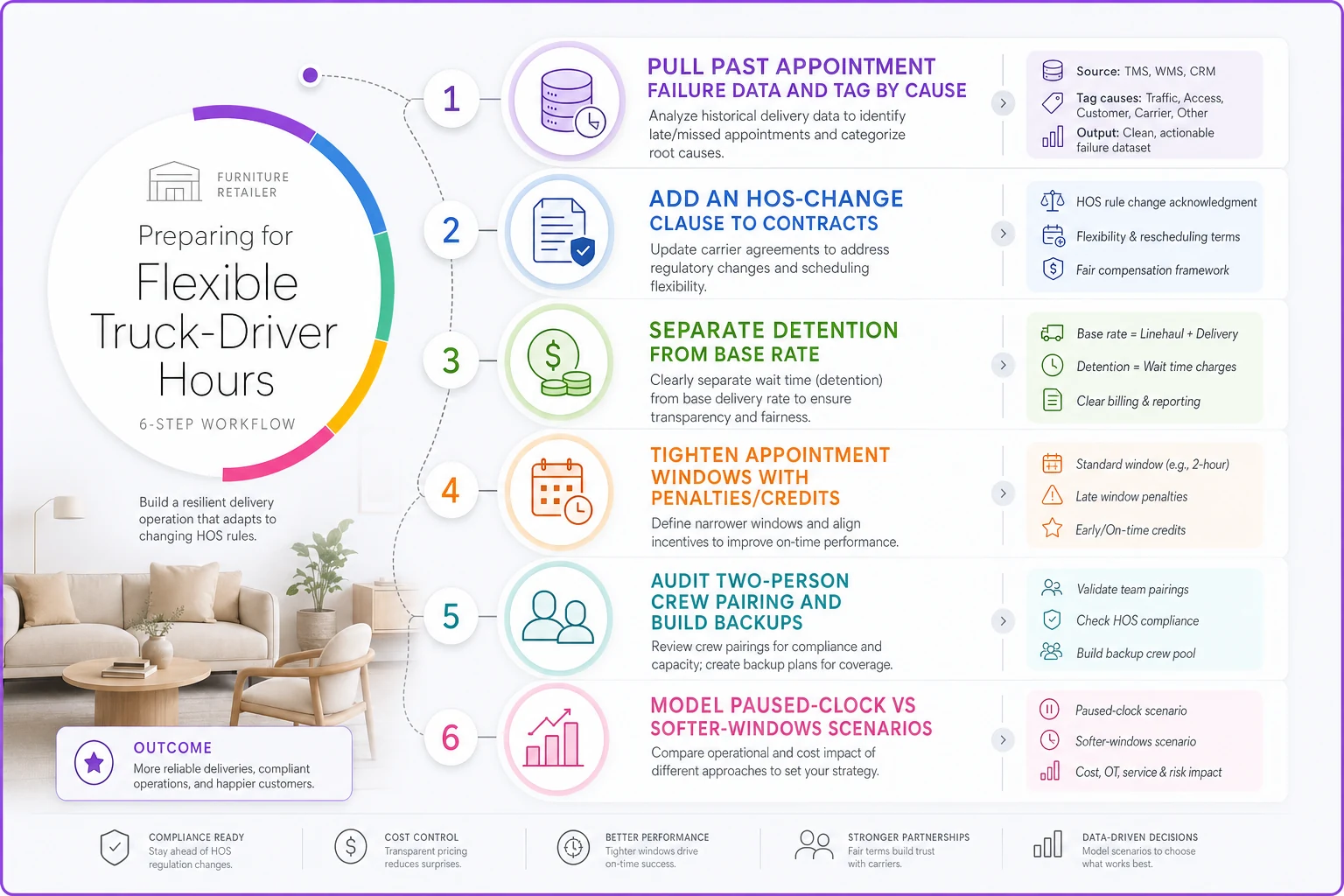
Pull your last 6–12 months of failed and bumped appointments. Tag each by cause: driver timeout, customer no-show, access issue, product issue. You need to know how many failures are hours-driven before you can estimate what flexible hours actually change for you.
-
Add an HOS-change clause to your next carrier renewal. Simple language: if hours-of-service rules change materially, both parties reopen detention terms and appointment-window commitments within 30 days. Don't lock a multi-year rate without it.
-
Separate your detention terms from your base rate. Bundled pricing hides who wins when driver hours flex. Break it out so you can see and renegotiate detention independently.
-
Tighten appointment windows in writing. As carriers gain flexibility, put your window commitments on paper with a defined penalty or credit. Verbal "usually by noon" won't hold.
-
Audit your two-person crew pairing rules. Identify which routes depend on a single fragile pairing. Build backup pairings so one schedule shift doesn't collapse a whole day.
-
Model two scenarios — paused-clock helps you, and softer-windows hurts you. Have a rough number for each. When the carrier comes to renegotiate, you're not guessing.
Here's a quick visual of the sequence to use in planning.
Model two scenarios — paused-clock helps you, and softer-windows hurts you. Have a rough number for each. When the carrier comes to renegotiate, you're not guessing.
A quick contract-readiness checklist
Before you sign or renew anything in the next 18 months:
-
Detention rates are itemized and separately renegotiable
-
There's an explicit reopener tied to regulatory/HOS changes
-
Appointment-window commitments have a defined credit or penalty
-
Redelivery cost responsibility is spelled out by failure cause
-
You have documented backup crew pairings for high-density routes
-
You're tracking failed appointments by root cause, monthly
-
Access-issue delays (elevators, docks, walk-ups) are logged, because those drive the detention that flexible hours interact with most
If you can't check most of these, you're negotiating blind — and the party across the table is about to have more room to maneuver than you.
When getting ahead of this makes sense — and when it doesn't
This matters most if you rely on contracted carriers for bulky delivery, run appointment-based windows, or operate in dense metros where detention and access delays are common. The more variable your stops, the more the hours question affects you.
This matters less if you outsource delivery entirely to a white-glove third party who owns the SLA end to end and you're paying a flat per-delivery fee. In that case your job is simpler: make sure their SLA to you has the reopener language, and let them worry about driver scheduling.
Don't over-engineer this if you're doing 40 deliveries a month with your own truck and crew. You control your hours, the pilots don't touch you the same way, and your energy is better spent on routing and appointment confirmation than on carrier contract clauses.
The operational layer that makes all of this easier to manage
None of the above works if your delivery data lives in three spreadsheets and a dispatcher's head. The retailers who handle regulatory shifts well are the ones who can pull failed-appointment root causes, crew pairing history, and detention logs in an afternoon — not the ones reconstructing it from memory when a contract comes up for renewal.
This is where an operational platform that centralizes delivery scheduling, appointment tracking, and failure-cause tagging earns its keep. When routing, crew pairing, and appointment windows sit in one system, you can actually see how many routes die from timeouts versus access issues — and AI-assisted scheduling can flag fragile pairings or at-risk windows before they turn into tomorrow's redelivery. The tooling isn't the point, though. The point is that flexible driver hours reward operations that already measure delivery performance precisely, and punish the ones running on gut feel.
Log access-issue delays with timestamps and photos so detention claims are indisputable.
The tooling isn't the point, though. The point is that flexible driver hours reward operations that already measure delivery performance precisely, and punish the ones running on gut feel.
Where this leaves you
The hours-of-service pilots are a signal, not a deadline. They tell you that within roughly 12–18 months, the assumptions baked into your carrier contracts and crew schedules could shift. The retailers who come out ahead won't be the ones who reacted fastest to the 2027 pilot results — they'll be the ones who quietly tightened their SLAs, itemized their detention terms, and firmed up their crew pairing rules while everyone else waited.
Start with the boring stuff: pull your failed-appointment data, add a reopener clause to your next renewal, and separate detention from base rate. That's most of the protection right there. The flexibility coming to driver schedules can genuinely help your route completion — but only if your contracts and operations are set up to capture the upside instead of absorbing the risk.
Ready to elevate your furniture business?
Join 500+ furniture retailers using Hosyly to increase efficiency, improve customer satisfaction, and grow revenue.