



The problem with long-lead furniture isn't the lead time itself. Retailers plan around 12- to 20-week windows all the time. The real problem is what those weeks do to your cash and your risk exposure — because in most supplier relationships, you're paying against a promise, not against goods you can touch, sell, or inspect.
A 40% deposit on a container of upholstered pieces sounds routine until the factory slips six weeks, a quality issue shows up on arrival, or demand softens while your money sits frozen in someone else's production queue. That's exactly what payment terms are supposed to protect against, and most furniture retailers negotiate them backwards. They argue over the deposit percentage and ignore the sequence, the triggers, and the clauses that actually decide who eats the risk when something goes wrong.
This is a systems problem. Payment structure connects to forecasting, to your SLA governance, to how you handle preorder deposits from customers, and to your working capital ceiling. Negotiate one piece in isolation and you quietly shift risk somewhere else in the operation without realizing it.
Why "just negotiate a better deposit" misses the point
Ask most owners what their supplier payment terms are and you'll hear one number: "30% down, balance on shipment." That's not a payment structure. That's one variable in a system with at least five moving parts:
-
When money leaves your account (deposit, milestones, balance)
-
What each payment is tied to (a date, a production stage, an inspection, a delivery event)
-
Who holds title and risk during transit and storage
-
What happens when the supplier misses their committed dates or quality standards
-
How the terms change as your volume with that supplier grows
When you only negotiate the deposit percentage, you're optimizing one number while leaving the four that actually protect you completely undefined. The retailers who get burned aren't usually paying 40% up front — they're paying 40% up front with no milestone verification, no quality-tied release, and no penalty when the factory ships four weeks late into their peak selling window.
The furniture supplier payment terms negotiation that matters isn't "can I pay less now." It's "can I tie each dollar to something verifiable, and can I claw value back when the supplier doesn't perform."
The four deposit and payment structures, and when each actually fits
There's no universally correct structure. There's a correct structure for a given supplier relationship at a given volume and trust level. Here's how the main options compare in practice.
Eliminate inventory headaches and order delays.
Hosyly streamlines your furniture orders and stock management for seamless store operations.
- Real-time inventory tracking
- Automated order processing
- Customer notifications & engagement
No credit card required
| Structure | How it works | Your risk | Best fit |
|---|---|---|---|
| Large deposit / balance on ship | 40–50% down, remainder before goods leave port | High — cash frozen early, limited leverage if dates slip | New supplier unwilling to budge; scarce or custom production runs |
| Phased milestone payments | Payments split across order confirmation, mid-production, pre-ship, and delivery | Moderate — money tied to verifiable production stages | Established supplier relationships, larger or custom orders |
| Consignment / pay-on-sale | Supplier retains ownership until you sell; you remit proceeds after | Low cash exposure — but rarely offered and usually margin-costly | High-trust, high-volume relationships; testing unproven new lines |
| Deposit + SLA-tied rebate | Standard deposit structure, with supplier rebating a percentage for missed dates or quality thresholds | Moderate, with meaningful downside protection built in | Suppliers with a consistent history of slippage you can't fully avoid |
The mistake isn't picking the "wrong" one. It's picking one and never revisiting it as the relationship matures. A supplier you paid 45% up front two years ago — because you had no history — should probably be on milestone terms now that you've done fifteen orders together. Most retailers never renegotiate because nothing broke badly enough. But "nothing broke" isn't the same as "your cash is being used efficiently."
Phased milestone payments — the workhorse for long-lead orders
-
Order confirmation (15–25%) — releases the supplier to schedule production and purchase materials
-
Production start / materials verified (15–20%) — tied to proof the run has actually begun, not just a promised date
-
Pre-ship inspection passed (30–40%) — the critical tranche, released only after QC sign-off
-
Delivery / acceptance (remainder) — final payment after goods arrive and are properly checked in
The key word is tied. A milestone payment that releases on a calendar date instead of a verified event is just a deposit with extra steps. If your "production start" payment fires on March 1 whether or not the factory has cut a single board, you've handed back every bit of leverage the structure was supposed to give you.
This is also where payment structure connects directly to lead-time management. If you don't have clean handoff verification between order, production, transit and assembly, you can't honestly tie payments to those stages. Getting those handoffs tight is worth doing for its own reasons — the mechanics are covered in cutting lead times for made-to-order furniture by fixing supplier, transit and assembly handoffs — but the payoff shows up in negotiation too. You can't negotiate milestone triggers you can't actually observe.
Consignment: powerful, misunderstood, and usually oversold to you
Every retailer wants consignment terms — pay only after you sell — and almost every supplier resists them, for obvious reasons. When consignment is offered to you, be a little suspicious about why.
In practice, consignment shows up in two situations. The good one: a high-trust supplier wants to grow your shared volume and is willing to float inventory to get you stocking deeper. The riskier one: a supplier is pushing a slow line, has excess capacity, and wants your showroom floor as free storage. That second version feels like a win because your cash isn't committed, but it quietly costs you in three ways:
-
Margin — consignment goods almost always carry a worse unit cost to compensate the supplier for carrying the financing
-
Floor discipline — "free" inventory tempts you to display and stock things you'd never buy outright, which distorts your assortment over time
-
Reconciliation drag — you now owe accurate sell-through reporting, and every missed unit or damaged sample becomes a dispute
Consignment makes genuine sense when you're testing a new, unproven line and want to protect cash while gathering sell-through data, or when a trusted partner is helping you stock depth you couldn't otherwise finance. It's a poor fit when it's being used to park slow inventory in your showroom, or when your inventory counts aren't clean enough to report sell-through accurately. If you can't reliably reconcile your own stock, consignment turns into a monthly argument rather than a cash-flow advantage.
Who should not pursue consignment
If you're a smaller operation without solid inventory reconciliation, skip it. The reporting burden and dispute risk will cost more than the cash-flow benefit. Consignment rewards operational tightness — if that's not in place yet, milestone terms with a modest deposit give you most of the cash protection with far less overhead.
SLA-tied rebates: the clause almost nobody negotiates, and the one that pays
Retailers spend most of their negotiating energy on the deposit percentage and almost none on what happens when the supplier underperforms. Yet slippage — late ships, partial ships, quality misses on arrival — is the single most predictable cost in long-lead furniture. You know it's going to happen several times a year. So negotiate for it.
-
On-time ship commitment if the confirmed ship date slips by more than a defined number of business days, the supplier rebates 2–4% of order value per week late, capped at 10–12%
-
Quality-on-arrival if the inspected defect rate exceeds an agreed threshold — say, 3–5% of units — the supplier credits the defective units plus a handling allowance for rework or returns
-
Fill-rate partial shipments below an agreed percentage trigger a proportional credit, not just a "we'll send the rest when we can"
The point isn't to punish the supplier or extract free money. It's to price the risk honestly and give the supplier a financial reason to protect your dates over some other retailer's. A supplier carrying rebate exposure on your order tends to call you before a slip happens instead of after — which is worth more than the rebate itself, because early warning lets you reforecast and manage customer expectations before they turn into complaints.
This connects directly to your customer-side deposit policy. If you're taking preorder deposits from customers against goods you're still waiting on, a supplier slip becomes your credibility problem with the buyer. Handling that cleanly starts with tight internal deposit SOPs — the common preorder deposit mistakes furniture retailers make piece covers how those break down — but the upstream fix is negotiating supplier terms so their delay carries a cost to them, not just to you and your customer.
A negotiation sequence that actually works
Retailers lose these negotiations by leading with the deposit and getting anchored there. Reverse the order. Negotiate the risk clauses first, while they're still abstract, and settle the deposit last.
-
Open with the SLA commitments, not the money. Ask what ship-date and defect-rate they'll commit to in writing. Their confidence level before any dollars are on the table tells you a lot.
-
Tie payments to those commitments. Propose milestone releases against verified stages. If they resist verification, that's useful information — it usually means their own production visibility is weak.
-
Introduce the rebate as a two-way term. Frame it as "you hit your dates, you get paid on schedule; you slip, we share the cost." Offer a small early-payment incentive in exchange so it reads as balanced, not punitive.
-
Now discuss the deposit. With milestones and rebates in place, the deposit percentage matters far less — your money is protected by structure, not by withholding it.
-
Lock in a volume-based review. Agree that terms revisit after a set number of orders or dollar threshold, so improved trust translates into better cash terms automatically.
The deposit is fourth on the list, not first. Once the risk is structured properly, the up-front percentage becomes the least important variable in the conversation — which is exactly the opposite of how most of these negotiations actually go.
What breaks at scale
Everything above works fine for one supplier and a dozen orders a year. The system starts breaking when you're managing several long-lead suppliers simultaneously, each on different terms, different milestone triggers, and different rebate clauses.
A fairly common example: a retailer with around eight active long-lead suppliers, each on slightly different terms. Supplier A releases payment on production start, B on pre-ship inspection, C is 45% up front with no verification at all, and D technically has an SLA rebate that nobody has ever claimed because no one tracks ship-date commitments against reality. The clauses exist. Nobody enforces them, because enforcement requires someone to notice the trigger fired, cross-check it against the contract, and act within the claim window.
That's the real failure point. Rebates go unclaimed. Milestone payments release on autopilot without anyone confirming the stage was actually hit. A supplier slips four weeks and it doesn't get flagged against the SLA until the quarter closes and the claim window is gone. The contracts are fine. The tracking collapses under volume.
This workflow shows how a tracking system enforces milestones, flags missed dates, and surfaces rebates.
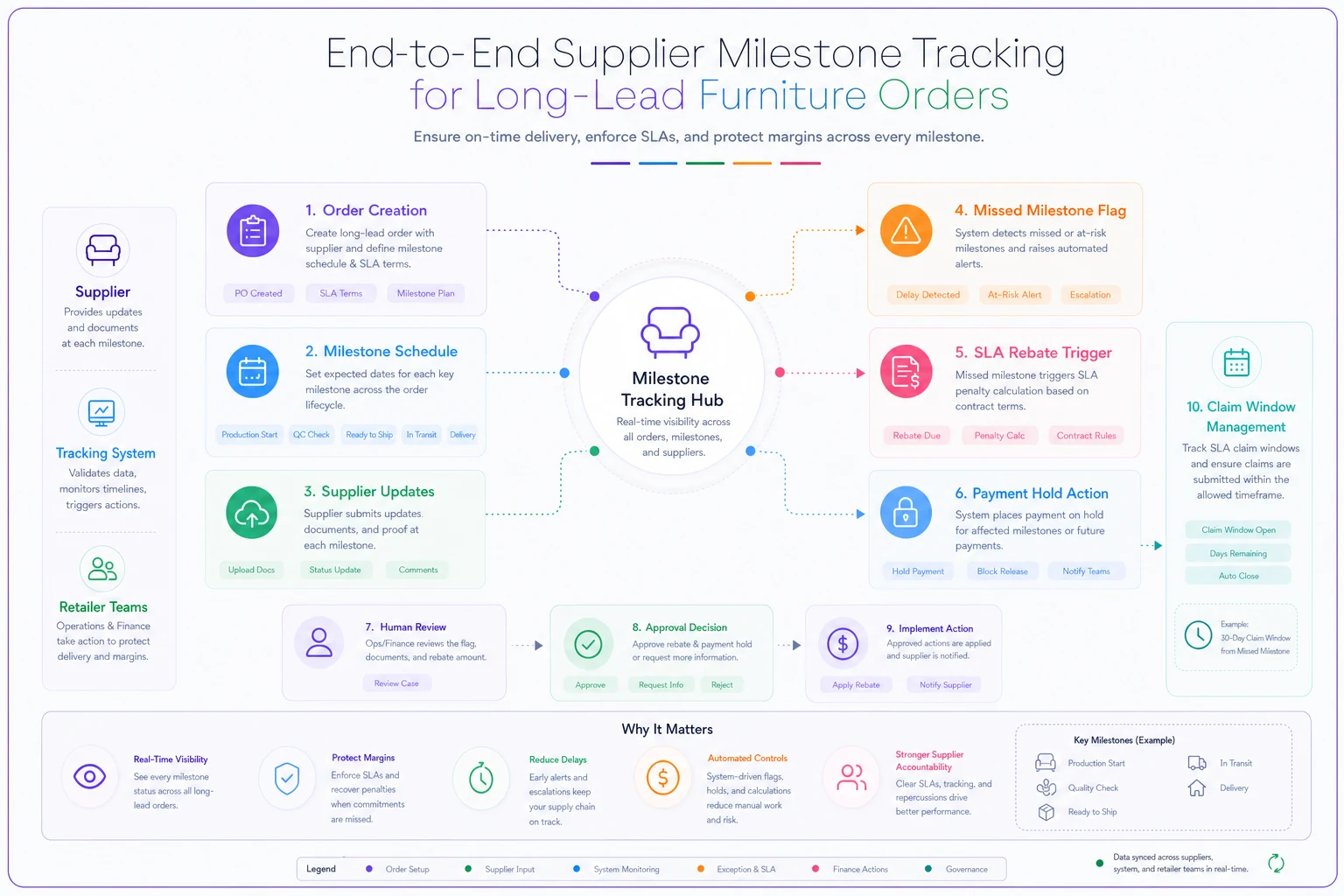
This is where operational software earns its place — not as a magic negotiator, but as the system that keeps track of the triggers. When your committed ship dates, milestone conditions and rebate thresholds live in one platform instead of scattered across POs and email threads, the workflow changes meaningfully: the system flags when a supplier's committed date passes without a ship confirmation, holds a milestone payment until someone marks the stage verified, and surfaces claimable rebates before the window closes. AI-assisted monitoring can watch these conditions across every active order and raise the ones that need a human decision, so the clauses you negotiated actually get enforced rather than quietly expiring. The negotiation only pays off if someone — or something — is keeping score.
A real scenario
A mid-sized furniture retailer, four showrooms, importing about 60% of their higher-ticket upholstery from two overseas suppliers on 14–18 week lead times. Standard terms were 45% deposit, balance before ship. Over roughly a year, both suppliers slipped ship dates on about a third of orders — nothing catastrophic, usually two to four weeks — but enough that they were regularly disappointing preorder customers and eating expedited freight costs to catch up.
On renewal, they restructured. The deposit dropped to 25%, with a mid-production milestone at 20% tied to a materials-verified photo, a pre-ship tranche at 40% released only on inspection sign-off, and an SLA rebate of 3% per week late, capped at 9%. Nothing exotic.
Over the following year, the rebate clause triggered on a handful of orders and recovered somewhere in the low five figures — real money, but not the main win. The bigger change was behavioral: the suppliers started sending proactive delay warnings, because the slip now cost them directly. That early notice let the retailer reforecast and reset customer delivery dates before they became complaints. Expedited freight dropped noticeably, and the smaller deposit freed up working capital that had previously been sitting locked up months before goods even arrived.
None of that came from being a tougher negotiator on price. It came from negotiating the structure — the sequence, the triggers, and a rebate clause that made the supplier's slippage their problem too.
Where to start
If your current terms are a single deposit number and "balance on ship," you're carrying more risk than you're being compensated for. You don't need to overhaul every supplier relationship at once. Start with your worst-performing long-lead supplier — the one that slips most frequently or ties up the most cash — and rebuild those terms first: milestones tied to verifiable stages, an SLA rebate priced to the actual slippage you experience, and a volume-review clause so trust converts into better cash terms over time.
Then make sure someone is actually watching the triggers. A perfectly negotiated rebate clause that nobody tracks is worth exactly nothing. The negotiation is honestly the easy part — enforcement across every order, quarter after quarter, is where the real protection lives.
Then make sure someone is actually watching the triggers. A perfectly negotiated rebate clause that nobody tracks is worth exactly nothing. The negotiation is honestly the easy part — enforcement across every order, quarter after quarter, is where the real protection lives.
Ready to elevate your furniture business?
Join 500+ furniture retailers using Hosyly to increase efficiency, improve customer satisfaction, and grow revenue.