

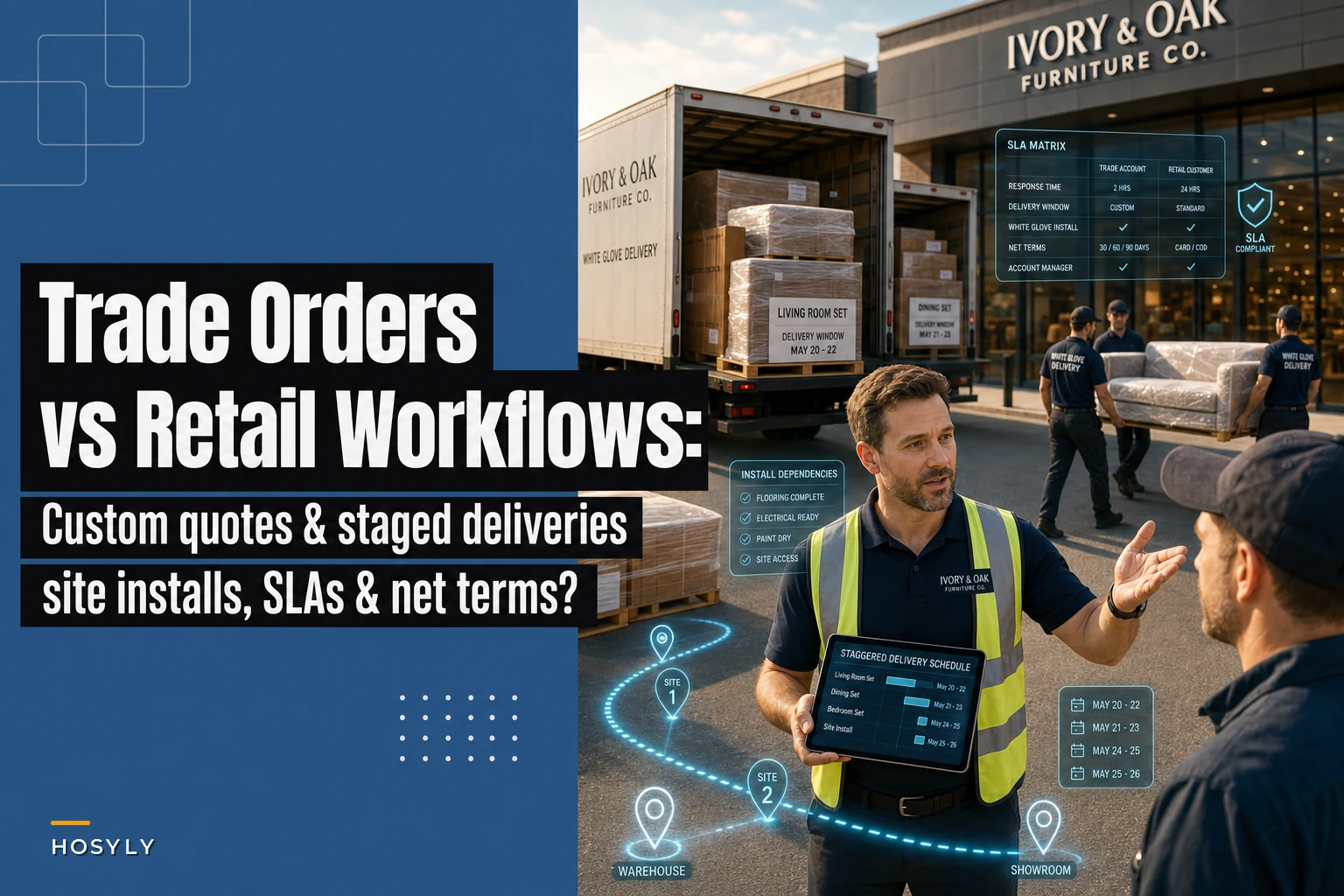

Trade furniture orders create chaos in retail operations built for walk-in customers. The problem isn't volume or complexity — it's that B2B orders fundamentally violate every assumption your retail systems make about how transactions work.
Your point-of-sale expects immediate payment. Trade customers need net-30 terms with purchase orders. Your delivery team schedules residential drops. Commercial projects require staged deliveries across multiple floors with specific elevator windows. Your sales staff quotes standard retail prices. Designers demand custom finishes with volume discounts that vary by project phase.
These aren't edge cases anymore. Trade customers — designers, contractors, property managers, corporate buyers — now represent somewhere between 15-30% of furniture store revenue depending on market. But most stores still force these orders through retail workflows, creating friction that costs both margin and client relationships.
Why retail systems fail trade orders
Retail furniture operations assume linear, predictable order flows. Customer selects products, pays upfront or finances, receives delivery, transaction complete.
Trade orders operate on completely different logic. A designer might submit a quote request for 40 conference chairs knowing they'll likely order 32, but wanting pricing for the full quantity. Payment comes 30 days after delivery — but only if the invoice matches the purchase order exactly. The chairs ship to three different floors across two weeks, coordinated with other vendors' installation schedules.
Every step breaks retail assumptions. Quote systems designed for "10% off this sofa" can't handle tiered pricing based on total project value. Delivery routing built for residential drops fails when you need certificates of insurance, union labor, and specific dock times. Payment processing expecting credit cards chokes on purchase orders requiring specific formatting and approval chains.
Most damaging: trade orders often bypass normal inventory allocation entirely. A retail system reserves stock when payment processes. But trade orders might sit as quotes for weeks before converting, creating phantom availability that leads to overselling when multiple designers quote the same limited inventory.
Quote templates that prevent scope creep
Standard retail quotes list products and prices. Trade quotes become contractual documents defining entire project relationships. Miss a detail and you're either eating the cost difference or losing the client.
Eliminate inventory headaches and order delays.
Hosyly streamlines your furniture orders and stock management for seamless store operations.
- Real-time inventory tracking
- Automated order processing
- Customer notifications & engagement
No credit card required
A furniture store serving hospitality projects learned this after delivering 200 guest room chairs, only to discover the quote didn't specify FOB destination. The designer assumed delivery included placement in each room. The store assumed curbside drop. The emergency labor hire to move chairs into position cost $3,400 in unexpected overtime.
| Item | Details |
|---|---|
| Delivery scope boundaries: | Does "delivery" mean dock drop, floor placement, or positioned in final location? Are you responsible for removing packaging? Who handles disposal? One high-end retailer uses a three-tier delivery matrix — "Dock" (driver drops at loading dock), "Floor" (delivered to specified floor via freight elevator), and "White glove" (unpacked, positioned, debris removed) — with each tier priced clearly upfront. |
| Modification procedures: | Trade projects change constantly. Your quote needs clear rules for how changes get processed. Written approval required? Price adjustment thresholds? Timeline impacts? A contract furniture dealer requires written change orders for any modification over $500 or affecting delivery dates by more than three days. That one rule eliminated most "but we discussed this" disputes. |
| Payment milestones: | Net-30 from when exactly? Delivery? Installation? Acceptance? Many stores now tie payment terms to specific milestones — 50% on order confirmation for custom items, remainder net-30 from delivery signature. This protects cash flow while accommodating trade payment cycles. |
| Damage and defect protocols: | Who inspects? When? What documentation is required? A retailer serving property management companies includes a 48-hour inspection window in every quote. Claims after that window require photo documentation from delivery day, which shifts responsibility for timely inspection onto the receiving party. |
This protects cash flow while accommodating trade payment cycles.
Staged delivery coordination
Retail deliveries follow simple geography — group nearby addresses, optimize routes, minimize trucks. Trade deliveries follow project logic that completely ignores geographic efficiency.
Consider a typical hotel renovation: 50 nightstands deliver to floors 3-7 on Tuesday morning between 6-8 AM before guests wake up. 50 desk chairs arrive Thursday afternoon to the loading dock for facilities to distribute. 15 lobby chairs get white-glove placement on Saturday night after 11 PM when lobby traffic drops. Same address, three completely different delivery requirements.
Standard routing software falls apart facing these constraints. You're not optimizing for distance anymore — you're solving a scheduling puzzle with dependencies. The nightstands can't deliver until the old ones are removed. The desk chairs need to arrive after new desks but before IT runs cables. The lobby installation requires your specific insurance carrier to cover after-hours work.
This diagram shows the staged delivery workflow and dependencies.
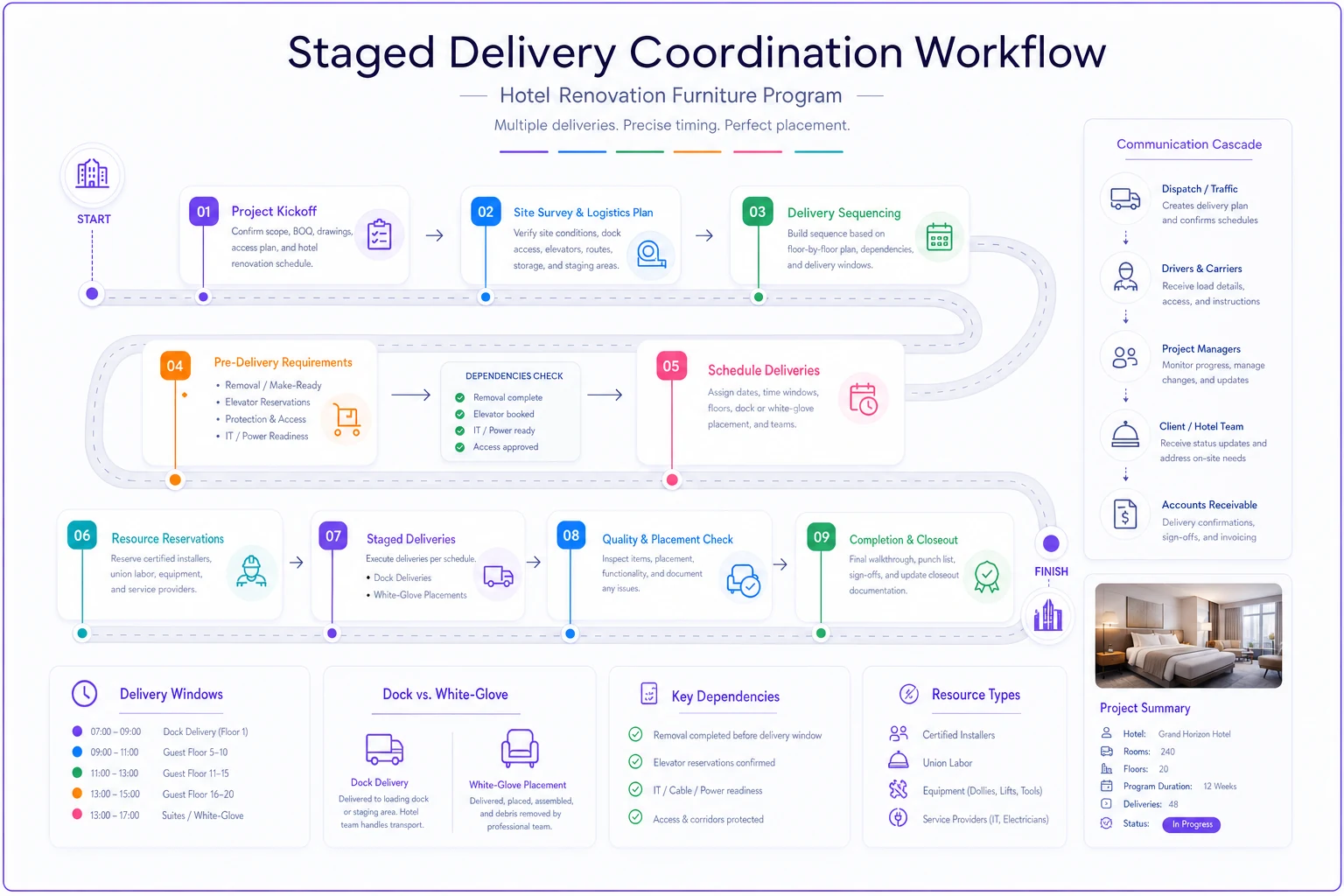
Successful trade delivery coordination requires:
Project phase mapping: Instead of treating each delivery as isolated, map the entire project timeline. A retailer specializing in office furniture now requires project managers to submit a "delivery dependency chart" showing what must happen before, during, and after each drop. This revealed that roughly 40% of their "failed" deliveries actually got to the site fine — other contractors just weren't ready, so furniture got refused.
Resource reservation systems: Trade deliveries often need specific resources: certified installers, union labor, special equipment. These can't be scheduled day-of like retail routes. One store pre-blocks installer time for confirmed trade projects, treating labor like inventory. This reduced emergency contractor calls significantly and improved margin by avoiding rush rates.
Communication cascades: Everyone needs different information. The driver needs dock access codes. The project manager needs delivery confirmation. Accounts receivable needs signed proof of delivery for invoicing. Building these communication workflows prevents the chaos of everyone calling everyone when something goes slightly wrong.
Net payment terms without cash flow problems
Retail furniture stores live on cash flow. Customer pays, you order inventory, margin covers operations. Net payment terms break this cycle — you're essentially becoming a bank, floating inventory costs for 30-60 days.
The math gets dangerous quickly. A $40,000 trade order at 40% margin means $24,000 in inventory cost you're carrying. At typical working capital costs around 8% annually, that's roughly $160 per month in carrying costs. If payment stretches to net-45, which is common in commercial, you've effectively given up a chunk of margin just in float.
But the real danger isn't the carrying cost — it's concentration risk. Three large trade accounts representing 30% of revenue sounds great until they all pay late simultaneously. Suddenly you can't make inventory payments despite strong sales numbers.
Smart net terms management requires:
-
Credit qualification beyond credit checks Standard business credit reports miss crucial details. That design firm with perfect Dun & Bradstreet scores? They're waiting on payment from their own client before they pay you. The property management company with $100M in assets? Those assets are buildings, not cash, and their internal approval chains take 45 days minimum. One retailer now requires trade accounts to provide payment history from other vendors, not just credit scores.
-
Progress billing structures Instead of net-30 on the full amount, break payments into phases. A store serving restaurant build-outs moved to 30% on order, 50% on delivery, 20% net-30 from installation. This cut working capital needs substantially while still accommodating trade payment preferences.
-
Concentration limits No single trade account should represent more than 15% of receivables. When a major hotel chain wanted to become 40% of one store's business, the owner created a separate legal entity just for that relationship, protecting the core retail operation from the exposure.
-
Collection escalation triggers Don't wait until day 45 to worry about a net-30 invoice. Successful stores build escalation schedules: friendly reminder at day 25, formal notice at day 32, hold on new orders at day 35. One retailer found that a simple automated email at day 20 reduced late payments by around a third — buyers just needed a nudge to start their internal approval process.
This cut working capital needs substantially while still accommodating trade payment preferences.
Service level agreements that actually work
Retail furniture comes with simple promises: it arrives when scheduled, looks like the floor model, works as expected. Trade furniture comes with SLAs that define precise performance standards and remedies.
A furniture dealer learned this after losing a $200,000 university dormitory contract. Their retail-focused proposal promised "delivery within 4-6 weeks" and "prompt resolution of any issues." The winning bid specified: "95% on-time delivery measured by scheduled date, $100 per day per piece credit for delays, 4-hour response time for warranty claims, temporary replacement furniture provided within 24 hours for critical items."
Effective trade SLAs include:
Measurable performance metrics: "Fast delivery" means nothing. "95% of orders delivered within the specified 4-hour window" creates accountability. A dealer serving medical offices tracks percentage delivered on scheduled date, average response time to issues, and percentage of problems resolved in one visit. These numbers go into quarterly business reviews that actually strengthen client relationships by showing consistent, documented performance.
Graduated remedy structures: Not all failures are equal. Late delivery of one guest chair is different from delaying 50 workstations ahead of a Monday office opening. Smart SLAs tier remedies: 2% credit for 1-3 day delays, 5% for 4-7 days, 10% beyond a week. This prevents minor hiccups from triggering nuclear options while protecting customers from major failures.
Scope boundaries: Trade customers often expect retail stores to become full-service project managers. Clear SLAs define what you do and don't handle. One store's agreement specifically excludes coordination with other vendors, permits and inspections, disposal of competitor's furniture, and assembly of items not sold by them. This clarity stops scope creep before it destroys margins.
Documentation requirements: Claims need evidence. A retailer implemented a simple rule: all SLA claims require photos and written description within 72 hours. This eliminated most of the vague "this wasn't right" complaints made weeks after delivery and protected against customers trying to blame shipping damage on manufacturing defects.
Technology gaps in trade order management
This is where operational software makes the difference between barely managing trade orders and actually profiting from them. Retail POS systems treat trade orders like exceptions, requiring manual workarounds that don't scale past a handful of accounts.
AI-powered operational platforms built for trade workflows handle the complexity systematically. Quote generation pulls from rule-based pricing tiers, automatically calculating volume discounts and applying customer-specific terms. Staged delivery scheduling considers project dependencies, resource availability, and site constraints — not just geographic routing.
Sync quote status with inventory allocation so long quotes don't create phantom availability and risk overselling.
Payment term management moves beyond simple aging reports to predictive cash flow modeling, flagging concentration risks before they become problems. When the platform knows that a particular property management company historically pays on day 42, it adjusts cash flow projections and triggers collection activities earlier without anyone manually tracking it.
More critically, these platforms connect previously isolated workflows. The quote system talks to inventory allocation, preventing overselling during long quote cycles. Delivery scheduling connects to installer management, ensuring certified resources are available when needed. The common preorder deposit mistakes furniture retailers make — and a step-by-step SOP to prevent them become nearly impossible when deposits, quotes, and orders exist in one unified system that enforces business rules consistently.
Making trade sales profitable
The furniture stores successfully serving trade customers didn't just add net terms to their existing operations. They built parallel workflows that recognized B2B orders operate on fundamentally different logic than retail sales.
This doesn't mean choosing between retail and trade. The same showroom serves both, inventory supports both, and plenty of operational assets overlap. But the workflows diverge at crucial points, and forcing trade orders through retail processes guarantees friction, errors, and unprofitable sales.
Start with quote templates that define complete project scope, not just pricing. Build delivery coordination that respects project logic over geographic efficiency. Structure payment terms that protect cash flow while accommodating trade cycles. Create SLAs that set clear expectations and remedies. Then connect these elements through operational software that handles complexity systematically rather than through manual effort that doesn't scale.
Trade furniture order workflows will always be more complex than retail sales. But complexity doesn't have to mean chaos. With the right operational rules and supporting technology, trade sales become a profitable growth channel instead of a necessary evil that quietly breaks your retail systems.
Ready to elevate your furniture business?
Join 500+ furniture retailers using Hosyly to increase efficiency, improve customer satisfaction, and grow revenue.