

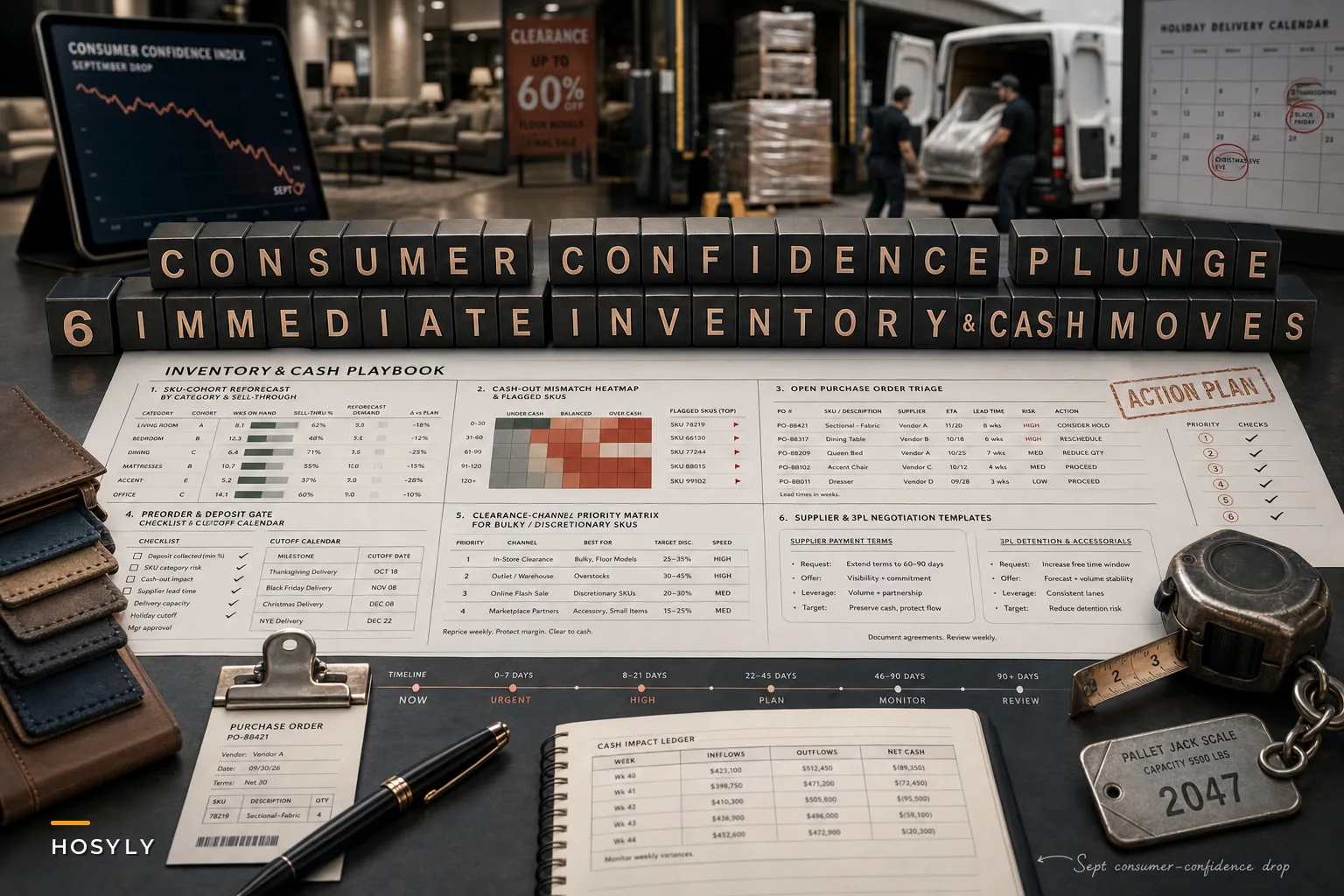

The Conference Board's September reading landed hard. Consumer confidence dropped 6.7 points to 81.9 — the weakest since 2014 — with people pointing at rising prices and a shaky labor market as the reasons they're pulling back. You can read the full Conference Board release here, and CNBC's coverage noted that optimism slid sharply on job and price fears.
For most industries, a confidence dip is a slow leak. For furniture, it's closer to a valve slamming shut. Nobody needs a new sectional the way they need groceries or gas. A dining set is the easiest purchase in the world to push back six months. When sentiment drops this fast, this close to Q4, the real danger isn't just a slow holiday season — it's that your inbound purchase orders, floor plan, and staffing were all built around a demand curve that no longer exists.
This isn't a wait-and-see moment. The orders you placed in July for January delivery are already in motion. The question is what you can still change in the next 30, 60, and 90 days before markdown season catches you holding the bag.
Why furniture gets hit first and recovers last
Furniture sits at an awkward intersection. It's high-ticket, highly discretionary, and tied directly to housing activity and major life changes — moves, renovations, new households forming. When people get nervous about their job or feel squeezed by prices, the sofa purchase quietly falls off the list first.
What makes it worse operationally is the lead time mismatch. The commitments that determine your cash position over the next four to six months were made before this sentiment shift. A container of case goods ordered in late summer doesn't care that confidence tanked in September. It's still showing up at your dock, still needs to be paid for, and still needs floor space.
So you end up with a dangerous combination: demand falling in real time while supply is locked in from decisions made under different assumptions. That gap is where cash gets trapped and margins get shredded.
The retailers who handle this well aren't the ones who predicted the dip. They're the ones who move quickly on commitments already in the pipeline — slowing some, cancelling others, repositioning the stock they can't stop.
Move 1: Freeze and re-triage your open purchase orders this week
Before touching pricing or promotions, go straight to your open PO list. Not the whole catalog — just what's inbound in the next 90 days and anything you haven't committed deposits on yet for Q1.
Eliminate inventory headaches and order delays.
Hosyly streamlines your furniture orders and stock management for seamless store operations.
- Real-time inventory tracking
- Automated order processing
- Customer notifications & engagement
No credit card required
-
Cannot cancel — in production, deposit paid, or past the supplier's change window
-
Can delay — supplier will push the ship date without penalty
-
Can cancel or reduce — still inside the modification window, low deposit exposure
One pattern worth noting: most retailers assume far more of their pipeline is locked than actually is. When you call suppliers directly, you'll often find that long-lead case goods and upholstery programs have more flexibility than the paperwork suggests — especially right now, when your supplier is watching the same demand signals and would rather push your ship date than lose the relationship.
A rough triage frame that holds up across tightening cycles:
| Category | Demand sensitivity to confidence | Action in a downturn |
|---|---|---|
| Entry-price upholstery | Moderate | Hold volume, watch sell-through weekly |
| Mid/premium sectionals | High | Delay or trim inbound by 20–30% |
| Dining & bedroom sets | High | Delay; recheck deposits before Q1 orders |
| Occasional/accent pieces | Lower (impulse, lower ticket) | Keep flowing, good cash velocity |
| Mattresses | Mixed (replacement demand) | Hold, less discretionary than it looks |
The accent and small-ticket category is the one people consistently underweight here. When confidence falls, customers often still spend — they just trade down. A $340 accent chair closes when a $2,900 sectional stalls. Don't gut the inventory that's still moving just because the headline number scared you.
Move 2: Protect working capital by matching cash-out to real sell-through
This is the move that separates retailers who survive a soft quarter from those scrambling for a credit line in Q1. Money leaving your business for new inventory should track what's actually selling, not what you forecasted in a more optimistic month.
The problem is that most furniture retailers don't look at inventory and cash together. Inventory lives in one system, cash flow lives in a spreadsheet the owner updates when they remember, and purchasing decisions get made on gut and vendor relationships. In a stable market, you can get away with it. In a falling-confidence market, that disconnect is exactly how a showroom ends up overstocked and under-cash at the same time.
If you haven't tied purchasing decisions to a working-capital view yet, this is the quarter to build it. We walked through the mechanics in our inventory-to-capital model for furniture retailers — the short version being that every SKU category should have a clear picture of how much cash it ties up versus how fast it converts back. When sentiment drops, you shift ordering toward fast-converting, cash-light categories and slow down the heavy ones.
-
Pull sell-through by category for the trailing 2 weeks, not the trailing quarter
-
Compare against inbound cash committed for that same category
-
Flag any category where cash committed is growing while sell-through is shrinking
-
Delay or cancel the next order in every flagged category before the deposit deadline
-
Redeploy freed cash into reserves or faster-moving stock
The categories that fail step 3 are your bleed points. Stopping the inflow there is usually worth more than any promotion you could run.
Move 3: Reprice floor samples and aging stock before everyone else does
In a confidence drop, markdown timing matters more than markdown depth. Retailers who wait until January to clear slow stock are competing with every other retailer doing the exact same thing — into a weaker demand pool, with deeper discounts, and higher per-unit logistics cost because everyone's dumping simultaneously.
Moving early on genuinely stuck inventory — the floor sample that's been out 14 months, the discontinued finish, the one-off special order a customer walked away from — gets you ahead of the pack. A moderate 15–20% reduction in October often recovers more total dollars than a desperate 40% cut in February.
-
Floor samples past their rotation window with visible wear
-
Discontinued or soon-to-be-discontinued finishes and fabrics
-
SKUs with more than one unit in stock and no sale in the last 60 days
-
Orphaned special orders and customer cancellations
-
Anything taking premium floor space with below-average margin per square foot
The trap is treating all slow stock the same. A slow-moving, high-margin anchor piece that defines your showroom's look is not the same as a slow-moving commodity SKU eating cash. The first might be worth holding through the dip. The second should be gone by November.
Move 4: Rework staffing and installation capacity to match softer volume
Most retailers ramp delivery and install crews ahead of the holidays. In a falling-confidence quarter, over-ramping is a quiet margin killer — you're paying for capacity against a demand curve that's flattening.
This doesn't mean cutting to the bone. Failed or delayed deliveries on the sales you do close will cost you reviews and referrals you can't afford right now. The move is shifting from fixed to flexible capacity — lean harder on subcontracted or on-call crews for surge periods, keep your core team, and avoid locking in full seasonal headcount until you've seen a few weeks of actual booking data.
A useful rule: don't staff to your optimistic forecast. Staff to your trailing two-week booking pace, with a flexible layer on top you can activate in 48 hours if volume surprises you. It almost never does during a confidence slide, but the flexibility costs little and protects you either way.
Move 5: Tighten deposit and cancellation terms to stop preorder churn from eating cash
When people get nervous, buyer's remorse increases. Preorder cancellations and financing fall-throughs climb exactly when you can least afford the cash swing — you've committed to the supplier, maybe already paid a deposit, and now the customer walks.
This is the quarter to review your deposit structure and cancellation policy with cash protection in mind, without scaring off buyers who are ready to commit. A few levers worth adjusting:
-
Non-refundable deposit on special orders above a certain ticket — modest enough to feel fair, meaningful enough to filter out tire-kickers
-
Shorter cancellation windows on made-to-order pieces, clearly communicated at point of sale
-
Deposit tiers that scale with lead time — longer lead, higher deposit
-
Clear financing pre-approval before a custom order is placed, so a declined application doesn't cancel a committed PO
The point isn't rigidity. It's making sure that when a customer commits to a long-lead order, your cash isn't fully exposed to their change of heart. A sensible non-refundable deposit does more to protect Q1 cash than almost anything on the pricing side.
Move 6: Rebuild the forecast weekly, not quarterly
The forecast you built in summer is dead. Confidence moved too fast for it to be useful. For the next 90 days, your planning horizon needs to shrink — monthly reforecasts are too slow when sentiment is shifting week to week.
This is where keeping inventory, sales, and cash data in one connected view stops being a nice-to-have. When purchasing, sell-through, and cash commitments live in separate places, a weekly reforecast is physically painful — you spend the week assembling data instead of acting on it. AI-powered operational software helps close that gap; retailers who've consolidated into a single platform can run the triage cycle from Move 2 in roughly an hour, catch a bleeding category before the next deposit deadline, and actually cancel the order in time.
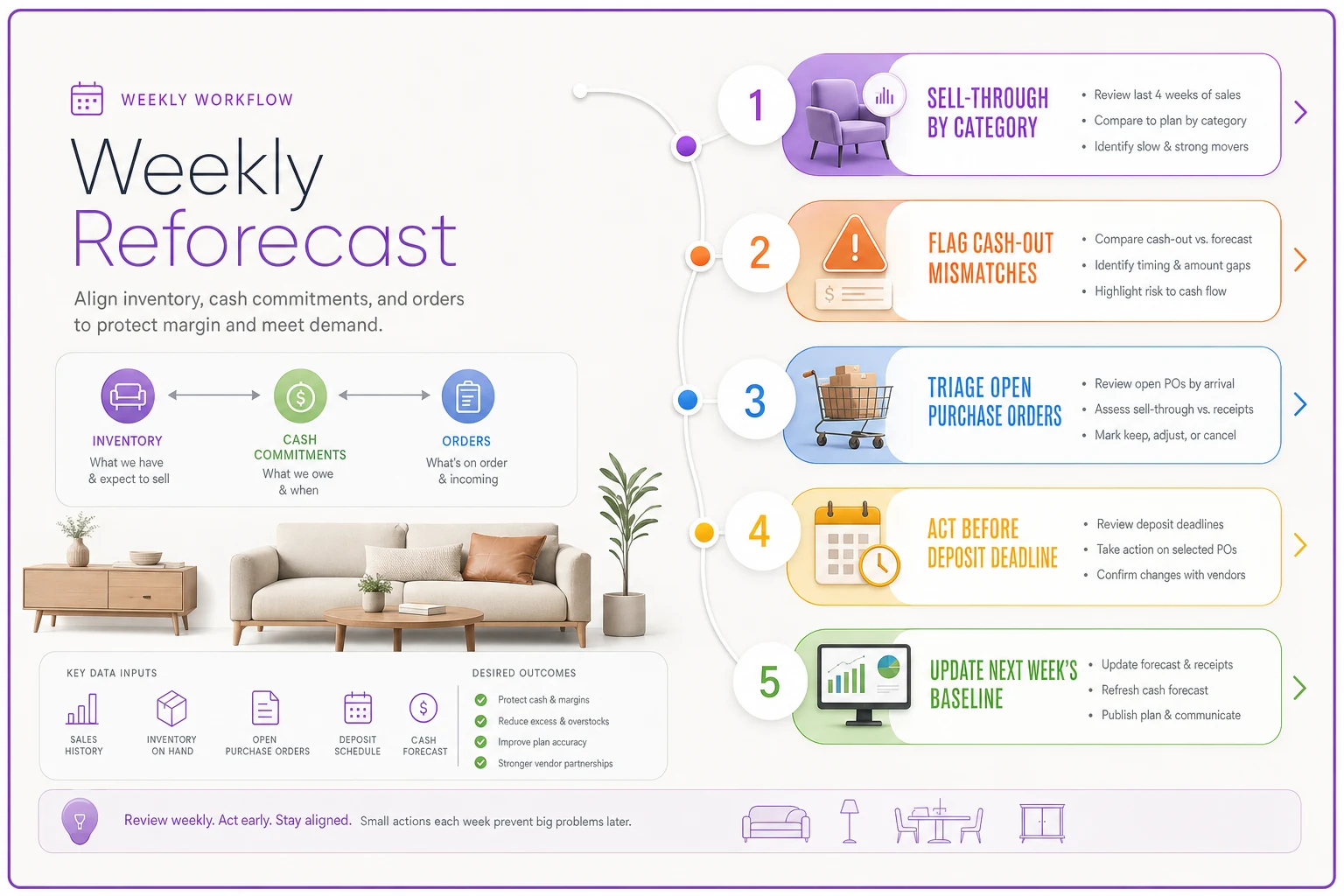
That speed is the whole game in a downturn. The decisions are rarely complicated. The cost is in how long it takes to see the problem and act on it. Shortening that gap — from a monthly scramble to a weekly rhythm — is what keeps cash in the business.
Automate the sell-through pull so you can run the weekly reforecast without manual data assembly.
When purchasing, sell-through, and cash commitments live in separate places, a weekly reforecast is physically painful — you spend the week assembling data instead of acting on it.
A quick real-world picture
Think about a single-location retailer doing somewhere around $4M a year, heavy in mid-premium upholstery and dining. Going into a sentiment drop like this, their open PO book had roughly $500k of inbound committed over the next four months, most of it mid-to-high ticket.
Running the triage: about 40% was truly locked, another 35% could be delayed one to two months without penalty, and roughly a quarter was still inside the cancel window. By delaying the middle bucket and trimming the cancellable portion, they pulled close to $120k–$150k of committed cash-out off the next 90 days. Pair that with early markdowns on aging floor samples and tighter special-order deposits, and the quarter went from "where do we find a credit line" to "soft, but stable."
The pieces that still moved — accent chairs, smaller case goods, a couple of value upholstery lines — kept the lights on. The sectionals that stalled didn't become a January fire sale, because the inbound was stopped before it hit the dock.
When to act aggressively, and when to hold
Not every retailer should slam the brakes. If you're heavily weighted toward replacement-driven categories like mattresses, or your customer base skews toward households less exposed to the labor-market worries driving this dip, you can afford a steadier hand. Over-reacting and gutting your assortment can cost you sales when demand stabilizes.
The retailers who should move hardest are those concentrated in high-ticket discretionary pieces, carrying thin cash reserves, with a large long-lead PO book already committed. That combination is where a confidence slide turns into a genuine cash problem fast.
The thread running through all six moves is the same: a confidence drop doesn't instantly kill your sales, but it immediately changes the risk profile of every commitment you've already made. The work now is matching what leaves your business — cash, inventory, labor — to demand as it actually is this week, not as you hoped it would be back in July. Do that quickly, and a weak quarter stays a weak quarter instead of becoming the reason you spend next spring digging out.
Ready to elevate your furniture business?
Join 500+ furniture retailers using Hosyly to increase efficiency, improve customer satisfaction, and grow revenue.