

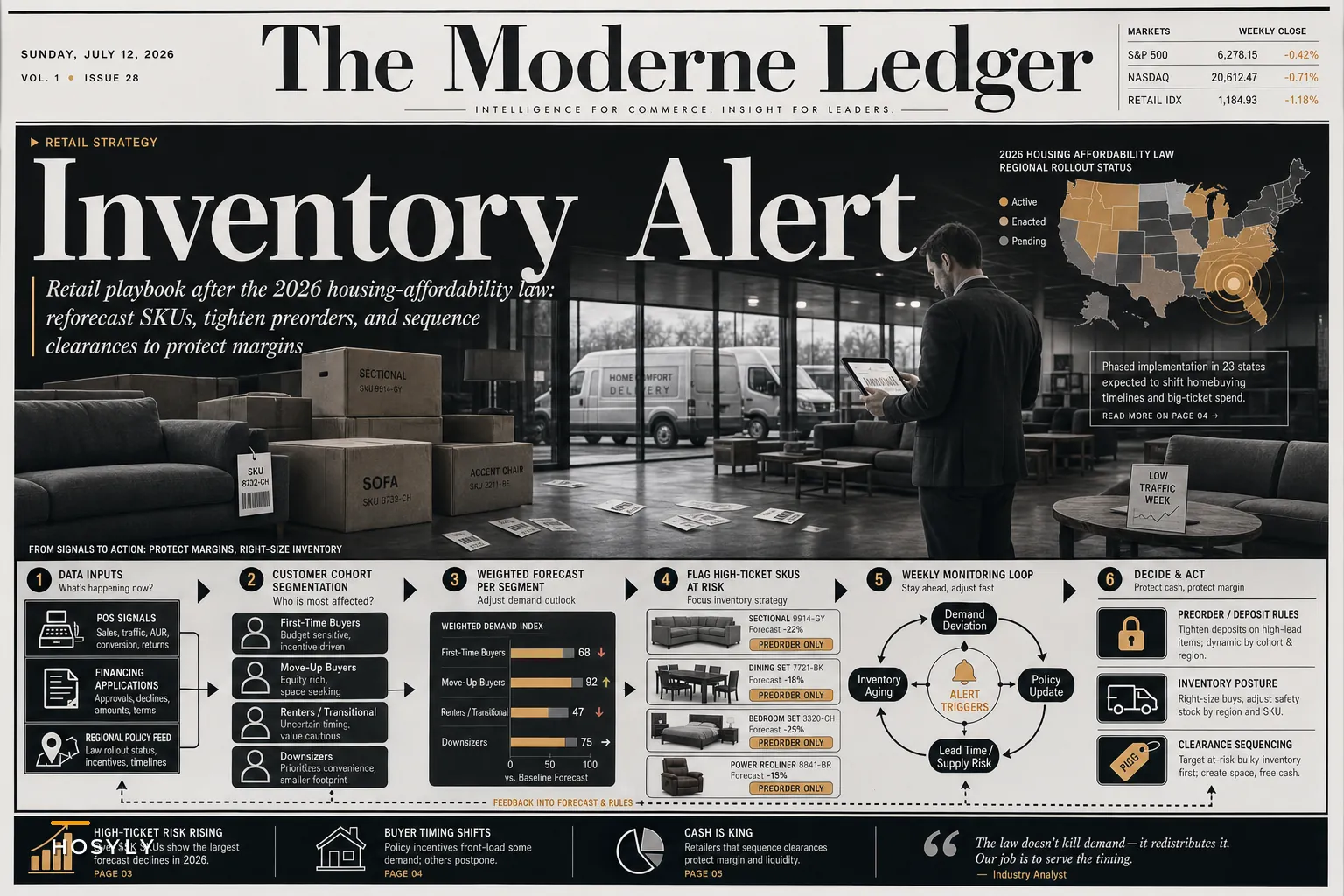

The housing affordability law furniture inventory challenge landed on our doorstep this July. While politicians were busy celebrating the new federal housing initiative, furniture retailers started noticing something different in their weekend traffic. Foot traffic didn't stop, but the conversations shifted. Customers who used to browse dining sets started asking about delivery windows six months out. Young couples who would normally pull the trigger on a bedroom suite suddenly wanted to know about cancellation policies.
CNBC reported that the new law introduces various measures aimed at boosting housing supply and lowering buyer costs. What they didn't cover was how this would scramble furniture retail operations across the country. The incentives don't just change when people buy homes — they change what furniture people buy, how they finance it, and whether they commit to orders at all.
The inventory problem nobody saw coming
Most furniture retailers plan inventory around predictable patterns. Spring means patio furniture. Fall means dining room sets ahead of the holidays. Housing policy changes break those patterns in ways that catch even experienced managers off guard.
A multi-location furniture chain in Phoenix is a decent example. They had placed fall orders based on historical data showing strong bedroom and living room sales from September through November. Three containers of sectionals and recliners were expected by mid-August. Then the housing law details started trickling out, and their preorder volume dropped around 40% in two weeks.
The problem wasn't that people stopped wanting furniture. It was timing uncertainty. First-time buyers who qualified for new incentives wanted to wait until programs fully rolled out in their state. Existing homeowners considering upgrades suddenly had reasons to delay. Orders that normally flow steadily from July through September turned into a trickle of tentative inquiries.
Regional variation made it worse. States implementing the housing programs at different speeds meant a store in Dallas might see completely different patterns than one in Orlando. Applying company-wide trends uniformly across locations stopped working almost overnight.
Why traditional forecasting breaks during policy transitions
Standard furniture forecasting relies on cohort behavior staying relatively stable. You track how many customers who bought dining sets also bought china cabinets within 90 days. You monitor seasonal patterns for outdoor furniture based on several years of weather data. You adjust safety stock based on supplier lead times that have been consistent for the past year or two.
Eliminate inventory headaches and order delays.
Hosyly streamlines your furniture orders and stock management for seamless store operations.
- Real-time inventory tracking
- Automated order processing
- Customer notifications & engagement
No credit card required
Policy-driven demand shifts destroy those assumptions. The couple who would have bought a $4,000 bedroom set might now wait three months to see if mortgage rates drop. The investor furnishing rental properties might pause all orders until they understand new tax implications. The retiree downsizing might accelerate their timeline to take advantage of transitional incentives.
This connects directly to the deeper challenge of forecasting slow-moving, high-ticket furniture SKUs. When external shocks hit, expensive leather sectionals and custom dining tables get even harder to predict. The rules that worked last quarter become actively harmful if you follow them blindly.
Adjusting preorder terms without losing customer trust
What kills furniture retailers during demand transitions is inflexible preorder policies built for stable markets. Requiring 50% deposits on custom orders with no refunds after 72 hours worked fine when customers were confident about their moving dates. Now it's a deal-breaker.
Smart retailers are building tiered deposit structures that reflect actual uncertainty levels. For made-to-order pieces with 12-week lead times, they're offering lower initial deposits — around 20% — with the ability to adjust specifications until week six. For in-stock items, they're extending hold periods from 7 days to 21, with a small fee to reserve inventory.
Pro-tip: Clearly label which preorder terms apply to orders placed before or after policy announcements to avoid staff confusion during transitions.
The operational complexity comes from tracking varied terms across different SKUs, customers, and time periods. A customer who placed an order in June under old terms needs different handling than one who ordered in August under revised policies. Staff need clear decision trees for handling modifications, cancellations, and delivery rescheduling requests.
One regional chain in the Southeast built what they call "confidence pricing" — customers who commit to firm delivery dates get standard pricing, while those who want flexibility pay slightly more but can adjust their orders. This wasn't about squeezing uncertain buyers. The premium covers real costs: extended warehouse storage, extra handling, and the opportunity cost of tying up inventory that might have sold to someone else.
Inventory positioning strategies for uncertain demand
The traditional approach says keep bestsellers in stock and special order everything else. But housing policy shifts change what qualifies as a bestseller. A modular sofa system that appeals to renters might suddenly outsell traditional sectionals if more people delay home purchases. Compact dining sets might move faster than formal dining room suites if buyers gravitate toward smaller starter homes.
Commitment-light inventory: Pieces that work for both renters and owners, broad style appeal, moderate price points. These become your bridge inventory during transition periods — storage ottomans, accent chairs, modular shelving. You can afford to be slightly heavy here because they'll sell eventually regardless of housing market direction.
Policy-sensitive inventory: High-ticket items strongly correlated with home purchases. Custom sectionals, formal dining sets, master bedroom suites. For these, maintain minimal floor models and rely on vendor-managed inventory or quick-ship programs. You'd rather pay slightly higher unit costs for flexibility than get stuck with three truckloads of furniture nobody's ready to buy yet.
Hedge inventory: Items that actually benefit from housing uncertainty. Home office furniture when people extend apartment stays. Portable pieces for those expecting to move soon. Multi-functional items for uncertain space requirements. Position these prominently and market them honestly as transition-friendly options.
The following table shows how to think about each bucket across key operational dimensions:
| Inventory Type | Examples | Stock Posture | Risk Level |
|---|---|---|---|
| Commitment-light | Accent chairs, modular shelving, ottomans | Slightly heavy | Low |
| Policy-sensitive | Custom sectionals, formal dining sets | Minimal floor models | High |
| Hedge | Home office furniture, portable pieces | Prominent positioning | Medium |
The key is avoiding the middle ground — neither committed to a position nor flexible enough to adjust. Sitting on six months of traditional inventory with standard terms during a policy transition is a reliable way to create cash flow problems.
Reading early signals in customer behavior
Before customers stop buying, they change how they shop. The signals are there if you track the right things. Average time from first visit to purchase stretches from 14 days to 35. Customers who used to visit twice before buying come in four or five times. The ratio of "just looking" to "ready to buy today" shifts noticeably.
Financing applications tell another story. During stable periods, maybe 60% of applications result in purchases. During housing policy transitions, that can drop to around 30% — not because people can't get approved, but because they're testing options without committing. They want to know what they could buy, not what they will buy.
Questions at the point of sale become more revealing than sales data itself. Track what customers are asking about:
-
Delivery windows and flexibility
-
Cancellation policies and fees
-
Whether specific items will still be available in three months
-
If prices are likely to change
-
Storage options for early delivery
When those questions spike, you're usually 4–6 weeks away from a meaningful demand shift. That's your window to adjust ordering, modify terms, and reposition inventory before you're stuck reacting. Most retailers miss it because nobody's tracking questions — only transactions.
Making forecasting adjustments that actually work
Throwing out historical data during policy transitions seems logical but it's usually wrong. The better move is to weight recent signals more heavily while keeping longer-term baselines as a sanity check. A furniture retailer in Austin shifted from roughly 70% historical weight to 40%, bumping recent trend weight from 30% to 60% — but they kept the historical data visible rather than hiding it.
Here's a simplified version of the forecast adjustment process they used:
-
Segment customers by behavior type (first-time buyers, upgraders, investors, renters)
-
Identify which segments are most affected by the policy change
-
Adjust forecast weights for each segment independently
-
Flag SKUs with strong correlation to policy-sensitive segments for inventory review
-
Monitor early behavioral signals weekly rather than monthly during the transition period
They also moved to forecasting by customer segment rather than product category. Instead of asking "how many dining sets will we sell," they asked "what will young families buy, what will retirees buy, what will investors buy." Each segment responds differently to housing policy changes. Young families might accelerate purchases to lock in incentives. Retirees might pause to understand tax implications. Investors might shift focus entirely.
The segmented approach helped them spot opportunities others missed. While competitors slashed orders across the board, they noticed that newly-eligible first-time buyers under the affordability program were actually increasing their furniture budgets — they just needed different payment terms and longer decision windows. Adjusting terms for that specific segment while tightening inventory for others let them maintain revenue while reducing overall risk.
The diagram below outlines that segmented forecast adjustment workflow.
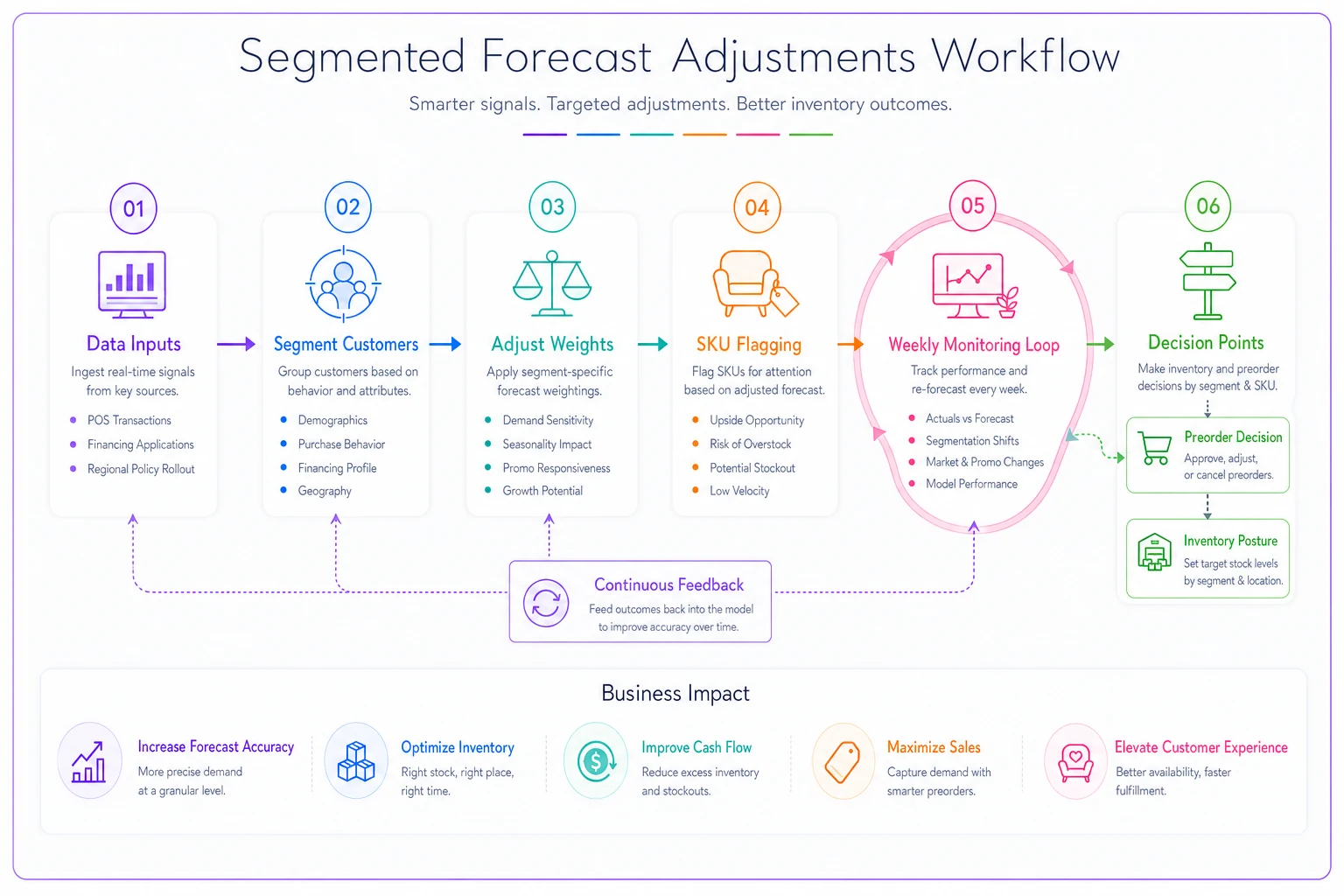
Use this to align weekly monitoring steps with segment-based forecasts.
Protecting margins when everything feels uncertain
The instinct during demand uncertainty is to compete on price. But furniture retail margins are already tight, and panic discounting during a policy transition can damage profitability for multiple quarters.
Better retailers protect margins through operational efficiency instead of price cuts. They negotiate extended payment terms with suppliers, explaining that policy uncertainty affects everyone in the chain. They consolidate shipments to cut freight costs. They cross-train staff to cover multiple roles as traffic patterns shift. They renegotiate warehouse space to month-to-month terms instead of annual locks.
They also get creative with inventory monetization. That sectional not selling at full price might work for a corporate furniture rental program. Dining sets collecting dust could become staging inventory for real estate agents navigating the same housing policy changes. The goal is finding alternative channels that generate cash flow without destroying retail price integrity.
Technology and tools that make adaptation possible
Manual forecasting and inventory management breaks down during policy transitions. The spreadsheet that handled steady-state operations can't deal with constantly shifting parameters, multiple scenarios, and segment-based adjustments simultaneously.
AI-powered operational software changes this — not the buzzword version that promises to predict the future, but practical platforms that help you spot patterns faster, adjust parameters quickly, and test scenarios before committing to them. These tools can track early customer signals, automatically adjust forecast weights, and flag when specific SKUs start behaving unusually compared to baseline.
Operations platforms now integrate point-of-sale conversation patterns, showing which questions spike before demand shifts. They connect financing applications to actual purchase rates, revealing when customers are browsing versus buying. They segment customers based on behavior, not just demographics, adjusting forecasts for each group independently.
The real value isn't the software making decisions for you. It's processing large volumes of operational data and surfacing patterns that would otherwise take weeks to appear in monthly reports. When a housing policy change affects your Tennessee stores differently than your Georgia locations, a decent platform flags it within days rather than waiting for quarterly reviews to catch the divergence.
Moving forward with confidence
Housing affordability law furniture inventory challenges aren't going away. If anything, we'll see more policy interventions as governments keep trying to address housing costs. The retailers who come out ahead won't be the ones who predict changes perfectly — that's not realistic. They'll be the ones who build operations flexible enough to adapt quickly.
Start with the basics: segment inventory by commitment level, adjust preorder terms to reflect actual uncertainty, and watch behavioral signals closely. Use technology to process complexity but keep human judgment at the center of major decisions. Policy transitions create real opportunities for retailers prepared to move — while competitors freeze up trying to understand what's happening, operations with flexibility can capture market share by serving customers that more rigid businesses can't accommodate.
The housing law caught a lot of people off guard this July, but the next shift is always coming. Build your operations to bend without breaking, and uncertainty starts to feel less like a threat and more like something you can actually use.
The housing law caught a lot of people off guard this July, but the next shift is always coming. Build your operations to bend without breaking, and uncertainty starts to feel less like a threat and more like something you can actually use.
Ready to elevate your furniture business?
Join 500+ furniture retailers using Hosyly to increase efficiency, improve customer satisfaction, and grow revenue.