

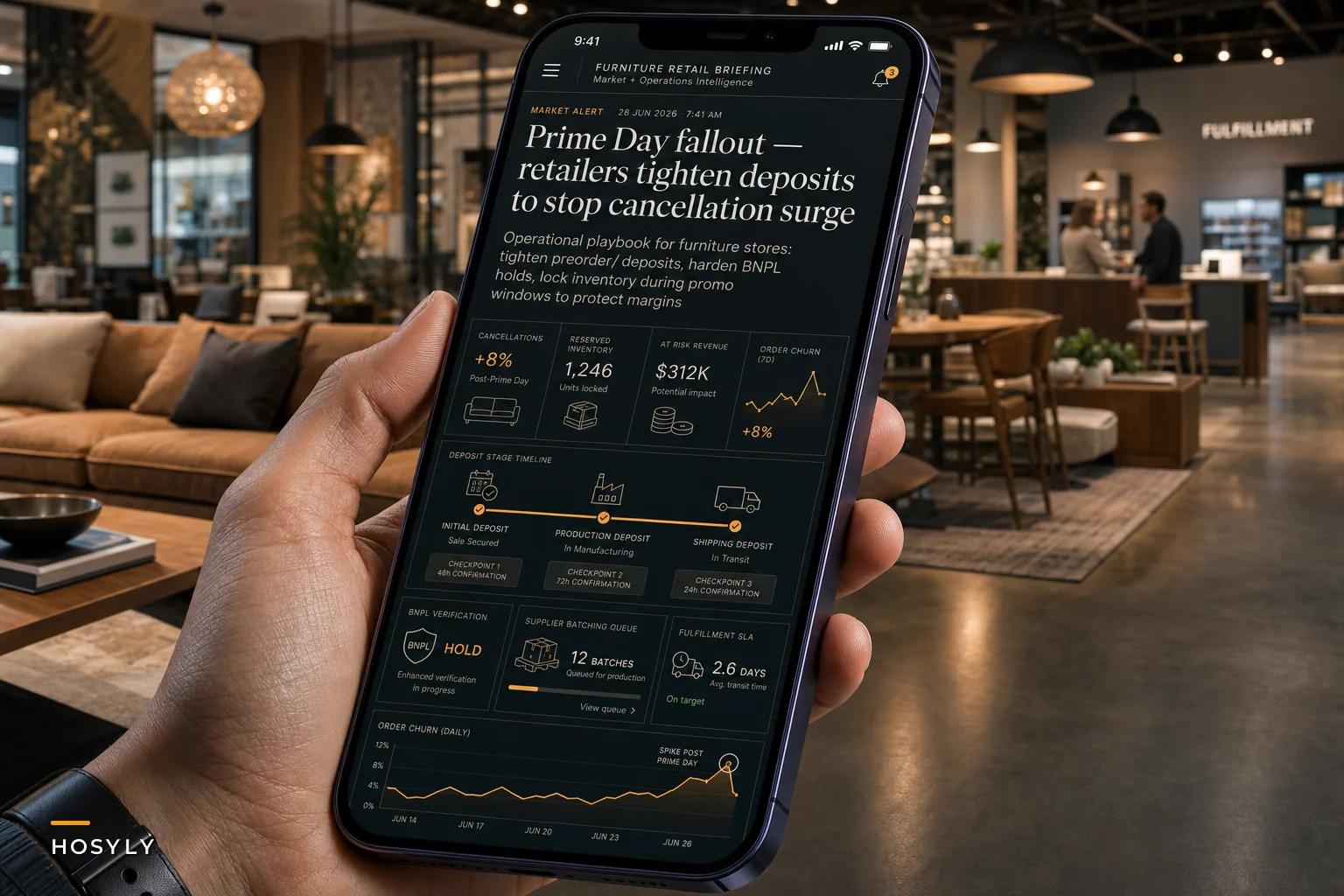

Prime Day just wrapped up with Adobe reporting $8.3 billion in day-one spending, and if you run a furniture store, you're probably already feeling it. Customers walking in with screenshots of Wayfair deals, asking why your solid oak dining set costs triple what they saw online yesterday. BNPL transactions spiking. Deposit policies getting tested by people who are really just browsing for the best price.
The real problem isn't the four-day event itself. It's what follows. Prime Day has conditioned customers to expect deep discounts on everything, including furniture that takes 12-16 weeks to manufacture. When you're dealing with made-to-order pieces, custom upholstery, or imported collections with six-month lead times, the standard retail playbook doesn't hold up.
The deposit nightmare nobody talks about
Most furniture stores are running deposits wrong, and Prime Day makes the cracks more visible. What typically happens: customer places an order during your "matching Prime Day prices" promotion, puts down 30% on a $4,800 sectional. That's $1,440 upfront. Seems fine until they find the same style somewhere else for $3,200 three weeks later and want out.
Now you're stuck with a custom order from your manufacturer, arguing about refund policies, and probably eating the loss because fighting over deposits tanks Google reviews. The kicker is that the sectional was already ordered with your supplier who requires 50% from you upfront. So you're floating $2,400 while only holding $1,440 from the customer.
A boutique furniture store in Denver discovered they were underwater on roughly 40% of their special orders once they actually ran the numbers. They'd match online pricing to close sales but never adjusted their deposit structure to account for the added risk. Customer cancellations spiked every time Wayfair or Article ran flash sales, leaving around $185,000 in orphaned inventory sitting in their warehouse over six months.
The fix isn't complicated, but it takes discipline. For any order where you're matching aggressive pricing or processing BNPL purchases, your deposit needs to cover actual costs plus a real cancellation buffer. That usually means 60-65% down, not 30%. Yes, it loses you some sales. But those are the sales that were going to cost you anyway.
BNPL is breaking traditional furniture math
According to CNBC's analysis of Prime Day spending, Buy Now Pay Later usage hit record levels during the event. For furniture retailers, this creates a specific problem that most haven't planned around.
Eliminate inventory headaches and order delays.
Hosyly streamlines your furniture orders and stock management for seamless store operations.
- Real-time inventory tracking
- Automated order processing
- Customer notifications & engagement
No credit card required
When a customer finances a $3,000 bedroom set through Affirm or Klarna, they're mentally spending $125 a month, not three grand. So they add the nightstands, upgrade the mattress, throw in the ottoman. Average ticket jumps from $3,000 to $4,800, which looks great until you realize these customers cancel at much higher rates than average.
The BNPL buyer who stretched beyond their budget is the same one who panics when the first payment posts. Or when delivery takes longer than expected. Or when they spot another deal two weeks out. Standard furniture operations assume somewhere around 5-8% order cancellations. BNPL-heavy orders run closer to 15-20%.
One store owner in Phoenix shared their BNPL numbers with me. Out of 127 BNPL transactions above $2,500 in a single quarter, 31 either cancelled before delivery or initiated returns within 30 days. That's nearly a 25% failure rate on their highest-margin orders. The operational chaos from restocking, rescheduling deliveries, and reshuffling warehouse space ate most of the profit from the sales that did go through.
Inventory velocity assumptions are completely backwards now
Prime Day furniture strategy usually focuses on having the right stock ready for promotional items. But the harder challenge comes after the event, when your inventory turnover calculations get destroyed by discount-driven demand patterns.
Traditional retail math says a dining set should turn 3-4 times a year, living room furniture maybe 4-5 times. When customers only buy during major sale events, your inventory sits untouched for months between promotions. You end up running a warehouse with a showroom attached.
The obvious response is to order less and lean on special orders. Except online retailers can now drop-ship many of the same items faster than your suppliers can produce them. A customer who'll wait 14 weeks for a custom sofa at normal prices won't wait 14 days during a sale.
Creating a preorder system that actually protects margins
This connects directly to the systematic deposit problems most furniture retailers run into. When discount events compress buying decisions, your preorder process becomes the difference between profitable sales and expensive ones.
-
Initial deposit
25% to secure the sale
-
Production deposit
35% when the order goes to the manufacturer (usually 48-72 hours later)
-
Shipping deposit
15% when items leave the factory
This does two things. It gives impulsive buyers a low-cost exit before you've committed serious capital, and it builds psychological investment as customers pay incrementally. Someone who's made three deposits over eight weeks rarely cancels at delivery.
For BNPL purchases specifically, require the full deposit amount in real money regardless of their payment plan. If they're financing $5,000 through Klarna, they still need $2,500-3,000 down. This filters out buyers who can't actually afford the purchase and are just riding the BNPL wave.
Require the full deposit amount in real money for BNPL purchases to filter out buyers who can't actually afford the purchase.
The diagram below illustrates the staged deposit checkpoints and verification steps for preorders.
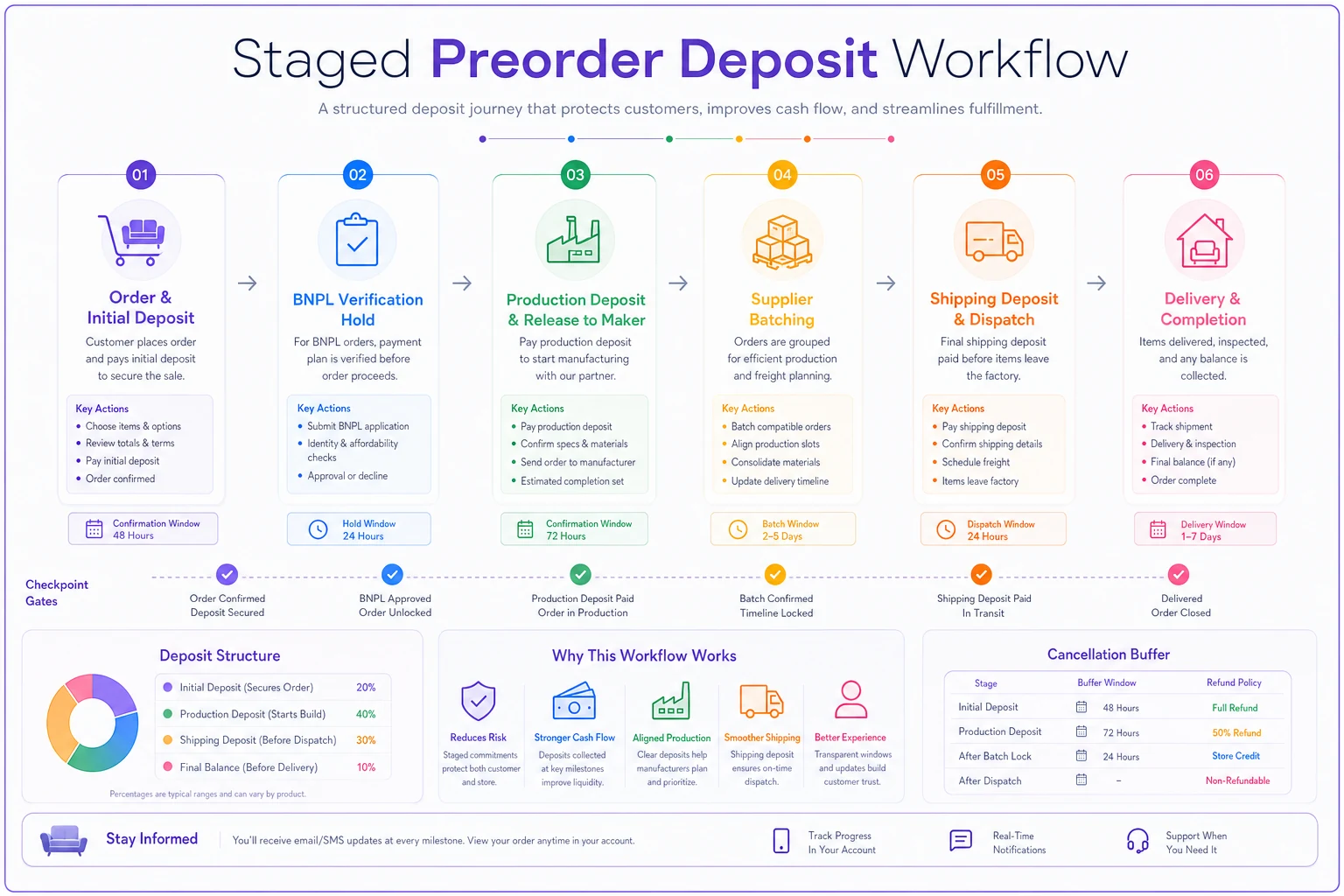
This staged approach protects margins by aligning customer payments with your supplier obligations and reducing the capital you float on risky orders.
The pricing transparency trap
After Prime Day, customers want to understand your cost structure. They want to know why your furniture costs more than Amazon's. The mistake is thinking you have to match prices. What you need to match is value perception, which is a different problem entirely.
Break your pricing into visible components:
-
Base furniture cost
-
Quality inspection and prep
-
White glove delivery and setup
-
Local service and warranty
-
Removal of old furniture
| Component |
|---|
| Base furniture cost |
| Quality inspection and prep |
| White glove delivery and setup |
| Local service and warranty |
| Removal of old furniture |
Now your $2,400 sofa isn't competing with a $1,200 online option. It's a $1,500 sofa with $900 in local services that online retailers genuinely can't match. Some customers will still buy online. The ones who value service will understand the difference.
A family-owned store in Austin restructured pricing this way and got an unexpected result. Sales volume dropped about 15%, but average margins improved by 8%. More importantly, their cancellation rate fell from 12% down to 4%. Customers who understood what they were paying for followed through.
Building controls that scale with demand spikes
When a discount event hits, most furniture stores scramble to process orders, update inventory counts, and manage customer expectations all at once. The chaos comes from manual processes that can't scale beyond a certain volume.
A control framework that actually holds up:
-
Order velocity triggers Set maximum daily order limits by product category. Once you hit 80% of delivery capacity for any given week, orders automatically shift to the next available slot. This prevents the "we sold 50 dining sets but can only deliver 20 this month" problem.
-
Deposit escalation rules As inventory depletes, deposits increase. First 10 units at 40%, next 10 at 50%, remaining at 60%. This naturally throttles demand while improving your cash position on higher-risk orders.
-
Supplier commitment gates Don't transmit orders to suppliers immediately. Batch them daily with a 24-hour customer confirmation window. This catches buyer's remorse before it turns into supplier cancellation fees.
-
BNPL verification holds Any BNPL order over $2,000 gets a confirmation call within 24 hours. Not to upsell — to confirm the customer understands delivery timeframes and deposit requirements. This one step alone cuts BNPL cancellations roughly in half.
This framework prevents the classic scenario where you sold more units than you can deliver in a given month while also improving cashflow on higher-risk orders.
The showroom problem nobody mentions
During Prime Day and similar events, your showroom becomes a fitting room for online purchases. Customers browse in person, then buy online for the discount. Smart operators are starting to charge for the consultation itself.
-
Design consultations now require a $150 fee, credited toward purchase.
-
Extended showroom appointments book for $75 an hour after the first 30 minutes.
-
Fabric samples run $25 per set, refundable with an order.
These aren't revenue streams — they're qualification filters.
Managing the back-to-school collision
Prime Day's June timing creates a specific operational problem: it runs right into back-to-school furniture buying. College students and parents are hunting dorm furniture deals while you're still working through Prime Day custom orders.
The collision is rough. Delivery teams handling complicated custom pieces are simultaneously dealing with high-volume, low-margin dorm furniture. Apartment complexes have fixed move-in windows. Custom order customers expect white glove service. The two don't mix well in the same pipeline.
Operators who manage this well separate the channels completely. Different delivery teams, different inventory locations, different deposit structures. One regional chain I know handles it this way: back-to-school orders are cash-and-carry or next-day delivery only, no special orders, no customization, no payment plans. Prime Day and custom orders run through their traditional channel with longer lead times and higher service levels. Customer complaints dropped around 60% after they made the split.
Where operational software actually helps
Most furniture stores still run on spreadsheets, paper order forms, and whatever their POS system half-heartedly does for inventory. When demand spikes, these systems break fast.
AI-powered operational platforms handle a lot of what breaks manually. Instead of your team manually checking supplier inventory, adjusting deposits, and calculating delivery windows under pressure, the system manages it in the background. When orders spike during a sale event, the platform can automatically adjust delivery windows based on real capacity, increase deposits on higher-risk orders, batch supplier orders, flag inventory about to run out, and surface alternative products.
This isn't about cutting staff. It's about eliminating the category of problems that come from manual processes running at their limit. Your sales team focuses on customers instead of checking delivery calendars. Your operations team handles actual exceptions instead of routine order entry.
Stores using AI-assisted operational software tend to see meaningful reductions in order errors, faster processing times, and better margin protection during discount periods — not because the software is magic, but because the workflows are tighter and the mistakes that normally compound during busy periods don't get a chance to stack up.
The path forward
Prime Day isn't going away. Neither is customer expectation for deep discounts, fast delivery, and flexible payment options. The furniture stores that hold up through the next wave won't be the ones with the lowest prices. They'll be the ones with operational discipline and systems that protect margins while still delivering good service to customers who actually value it.
Start with deposit restructuring. Calculate your true cost per order including supplier minimums, shipping, and handling. Your deposits should cover 100% of hard costs plus a 10-15% risk buffer.
Then segment your customers. First-time buyers using BNPL need different terms than repeat cash-paying customers. Your operational setup should reflect that automatically rather than relying on a salesperson to make the call in the moment.
Finally, accept that some sales aren't worth making. The customer demanding Prime Day pricing on a custom Italian leather sectional with a 16-week lead time will probably cancel anyway. Let your competition have that headache.
Your Prime Day strategy shouldn't be about matching Amazon's prices. It should be about building an operation that stays profitable when everyone else is racing to the bottom.
Ready to elevate your furniture business?
Join 500+ furniture retailers using Hosyly to increase efficiency, improve customer satisfaction, and grow revenue.