


Running furniture inventory across multiple locations feels like playing three-dimensional chess while blindfolded. You've got that $4,800 leather sectional sitting in your warehouse for six months while your downtown showroom just lost three sales because they don't have one on the floor. Meanwhile, your suburban location has two of them gathering dust.
This isn't just about moving boxes around. When you're managing bulky furniture across showrooms, satellite stores, and warehouses, every wrong allocation decision compounds. You're burning cash on storage, missing sales, and watching your team waste hours shuffling inventory between locations just to keep up.
The real killer? Most furniture retailers are still approaching multi-location inventory like it's 1995. They rely on gut feelings, occasional stock counts, and panicked phone calls between store managers. And the operational reality is far messier than that—you're dealing with lead times measured in months, SKUs that eat up half a truck, and customers who want to physically sit on something before dropping five grand.
Why traditional allocation models fail for furniture
Furniture breaks every standard retail inventory rule. A dining set isn't a t-shirt. You can't just order extra "just in case" when each piece eats up 40 square feet of showroom space and costs $80 a month to warehouse.
The dimensional challenge creates cascading problems. Your warehouse team can physically move maybe 15-20 pieces per day between locations. That means a single reallocation decision can consume your logistics capacity for the entire week. Factor in two-person delivery requirements, specialized equipment, and damage risk during transfers, and that "simple" inventory move becomes a $400 operational decision pretty quickly.
Then there's visibility. Your POS system shows you sold a sectional yesterday, but it doesn't tell you that three customers at other locations asked about that exact model and walked out. Your warehouse management system tracks what's in storage, but it can't factor in that your strip mall lease renewal means 30% less showroom space in two months.
Most furniture operations end up in reactive mode—constantly playing catch-up, moving inventory to wherever the last complaint came from. One store manager calls about stockouts, so inventory gets rushed over. Next week, another location complains about dead stock eating up floor space. The cycle continues because there's no systematic approach underneath any of it.
The three-tier allocation framework
After watching a lot of furniture retailers struggle with this, certain patterns emerge around what actually works. The most effective operations segment locations into three tiers based on volume, demographics, and operational capabilities.
Eliminate inventory headaches and order delays.
Hosyly streamlines your furniture orders and stock management for seamless store operations.
- Real-time inventory tracking
- Automated order processing
- Customer notifications & engagement
No credit card required
Tier 1 locations are your flagship showrooms and high-volume stores. These typically account for 50-60% of total revenue but only represent 20-30% of your locations. They get priority on fast-movers, full category representation, and premium display space. A typical Tier 1 location might carry 120-150 unique SKUs on the floor with another 30-40 in immediate back-stock. Tier 2 stores focus on proven sellers and regional preferences. They carry 60-80% of the Tier 1 assortment, emphasizing pieces with consistent demand. These locations often serve as transfer hubs for their geographic cluster, maintaining light overstock on high-velocity items. Tier 3 locations and satellites run on a curated model. They showcase 30-40 hero SKUs that represent your brand while fulfilling everything else through transfers or direct-from-warehouse delivery. These stores maximize revenue per square foot by focusing on closing sales, not maintaining comprehensive inventory.
A simple workflow for transfer decisions between tiers:
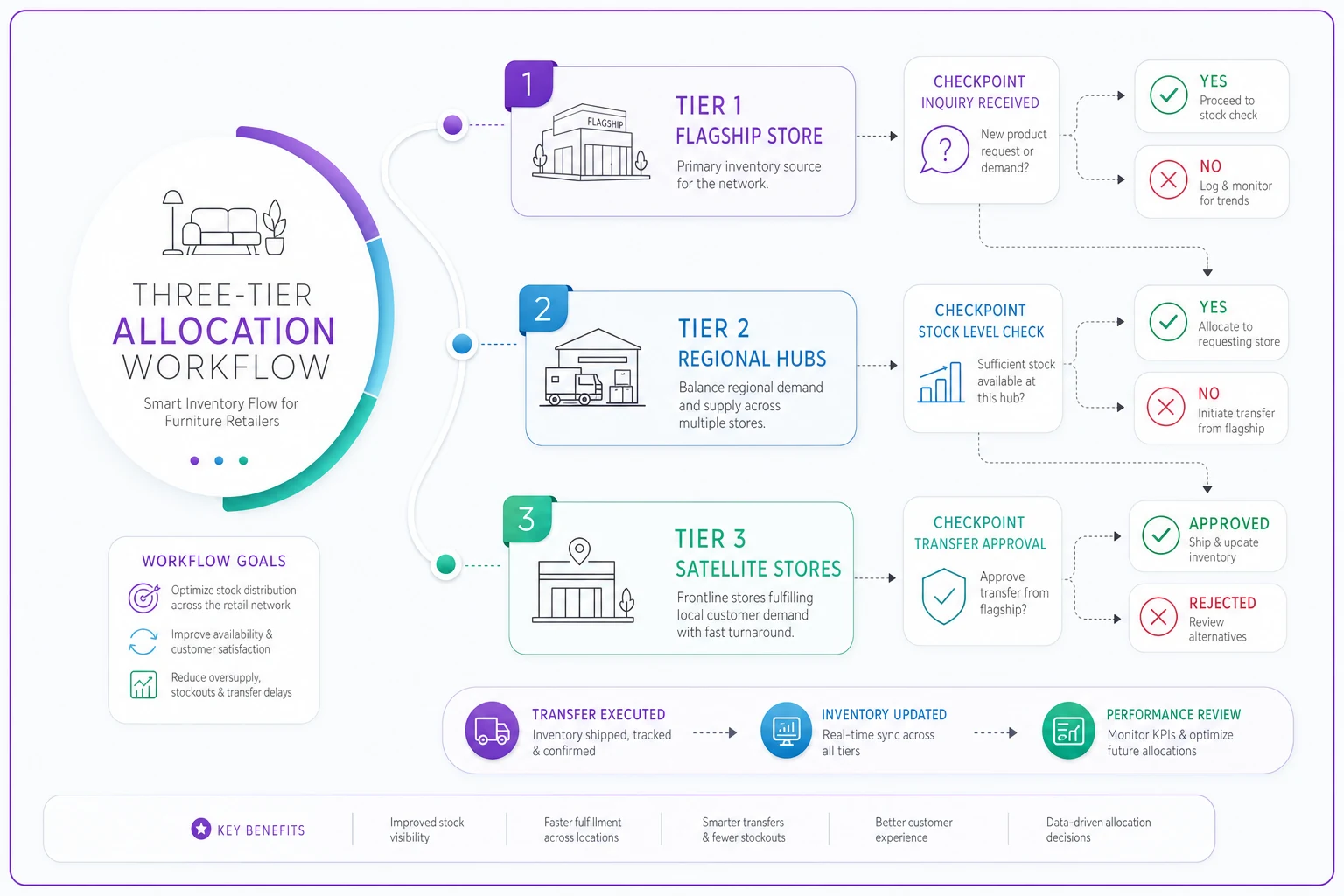
The framework only works when you establish clear transfer triggers between tiers. When a Tier 3 location sells their last white leather recliner, they don't automatically get a replacement from the warehouse. The system checks whether any Tier 2 locations have excess stock first. That one step prevents the common problem of shipping from central warehouse while perfectly good inventory sits idle somewhere else in your network.
Decision matrices for bulky SKU allocation
The physical reality of moving a 400-pound sectional means you need firm decision criteria. Every transfer should clear multiple hurdles before it's worth the cost and disruption.
Dimension-based routing starts with cubic footage and weight thresholds. Items over 150 cubic feet or requiring special handling follow different allocation rules than standard pieces. A king-size bedroom set might seem like a solid transfer candidate, but if it requires disassembly and two box truck trips, the economics often don't pencil out unless you're bundling multiple pieces on the same route.
A working decision matrix for transfer triggers:
| SKU Category | Transfer Threshold | Lead Time Impact | Decision Owner |
|---|---|---|---|
| Sectionals & Large Sofas | 2+ customer inquiries in 7 days | 8-12 weeks from supplier | Regional Manager |
| Dining Sets (6+ pieces) | 1 confirmed presale opportunity | 10-14 weeks | Store Manager with approval |
| Bedroom Suites | 3+ inquiries OR 1 sale lost | 12-16 weeks | Regional Manager |
| Recliners & Accent Chairs | Weekly velocity > 0.5 units | 6-8 weeks | Store Manager |
| Coffee Tables & Side Pieces | Monthly velocity > 2 units | 4-6 weeks | Auto-transfer via system |
The lead time factor changes everything. When you're looking at 12 weeks to restock from a supplier, every piece sitting in the wrong location represents three months of missed sales opportunity. Transfer decisions need to happen quickly, but not carelessly.
Stock positioning based on sales velocity and seasonality
Velocity-based positioning sounds obvious until you actually try to implement it. The challenge with furniture is that "high velocity" might mean selling one unit per week at your best location. Standard retail velocity calculations fall apart when your fastest-moving SKU has a 60-day turn rate.
Furniture operations need relative velocity rankings within categories. Your cream-colored loveseat might only sell twice a month, but if every other loveseat sells once per quarter, it's a fast mover that deserves prime positioning across locations.
Seasonality adds another layer. Patio furniture obviously follows weather patterns, but less obvious cycles show up when you track the data. Dining room sets spike in October and November ahead of the holidays. Home office furniture surges in January and August. Bedroom furniture picks up in spring when people start tackling home projects.
Pre-positioning inventory 6-8 weeks ahead of those patterns is what actually works. Your August allocation plan is really setting up for October sales. The warehouse starts staging dining sets in September even when current demand looks soft. By the time customer interest spikes, inventory is already at the right locations.
What breaks this model is promotional decisions made without looping in operations. Marketing runs a flash sale on sectionals, but ops finds out when the email blast goes out. Now you're scrambling to redistribute inventory while customers are already walking in expecting to see the advertised items.
Transfer triggers and escalation paths
Clear transfer triggers prevent reactive inventory chaos. The trigger system needs multiple inputs beyond just stockout alerts.
Customer inquiry tracking is a leading indicator that most retailers completely ignore. When two customers at your Riverside location ask about the same mahogany dining set within three days, that's a transfer signal even before you've lost a sale. The challenge is capturing it—most POS systems don't have a clean way to log "customer asked about something we don't carry."
Competitive shifts factor in too. If the Ashley Furniture two miles away just cleared their contemporary bedroom section, preemptively moving more modern bedroom pieces to that location to capture displaced demand isn't a bad call.
Your escalation path needs clear ownership:
-
Automatic transfers
High-velocity items under 100 cubic feet with established transfer patterns
-
Store manager discretion
Items with clear demand signals and transfer cost under $200
-
Regional approval required
Bulk transfers exceeding $500 in logistics costs or involving Tier 1 locations
-
Executive override
Category-level rebalancing or transfers exceeding $2,000 in movement costs
Log customer inquiries with SKU IDs in the POS to surface early transfer signals before stockouts occur.
Without accountability metrics, the system drifts. Track transfer success rates—how often did moved inventory actually sell within 60 days? If a store manager consistently requests transfers that don't convert, that's either a training gap or a local market signal you're missing.
Central warehouse vs. cross-dock strategies
The debate between centralized and distributed furniture inventory usually misses the point. It's not either/or—it's about which SKUs follow which model based on operational realities.
Your central warehouse should hold three things: slow-movers that need market-wide availability, bulk storage for promotional inventory, and buffer stock for items with volatile demand. Everything else should live as close to the customer as possible.
The math shifts dramatically when you factor in damage rates. Every time you move a piece of furniture, there's roughly a 3-5% chance of damage that either needs repair or pushes the piece to clearance. Move that same dining set three times—warehouse to store, store to store, store to customer—and you're looking at 10-15% accumulated damage risk across those touches.
Cross-docking works when you have predictable transfer patterns. If your Tampa store consistently replenishes from Orlando every two weeks, you can coordinate supplier deliveries to Orlando with planned transfers to Tampa. That cuts out the warehouse middle step and reduces handling significantly.
But cross-docking requires operational discipline that a lot of furniture retailers don't have yet. You need precise appointment scheduling, dedicated staging areas, and teams trained in rapid sort-and-load. One delayed supplier delivery can cascade into missed transfers across your whole network.
Technology and tools for multi-location visibility
The gap between what furniture retailers actually need and what traditional retail systems provide is pretty wide. Most inventory management platforms treat all SKUs the same, whether it's a paperback book or a sectional sofa.
Real multi-location visibility for furniture means tracking more than just quantity and location. You need display status (floor model, boxed, partial display), condition grade, and assembly state. That sectional showing "in stock" might be in seventeen boxes spread across two storage areas, requiring three hours to assemble before it can even be shown to a customer.
AI-powered operational software built for furniture logistics can genuinely change how allocation decisions get made. Instead of manually checking each store's inventory, transfer costs, and sales patterns, the platform monitors triggers continuously across your network. When conditions align—demand spike at Location A, excess inventory at Location B, available transport capacity—it surfaces the opportunity for review rather than burying it in spreadsheets.
The automation earns its keep on routine transfers. High-velocity items with established patterns don't need a human decision every single time. Set the parameters once—transfer recliners from warehouse to stores when store inventory drops below two units and customer inquiries exceed one per day—and let the system handle the coordination.
That extends to logistics coordination too. Instead of store managers calling the warehouse, checking truck schedules, and manually plotting routes, the system batches transfers efficiently. Grouping multiple small transfers into optimized routes can meaningfully reduce per-piece transportation costs without requiring anyone to build that logic manually each time.
Measuring allocation effectiveness
Most furniture retailers track the wrong metrics. They monitor inventory turns and stockout rates, but miss the operational numbers that actually drive profitability in multi-location networks.
Transfer-to-sale conversion rate tells you whether you're moving the right inventory. If less than 60% of transferred items sell within 60 days, your allocation logic needs adjustment. Break this down by transfer type—emergency stockout transfers should convert at 80%+, while seasonal pre-positioning might only hit 40-50% in the first 60 days.
Showroom productivity per square foot factors in both sales and holding cost. That gorgeous $8,000 dining set might anchor your showroom design, but if it's eating 120 square feet for six months, it's actually costing you money. Track revenue per square foot by category and location to see which pieces genuinely earn their floor space.
Customer journey completion rate captures the multi-location reality. When a customer sees a floor model downtown but picks up from your warehouse location, did your allocation strategy support or undermine that sale? Track how often customers need to visit multiple locations or wait on transfers to complete purchases.
Logistics cost per sale reveals the true cost of poor allocation. Include transfer costs, damage from extra handling, and labor hours coordinating moves. Retailers with solid allocation tend to keep this below 3% of revenue. Struggling ones often hit 7-8% without fully understanding why margins keep slipping.
Common pitfalls in bulky furniture allocation
The biggest mistake is treating all large furniture the same. A mattress and a sectional sofa might take up similar cubic footage, but their allocation strategies should look nothing alike. Mattresses are largely commoditized with predictable demand. Sectionals are design-driven purchases where customers need to touch the fabric, test the comfort, and picture the piece in their home.
Another trap is the "fairness" instinct. Trying to give every location equal access to inventory sounds reasonable but destroys profitability. A mall location pulling $200K monthly deserves different inventory depth than a strip center doing $40K. Fair doesn't mean equal—it means appropriate to revenue potential.
The promotional panic response wastes enormous operational capacity. Marketing announces a weekend sale, ops scrambles to redistribute inventory to "support" it. By the time pieces are moved, staged, and ready, the sale is winding down. The transferred inventory then sits at the wrong locations for weeks.
Ignoring reverse logistics creates zombie inventory. Everyone focuses on getting furniture to stores, but nobody plans for when it doesn't sell. That discontinued bedroom set bounces between three locations over six months, accumulating damage and transfer costs, before finally hitting clearance at 70% off.
The "hero SKU" bias distorts decisions too. That one sectional that sold incredibly well last year gets premium placement everywhere, even as customer preferences shift. Emerging winners can't get floor space because ops keeps feeding the previous year's hits.
Building your allocation playbook
Start with an honest assessment of your operational capabilities. Can your team actually execute complex transfer logic, or do you need simple rules anyone can follow? There's no point designing a sophisticated allocation system if your warehouse can only coordinate one transfer a day.
Document your transfer economics clearly. What does it actually cost to move a dining set between locations? Include truck time, fuel, loading and unloading labor, damage risk, and the opportunity cost of tying up logistics capacity. Most retailers underestimate this by 40-50%, which leads to excessive transfers that quietly destroy margins.
Create category-specific allocation rules. Bedroom furniture might follow a hub-and-spoke model where satellite stores never hold inventory. Living room pieces might use a distributed model where every location maintains core SKUs. Office furniture could be pure centralized fulfillment with showroom displays only.
Your playbook needs clear role definitions:
-
Who decides transfer priorities when multiple stores need the same SKU?
-
Who approves deviations from standard allocation rules?
-
Who monitors transfer effectiveness and adjusts triggers?
-
Who coordinates with marketing on promotional inventory needs?
Build in regular rebalancing windows. Rather than constant reactive transfers, schedule quarterly rebalancing where you systematically review positioning across the network. Planned rebalancing reduces logistics costs and gives stores predictability in their inventory flow.
Include sunset provisions for slow-movers. After 90 days without movement, pieces go on transfer-alert to find a better home. After 180 days, they shift to clearance positioning. After 270 days, they move to your liquidation channel. This prevents dead inventory from quietly consuming valuable showroom space.
Downloadable templates and decision tools
The allocation framework means nothing without practical tools your team can actually use. Build simple decision matrices that don't require deep analytics knowledge to interpret.
A basic transfer decision scorecard might include:
-
Requesting location's sales velocity for category (High/Medium/Low)
-
Available inventory within 50-mile radius (Yes/No)
-
Transfer cost vs. item margin (percentage)
-
Days of remaining selling season (for seasonal items)
-
Customer pre-sales or holds (count)
Score each factor and set clear thresholds: scores above 15 trigger automatic approval, 10-15 requires manager review, below 10 gets declined unless overridden.
Transfer planning templates should capture:
-
Origin and destination locations
-
SKUs included with quantities and cubic footage
-
Estimated transport cost and method
-
Target delivery window
-
Success metrics (expected sale within X days)
The tracking spreadsheet needs to follow through on results. Did the transfer achieve its objective? Track requesting location, transfer date, sale date if applicable, and final disposition. That data becomes your feedback loop for refining triggers and thresholds over time.
Multi-location furniture inventory isn't about perfect optimization—it's about systematic decision-making that reduces expensive mistakes. Every furniture retailer faces the same physical constraints: bulky products, long lead times, limited showroom space. The ones that pull ahead build repeatable processes that actually account for those realities instead of fighting them.
The framework here isn't theoretical. It comes from watching furniture operations run into the same allocation problems repeatedly and seeing what separates the ones that figure it out from the ones that don't. Even basic transfer triggers and tier-based positioning tend to show immediate improvements in inventory productivity and customer satisfaction.
Your multi-location inventory strategy shouldn't feel like constant firefighting. With clear allocation rules, documented transfer triggers, and the right operational tools, you can shift from reactive shuffling to proactive positioning—higher sales per square foot, lower logistics costs, and staff spending less time coordinating transfers and more time actually helping customers.
Furniture will never achieve the inventory velocity of other retail categories. The product just doesn't work that way. But you can build an allocation system that puts the right pieces in the right locations most of the time. And when your competitors are still making allocation decisions based on whoever complains loudest, that systematic approach becomes a real competitive edge.
Ready to elevate your furniture business?
Join 500+ furniture retailers using Hosyly to increase efficiency, improve customer satisfaction, and grow revenue.