

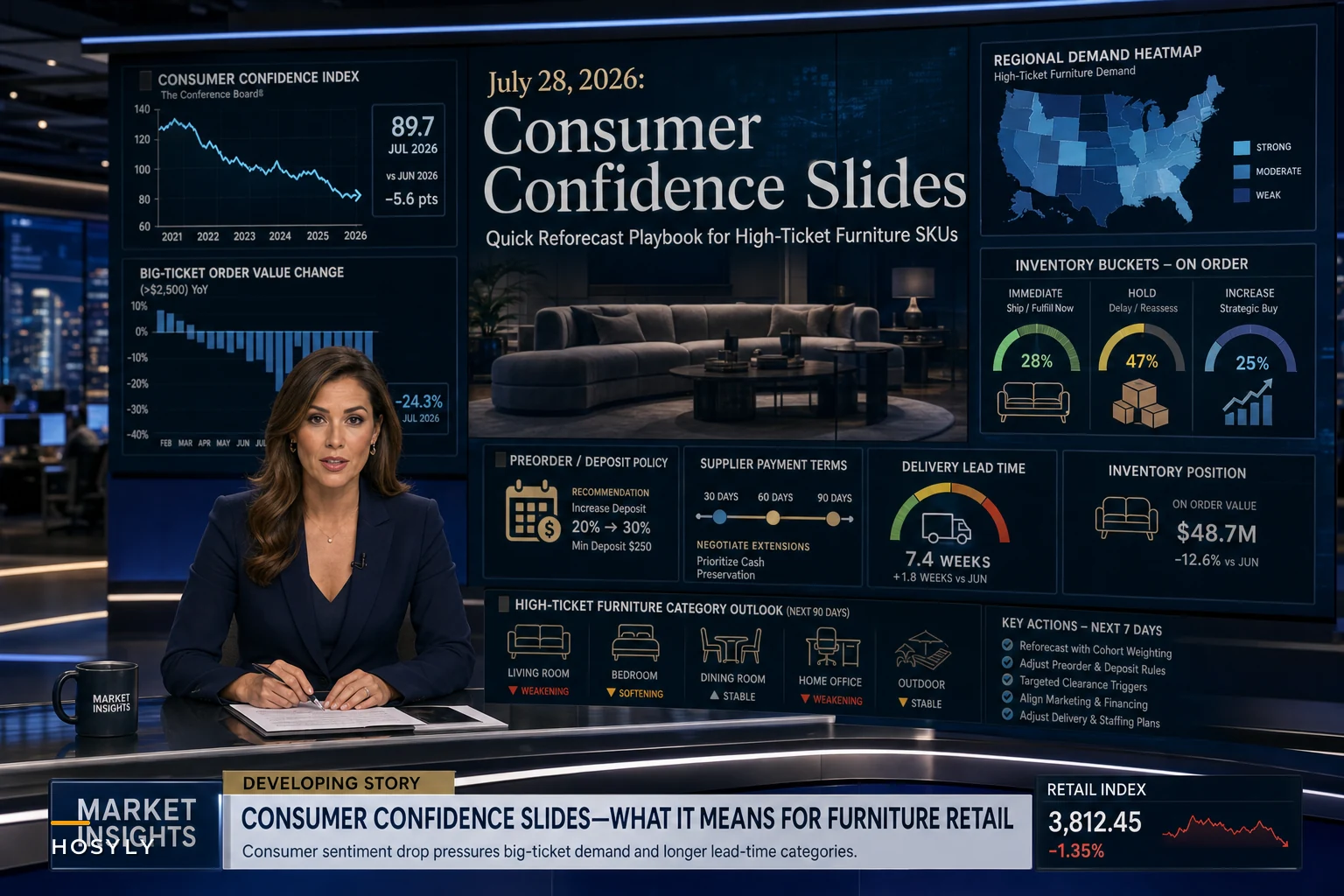

The latest consumer confidence numbers just dropped, and if you're sitting on $80,000 worth of leather sectionals that haven't moved in six weeks, you're probably already feeling it. The Conference Board's July report shows confidence slipped to 90.8, with the Present Situation Index softening for the third straight month. What caught my attention wasn't the headline number—it was the detail buried halfway through: furniture still ranks high on planned purchases for the next six months.
That disconnect tells you everything. People want to buy furniture. They're just getting nervous about pulling the trigger on that $4,200 dining set.
Last week I was reviewing sales data with a store owner in Charlotte who'd ordered heavy for fall based on Q1 performance. His high-ticket bedroom sets—anything above $3,500—had basically flatlined since early June. Meanwhile, his sub-$1,500 pieces were still moving at normal velocity. Classic confidence wobble pattern. The demand hasn't disappeared; it's just migrating downmarket and stretching out the decision timeline.
The math breaks when confidence slides
Most furniture forecasting models assume relatively stable consumer behavior within a quarter. You take your trailing 12-week average, apply seasonality adjustments, factor in your promotional calendar, and order accordingly. Works fine when confidence holds steady.
When confidence drops even slightly, high-ticket furniture buying patterns shift in ways that break those assumptions. The consideration period for a $5,000 sectional stretches from 3-4 weeks to 8-10 weeks. Conversion rates on first showroom visits drop from around 22% to 14%. People who would have bought outright suddenly want to know about financing options.
None of these are huge swings on their own. Stack them across your entire high-ticket inventory and you're looking at real cash flow problems.
Here's what typically happens to ordering patterns when confidence softens:
| SKU Price Range | Normal Lead Time | Confidence-Adjusted Lead Time | Typical Order Reduction |
|---|---|---|---|
| $500-$1,500 | 8-10 weeks | 8-10 weeks | 0-5% |
| $1,500-$3,000 | 10-12 weeks | 12-14 weeks | 15-25% |
| $3,000-$5,000 | 12-14 weeks | 16-18 weeks | 25-35% |
| $5,000+ | 14-16 weeks | 20-24 weeks | 35-50% |
The problem is your suppliers still expect orders based on historical patterns. Miss your minimums and you lose volume discounts. Over-order and you're sitting on inventory that won't move until confidence recovers.
Regional signals matter more than national averages
National confidence numbers hide massive regional variation. A store in Austin might still see solid demand for high-ticket items while a similar operation in Portland watches sales dry up.
Eliminate inventory headaches and order delays.
Hosyly streamlines your furniture orders and stock management for seamless store operations.
- Real-time inventory tracking
- Automated order processing
- Customer notifications & engagement
No credit card required
Track these local indicators weekly:
-
Mortgage application volume in your metro
-
Local unemployment claims
-
Permits for home sales and renovations
-
Regional bank deposit flows
One furniture group I work with built a simple scoring system. Each store tracks four local indicators and adjusts high-ticket forecasts when two or more flash negative for three consecutive weeks. Nothing fancy—just a basic early warning system that beats waiting for quarterly reports.
Reforecasting without overreacting
The temptation when confidence drops is to slash all high-ticket orders. But furniture demand doesn't just vanish—it reshapes itself. People still need dining tables and bedroom sets. They just approach the purchase differently.
Start with your sales velocity by price band over the last 6 weeks. Not quarterly averages—recent weeks only. Calculate the percentage shift in units sold for items above $3,000 versus those below $2,000. If high-ticket velocity dropped 30% but mid-range only dropped 10%, that's your adjustment ratio.
Use sales velocity by price band over the last 6 weeks, not quarterly averages.
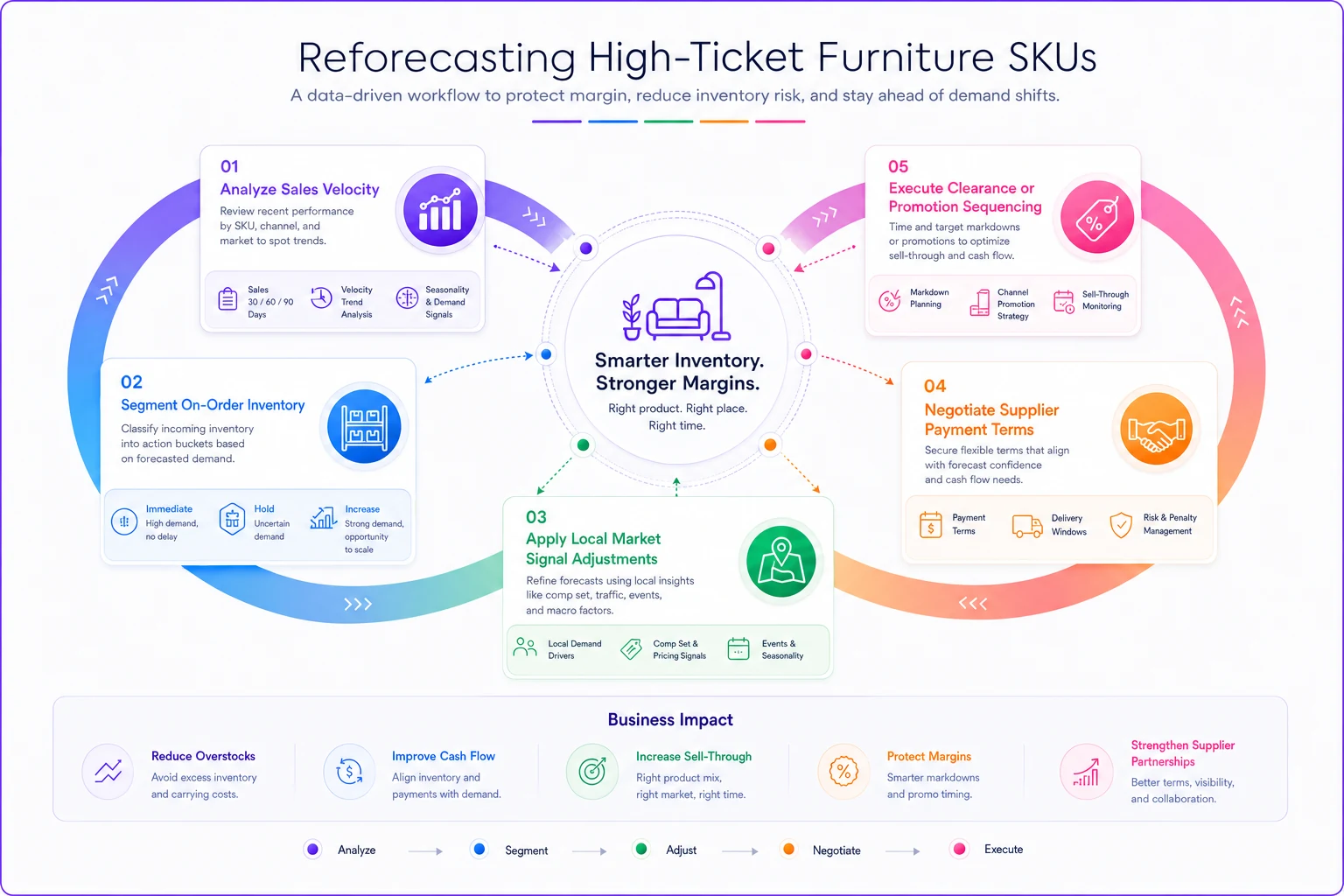
Segment your on-order inventory into three buckets:
Immediate reforecast candidates (cancel or defer if possible):
-
Special orders not yet in production
-
High-ticket items with 16+ week lead times
-
Anything ordered based on Q1 performance that hasn't shipped
Hold and monitor:
-
Items already in production or transit
-
Core SKUs with consistent baseline demand
-
Anything with favorable payment terms from suppliers
Actually increase:
-
Sub-$2,000 best sellers
-
Financing-friendly modular pieces
-
Items that work for both retail and trade customers
Here’s a visual workflow for reforecasting high-ticket SKUs.
A store in Denver ran this exercise recently and found they could defer $120,000 in sectional sofa orders while increasing mid-range dining chair orders by $35,000—improving their cash position while better matching where demand was actually heading.
Payment term negotiations during uncertainty
When confidence wavers, your supplier payment negotiations matter as much as forecast accuracy. Most furniture retailers leave money on the table here because they don't push for adjusted terms when market conditions shift.
Extended dating becomes valuable fast. That 120-day term on special orders? Push for 150. Your regular 30-day net terms on stock orders? Ask for 45 or 60. Suppliers dealing with their own uncertainty often accept longer terms rather than risk cancellations.
One retailer negotiated a sliding payment schedule tied to sell-through rates. If pieces moved within 60 days, they paid net 30. If inventory sat past 90 days, payment terms extended to match. The supplier preferred predictable volume over faster payment, and the retailer protected their cash flow during uncertain demand.
Tracking varied payment terms across dozens of suppliers and hundreds of SKUs gets messy fast though. One missed payment can damage a supplier relationship you've spent years building. This is where operational software with automated payment tracking earns its keep—not glamorous, but it prevents expensive mistakes.
Clearance sequencing when you've already over-ordered
By the time confidence data publishes, you've probably already received inventory ordered 12-16 weeks ago. Now you're looking at a warehouse full of high-ticket pieces that won't move at full price anytime soon.
Traditional clearance follows a predictable pattern: start at 10% off, escalate to 20%, hit 30% on real dogs. When confidence drops, this approach burns margin without solving the core problem—consumers aren't waiting for a better price, they're delaying the decision entirely.
Restructure your clearance around financing and bundling instead:
-
Week 1-2
Offer 18-month zero interest financing on pieces above $3,000. No price reduction yet. You'd be surprised how many fence-sitters just need payment flexibility.
-
Week 3-4
Create bundles that reduce perceived price points. That $4,500 sectional becomes a $5,200 "living room package" with tables and lamps—easier to finance and justify.
-
Week 5-6
Layer in actual discounts, but tie them to specific actions. 15% off for trade customers. 10% off plus free delivery for cash purchases. Different segments respond to different triggers.
-
Week 7-8
Move remaining pieces to your clearance center or liquidation partner. Take the hit and free up floor space for inventory that matches current demand.
A multi-location retailer in the Southeast used this sequence last summer and cleared about 70% of their overstock without dropping below 32% margins. Straight progressive discounting would have pushed them to 20-25% on the same inventory.
Staffing pivots that actually help
Everyone's first instinct during a confidence dip is to cut staff hours. For high-ticket furniture, that's usually the wrong call. When customers need more time and reassurance to make big purchases, reducing floor coverage kills your already-declining conversion rates.
Restructure how your team spends their time instead. That full-time design consultant who usually handles walk-ins? Shift 40% of their hours to proactive outreach—following up on quotes from the last 90 days, checking in with past customers, working the trade pipeline harder.
Your delivery team probably has slack capacity too. Instead of cutting routes, add white-glove services to justify premium pricing. Assembly, room layout, old furniture removal—services that help nervous buyers feel better about the purchase.
Training priorities shift too. Stop teaching features and benefits. Start teaching financing options, value engineering, and objection handling specific to economic uncertainty.
Systems breakdown during volatility
Normal workflows start breaking in weird ways when consumer confidence slides. Your POS assumes stable reorder points. Inventory planning spreadsheets use trailing averages. Supplier portals lock in orders weeks before you realize demand shifted.
Manual overrides become necessary everywhere. But manual overrides create mistakes—missed orders, payment confusion, inconsistent adjustments across locations.
This is exactly where cohort-based forecasting approaches prove their value. Instead of treating all high-ticket SKUs the same, you segment them by behavior patterns and adjust each cohort's parameters independently. Your leather sectionals might need a 40% forecast reduction while dining sets only need 15%.
AI-powered operational platforms can handle this complexity by automatically adjusting forecast parameters based on multiple signals—not just confidence data but actual sales velocity, local market indicators, and showroom traffic patterns. More practically, these platforms flag when manual forecasts deviate significantly from adjusted models, which catches human errors before they become expensive inventory mistakes. They also maintain clear audit trails of every forecast adjustment, so six months from now you have documentation of decision logic rather than just "Steve thought we should order less."
Trade sales as a hedge
When retail consumers hesitate, trade customers often fill the gap. Interior designers on committed project budgets. Property managers refreshing apartment complexes. Corporate buyers updating office spaces. These buyers operate on different timelines than retail consumers.
Capturing trade business requires different workflows though. Net payment terms instead of deposits. Staged deliveries matching project timelines. Quote management with multiple revision rounds. Sample checkout programs.
The furniture retailers weathering confidence dips best have built real dual-channel operations—not just offering "designer discounts" but actually supporting trade workflows. Dedicated account managers, project tracking, commercial delivery options.
One operation in Phoenix shifted from 20% trade sales to 35% during the last confidence wobble. They didn't advertise more or discount deeper. They just made it easier for trade buyers to work with them—automated quote generation, real-time inventory visibility, flexible delivery windows.
Watch micro-signals, not macro headlines
Confidence indices make headlines but micro-signals predict your actual sales. Track these weekly, not monthly:
-
Showroom traffic patterns (weekday vs weekend splits tell you something about employment)
-
Financing application approval rates
-
Average time between first visit and purchase
-
Percentage of customers asking about return policies
-
Quote-to-order conversion rates by price band
When two or more signals flash negative for two consecutive weeks, start adjusting forecasts. Don't wait for monthly confidence reports.
A three-location retailer in Ohio built a simple dashboard tracking these metrics—just a spreadsheet updated every Monday. They spotted early-summer demand softening three weeks before their competitors and adjusted orders accordingly. Saved them somewhere around $200,000 in carrying costs.
The preorder trap
Preorders seem like the perfect solution during uncertain times. Customers commit with deposits, you order exactly what's sold, no inventory risk. Except confidence wobbles create preorder disasters.
That customer who put $500 down on a $5,000 bedroom set in May? When confidence drops in July and the furniture arrives in September, they might walk away from their deposit rather than complete the purchase. Now you're stuck with custom-ordered inventory and an angry customer demanding their money back.
Tighten preorder policies when confidence softens:
-
Increase deposit percentages from 25% to 40%
-
Shorten cancellation windows from 30 days to 14 days
-
Require financing pre-approval for orders above $3,000
-
Add explicit "market condition" clauses to special order agreements
But build in flexibility too. Let customers swap items within the same collection. Offer to hold delivered items for 30 days if they need more time. Convert deposits to store credit rather than forcing completion. Better to maintain the relationship than win a single transaction you'll regret.
Recovery positioning starts now
Confidence cycles are predictable in their unpredictability. This dip will end, probably within 6-9 months based on historical patterns. The retailers who capture the recovery demand are setting up their operations now.
Document what you're learning during this adjustment period. Which SKUs proved most resilient? Which suppliers worked with you on payment terms? Which messages resonated with hesitant buyers? This becomes your playbook for the next cycle.
Build your opportunity inventory list—high-margin pieces you'll order aggressively when confidence signals turn positive. Negotiate tentative volume commitments with suppliers at favorable terms, triggered by specific confidence thresholds.
And keep your operational capabilities intact. The retailers who struggle most during recovery are those who cut too deep during downturns—losing experienced staff, damaging supplier relationships, or letting systems atrophy.
Making decisions with incomplete information
The frustrating part of consumer confidence forecasting is that you're always working with backward-looking data. By the time numbers publish, consumer behavior has already shifted. By the time you adjust forecasts, orders placed months ago are arriving.
But paralysis is worse than imperfect action. Set clear triggers and stick to them. When local unemployment rises 0.5% month-over-month, cut high-ticket orders by 20%. When financing approval rates drop below 70%, shift marketing budget toward cash-buyer segments. When trade inquiries increase 25%, add dedicated trade sales hours.
Your competitors are probably frozen, hoping things improve without making hard decisions. Their hesitation is your opening to rightsize inventory, strengthen supplier relationships, and pick up share from retailers who ordered wrong.
The furniture stores that get through confidence cycles aren't necessarily the ones with the best forecasting models. They're the ones with operational flexibility—systems that handle rapid adjustments, teams trained for multiple scenarios, and the discipline to act on leading indicators rather than waiting for certainty that never arrives.
Build that capability now, while the pain is fresh and the lessons are clear.
Ready to elevate your furniture business?
Join 500+ furniture retailers using Hosyly to increase efficiency, improve customer satisfaction, and grow revenue.